Cavapoo vs Cockapoo: Size, Temperament, Grooming and Health Compared
 Written by Sofia Marin
 Fact checked by Dr. Tomas Ellery, DVM
The Cavapoo (8 to 25 lb) is the calmer lap dog with a heart and spine risk from the Cavalier side; the Cockapoo (10 to 25 lb) is livelier, needs more exercise and has twice a Cocker's ear-infection odds. A 2026 study of 9,402 dogs found Cockapoos showed more undesirable behaviour than Cavapoos.
The information is current and up-to-date in accordance with the latest veterinary research. Learn more »
The Cavapoo and the Cockapoo are the two most popular small Poodle crosses in the United Kingdom and among the most popular in the United States, and they are confused with each other constantly. Both weigh roughly 10 to 25 lb, both have a wavy coat that sheds little and mats a lot, and both are sold as easy family dogs.
The differences come from the spaniel. The Cavalier King Charles Spaniel behind the Cavapoo was bred as a lap dog and brings a softer, quieter temperament along with serious inherited diseases of the heart and spine. The Cocker Spaniel behind the Cockapoo was bred as a gundog and brings more drive, noise and sensitivity, and a well-documented weakness in its ears and skin.
This comparison uses the two largest studies yet published on Poodle crosses and ends with who should choose which. For the full picture on each, read our Cavapoo breed guide and Cockapoo breed guide; for the whole family, start with our Doodle Dog guide.
Key Takeaways
- Cavapoos (8 to 25 lb) are the calmer, quieter, more trainable lap dog; Cockapoos (10 to 25 lb or more) are livelier, more vocal and need more exercise.
- Coat, shedding and grooming are effectively identical, and neither cross is hypoallergenic.
- A 2024 RVC study found both about as healthy as their parents; Cockapoos had 2.13 times a Cocker's odds of ear infection and 2.67 times the odds of itchy skin.
- The Cavapoo's hidden risks are mitral valve disease and syringomyelia, which appear after age five and have no puppy test; ask for a cardiologist clearance and a CM/SM MRI grade on the Cavalier parent.
- A 2026 RVC study found Cockapoos showed more undesirable behaviour than Cavapoos, and neither was calmer than its parents, so breeder choice and socialisation matter most.
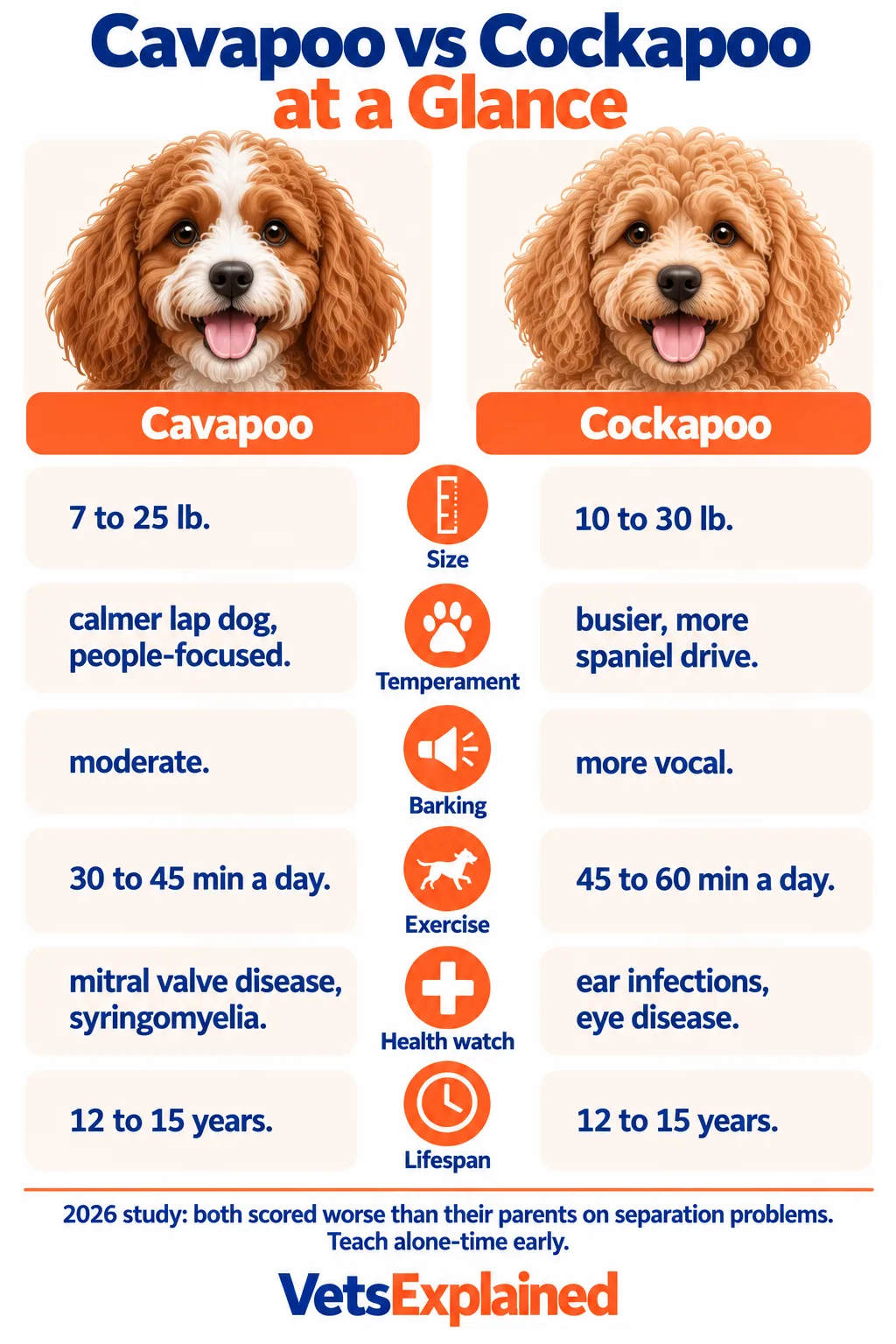
1Cavapoo vs Cockapoo at a Glance
- Parents: Cavapoo is Cavalier King Charles Spaniel × Toy or Miniature Poodle / Cockapoo is Cocker Spaniel × Toy, Miniature or occasionally Standard Poodle
- Size: Cavapoo roughly 8 to 25 lb and 9 to 14 inches / Cockapoo roughly 10 to 25 lb and 10 to 15 inches, larger from a Standard Poodle
- Coat: both wavy to curly and low-shedding, never non-shedding; grooming needs are equal
- Temperament: Cavapoo calmer lap dog, quieter / Cockapoo livelier, more sensitive, more vocal
- Exercise: Cavapoo 30 to 60 minutes a day / Cockapoo 45 to 60 minutes or more
- Key health risks: Cavapoo inherits mitral valve disease and syringomyelia risk / Cockapoo inherits ear disease, allergic skin, PRA and FN or PFK
- Lifespan and price: both 12 to 15 years and roughly 1,500 to 4,000 dollars in the US; varies by region
- Best for: Cavapoo suits quieter homes with someone in most of the day / Cockapoo suits active homes that want a playmate
2Origin and Size
The Cockapoo is the older cross by about forty years and the slightly bigger dog, though the size ranges overlap almost completely.
- Origin: Cavapoo is usually credited to Australia in the 1990s, where it is called the Cavoodle / Cockapoo has been bred in the United States since around 1950. Neither is a recognised breed.
- The spaniel side: Cavapoo gets a 12 to 18 lb toy spaniel bred as a companion / Cockapoo gets a 20 to 30 lb gundog in American and English breeds and show or working lines, so Cockapoos vary more.
- Size: Cavapoo is 8 to 14 lb from a Toy Poodle and 12 to 25 lb from a Miniature, 9 to 14 inches tall; in the 2024 RVC study 41.5 per cent of Cavapoos had a Toy Poodle parent / Cockapoo is under 12 lb from a Toy, 12 to 20 lb from a Miniature (the most common) and 20 to 30 lb or more from a Standard, 10 to 18 inches tall. Like for like, the Cockapoo finishes a few pounds heavier. The measured size of both parents predicts a puppy far better than any label.
3Coat and Shedding
There is very little difference. Both crosses produce straight, wavy and curly coats, often within one litter, and the wavy coat is the most common in each.
- Coat: Cavapoo is mostly red, apricot, cream and Blenheim / Cockapoo covers a wider palette, including chocolate, black, sable and roan.
- Shedding: Neither is non-shedding. Wavy and curly dogs shed little because loose hair stays in the coat, which is also why they mat; straight-coated dogs shed like their spaniel parent.
- Allergies: Neither is hypoallergenic; see whether Doodles are hypoallergenic.
4Temperament: Calm Lap Dog or Busy Spaniel?
The Cavapoo is, on average, the calmer and more sedentary of the two; the Cockapoo is livelier, more driven and more sensitive. That is the biggest practical difference between them.
- Cavapoo: Affectionate, people-focused and happiest on a lap. Most inherit the Cavalier's wish to be close, a tolerant nature with children and a willingness to settle once exercised.
- Cockapoo: Affectionate too, but with a gundog's engine: bouncier, especially from six months to two years, obsessed with sniffing, carrying and getting wet, and sensitive to tone of voice and household tension.
- What the research found: In 2026 the Royal Veterinary College published a study in PLoS One of 9,402 UK dogs, using the validated C-BARQ questionnaire to compare the crosses with their parent breeds across 12 behaviour scales. Neither came out calmer than its parents. Cavapoos scored worse than Cavaliers on eight of twelve scales, including excitability, fear and aggression, and better on trainability. Cockapoos scored worse than Cocker Spaniels or Poodles in all 16 significant comparisons and showed the most undesirable behaviour of the three crosses studied; the Cavapoo sat in the middle. The differences were modest, so the breeder's choice of parents and early socialisation still decide the individual dog.

Which barks more?
The Cockapoo, in most households. Both of its parents are alert, and a Cockapoo will usually announce the doorbell and the neighbour's cat; Cavapoos are generally quieter. In both, persistent barking is usually boredom or being left alone, and both respond well to a "quiet" cue taught early.
Which is worse for separation anxiety?
Both struggle, and it is the most common reason either ends up in rescue. The 2026 study found Cavapoos scored worse than Cavaliers for separation-related behaviour, and Cockapoos worse than both parent breeds. A trained adult Cavapoo can usually manage four to five hours alone, a Cockapoo about four.
5Which Is Easier to Train?
The Cavapoo, on the evidence. It scored higher for trainability than both parent breeds in the 2026 study. Cockapoos learn fast too, but owners rated them less trainable than Cocker Spaniels, and recall needs more work because the Spaniel nose leads the dog away. Both shut down under harsh handling, and each scored worse than its spaniel parent for fear, so careful socialisation between 3 and 14 weeks matters more for these dogs, not less.
6How Much Exercise Does Each Need?
A Cockapoo needs more. An adult Cavapoo is content with 30 to 60 minutes a day and settles after a moderate walk and ten minutes of training. An adult Cockapoo needs 45 to 60 minutes in two outings, more for working-Cocker lines, and sniffing, retrieving and scent games tire it far better than mileage. Puppies of both should keep lead walks to roughly five minutes per month of age twice a day until fully grown at 10 to 12 months.
7Grooming: Which Is Higher Maintenance?
Neither. Grooming is the great equaliser and the part most buyers underestimate. A wavy or curly dog of either needs brushing to the skin three or four times a week, a metal comb afterwards, professional clipping every six to eight weeks at roughly 60 to 100 dollars or 40 to 70 pounds a visit, weekly ear checks and regular tooth brushing; our Doodle grooming guide covers technique. Cavapoos are more prone to tear staining; Cockapoos have longer ears and come home wetter and muddier.
8Health: What Does Each Cross Inherit?

This is where the two diverge most. In youth both are about as healthy as their parents; the difference is which parent problems each can inherit.
In 2024 the Royal Veterinary College published "The doodle dilemma" in PLoS One, an owner survey comparing 985 Cavapoos and 1,856 Cockapoos with their parent breeds across 57 disorders in dogs under five. For both, the headline was no difference from the parents for the great majority of disorders and little evidence of "hybrid vigour".
- Cavapoo findings: No difference from Cavaliers for 50 of 57 disorders; lower odds of eye disorders and obesity, higher odds of vomiting, diarrhoea and ear infections (1.6 times). Heart murmurs were found in 1.4 per cent of Cavaliers and 0.4 per cent of Cavapoos, not a significant difference, but the study stopped at age five, before Cavalier heart disease usually appears.
- Cockapoo findings: No difference from Cocker Spaniels for 49 of 57 disorders; lower odds of eye disorders and lameness, higher odds of itchy skin (2.67 times), ear infections (2.13 times) and vomiting (1.41 times). It was the only cross with higher ear-infection odds than both parents.
The Cavapoo's inherited risks: heart and spine
- Mitral valve disease (MVD): A degeneration of the heart's mitral valve that is near-universal in older Cavaliers. UFAW's review puts the proportion with a murmur at about half by age five and almost all by ten, with heritability around 0.64 and MVD causing over 40 per cent of deaths in the breed. There is no DNA test. Crossing to a Poodle should lower and delay the risk, but no study has yet followed Cavapoos into old age.
- Syringomyelia (SM) and Chiari-like malformation (CM): A skull malformation that lets painful fluid cavities form in the spinal cord. UFAW reports SM in 25 per cent of one-year-old Cavaliers rising to around 70 per cent by six. Signs include "phantom" scratching and yelping when picked up. There are no prevalence figures for Cavapoos.
- What protects a buyer: A Cavalier parent heart-cleared by a veterinary cardiologist, which the Cavalier King Charles Spaniel Club USA recommends at a minimum age of 2.5 years, and ideally an MRI graded under the BVA/Kennel Club CM/SM scheme. Most Cavalier parents of Cavapoo litters have not been scanned.
The Cockapoo's inherited risks: ears, skin, eyes and kidneys
- Ear disease (otitis externa): The Cockapoo's best-documented problem. A 2021 VetCompass study of 22,333 UK dogs found Cockapoos had 2.22 times the odds of a crossbred dog, higher than the Cocker Spaniel's 1.67. The heavy Cocker ear, the hairy Poodle canal and a love of water combine badly.
- Allergic skin disease: Itchy skin at 2.67 times a Cocker's odds; repeated ear infections are often a sign of underlying allergy.
- Progressive retinal atrophy (PRA): Inherited, painless blindness from around 3 to 7 years, present in Cockers as well as Poodles, so both parents of a Cockapoo need the prcd-PRA test.
- Familial nephropathy (FN) and PFK deficiency: FN is a fatal inherited kidney disease of English Cocker Spaniels, causing kidney failure between six months and two years; UFAW notes DNA testing has reduced affected numbers. Phosphofructokinase (PFK) deficiency is the American Cocker's equivalent. Both are recessive and DNA-testable: English-type Cockapoos need FN, American-type PFK.
- What protects a buyer: The Cockapoo Club of GB requires approved breeders to test for FN or PFK, prcd-PRA on both sides and von Willebrand disease, and to hip score both parents.
9Which Lives Longer?
They are about even. Both typically live 12 to 15 years, with some reaching 17 or 18; figures vary because no registry tracks either. Inherited heart disease is the main threat to a Cavapoo's lifespan; obesity and dental disease are the controllable factors for both.
10Which Costs More?
Prices are similar and vary widely by region, breeder and colour.
- Puppy price: Both commonly 1,500 to 4,000 dollars in the US in 2026; in the UK, Cockapoos typically 1,000 to 2,500 pounds and Cavapoos a similar range. A very cheap puppy of either means the health tests have been skipped.
- Ongoing: Grooming costs are identical. The Cavalier's heart and spine make high-limit lifetime insurance more valuable for a Cavapoo; frequent ear and skin claims are the Cockapoo's pattern. Rescue fees are a few hundred dollars or pounds for either.
11Cavapoo vs Cockapoo: Pros and Cons
Potential advantages
- Cavapoo: calmer, quieter, more trainable, lower exercise needs, the easier flat dog
- Cockapoo: livelier and more athletic, available up to 30 lb, a seventy-year track record, a club testing scheme
Potential challenges
- Cavapoo: can inherit mitral valve disease and syringomyelia with no puppy test, prone to separation distress, fragile at the Toy end
- Cockapoo: ear infections at twice a crossbred dog's odds, allergic skin at double a Cocker's, the most undesirable behaviour of the three crosses studied in 2026, more barking and exercise
12Choose a Cavapoo If
- You want a small, cuddly companion happy with 30 to 60 minutes of exercise and a long nap.
- Someone is home most of the day, or you can arrange company.
- You are a first-time or older owner, or live in a flat, and want the quieter, more trainable dog.
- You will insist on a cardiologist heart clearance and a CM/SM MRI on the Cavalier parent, and accept that heart disease later remains possible.
13Choose a Cockapoo If
- You want a playmate for walks, hikes and games, and can give 45 to 60 minutes of real exercise daily.
- You can live with a more alert, vocal dog and will train a "quiet" cue.
- You would rather manage ears and skin than worry about the heart, or want a 25 to 30 lb dog.
- You will ask which Cocker type went into the litter and see FN or PFK, prcd-PRA and eye results.
14Final Thoughts
The choice comes down to the spaniel: pick the Cavapoo for a calmer, quieter, more trainable lap dog and accept the Cavalier's heart and spine risks; pick the Cockapoo for a livelier, more vocal companion and accept lifelong ear and skin care. Either way, the two RVC studies carry the same message: neither cross is healthier or calmer than its parents, so the breeder's testing and the puppy's first four months decide far more than the name. For how both compare with the other Poodle crosses, read our complete Doodle Dog guide.
Sources
- Bryson GT, O'Neill DG, Brand CL, Belshaw Z, Packer RMA. The doodle dilemma: how the physical health of "designer-crossbreed" Cockapoo, Labradoodle and Cavapoo dogs compares to their purebred progenitor breeds. PLoS One. 2024;19(8):e0306350. pmc.ncbi.nlm.nih.gov
- Bryson GT, O'Neill DG, Belshaw Z, Brand CL, Packer RMA. Comparing undesirable behaviours between "designer" Poodle-cross dogs and their purebred progenitor breeds. PLoS One. 2026;21:e0342847. journals.plos.org
- O'Neill DG, Volk AV, Soares T, Church DB, Brodbelt DC, Pegram C. Frequency and predisposing factors for canine otitis externa in the UK: a primary veterinary care epidemiological view. Canine Medicine and Genetics. 2021;8:7. pmc.ncbi.nlm.nih.gov
- Universities Federation for Animal Welfare (Science for Animal Welfare). Genetic welfare problems of companion animals: Cavalier King Charles Spaniel, mitral valve disease. scienceforanimalwelfare.org
- Universities Federation for Animal Welfare (Science for Animal Welfare). Genetic welfare problems of companion animals: Cavalier King Charles Spaniel, syringomyelia. scienceforanimalwelfare.org
- Universities Federation for Animal Welfare. Genetic welfare problems of companion animals: Cocker Spaniel, familial nephropathy. ufaw.org.uk
- British Veterinary Association / Kennel Club. Chiari malformation / syringomyelia (CM/SM) scheme. bva.co.uk
- Cavalier King Charles Spaniel Club, USA. Health testing guidelines. ckcsc.org
- The Cockapoo Club of GB. Health testing. cockapooclubgb.co.uk
Frequently Asked Questions
?What is the difference between a Cavapoo and a Cockapoo?
The spaniel parent. A Cavapoo is a Cavalier King Charles Spaniel crossed with a Poodle and tends to be a calmer, quieter lap dog. A Cockapoo is a Cocker Spaniel crossed with a Poodle and tends to be livelier and more vocal. Coat and grooming are almost identical; the health risks differ.
?Which is calmer?
The Cavapoo, on average. The Cavalier was bred as a lap dog and the Cocker as a gundog, and it shows. A 2026 RVC study found Cockapoos showed more undesirable behaviour than Cavapoos, though neither cross was calmer than its parents.
?Which barks more?
The Cockapoo. Both of its parents are alert, and owners commonly report Cockapoos as the more vocal cross. Cavapoos bark to greet and alert but are generally quieter. In both, persistent barking usually means boredom or being left alone.
?Which is easier to train?
The Cavapoo. It scored higher for trainability than both Cavaliers and Poodles in the 2026 RVC study, while Cockapoos were rated less trainable than Cocker Spaniels on average. Both shut down under harsh handling.
?Which is healthier?
Neither overall. A 2024 RVC study found both about as healthy as their parents in youth. The Cavapoo can inherit the Cavalier's mitral valve disease and syringomyelia, which appear later in life; the Cockapoo has twice a Cocker's odds of ear infections.
?Which needs more exercise?
The Cockapoo. An adult needs around 45 to 60 minutes a day, more for working-Cocker lines, while a Cavapoo is content with 30 to 60 minutes. Sniffing walks and scent games tire a Cockapoo better than mileage.
?Which is better for a first-time owner?
The Cavapoo, narrowly, for its calmer baseline, lower exercise needs and higher trainability. A Cockapoo is manageable for a committed beginner, but its energy, barking and ear care ask more. Both need company and lifelong grooming.
?Can you leave a Cavapoo or Cockapoo alone all day?
No. Both scored worse than their parents for separation-related problems in the 2026 study, and separation distress is the most common reason either is surrendered. A trained adult Cavapoo manages four to five hours, a Cockapoo about four.
Help us do better!
Was this article helpful and relevant?
Thanks for your feedback!
About Sofia Marin
Sofia Marin is VetsExplained's senior editor. She has edited pet and consumer titles for fifteen years and is responsible for the site's editorial standards and breed coverage.
View all posts by Sofia Marin →