Cavapoo Dog Breed Guide: Size, Temperament, Health, Grooming and Cost
 Written by Sofia Marin
 Fact checked by Dr. Tomas Ellery, DVM
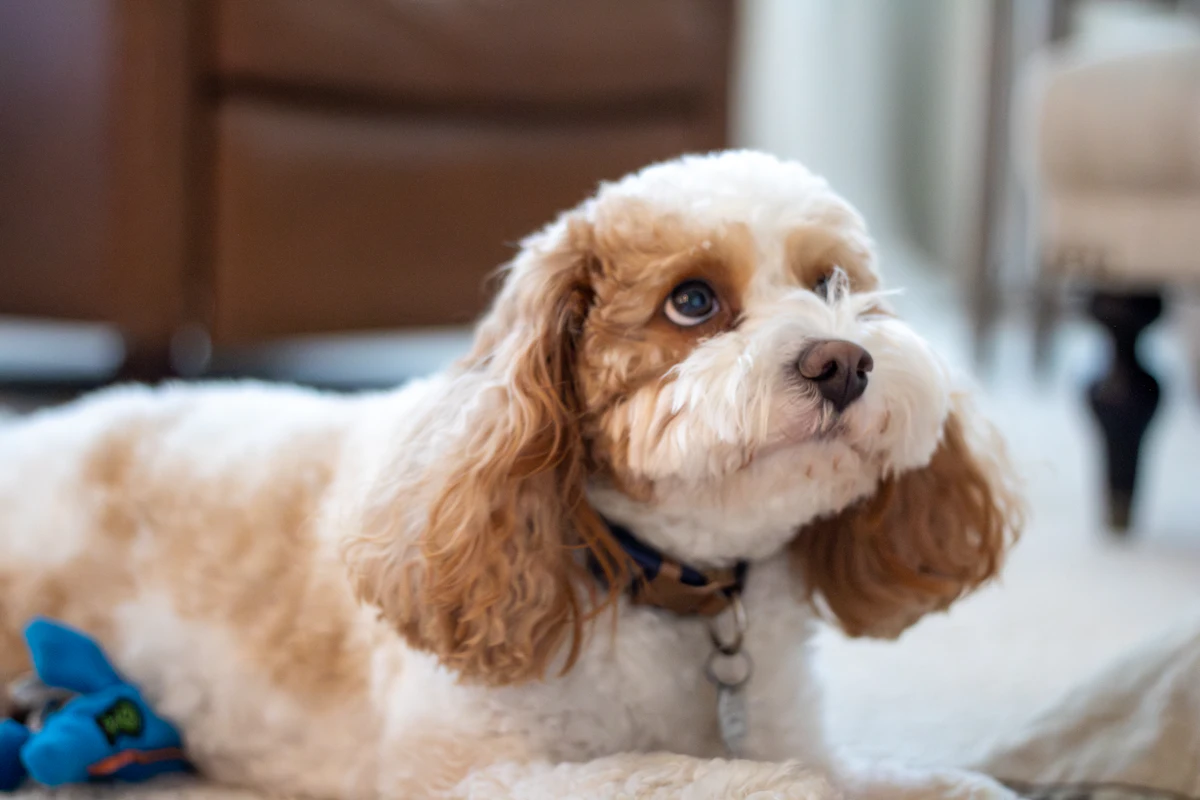
A Cavapoo is a Cavalier King Charles Spaniel crossed with a Toy or Miniature Poodle, usually 8 to 25 lb and 9 to 14 inches tall. Most are affectionate, trainable and low-shedding. A 2024 study of 985 Cavapoos found them about as healthy as their parents; the Cavalier's heart and spine problems can still be inherited.
The information is current and up-to-date in accordance with the latest veterinary research. Learn more »
The Cavapoo is a Cavalier King Charles Spaniel crossed with a Toy or Miniature Poodle. It is one of the smallest and most popular Poodle crosses, sold on a simple promise: the Cavalier's famously gentle, cuddly nature in a smaller package that sheds less and, buyers hope, avoids the Cavalier's well-known heart and spine problems.
Parts of that promise hold up. Cavapoos are, on the whole, affectionate, sociable little dogs that train well and fit into flats, family homes and retirement alike. Other parts do not. The coat still needs serious work, the "healthier than a Cavalier" claim is weaker than most people assume, and the same closeness that makes a Cavapoo such good company can tip into real distress when it is left alone.
This guide covers what a Cavapoo is, how Toy and Miniature Poodle parents change the adult size, temperament and what a 2026 behaviour study found, exercise and training, grooming, the Cavalier-side risks of mitral valve disease and syringomyelia, what the 2024 Royal Veterinary College health study showed, the health tests to ask a breeder for, cost, and whether a Cavapoo is the right dog for you. If you are weighing up Poodle crosses more generally, start with our Doodle Dog guide.
Key Takeaways
- A Cavapoo is a Cavalier King Charles Spaniel crossed with a Toy or Miniature Poodle; the Poodle variety mostly decides whether the adult is 8 to 14 lb or 12 to 25 lb.
- A 2024 study of 985 Cavapoos found them about as healthy as their parents, with lower odds of eye disease and obesity than Cavaliers but higher odds of ear infections and digestive upsets.
- Mitral valve disease and syringomyelia are near-universal in Cavaliers and can be inherited; ask for a cardiologist heart clearance and a CM/SM MRI grade on the Cavalier parent.
- Cavapoos are highly trainable but scored worse than Cavaliers for separation-related problems, fear and excitability in a 2026 study; plan for company and early socialisation.
- Budget for brushing several times a week and professional clipping every six to eight weeks for life.
1Cavapoo at a Glance
- Parent breeds: Cavalier King Charles Spaniel × Poodle (Toy or Miniature)
- Other names: Cavoodle (Australia), Cavadoodle, Cavapoodle
- Origin: Usually credited to Australia in the 1990s, though the cross almost certainly existed earlier; not a recognised breed
- Size: Toy Cavapoo roughly 8 to 14 lb; Miniature Cavapoo roughly 12 to 25 lb
- Height: About 9 to 14 inches at the shoulder
- Coat: Wavy or curly, sometimes straighter; soft and dense
- Common colours: Red, apricot, cream, gold, chocolate, black, tricolour and Blenheim-style red and white
- Shedding: Low in most dogs, but never none
- Grooming: High; brushing several times a week and clipping every 6 to 8 weeks
- Exercise needs: Moderate, around 30 to 60 minutes a day for an adult
- Trainability: High; scored better than both parent breeds in a 2026 study
- Lifespan: Typically 12 to 15 years, with some living longer
- Best for: Households where someone is home most of the day and will keep up the grooming
2What Is a Cavapoo?
A Cavapoo is any dog with Cavalier King Charles Spaniel and Poodle ancestry. It is not a breed. No major kennel club recognises it, there is no breed standard, and there is no central registry that checks pedigrees or health tests, which is why the quality of Cavapoos varies so much from one breeder to the next.
The two parents bring very different histories. The Cavalier was developed as a lap and companion dog, selected for centuries for a soft temperament and a wish to be close to people. The Poodle began as a water retriever and keeps the sharp mind, athleticism and dense, low-shedding coat of a working dog, scaled down in its Toy and Miniature varieties. A Cavapoo can take after either side in size, coat, energy and health, and a single litter can contain dogs that look and act quite differently.
A short history
The Cavapoo is usually said to have been bred deliberately in Australia during the 1990s, where it is still called the Cavoodle and remains one of the country's most popular dogs. Claims of an earlier American origin also circulate, and the truth is probably that Cavalier and Poodle crosses appeared in several places before anyone named them. The cross took off in the United Kingdom in the 2000s and in the United States shortly after, riding the wider Doodle wave.
3How Big Does a Cavapoo Get?
Most Cavapoos finish between 8 and 25 lb and 9 to 14 inches at the shoulder, and the Poodle parent is the biggest single influence on where in that range a puppy lands.
The AKC and UK breed standards define Poodle varieties by height, not weight: a Toy Poodle stands 10 inches or under, a Miniature Poodle over 10 and up to 15 inches. Toy Poodles typically weigh around 4 to 6 lb and Miniatures around 10 to 15 lb. A Cavalier is a 12 to 18 lb dog of 12 to 13 inches. Put those together and you get two broad Cavapoo sizes:
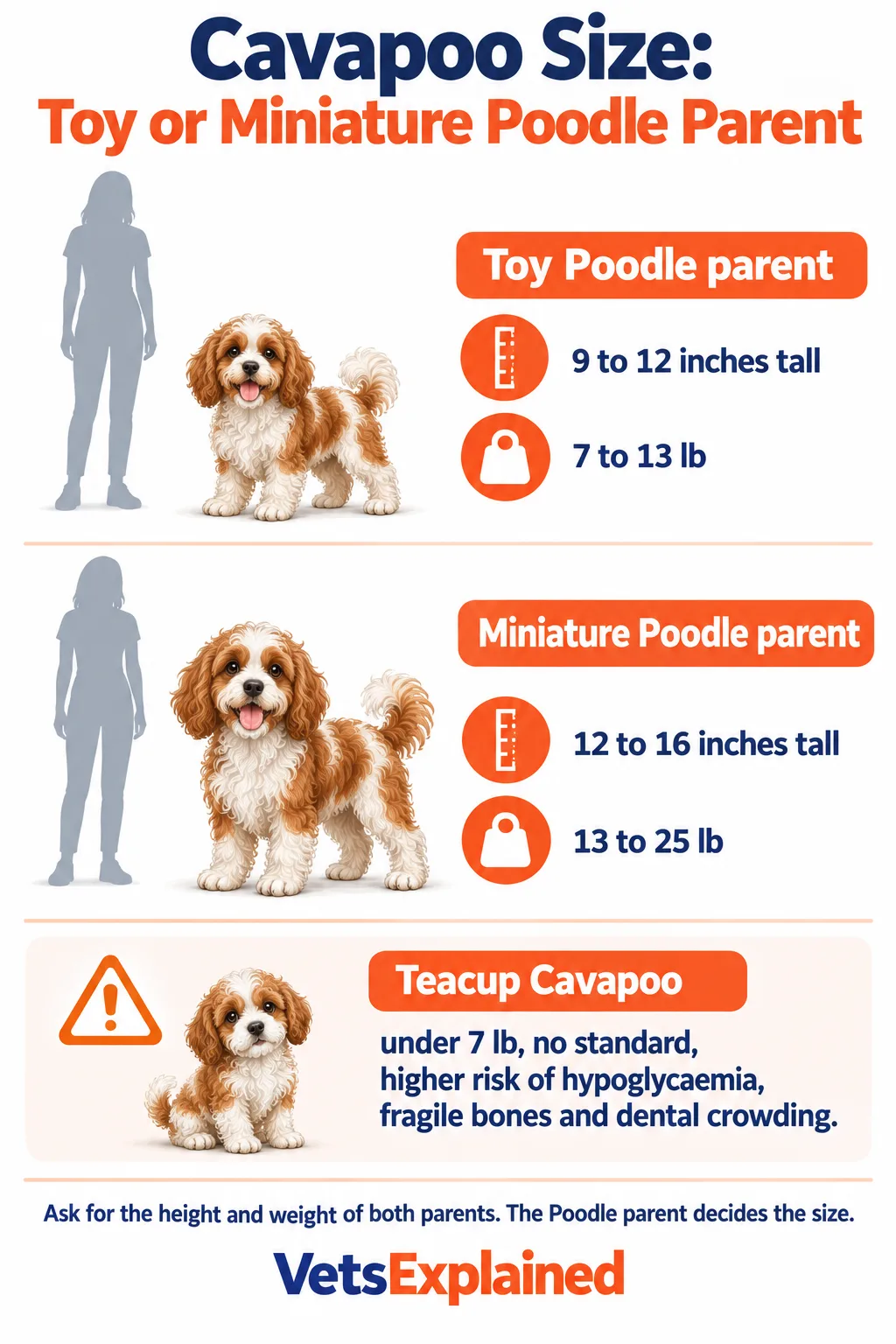
- Toy Cavapoo (Cavalier × Toy Poodle): typically 8 to 14 lb and 9 to 12 inches. Many breeders also call these "mini" or "petite", so ask which Poodle variety was used rather than relying on the label.
- Miniature Cavapoo (Cavalier × Miniature Poodle): typically 12 to 25 lb and 12 to 14 inches, closer to the size of the Cavalier itself.
Three cautions. First, these are typical ranges, not guarantees; a first-generation litter can straddle both. Second, "teacup" Cavapoos have no agreed definition and often come from breeding undersized dogs or from a Poodle that is exceptionally tiny, which brings its own health problems. Third, the measured adult height and weight of both parents predict a puppy far better than any size word. In the 2024 RVC study, 41.5 per cent of Cavapoos had a Toy Poodle parent, which is a reminder that the Toy cross is common, not a rarity.
4What Does a Cavapoo Look Like?
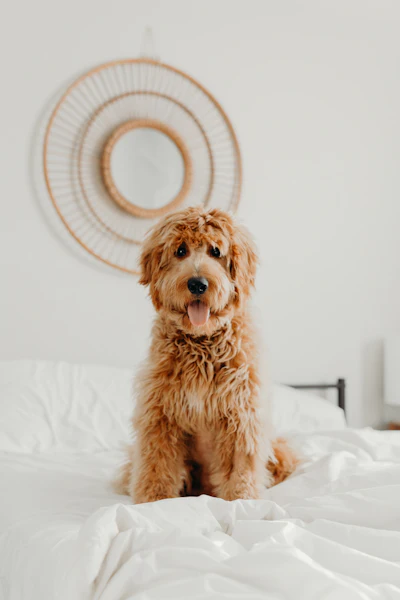
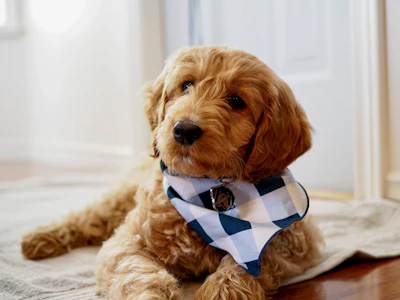
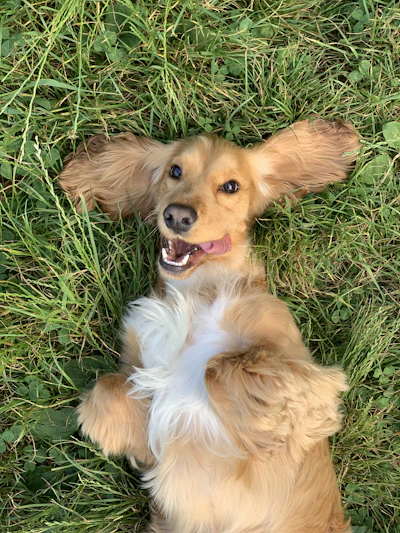
There is no single Cavapoo look. Most have a rounded head, a shortish muzzle that is longer than a Cavalier's, large dark eyes, and ears that hang low and are heavily feathered. The body is compact and slightly longer than tall. Dogs that take after the Poodle are leggier with a narrower face; dogs that take after the Cavalier are stockier with a broader skull.
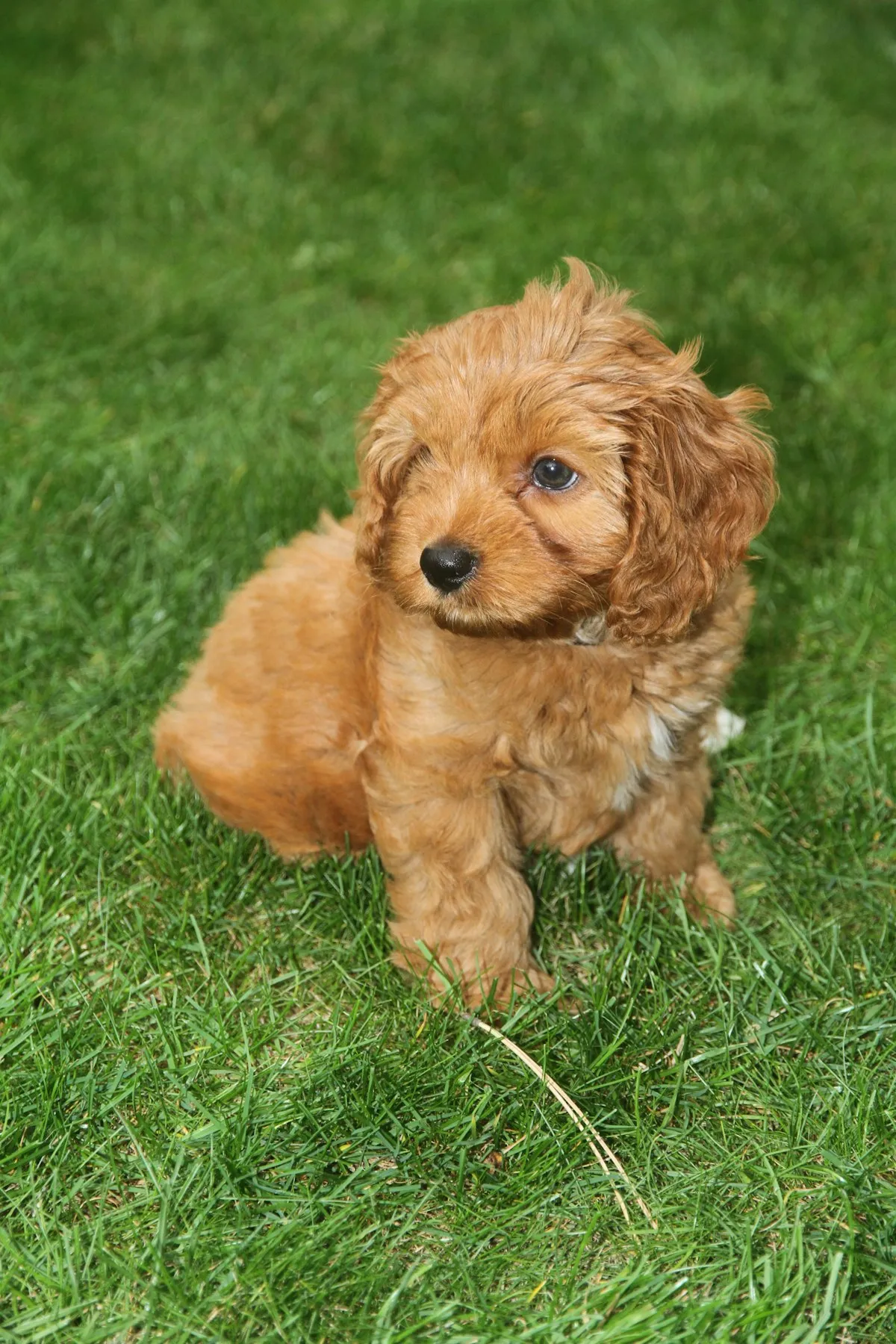
Colour comes from both sides. Red, apricot, gold and cream are the most common, and the Cavalier's Blenheim pattern often shows up as red and white. Chocolate, black, tricolour and black-and-tan also occur, and parti (patched) coats are common because the white-spotting genes come from the Cavalier. Like most Poodle crosses, many Cavapoos fade with age, so a deep red puppy may be a pale apricot adult.
5Cavapoo Coat Types and Shedding
Cavapoo coats sit on a spectrum from the Cavalier's silky, straight-to-wavy feathering to the Poodle's tight curls. Most first-generation dogs land in the middle with a soft, loose wave, which is the coat most people picture.
- Wavy coat: the most common. Low to moderate shedding, mats readily, needs brushing three or four times a week.
- Curly coat: closest to the Poodle. Sheds very little because loose hair stays in the curl, which is exactly why it mats so fast if brushing is skipped.
- Straight or flat coat: closest to the Cavalier, more often in F1 litters. Sheds the most of the three and needs the least brushing.
No Cavapoo is non-shedding. The puppy coat also changes at around 8 to 12 months, when a soft, easy puppy coat is replaced by a denser adult coat that mats far more, and that transition is when many owners first discover how much grooming they have taken on.
6Are Cavapoos Hypoallergenic?
No dog is hypoallergenic, and that includes the Cavapoo. Allergic people react to proteins in dander, saliva and urine, which every dog produces regardless of coat. A low-shedding coat keeps less dander circulating in the home, and some allergic people find a curly-coated Cavapoo easier to live with, while others react just as badly.
If allergy is your reason for choosing a Cavapoo, spend time with the actual puppy or adult dog more than once, ideally indoors, and talk to your doctor first. Treat a breeder's "100 per cent hypoallergenic" guarantee as a reason to walk away, because it cannot be true.
7Cavapoo Temperament
Most Cavapoos are affectionate, people-focused, playful and quick to learn. They are often described as velcro dogs, happiest on a lap or at your feet, and they tend to be friendly with visitors, children and other dogs when they have been socialised properly. Both parents were bred to work closely with people, and it shows.
Two features of the cross deserve more honesty than they usually get.
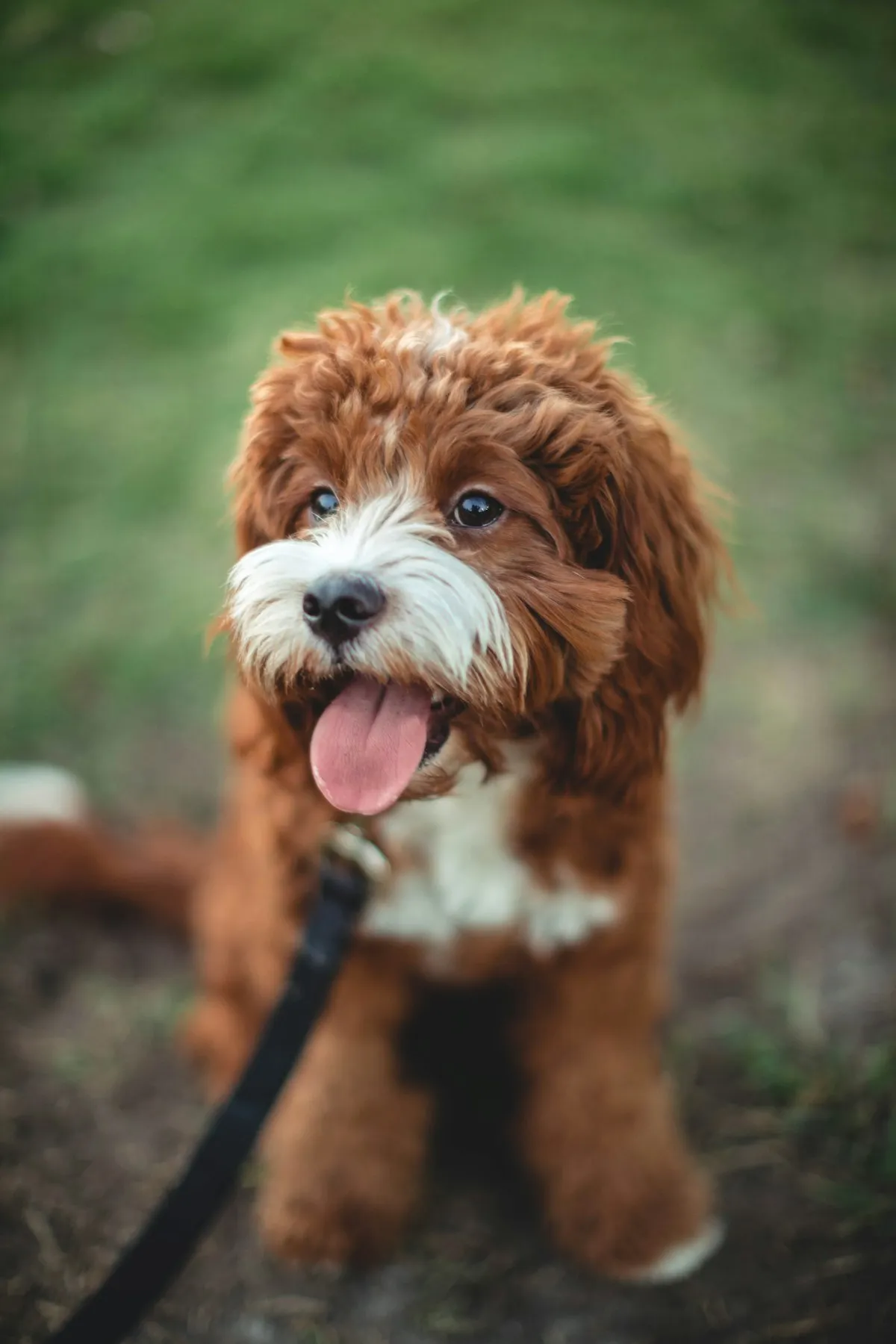
They need company. The Cavalier is one of the most people-dependent breeds there is, and the Cavapoo inherits that. This is a dog for a household where someone is around most of the day, not one that will cope with a full working day alone from the start.
They are not automatically calmer than their parents. In March 2026, the Royal Veterinary College published a study in PLoS One comparing owner-reported behaviour (using the validated C-BARQ questionnaire) in 985 Cavapoos, 715 Cavaliers and 927 Poodles. Compared with Cavaliers, Cavapoos scored worse on eight of twelve scales, including separation-related problems, excitability, stranger-directed and non-social fear, and all three aggression scales, and better on one: trainability. Compared with Poodles, Cavapoos scored worse on non-social fear, dog-directed fear and trainability, and no differently on the rest. The differences were statistically significant but, as the authors note, modest in size, and Cavapoos and Labradoodles came out better overall than Cockapoos.
The practical lesson is not that Cavapoos are difficult dogs. Most are easy to live with. It is that the Cavalier's famously soft temperament is not guaranteed to come through a cross, and that early socialisation, the temperament of both parents, and how the puppy is reared matter more than the name.
Do Cavapoos bark a lot?
Cavapoos are not usually among the most vocal small dogs, but many bark to alert, to greet, or when bored or anxious. Barking when left alone is common and is usually a symptom of separation distress rather than a training problem on its own. Daily exercise, mental work, calm greetings and a gradual introduction to time alone prevent most of it.
8Are Cavapoos Good Family Dogs?
Usually, yes. Cavapoos are small enough to be safe around children and robust enough, at the Miniature end, to enjoy playing with them. They tend to be tolerant and affectionate, and their trainability makes household rules easy to teach.
The one caveat is size. A Toy Cavapoo of 8 or 9 lb can be injured by a toddler falling on it or a child picking it up badly, and a frightened small dog may snap. Teach children to let the dog come to them, never to disturb it when eating or sleeping, and supervise young children with any dog. For families with small children, a Miniature-parent Cavapoo is often the sturdier choice. Cavapoos also appear in our list of gentle breeds for first-time owners for good reason.
9Are Cavapoos Easy to Train?
Yes. Cavapoos are one of the few Poodle crosses that scored higher for trainability than both parent breeds in the 2026 RVC study, and most owners find them keen, food-motivated and quick to pick things up. Reward-based methods work; harsh handling tends to produce a worried dog that shuts down rather than complies.
Priorities for the first months:
- Toilet training, which small dogs are often slower at because their bladders are tiny and owners miss the signals
- Settling on a mat and being alone for short, gradually longer periods
- Recall, practised every day
- Loose-lead walking, even for a dog you could carry
- Handling tolerance: ears, paws, mouth and being brushed, from the first week
- Calm greetings instead of jumping up
Socialise the puppy carefully between roughly 3 and 14 weeks of age. Given that fear of strangers, other dogs and novel situations were among the behaviours where Cavapoos scored worse than Cavaliers, positive early exposure to people, calm vaccinated dogs, traffic, car journeys and the vet is time well spent.
10How Much Exercise Does a Cavapoo Need?
An adult Cavapoo needs around 30 to 60 minutes of activity a day, which can be split into two walks plus play and training. Dogs with more Poodle in them tend to sit at the top of that range and enjoy agility, scent games and retrieving; dogs with more Cavalier are often content with a shorter walk and a long cuddle.
Mental work matters as much as mileage for this cross. Ten minutes of training, a puzzle feeder and a sniffing walk will settle a Cavapoo more reliably than a long march. Keep puppy walks short and let the puppy set the pace until it is around a year old; small dogs mature faster than large ones, but repetitive jumping and stairs are still best avoided while joints are growing.
11Can Cavapoos Be Left Alone?
Not for long, and not without practice. Separation-related behaviour is the single most common behaviour problem owners report in this cross, and it is the one most worth planning for before the puppy arrives.
A 2024 study from the Dogs Trust Generation Pup project found that almost half of puppies of all breeds (47 per cent of 145) showed separation-related behaviours by six months of age. Puppies that slept at least nine hours a night and were confined to a crate or room overnight at under 16 weeks were less likely to develop them; puppies whose owners used punishment-based methods, or who fussed over the dog on returning after unwanted behaviour, were more likely to. Breed was not a significant factor in that study, which is a reminder that how the puppy is raised matters more than what it is.
Build time alone from the first week: short absences while the puppy is tired and settled, a safe resting space, something to chew, departures and returns kept boring, and a predictable routine. An adult Cavapoo that has been taught this way can usually manage four to five hours. One that howls continuously, soils, injures itself or destroys doors is in distress and needs help from a vet or a qualified behaviourist, not more time to "get used to it".
12Cavapoo Grooming Requirements
Grooming is the part of Cavapoo ownership most people underestimate, and matting is the most common reason a Cavapoo arrives at the groomer to be shaved off.
A wavy or curly Cavapoo needs:
- Brushing to the skin three or four times a week, daily during the coat change at 8 to 12 months
- Combing after brushing with a metal comb to find the tangles a brush slides over
- Professional clipping every six to eight weeks
- Bathing every four to eight weeks, followed by thorough drying and brushing
- Nail trims every three to four weeks
- Ear checks weekly, and after every bath or swim
- Face and eye care daily or every other day, because tear staining and food in the beard are common
- Tooth brushing daily if possible; small dogs lose teeth to periodontal disease early
Work in small sections, brushing from the skin outward, and pay particular attention to behind the ears, under the collar, the armpits, the inner thighs and the tail base. If you find mats tight against the skin, book a groomer rather than cutting them out with scissors; a short clip and a fresh start is kinder than de-matting.
Ear care
Cavapoos have heavy, hair-filled drop ears from both sides, and ear infections are a known problem for the cross. The 2024 RVC study found Cavapoos had 1.6 times the odds of ear infection of Cavaliers, though lower odds than Poodles. Check ears weekly for redness, odour, discharge, head shaking or scratching, dry them after bathing, and ask your vet or groomer whether hair inside the canal should be trimmed for your dog. A painful, smelly ear needs a vet; repeated home cleaning without a diagnosis usually makes things worse.
13Cavapoo Health: What the Evidence Shows
For years, the Cavapoo was sold as the way to get a Cavalier without the Cavalier's health problems. The best evidence to date says it is more complicated than that.
In 2024, researchers at the Royal Veterinary College published a study in PLoS One comparing owner-reported health in 985 Cavapoos, 715 Cavalier King Charles Spaniels and 927 Poodles across 57 common disorders, all in dogs under five years old. The Cavapoo findings were:
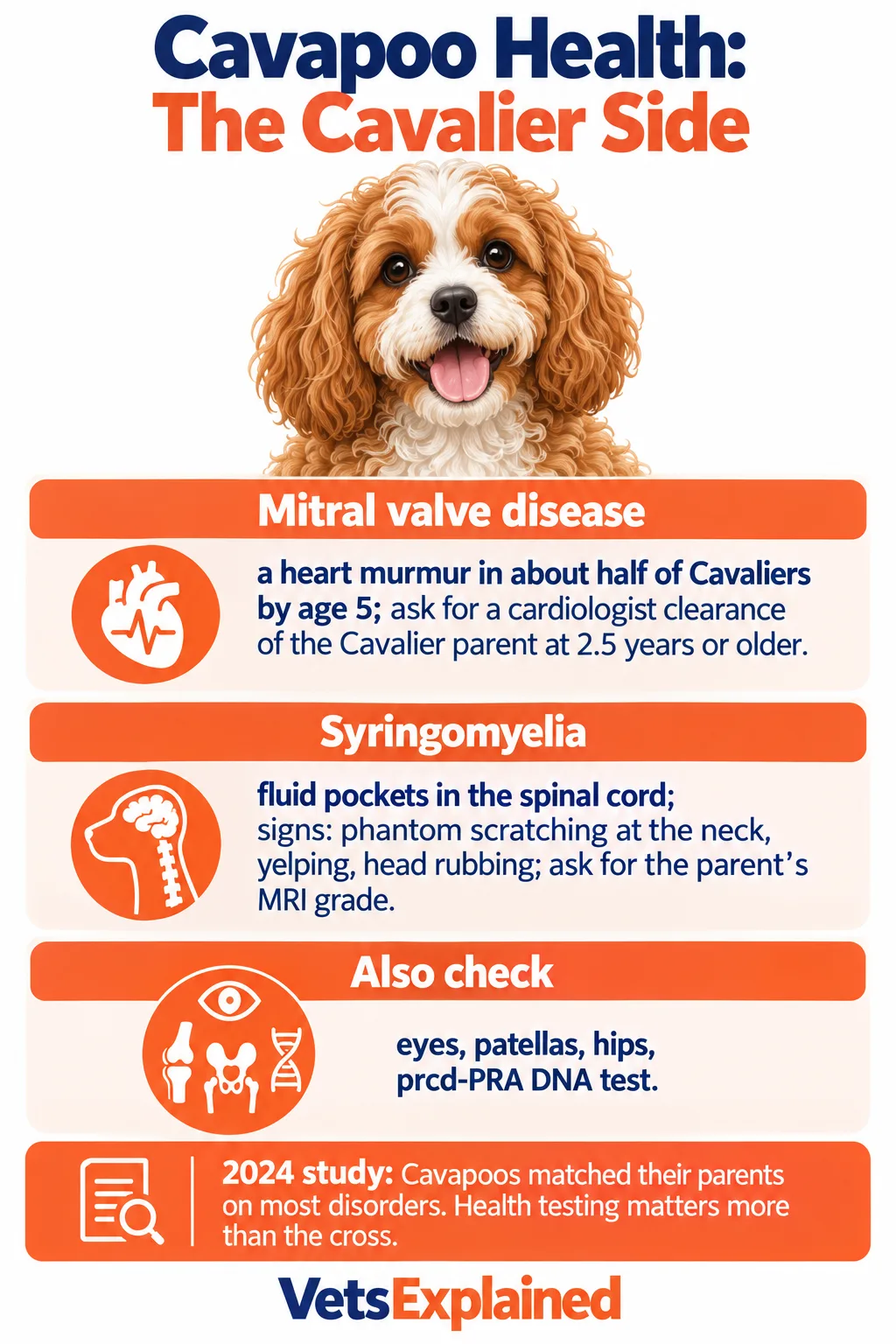
- No difference from Cavaliers for 50 of the 57 disorders, and no difference from Poodles for 50 of 57.
- Lower odds than Cavaliers of eye disorders, anal sac problems, obesity and overgrown nails.
- Higher odds than Cavaliers of vomiting, ear infections and diarrhoea.
- Lower odds than Poodles of ear infections, eye disorders and lameness.
- Higher odds than Poodles of anal sac problems, diarrhoea, dietary indiscretion and vomiting.
- Heart murmurs were recorded in 1.4 per cent of Cavaliers, 0.4 per cent of Cavapoos and 0.1 per cent of Poodles, a difference that was not statistically significant.
In plain terms, a young Cavapoo is about as healthy as its parents: not healthier, not worse. The authors found little evidence of "hybrid vigour". The important limitation is age. Because the study only included dogs under five, it could not measure the two Cavalier conditions that worry vets most, both of which mostly appear later in life. They are covered next.
Mitral valve disease
Mitral valve disease (MVD) is a slow degeneration of the valve between the left chambers of the heart. It is the most common heart disease of older small dogs of any breed, but in the Cavalier it starts far earlier and progresses faster. According to UFAW's review of the condition, the proportion of Cavaliers with a heart murmur rises by roughly 10 per cent for every year of age, about half have a murmur by five, and by ten almost all do; heritability is estimated at 0.64, meaning most of the variation is genetic, and MVD accounts for over 40 per cent of deaths in the breed. A 2021 study of 126 Cavaliers aged eight and over found echocardiographic evidence of the disease in every single dog.
What that means for a Cavapoo is not yet known with any precision. MVD is polygenic, there is no DNA test, and a cross with a Poodle (a breed where the disease is much rarer and later) should on average lower and delay the risk, but it cannot remove it: every Cavapoo carries half its genes from a breed in which the disease is close to universal. The 2024 study's low murmur rate in young Cavapoos is reassuring as far as it goes, but murmurs in Cavaliers also usually start after the age the study stopped at.
Practical steps:
- Buy only from a breeder whose Cavalier parent has an annual heart examination by a veterinary cardiologist and was murmur-free at the time of breeding, ideally with the Cavalier's own parents murmur-free at five. This is the basis of the MVD breeding protocol that cardiologists have recommended since 1998 and that the breed clubs have adopted in some form.
- Have your Cavapoo's heart listened to at every annual check from age one, and ask your vet to grade any murmur.
- Know the early signs: a cough, especially at night or after lying down, faster breathing at rest, tiring on walks, and in later stages a swollen abdomen or collapse.
- If a murmur is found, an ultrasound (echocardiogram) stages the disease. Modern treatment started at the right stage can delay heart failure by many months, which is why early detection matters.
Syringomyelia and Chiari-like malformation
Chiari-like malformation (CM) is a mismatch between the size of the back of the skull and the brain, which crowds the base of the brain and obstructs the flow of spinal fluid. Syringomyelia (SM) is the fluid-filled cavity that can then form inside the spinal cord, and it is painful. In Cavaliers both are extremely common. UFAW reports that CM is found in the great majority of the breed, that MRI studies have found SM in 25 per cent of one-year-old Cavaliers rising to around 70 per cent by six, and that heritability is high, with roughly three-quarters of the offspring of affected dogs expected to inherit it. Not every dog with SM shows signs; surveys of clinical signs in the breed range from a few per cent to over 30.
Signs usually begin between six months and four years and include:
- "Phantom" scratching at the neck, shoulder or ear, often on one side, with the paw not quite touching the skin, worse with excitement, on waking or in a collar
- Yelping when picked up, jumping down or changing position
- Reluctance to be touched around the head and neck
- Head rubbing, face scratching and a tendency to sleep with the head raised
- In severe cases, weakness, a wobbly gait and constant pain
Diagnosis needs an MRI under anaesthesia. Treatment is mostly medical, with pain relief and drugs that reduce spinal fluid production; surgery is an option for some dogs.
For Cavapoos, the picture is uncertain and under-researched. The skull shape that causes CM is inherited, and crossing to a Poodle with a longer skull should reduce the risk, but there are no published prevalence figures for Cavapoos and the condition has been found in other toy breeds and crosses. The practical protection is at the breeder's end. In the UK, the BVA/Kennel Club CM/SM scheme grades MRI scans of breeding dogs from 0 to 2 for each condition, and it is open to crossbreeds. A Cavalier parent that has been scanned and graded SM 0, preferably after the age of three, is the best evidence you can get. If your Cavapoo scratches at thin air or yelps when lifted, mention syringomyelia to your vet by name; it is often mistaken for an ear or skin problem for months.
Other conditions to know about
- Patellar luxation: a kneecap that slips out of its groove, common in both Toy Poodles and Cavaliers. The 2024 study found no difference between Cavapoos and either parent. Signs are a skipping gait or a hind leg held up for a few steps; mild cases are managed with weight control, severe ones with surgery.
- Hip dysplasia: less common in small dogs but screened for in both parent breeds. See our guide to hip dysplasia in dogs.
- Eye disease: progressive retinal atrophy (PRA), for which a DNA test exists on the Poodle side, cataracts, and the Cavalier's dry eye and retinal problems. Cavapoos had lower odds of eye disorders than either parent in the 2024 study, which is one of the cross's genuine advantages.
- Dental disease: small mouths with crowded teeth lose them early. Daily brushing is the single most useful habit.
- Legg-Calvé-Perthes disease: a hip problem of small young dogs from the Toy Poodle side, causing lameness at 4 to 12 months.
- Epilepsy and episodic falling: both occur in Cavaliers; episodic falling has a DNA test.
- Digestive upsets: Cavapoos had higher odds of vomiting and diarrhoea than both parents in the 2024 study, and more dietary indiscretion than Poodles. Keep bins closed and treats measured, and see a vet for any episode that lasts more than a day or comes with lethargy.
How long do Cavapoos live?
Most Cavapoos live 12 to 15 years, and a few reach 17 or 18. The main thing that shortens a Cavapoo's life is the Cavalier's heart disease, which is why the parent's cardiac history matters so much, followed by obesity, which worsens both heart and joint problems. A lean Cavapoo from heart-tested lines has a very good chance of a long life.
14Health Testing Before Buying a Cavapoo Puppy
Because a Cavapoo can inherit problems from either side, both parents should be tested for the conditions relevant to their own breed. "Vet-checked" is not health testing. Ask to see certificates and check them against the registries (OFA in the US; BVA/Kennel Club schemes in the UK).
For the Cavalier parent, the Cavalier King Charles Spaniel Club USA's guidelines call for a heart clearance by a board-certified veterinary cardiologist at a minimum age of 2.5 years, an eye examination by a veterinary ophthalmologist, a patella examination and OFA hip X-rays. The UK Cavalier Club adds the BVA/KC heart scheme, DNA tests for episodic falling and curly coat/dry eye syndrome, and MRI screening under the CM/SM scheme. Ask specifically whether the Cavalier parent has had an MRI; many have not, and that is the gap that matters most.
For the Poodle parent, the United Poodle Association's minimum for Toys and Miniatures is an eye examination, a patellar luxation evaluation at 12 months or older, the prcd-PRA DNA test, and OFA or PennHIP hips for Miniatures. DNA tests for von Willebrand's disease and degenerative myelopathy are recommended for Miniatures.
Questions to ask a breeder
- Which Poodle variety is the father or mother, and how tall and heavy is each parent?
- When was the Cavalier's heart last checked, by whom, and was it clear? Were its parents clear at five?
- Has the Cavalier parent had an MRI under the CM/SM scheme, and what was the grade?
- Can I see the eye, patella and PRA results for the Poodle parent?
- Can I meet the mother, and see where the puppies are being raised?
- How are the puppies being socialised and introduced to short periods alone?
- What happens if I can no longer keep the dog?
A good breeder will ask you as many questions as you ask them. One with several litters a year in every colour and size, and puppies always "available now", is not the one to buy from.
15F1, F1B and Multigenerational Cavapoos
- F1: Cavalier × Poodle. The most variable generation for coat; straight, wavy and curly coats can all appear in one litter. Also the generation where Cavalier health testing matters most, because half the genes come directly from the breed.
- F1B: F1 Cavapoo × Poodle. Three-quarters Poodle, so more likely to have a curly, low-shedding coat and, in theory, a lower share of Cavalier-side risks. More Poodle in temperament as well.
- F2 and multigen: Cavapoo × Cavapoo. Can produce the widest range of all, and health depends entirely on what the breeder has selected for.
Generation labels describe ancestry, not outcomes. No generation guarantees a non-shedding coat, an allergy-friendly dog, or a heart that will stay sound.
16What Should a Cavapoo Eat?
A Cavapoo needs a complete and balanced diet for its life stage and expected adult size, which for most means a small-breed formula. Small-breed puppy foods are more energy-dense, in smaller kibble, and support the faster growth of a dog that will be fully grown by about a year. Toy-parent puppies in particular should eat small meals three or four times a day in the first months, because very small puppies can become hypoglycaemic if they go too long without food.
Measure every meal and count treats within the daily total. Cavaliers are prone to obesity, and although Cavapoos had lower odds of it than Cavaliers in the 2024 study, a 12 lb dog gains a dangerous proportion of its body weight from very little extra food. You should feel ribs easily under a thin covering, see a waist from above and a tummy tuck from the side; on a fluffy dog, use your hands. Our feeding guide by life stage covers portions as your dog grows.
17How Much Does a Cavapoo Cost?
Prices vary widely by country, region, breeder and the dog's colour, so treat any figure as a rough guide.
- Puppy from a breeder: in the US, commonly 1,500 to 4,000 dollars in 2026, with health-tested lines from established programmes at the upper end and some colours priced above that. UK prices follow a similar pattern in pounds.
- Rescue: usually a few hundred dollars in adoption fees. Cavapoos surrendered for separation anxiety or because the coat became unmanageable are not rare.
- Ongoing: professional grooming at roughly 60 to 100 dollars every six to eight weeks is the cost that surprises people most. Add food, insurance, routine vet care, dental work later in life, and training. Insurance is worth pricing before you buy; the Cavalier's heart and spine conditions make lifetime cover with a decent limit more valuable than for many breeds.
A very cheap Cavapoo puppy is a warning sign. Cardiology examinations, MRI scans and eye tests cost real money, and a breeder who has skipped them has passed the risk on to you.
18Cavapoo vs Cockapoo vs Cavalier
Cavapoo vs Cockapoo. These are the two most popular small Doodles in the UK and are often confused. The Cockapoo is usually a little bigger, more energetic and more "spaniel" in its drive, and needs more exercise; the Cavapoo is calmer and more of a lap dog. In the 2026 behaviour study, Cockapoos showed more undesirable behaviours than Cavapoos across the board. Health risks differ: the Cockapoo carries the Cocker's ear and eye problems, the Cavapoo the Cavalier's heart and spine. Our Cockapoo breed guide covers the other side, and Cavapoo vs Cockapoo sets them side by side.
Cavapoo vs Cavalier. A Cavalier gives you the gentlest temperament in dogs, a silky coat that sheds but needs no clipping, and a recognised breed with established health schemes. What you also get is a near-certain lifetime risk of mitral valve disease and a high risk of syringomyelia. A well-bred Cavapoo offers a lower-shedding coat, more trainability and, on average, probably a better outlook for heart and skull, at the price of more grooming and less predictability. Neither is the "safe" choice; the breeder's testing is what moves the odds.
19What Are the Disadvantages of a Cavapoo?
Being honest about the downsides is the best way to keep a dog out of rescue.
- The coat needs brushing several times a week and professional clipping for life, and cannot be predicted at purchase.
- Shedding and allergy outcomes are not guaranteed.
- They struggle when left alone and separation problems are common.
- They can inherit the Cavalier's mitral valve disease and syringomyelia, and neither can be ruled out by any test on the puppy.
- Ear infections and digestive upsets are more common than in some parent comparisons.
- Toy-sized Cavapoos are fragile around small children.
- There is no breed standard or registry, so quality varies enormously and the cross attracts puppy farms.
20Cavapoo Pros and Cons
Potential advantages
- Affectionate, sociable and gentle with people
- Highly trainable; scored better than both parents in the 2026 study
- Small enough for flats and easy to travel with; see our guide to the best Doodles for apartments
- Low-shedding in wavy and curly coats
- Moderate exercise needs
- Lower odds of eye disorders than either parent, and lower obesity odds than Cavaliers, in the 2024 study
- Usually good with children and other dogs when well socialised
Potential challenges
- High grooming needs and lifelong clipping costs
- Coat and shedding unpredictable in early generations
- Prone to separation-related distress
- Can inherit mitral valve disease and syringomyelia from the Cavalier side
- More fearful and excitable than Cavaliers on average, according to the 2026 study
- Prone to ear infections and dental disease
- Not a recognised breed, so buyer research matters more
21Is a Cavapoo Right for You?
A Cavapoo suits you if you want a small, affectionate, trainable dog that will be with you most of the day, you can give it a proper walk and some mental work daily, you are prepared to brush it several times a week and pay a groomer every couple of months, and you will take the time to find a breeder who tests the Cavalier parent's heart and, ideally, scans it for syringomyelia.
It is probably not the right dog if you work long hours away from home, want a dog that needs no grooming, need a guaranteed non-shedding or allergy-safe dog, or want to avoid the possibility of heart disease entirely.
Before you buy, ask yourself:
- Will someone be home most of the day for the next 12 to 15 years?
- Can I afford and manage the coat for the dog's whole life?
- Have I seen the Cavalier parent's heart certificate and asked about an MRI, not just been told about them?
- Am I prepared for a dog that may be more timid or excitable than the Cavalier I pictured?
- Am I choosing this dog for its temperament and health, or for how it looks online?
If the answers are yes, a Cavapoo can be a delightful companion and one of the easiest small dogs to share a home with.
22Final Thoughts
The Cavapoo takes the most affectionate of the toy breeds and crosses it with the cleverest of the small ones, and the best examples show why it caught on: a gentle, bright, portable dog with a coat many people find easier to live with.
What the Cavapoo is not is a guaranteed escape from the Cavalier's health problems. Two Royal Veterinary College studies now show that a Cavapoo is about as healthy as its parents in youth and not reliably calmer than them, and the heart and spine conditions that define the Cavalier can still be inherited. Choose the breeder before the puppy, insist on the Cavalier parent's heart and MRI results, plan for the grooming and the company this dog needs, and judge the dog in front of you rather than the name.
For the wider picture on Poodle crosses, including Cockapoos, Goldendoodles and Bernedoodles, read our complete Doodle Dog guide.
Sources
- Bryson GT, O'Neill DG, Brand CL, Belshaw Z, Packer RMA. The doodle dilemma: how the physical health of "designer-crossbreed" Cockapoo, Labradoodle and Cavapoo dogs compares to their purebred progenitor breeds. PLoS One. 2024;19(8):e0306350. pmc.ncbi.nlm.nih.gov
- Bryson GT, O'Neill DG, Belshaw Z, Brand CL, Packer RMA. Comparing undesirable behaviours between 'designer' Poodle-cross dogs and their purebred progenitor breeds. PLoS One. 2026;21(2):e0342847. journals.plos.org
- Universities Federation for Animal Welfare (Science for Animal Welfare). Genetic welfare problems of companion animals: Cavalier King Charles Spaniel, mitral valve disease. scienceforanimalwelfare.org
- Universities Federation for Animal Welfare (Science for Animal Welfare). Genetic welfare problems of companion animals: Cavalier King Charles Spaniel, syringomyelia. scienceforanimalwelfare.org
- Prieto Ramos J, Corda A, Swift S, et al. Clinical and echocardiographic findings in an aged population of Cavalier King Charles Spaniels. Animals. 2021;11(4):949. pmc.ncbi.nlm.nih.gov
- Dale FC, Burn CC, Murray J, Casey R. Canine separation-related behaviour at six months of age: dog, owner and early-life risk factors identified using the 'Generation Pup' longitudinal study. Animal Welfare. 2024;33:e60. cambridge.org
- British Veterinary Association / Kennel Club. Chiari malformation / syringomyelia (CM/SM) scheme. bva.co.uk
- Cavalier King Charles Spaniel Club, USA. Health testing guidelines. ckcsc.org
- United Poodle Association. Health testing for puppy buyers. 2024. unitedpoodleassociation.org
Frequently Asked Questions
?What two breeds make a Cavapoo?
A Cavapoo is a Cavalier King Charles Spaniel crossed with a Poodle, almost always a Toy or Miniature Poodle. In Australia the same cross is called a Cavoodle. It is not recognised as a breed by any major kennel club, so there is no breed standard.
?How big does a Cavapoo get?
Most finish between 8 and 25 lb and 9 to 14 inches at the shoulder. A Toy Poodle parent usually gives an 8 to 14 lb adult; a Miniature Poodle parent a 12 to 25 lb adult. The measured size of both parents is the best predictor for an individual puppy.
?Do Cavapoos shed?
A little. Wavy and curly Cavapoos shed very little because loose hair stays in the coat, which is also why they mat. Straighter-coated dogs, more common in first-generation litters, shed more. No Cavapoo is non-shedding.
?Are Cavapoos hypoallergenic?
No dog is truly hypoallergenic. Low-shedding coats spread less dander, which helps some allergic people and not others. Spend time with the individual dog before committing and never rely on a breeder's guarantee.
?Are Cavapoos high maintenance?
In grooming, yes: brushing several times a week and professional clipping every six to eight weeks for life. In exercise, no: 30 to 60 minutes a day suits most adults. The other big demand is company, because Cavapoos do not cope well with long periods alone.
?Do Cavapoos have health problems?
A 2024 study of 985 young Cavapoos found them about as healthy as Cavaliers and Poodles for most conditions, with more ear infections and digestive upsets but fewer eye problems. The main long-term worries are the Cavalier's mitral valve disease and syringomyelia, which can be inherited and appear later in life.
?Do Cavapoos get heart problems like Cavaliers?
They can. Mitral valve disease affects nearly all Cavaliers by old age and is strongly inherited, and a Cavapoo carries half its genes from that breed. Crossing to a Poodle should lower and delay the risk on average, but it cannot remove it, so the Cavalier parent should be heart-tested by a cardiologist before breeding.
?Can Cavapoos get syringomyelia?
Yes, although there are no published figures on how often. Syringomyelia is found in up to 70 per cent of older Cavaliers and is highly heritable. The best protection is a Cavalier parent that has been MRI-scanned and graded clear under the BVA/KC CM/SM scheme. Scratching at thin air or yelping when picked up should prompt a vet visit.
?Are Cavapoos good for first-time owners?
Usually, yes. They are small, affectionate, forgiving and among the most trainable Poodle crosses. The things that catch new owners out are the grooming, separation anxiety and the cost of health problems later in life, so plan for all three before buying.
?Can a Cavapoo be left alone for 8 hours?
Not routinely. Cavapoos are companion dogs that scored worse than Cavaliers for separation-related problems in a 2026 study. An adult taught gradually from puppyhood can usually manage four to five hours. Full working days need a dog walker, daycare or a different breed.
?Do Cavapoos bark a lot?
Not usually more than other small companion dogs, but many bark to alert or greet, and barking when left alone is common. Daily exercise, mental work and a gradual introduction to time alone prevent most of it.
?How long do Cavapoos live?
Most live 12 to 15 years and some reach 17 or more. Heart disease inherited from the Cavalier side is the main thing that shortens a Cavapoo's life, followed by obesity, so a lean dog from a heart-tested parent has the best outlook.
Help us do better!
Was this article helpful and relevant?
Thanks for your feedback!
About Sofia Marin
Sofia Marin is VetsExplained's senior editor. She has edited pet and consumer titles for fifteen years and is responsible for the site's editorial standards and breed coverage.
View all posts by Sofia Marin →