Are Doodles Hypoallergenic? What the Science Says About Dog Allergies
 Written by Sofia Marin
 Fact checked by Dr. Tomas Ellery, DVM
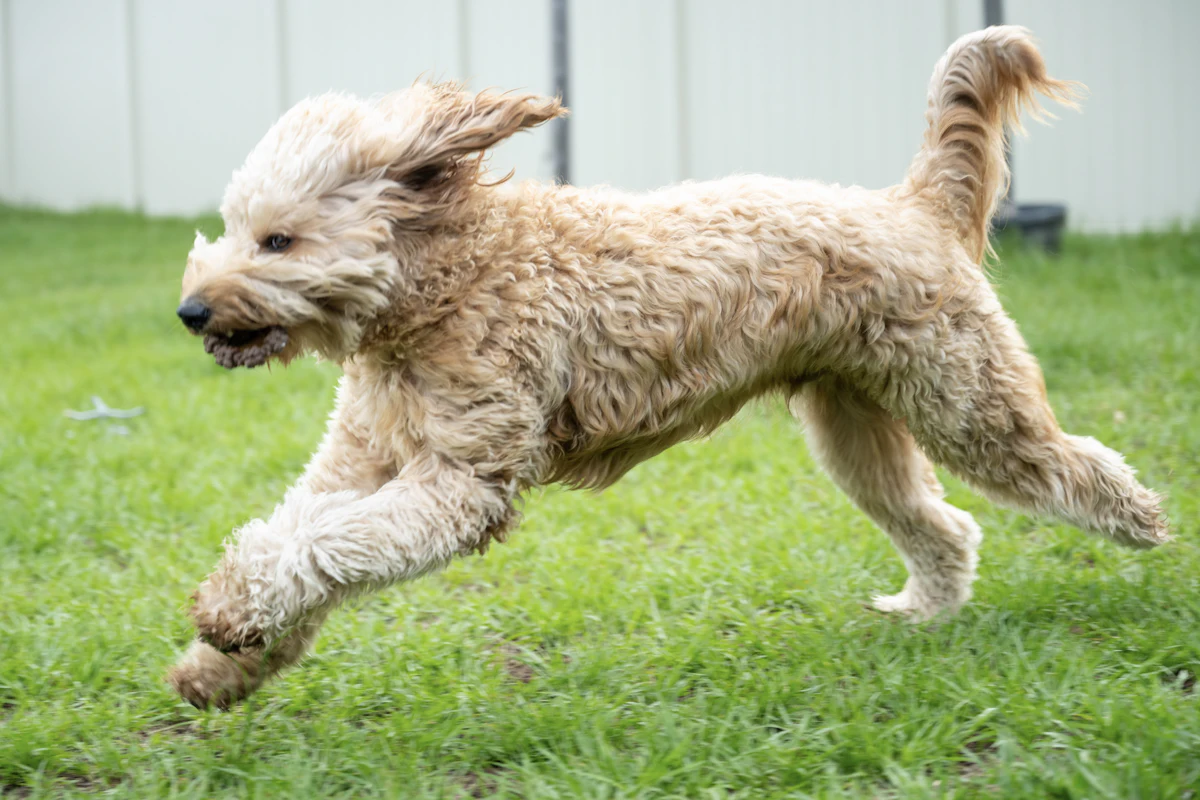
No. Doodles are not hypoallergenic. A 2012 study of 356 dogs found no lower airborne Can f 1 allergen in homes with Labradoodles and Poodles, and a 2011 study of family homes found the same. Low shedding is not low allergen; test the individual dog before you buy.
The information is current and up-to-date in accordance with the latest veterinary research. Learn more »
Doodles are not hypoallergenic. No dog is. The belief that a Poodle cross is safe for an allergic household is the commonest reason people buy one, and the claim with the least evidence behind it.
That does not mean every allergic person reacts to every Doodle. Some people with mild dog allergy live comfortably with a curly-coated Goldendoodle and sneeze within minutes of meeting a Labrador; others react just as badly to the Doodle. The difference comes down to which dog proteins you are sensitised to, how much a particular dog produces and how your home is managed, not to the word "Doodle" on a breeder's website.
"Hypoallergenic" means less likely to cause a reaction, not incapable of causing one; it is a marketing word, not a medical term. The American Academy of Allergy, Asthma and Immunology puts it plainly: there are no truly hypoallergenic breeds of dogs or cats, and dander allergens are not affected by hair length or shedding. This article covers what the research found, how to test a dog before you commit, what reduces allergen at home, and which Doodles and breeders to avoid. For the wider picture on Poodle crosses, start with our Doodle Dog guide.
Key Takeaways
- Doodles are not hypoallergenic; no dog is. The AAAAI, ACAAI and AAFA all say so.
- People react to proteins in dander, saliva and urine, mainly Can f 1 (all dogs) and Can f 5 (male dogs), not to hair.
- The 2011 Nicholas and 2012 Vredegoor studies found no lower airborne or home allergen with "hypoallergenic" breeds; curly dogs carried more Can f 1 on their coats.
- Washing cuts coat allergen by about 85 per cent but fades within three days; add a dog-free bedroom, HEPA filtration and, for lasting change, immunotherapy.
1What Are People With Dog Allergy Actually Allergic To?
People with dog allergy react to proteins made by the dog, carried on dander (shed skin flakes), in saliva and in urine. They are not allergic to hair. The main dog allergens are named Can f 1 to Can f 8, and two matter most:
- Can f 1 is the major dog allergen, a lipocalin protein made in the tongue and salivary glands, spread over the coat when the dog licks itself and shed into the home on dander. In a 2023 study of 313 dog-sensitised adults in western Sweden, 43 per cent were sensitised to Can f 1, more than to any other component.
- Can f 5 is a prostatic kallikrein, made in the prostate of male dogs and present in their urine. In the same study, 33 per cent reacted to it, and about one in six reacted to Can f 5 alone.
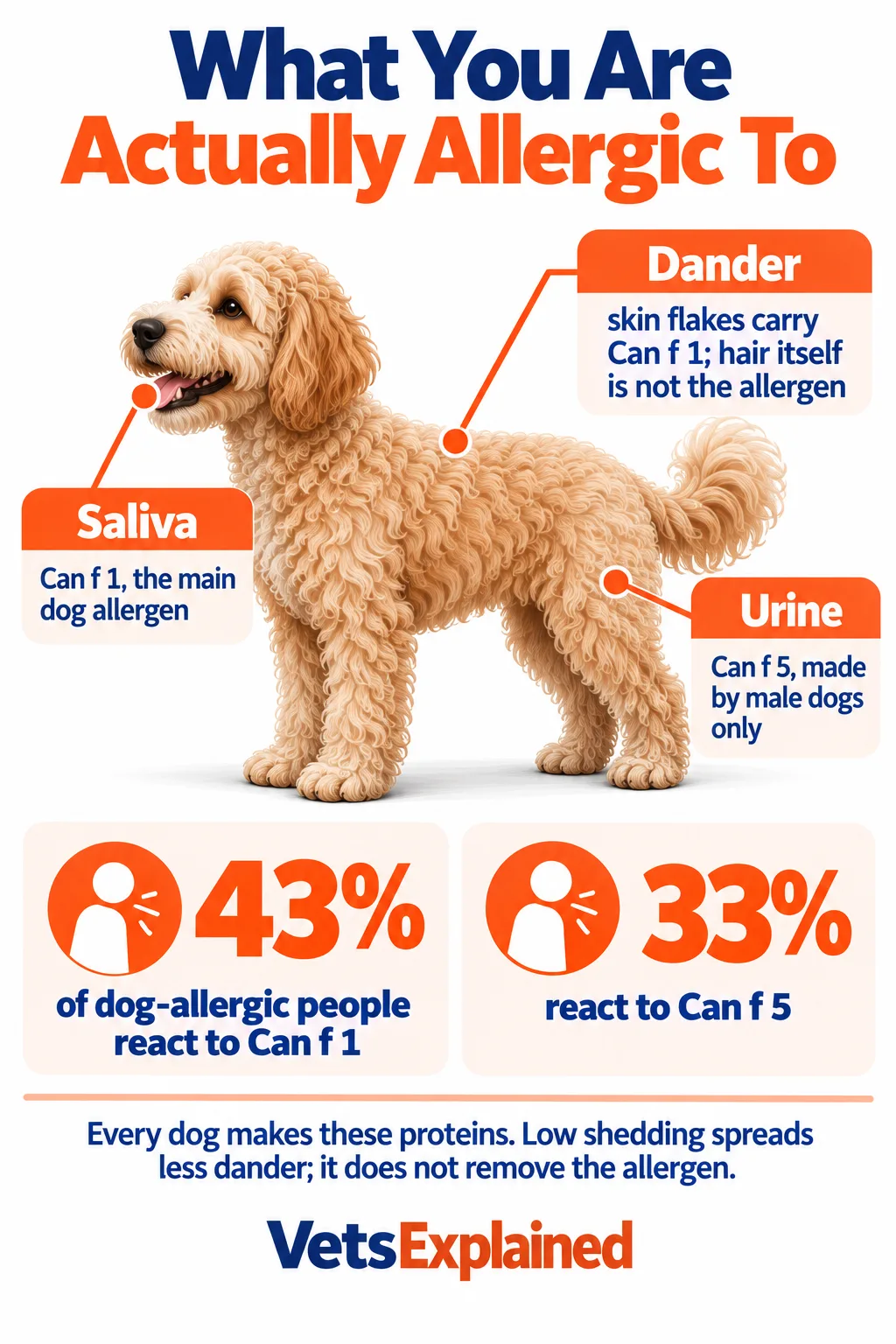
This matters for Doodles because every dog, curly or smooth, makes Can f 1 in its saliva and spreads it on its coat, and every intact male makes Can f 5. The proteins are the same whatever the coat looks like.
2What Did the Research on "Hypoallergenic" Breeds Find?
The two studies that directly tested the claim both found no evidence that "hypoallergenic" breeds, Labradoodles included, put less allergen into a home.
The 2011 Henry Ford study (Nicholas et al.)
Researchers in Detroit measured Can f 1 in dust from family homes in a birth cohort. They compared homes with breeds marketed as hypoallergenic against homes with other dogs, using four different classification schemes. None showed any difference in dog allergen between "hypoallergenic" and ordinary dog homes.
The 2012 Utrecht study (Vredegoor et al.)
A Dutch team sampled the dogs themselves: hair and coat from 196 "hypoallergenic" dogs (Labradoodles, Poodles, Spanish Water Dogs and Airedale Terriers) and 160 others (Labrador Retrievers and a control group), plus settled and airborne dust from their homes.
- The "hypoallergenic" dogs had significantly higher Can f 1 in their hair and coat, roughly three times as much in hair and twice as much on the coat.
- Differences between breeds were small compared with the variation between individual dogs of the same breed.
- Settled floor dust was somewhat lower in Labradoodle homes, but not with the other "hypoallergenic" breeds.
- Airborne Can f 1, the allergen you actually breathe, did not differ between any of the groups.
The authors concluded there is no evidence for classifying any breed as hypoallergenic. Curly, non-shedding coats probably hold saliva-coated dander on the dog rather than dropping it. Neither study measured symptoms or tested Goldendoodles or Cavapoos specifically, so an individual may still tolerate an individual dog better. What the research rules out is the idea that choosing a Doodle, by itself, lowers the allergen in your home.
3Why Low Shedding Is Not the Same as Low Allergen
A low-shedding coat means less hair on the sofa. It does not mean less of the protein you react to, because the allergen is on skin flakes and in saliva, not in the hair shaft. Dander is shed by every dog whatever the coat does, and saliva and urine carry Can f 1 and Can f 5 with no hair involved. Doodle coats themselves vary from Poodle-like curls to a flat retriever coat that sheds heavily; our guide to whether Doodles shed explains the genetics.
Hair does carry allergen on its surface, so a heavy-shedding dog spreads more around a room, which is why some allergic people notice a difference. But the curly dogs in the 2012 study carried more allergen on themselves, and the air was no different. The lower the shedding, the more the allergen stays on the dog, waiting for you to stroke it.
4Why Do Some Doodles Seem to Cause Fewer Reactions?
Because dogs differ as individuals far more than breeds differ from each other, and because allergic people differ in what they react to.
- The dog. In the 2012 study, the spread of Can f 1 between dogs of the same breed was wider than the gap between breeds.
- The dog's sex. Can f 5 comes from the prostate, so females produce little or none. In a 2020 randomised trial of teenagers sensitised only to Can f 5, all seven reacted to male dog extract on skin-prick testing and only one of seven to female dog extract; those sensitised to a mix of proteins reacted to both. Castration has not been properly studied.
- The person. A Can f 5-only reactor may be fine with a female Doodle and miserable with a male Poodle; a Can f 1 reactor will react to both.

5Which Doodles Are Best and Worst for Allergy Sufferers?
No Doodle is safe for a severely allergic person, and none should be bought on allergy grounds without testing the individual dog. Some choices stack the odds a little better.
Better bets
- A well-bred Poodle, or multigenerational or F1B Doodles with a confirmed curly or wool coat. The most likely to be genuinely non-shedding, though the adult coat cannot be confirmed until 10 to 14 months; see our guide to F1, F1B and F2 generations.
- A female, or a neutered male, if testing shows you react mainly to Can f 5.
- A smaller Doodle. A 15 lb Cavapoo has less skin, saliva and coat than a 70 lb Goldendoodle, and can realistically be bathed twice a week.
Worse bets
- F1 Doodles bought as puppies. A first-generation Goldendoodle or Labradoodle can grow a flat, heavy-shedding retriever coat, and nobody can tell which at eight weeks. In a 2022 survey of 689 Doodle owners, unexpected coat type and shedding were among the commonest complaints.
- Large, lick-prone crosses such as a Bernedoodle that takes after its non-Poodle parent: more saliva, and an hour to bath.
- Any Doodle for a person with dog-triggered asthma. The risk is an asthma attack, not sneezing; that decision belongs with an allergist.
- Intact males for anyone reactive to Can f 5.
Our guide to the best Doodle dogs for allergy sufferers compares the crosses.
6How to Test Living With a Dog Before You Buy
The only reliable test is the specific dog, over time, in an enclosed space, after an allergist has told you what you react to.
1. Get tested first. A skin-prick test takes about 15 to 20 minutes. Ask about component-resolved blood testing (Can f 1 to Can f 6), which tells you whether you are a Can f 1 reactor, a Can f 5 reactor or both. 2. Spend time with the actual dog, more than once. Sit in a closed room with it for an hour, handle it, then wait; late-phase reactions can take 4 to 8 hours. 3. Take a sample home. Keep a blanket the dog has slept on in your bedroom for a few nights. If you react to the blanket, you will react to the dog. 4. Foster or borrow before buying. The Asthma and Allergy Foundation of America suggests fostering first; many rescues allow a two to four week trial. 5. Agree in writing what happens if it fails. Rehoming a bonded dog at 14 months is a miserable and common outcome. Our checklist on bringing home a dog covers the other questions to settle first.
One warning: puppies produce less allergen than adults. A puppy that seems fine at eight weeks can be a problem at a year old, once the adult coat and, in males, Can f 5 production have arrived.
7How Do You Manage Dog Allergy If You Already Have a Doodle?
Reduce the allergen at its source, keep it out of the bedroom, filter the air and treat the person.
Bathing: the evidence
Washing the dog removes allergen, but the effect is short-lived. In a 1999 Manchester study, shampooing cut recoverable Can f 1 from hair clippings by 84 per cent and from dander by 86 per cent, but by day three hair levels were back to baseline, and airborne Can f 1 fell only by roughly 40 to 60 per cent. The conclusion is in the paper's title: the dog needs to be washed twice a week to maintain the reduction.
Twice-weekly bathing with a mild shampoo is realistic for a small Doodle and hard work with a large one. The ACAAI and AAFA recommend at least weekly. Brush the dog outdoors, and have a non-allergic family member do it.
Bedroom rules, HEPA filtration and cleaning
Keep the dog out of the bedroom, always, with the door shut; you spend around eight hours a day there, and the AAAAI lists this as the single most useful step short of rehoming. Then:
- Run a HEPA air cleaner continuously in the bedroom and main living room.
- Vacuum with a HEPA-filtered vacuum, damp-dust, and replace carpet with hard flooring where you can; AAFA notes pet allergen can persist for up to six months.
- Keep the dog off upholstered furniture, wash its bedding weekly at 60°C, and wash your hands after handling it.
Medication and immunotherapy
Antihistamines, steroid nasal sprays and eye drops control symptoms for most people with mild to moderate allergy; anyone with asthma needs an inhaler plan from a doctor. Allergen immunotherapy (allergy shots) is the only treatment that changes the underlying allergy, and the AAAAI describes it as having a proven track record. It takes three to five years, works less consistently for dog than cat allergy, and may be less effective for Can f 5 reactors, because standard dog extracts contain little of it.
8Breeder "Hypoallergenic Guarantee" Red Flags
Any breeder who guarantees a puppy is hypoallergenic is selling something they cannot deliver. Walk away from:
- "100 per cent hypoallergenic" or "non-allergenic" puppies. No such dog exists.
- "Guaranteed non-shedding" F1 litters. These can contain flat-coated, heavy-shedding puppies that nobody can identify at eight weeks.
- Coat DNA tests or "allergen testing" presented as proof of allergy safety. Furnishing and curl genes predict shedding, not allergen production, and no commercial test certifies a dog as low-allergen.
- A higher price attached to the word "hypoallergenic".
The honest version is: "Many owners with mild allergies do well, but we cannot guarantee it, and we will take the puppy back if not."
9Pros and Cons of a Doodle for an Allergic Household
Potential advantages
- Curly and wool-coated Doodles drop very little hair, so less allergen-coated hair spreads around the home
- A female or neutered male may suit a Can f 5 reactor
Potential challenges
- Not hypoallergenic: airborne Can f 1 was no lower with "hypoallergenic" breeds in two studies
- Curly coats held more Can f 1 on the dog, not less
- Coat type in F1 litters cannot be predicted at purchase
- Serious risk for anyone with dog-triggered asthma
10Final Thoughts
The Doodle began as an attempt to breed a guide dog for an allergic household, and the research answer has not changed since 2012: there is no evidence that any breed or cross is hypoallergenic, Labradoodles and Poodles included, and the air in their homes carries as much dog allergen as anyone else's.
Individual dogs vary a great deal, people react to different proteins and management makes a real difference. If you are allergic and want a Doodle, get tested, meet the actual dog more than once, foster if you can, and plan for frequent baths and a dog-free bedroom for life. Buy from a breeder who refuses to promise what they cannot deliver.
For everything else about Poodle crosses, see our complete Doodle Dog guide.
Sources
- Vredegoor DW, Willemse T, Chapman MD, et al. Can f 1 levels in hair and homes of different dog breeds: lack of evidence to describe any dog breed as hypoallergenic. J Allergy Clin Immunol. 2012;130(4):904-9. pubmed.ncbi.nlm.nih.gov
- Nicholas CE, Wegienka GR, Havstad SL, et al. Dog allergen levels in homes with hypoallergenic compared with nonhypoallergenic dogs. Am J Rhinol Allergy. 2011;25(4):252-6. pubmed.ncbi.nlm.nih.gov
- Hodson T, Custovic A, Simpson A, et al. Washing the dog reduces dog allergen levels, but the dog needs to be washed twice a week. J Allergy Clin Immunol. 1999;103(4):581-5. pubmed.ncbi.nlm.nih.gov
- Schoos AM, Chawes BL, Bloch J, et al. Children monosensitized to Can f 5 show different reactions to male and female dog allergen extract provocation: a randomized controlled trial. J Allergy Clin Immunol Pract. 2020;8(5):1592-7. pubmed.ncbi.nlm.nih.gov
- Özuygur Ermis SS, Borres MP, Basna R, et al. Sensitization to molecular dog allergens in an adult population: results from the West Sweden Asthma Study. Clin Exp Allergy. 2023;53(1):88-104. pmc.ncbi.nlm.nih.gov
- Hladky-Krage B, Hoffman CL. Expectations versus reality of designer dog ownership in the United States. Animals. 2022;12(23):3247. pmc.ncbi.nlm.nih.gov
- American Academy of Allergy, Asthma and Immunology. Pet allergy. aaaai.org
- American College of Allergy, Asthma and Immunology. Pet allergies. acaai.org
- Asthma and Allergy Foundation of America. Pet allergy: are you allergic to dogs or cats? aafa.org
Frequently Asked Questions
?Are Doodles hypoallergenic?
No. No dog breed or cross is hypoallergenic. Studies in 2011 and 2012 found no lower dog allergen in the homes or air of households with "hypoallergenic" breeds, including Labradoodles and Poodles. Some allergic people tolerate some individual Doodles, but the label cannot predict it.
?Which Doodle is the most hypoallergenic?
None is, but multigenerational or F1B Doodles with a confirmed curly or wool coat shed the least hair, which limits how much allergen-coated hair spreads through the home. A smaller dog is also easier to bath twice a week. Test the individual dog first.
?Are Goldendoodles better than Labradoodles for allergies?
There is no evidence either way. Both can have shedding or non-shedding coats depending on generation and luck, and both make the same allergen proteins. The individual dog, its sex and its coat type matter more than the cross.
?Are F1B Doodles hypoallergenic?
No. F1B Doodles are three-quarters Poodle and more likely to have a non-shedding coat, which reduces hair-borne allergen. They still produce Can f 1 in saliva and dander and, if male, Can f 5. "More likely to shed less" is all a breeder can honestly say.
?Do Doodles produce less dander?
There is no good evidence that they do. Dander is shed skin, and all dogs shed it. Non-shedding coats hold dander and saliva on the dog rather than dropping it, which is why coat allergen was higher, not lower, in curly breeds in the 2012 study.
?How often should I bath a Doodle if I have allergies?
Twice a week to keep coat allergen down, according to the 1999 Manchester study, which found an 84 to 86 per cent reduction after washing that was gone by day three. Weekly is the minimum allergy organisations recommend. Use a mild dog shampoo.
?Does a HEPA filter help with dog allergy?
Yes, as part of a package. HEPA air cleaners remove airborne dander and are recommended by the AAAAI, ACAAI and AAFA, with HEPA vacuuming, hard floors and a dog-free bedroom. A filter alone will not solve a significant allergy.
?Will a female Doodle be better for my allergies?
Possibly, if you are sensitised mainly to Can f 5, the prostate protein made only by male dogs. In a 2020 trial, six of seven Can f 5-only reactors tolerated female dog extract. If you react to Can f 1, sex makes no difference. Ask your allergist about component testing.
Help us do better!
Was this article helpful and relevant?
Thanks for your feedback!
About Sofia Marin
Sofia Marin is VetsExplained's senior editor. She has edited pet and consumer titles for fifteen years and is responsible for the site's editorial standards and breed coverage.
View all posts by Sofia Marin →