How Long Do Doodles Live? Lifespan by Cross and What Shortens It
 Written by Sofia Marin
 Fact checked by Dr. Tomas Ellery, DVM

Most Doodles live 10 to 15 years. Small crosses such as Maltipoos and Cavapoos often reach 13 to 16, while standard Bernedoodles average closer to 9 to 13 because Bernese Mountain Dogs have a median lifespan of only 8.4 years. Size, parent breeds and body condition matter most; lean dogs lived about 1.8 years longer in a lifetime study.
The information is current and up-to-date in accordance with the latest veterinary research. Learn more »
Most Doodles live between 10 and 15 years. That range is wide because "Doodle" covers everything from a 7 lb Maltipoo to a 90 lb Bernedoodle, and the biggest predictor of how long a dog lives is how big it is. The second biggest is which breeds went into it.
No study has yet followed enough Goldendoodles, Cavapoos or Bernedoodles to their deaths to give a true figure for each cross. What we do have is good data on the parent breeds, on crossbreeds as a group, and on what shortens or extends a dog's life. This article uses that evidence to give an honest estimate for each popular cross and sets out what you can control.
If you are still deciding which Poodle cross suits you, our Doodle Dog guide compares them all; this piece is about how long they live and why.
Key Takeaways
- Most Doodles live 10 to 15 years; small crosses such as Maltipoos and Cavapoos sit at the top of the range, standard Bernedoodles at the bottom.
- The two largest UK studies found crossbreeds lived no longer than purebreds (12.0 vs 12.7 years median), so hybrid vigour should not be relied on.
- Size and parent breed drive the differences: Bernese Mountain Dogs have a median lifespan of 8.4 years and Cavaliers about 10.5, and their crosses inherit those risks.
- Obesity, untested parents, bloat, cancer, dental disease and accidents are the main things that shorten a Doodle's life.
- Keeping a dog lean added about 1.8 years in the only lifetime feeding trial run in dogs; dental care, preventive medicine and early screening add more.
1How Long Do Doodles Live on Average?
A typical Doodle lives 10 to 15 years, and most fall in the 12 to 14 range. Small crosses sit at the top; standard-sized crosses with a large, cancer-prone parent sit at the bottom.
The best reference point is the general dog population. The largest UK study to date, McMillan and colleagues in 2024, analysed records of 584,734 dogs and found a median lifespan of 12.5 years: 12.7 for purebreds and 12.0 for crossbreeds. An earlier Royal Veterinary College analysis by Teng and colleagues in 2022, using 30,563 deaths recorded in veterinary practices, estimated life expectancy at birth at 11.23 years overall and 11.82 for crossbreeds.

Those two figures, 12.0 and 11.8 years, are the closest thing we have to a measured Doodle lifespan, because Doodles were counted as crossbreeds in both studies; the 2024 authors noted that their crossbreed group included designer crosses such as the Labradoodle.
2Doodle Lifespan by Cross
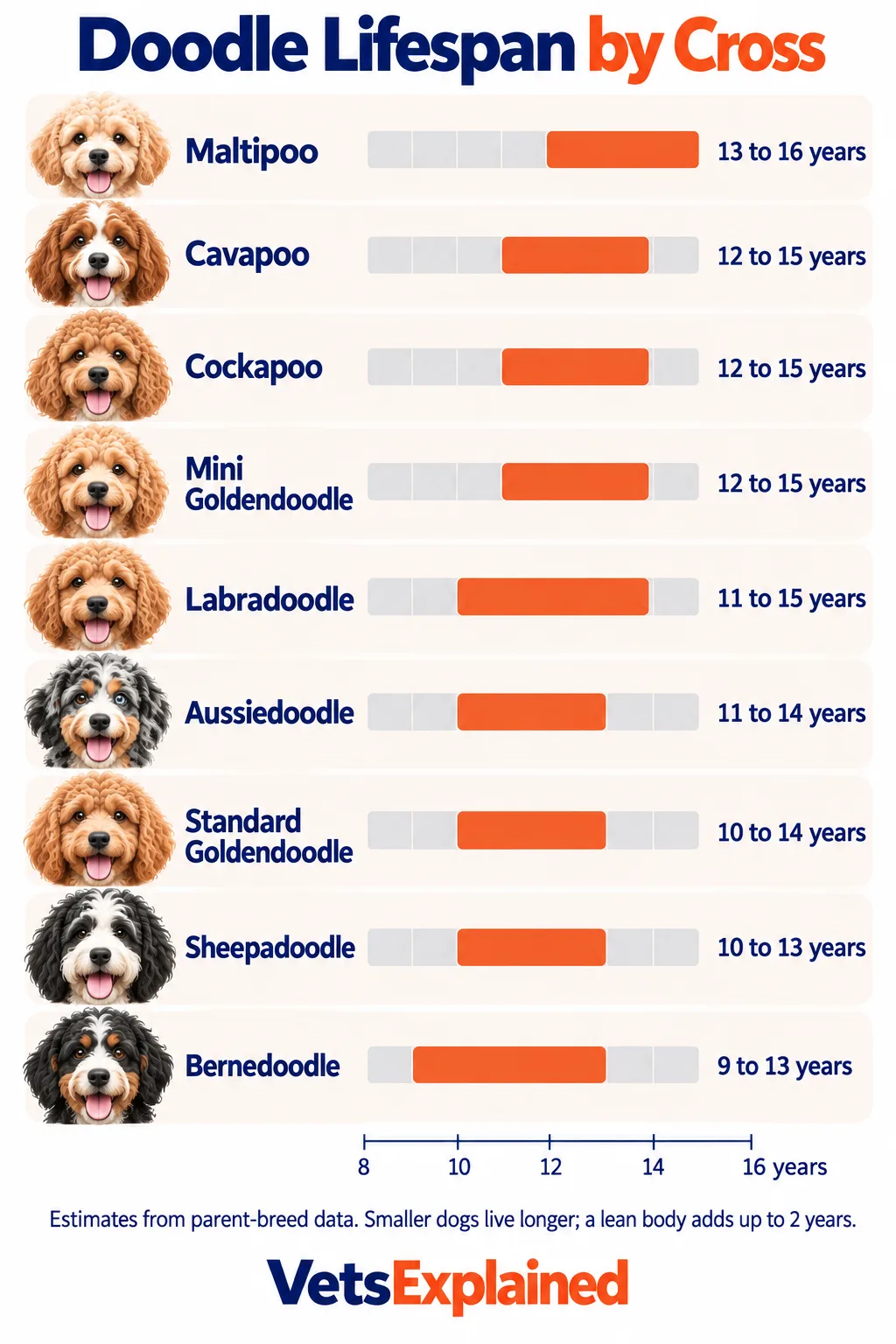
The figures below are estimates, not measured results. They are derived from the parent breeds' published longevity, adjusted for the adult size of the usual cross, and describe a likely range for a healthy dog from tested parents. Individual dogs will fall outside them in both directions.
- Maltipoo (Maltese × Toy or Miniature Poodle, 5 to 15 lb): 13 to 16 years. Both parents are small, long-lived breeds.
- Cavapoo (Cavalier King Charles Spaniel × Poodle, 10 to 25 lb): 12 to 15 years. Size favours a long life, but the Cavalier's heart disease drags the average down; the 2022 life tables gave Cavaliers only 10.45 years at birth. See our Cavapoo guide.
- Cockapoo (Cocker Spaniel × Poodle, 12 to 30 lb): 12 to 15 years. Cocker Spaniels came in at 11.31 years in the 2022 tables; a smaller Cockapoo tends to outlive that.
- Mini Goldendoodle (20 to 35 lb): 12 to 15 years. Longer-lived than a standard, but still carrying the Golden Retriever's cancer risk.
- Standard Goldendoodle (50 to 80 lb): 10 to 14 years. The Golden Retriever's high rate of lymphoma and haemangiosarcoma is why the range starts lower. See our Goldendoodle guide.
- Labradoodle (mini 15 to 30 lb; standard 50 to 80 lb): 12 to 15 years for minis, 11 to 14 for standards. Labradors did comparatively well in both UK studies, at 11.77 years in 2022 and a median of 13.1 in 2024. See our Labradoodle guide.
- Aussiedoodle (Australian Shepherd × Poodle, 25 to 70 lb): 11 to 14 years, depending on whether a Miniature or Standard Poodle was used.
- Sheepadoodle (Old English Sheepdog × Poodle, 50 to 85 lb): 10 to 13 years, with bloat and joint disease as the main risks.
- Bernedoodle (Bernese Mountain Dog × Poodle): 9 to 13 years for standards (70 to 90 lb) and 11 to 15 for minis. The Bernese is the shortest-lived Doodle parent.
3Why Do Smaller Doodles Live Longer?
Small dogs live longer than large dogs, and the effect shows in every longevity study ever published. In the 2024 UK study, small purebred dogs had a median lifespan of 12.7 years, medium dogs 12.5 and large dogs 11.9, and the longest-lived breed (the Lancashire Heeler, 15.4 years) and the shortest (the Caucasian Shepherd, 5.4 years) differ almost entirely by size.
Large dogs grow faster as puppies, which is linked to earlier joint disease and probably to cancer, and they are more prone to bloat, bone cancer and splenic tumours. So the choice between a mini and a standard version of the same cross is also a choice about lifespan: a Mini Goldendoodle will, on average, outlive a Standard Goldendoodle by a year or two.
4How Much Does the Parent Breed Matter?
A great deal, because a Doodle inherits its parents' disease risks, not a diluted version of them. The 2024 Royal Veterinary College study of Cockapoos, Labradoodles and Cavapoos found their health essentially matched their parent breeds for most disorders, and the same logic applies to lifespan.
The Bernedoodle is the clearest example. A Swiss study that followed 389 pedigree Bernese Mountain Dogs born in 2001 and 2002 until almost all had died found a median survival of just 8.4 years, and 76 per cent of the dogs with a known cause of death died of cancer. Crossing a Bernese with a Standard Poodle raises the average but does not remove the cancer genes the Bernese parent carries. No honest breeder should quote 15 years for a standard Bernedoodle; our Bernedoodle guide explains what to ask for.
The Golden Retriever is the other parent with a documented cancer burden. Cavaliers bring mitral valve disease, which affects most of the breed by old age. Labradors and Cocker Spaniels are mid-table breeds with no single dominant killer, and the Poodle in all three sizes is consistently reported as long-lived. Face shape matters too: the 2024 study found flat-faced dogs had a median lifespan of 11.2 years against 12.8 for dogs with a normal muzzle, and Doodles are not flat-faced.
5Do Doodles Live Longer Than Purebred Dogs?
No. In the 2024 UK data, crossbreeds had a median lifespan of 12.0 years against 12.7 for purebreds, and nearly half of all purebred breeds outlived the crossbreed group. The 2022 life tables put crossbreeds at 11.82 years, below the Jack Russell Terrier (12.72), Border Collie (12.10) and Springer Spaniel (11.92).
Hybrid vigour is strongest in a true first-generation cross and fades as Doodles are bred to Doodles. A Doodle from screened parents will be about as long-lived as those parents, which for most crosses means 12 to 14 years; generation labels (F1, F1B, multigen) predict coat and size far better than lifespan.
6What Shortens a Doodle's Life?
The biggest avoidable threats are obesity, untested parents, bloat in large crosses, cancer, dental disease in small crosses and accidents in young dogs.
- Obesity is the most common, most preventable cause of a shorter life, and Doodles with a Labrador or Golden Retriever parent gain weight easily under a coat that hides it. The lifetime diet study below put the cost at about 1.8 years.
- Untested parents. A puppy whose parents were not screened for hip dysplasia, eye disease, heart disease and the relevant DNA conditions is a puppy bought blind. Hip dysplasia rarely kills directly, but it leads to years of pain and to euthanasia when mobility fails; see our guide to hip dysplasia in dogs. Our Doodle health problems guide lists the tests to ask for by cross.
- Bloat. Gastric dilatation and volvulus (GDV), in which the stomach fills with gas and twists, kills within hours without surgery. Merck Veterinary Manual lists the Standard Poodle among the deep-chested breeds at risk and reports around 20 per cent mortality even in treated cases. Standard Goldendoodles, Labradoodles, Sheepadoodles and Bernedoodles inherit this chest shape. Signs are a swollen, tight abdomen, unproductive retching, drooling and restlessness.
- Cancer is the leading cause of death in older dogs of almost every breed, and the dominant risk for Bernedoodles and Goldendoodles. Any new lump should be sampled rather than watched, and pale gums, a swollen belly or sudden collapse in a large Doodle needs same-day attention, because splenic tumours can bleed internally without warning.
- Dental disease in small crosses. A 2021 VetCompass study of 22,333 UK dogs found Toy Poodles had nearly four times the odds of a recorded periodontal diagnosis compared with crossbreeds, and Cavalier King Charles Spaniels 2.4 times. Maltipoos, Cavapoos and small Cockapoos inherit this from both sides, and the bacteria involved have been linked to heart, kidney and liver disease.
- Trauma and accidents. In dogs under three, road accidents, falls and poisoning kill more often than disease. Secure fencing, a reliable recall and keeping chocolate, grapes, xylitol and medications out of reach prevent most of these deaths.
7What Helps a Doodle Live Longer?
Keeping your dog lean is the single most effective thing you can do, followed by dental care, preventive medicine, a considered decision on neutering, and catching disease early.
Keep the dog lean

This is the only lifespan intervention ever tested in a lifetime trial in dogs. Kealy and colleagues paired 48 Labrador Retriever littermates and fed one of each pair 25 per cent less than its sibling for life. The lean-fed dogs had a median lifespan of 13.0 years against 11.2 years for the controls, a gain of about 1.8 years, and they developed chronic conditions, especially osteoarthritis, roughly two years later. The dogs were kept at an ideal body condition, not starved. The study was funded by a pet-food manufacturer, but the design was sound and the result has never been contradicted.
In practice, you should feel your Doodle's ribs easily under a thin layer of fat and see a waist from above; on a curly coat, use your hands. Measure meals, count treats and ask your vet for a body-condition score at every visit. Our feeding guide by life stage covers how much to feed, and the WSAVA nutrition guidelines explain how to judge a food.
Look after the teeth, vaccinate and control parasites
Daily brushing with a dog toothpaste is the gold standard, and a few times a week still helps; dental chews are supplements, not substitutes. Most small Doodles will need a professional scale and polish under anaesthesia at some point, and the earlier it is done, the fewer teeth are lost. Parvovirus, distemper and leptospirosis still kill unvaccinated dogs every year, and heartworm, lungworm and tick-borne diseases are preventable with routine products matched to your region.
Think carefully about neutering and its timing
The 2022 UK life tables found neutered dogs lived longer than entire ones: 11.98 years against 10.50 for females and 11.49 against 10.58 for males. Part of that is real (no pyometra, no testicular cancer, fewer roaming accidents) and part is probably because owners who neuter also tend to vaccinate, insure and seek treatment.
Against that, University of California, Davis research covering 35 breeds found that neutering before a year of age raised the risk of joint disorders and some cancers in several large breeds, including Golden Retrievers and Labradors, while making little difference in most small breeds and in Poodles. For a standard Doodle with a Golden or Labrador parent, discuss waiting until 12 to 18 months with your vet; for a small Doodle, timing matters much less.
Screen early
Senior Doodles benefit from twice-yearly check-ups from about seven years old for standards and eight or nine for minis, with blood and urine tests to pick up kidney, liver and metabolic disease before it causes signs. For Cavapoos, an annual heart check from middle age catches mitral valve disease early enough for medication to delay heart failure. For large crosses, avoid forced running, stairs and jumping until growth plates close at 12 to 18 months.
8Doodle Lifespan: Pros and Cons of the Popular Crosses
Potential advantages
- Doodles have a normal muzzle, so they avoid the shortened lifespan of flat-faced breeds
- Poodle parents are consistently reported as long-lived in all three sizes
- Mini versions of most crosses have a realistic 13-to-15-year expectation
- The main avoidable killers all respond to owner effort
Potential challenges
- Crossbreeds did not outlive purebreds in either large UK study
- Bernese and Golden Retriever parents bring a cancer burden that crossing does not remove
- Cavalier parents bring early heart disease; standard crosses carry a bloat risk
- Lifespan figures quoted by breeders are usually optimistic and rarely based on data
9Final Thoughts
A Doodle's lifespan is mostly decided before you bring the puppy home: by the size of the cross, the breeds behind it, and whether the breeder tested the parents. After that, it is decided by you. Keep the dog lean, brush its teeth, keep up preventive care, and take new lumps seriously, and a Maltipoo, Cavapoo or Cockapoo can reasonably be expected to reach 13 to 15, a Goldendoodle or Labradoodle 11 to 14, and a Bernedoodle a little less.
For the wider picture on every Poodle cross, including temperament, grooming and cost, read our complete Doodle Dog guide.
Sources
- McMillan KM, Bielby J, Williams CL, Upjohn MM, Casey RA, Christley RM. Longevity of companion dog breeds: those at risk from early death. Scientific Reports. 2024;14:531. pmc.ncbi.nlm.nih.gov
- Teng KT, Brodbelt DC, Pegram C, Church DB, O'Neill DG. Life tables of annual life expectancy and mortality for companion dogs in the United Kingdom. Scientific Reports. 2022;12:6415. pmc.ncbi.nlm.nih.gov
- Klopfenstein M, Howard J, Rossetti M, Geissbühler U. Life expectancy and causes of death in Bernese Mountain Dogs in Switzerland. BMC Veterinary Research. 2016;12:153. pmc.ncbi.nlm.nih.gov
- Kealy RD, Lawler DF, Ballam JM, et al. Effects of diet restriction on life span and age-related changes in dogs. Journal of the American Veterinary Medical Association. 2002;220(9):1315-1320. pubmed.ncbi.nlm.nih.gov
- Hart BL, Hart LA, Thigpen AP, Willits NH. Assisting decision-making on age of neutering for 35 breeds of dogs: associated joint disorders, cancers, and urinary incontinence. Frontiers in Veterinary Science. 2020;7:388. frontiersin.org
- O'Neill DG, Mitchell CE, Humphrey J, Church DB, Brodbelt DC, Pegram C. Epidemiology of periodontal disease in dogs in the UK primary-care veterinary setting. Journal of Small Animal Practice. 2021;62(12):1051-1061. pmc.ncbi.nlm.nih.gov
- Merck Veterinary Manual. Gastric dilation and volvulus in small animals. merckvetmanual.com
- WSAVA Global Nutrition Committee. Global nutrition guidelines. wsava.org
Frequently Asked Questions
?How long do Goldendoodles live?
A Standard Goldendoodle is estimated to live 10 to 14 years and a Mini Goldendoodle 12 to 15. The Golden Retriever parent's high cancer rate is the main reason standards sit lower; keeping the dog lean and checking lumps early makes the most difference.
?How long do Bernedoodles live?
Standard Bernedoodles are estimated at 9 to 13 years and minis at 11 to 15. A Swiss study found Bernese Mountain Dogs had a median lifespan of only 8.4 years, mostly because of cancer, and crossing with a Poodle raises but does not remove that risk.
?How long do Cavapoos live?
Most Cavapoos should reach 12 to 15 years. Their small size favours longevity, but the Cavalier parent brings mitral valve disease, and UK life tables gave Cavaliers only about 10.5 years at birth. Choose a puppy whose Cavalier parent has an annual heart certificate.
?Do Doodles live longer than purebred dogs?
No. In the 2024 UK study of over 580,000 dogs, crossbreeds had a median lifespan of 12.0 years against 12.7 for purebreds. Hybrid vigour is real in a true first cross but is not strong enough to make a Doodle outlive a well-bred parent breed.
?What do Doodles usually die of?
Cancer is the leading cause of death in older Doodles, especially those with a Bernese or Golden Retriever parent. Heart disease is common in Cavapoos, bloat kills some large crosses suddenly, and in dogs under three, accidents and poisoning are the biggest risks.
?Does keeping a Doodle thin really make it live longer?
Yes, and it is the only lifespan intervention tested in a lifetime trial. Labradors fed 25 per cent less than their littermates lived a median of 13.0 years against 11.2, and developed arthritis about two years later. Aim for easily felt ribs and a visible waist.
?Should I neuter my Doodle early to help it live longer?
Not necessarily early. Neutered dogs lived longer in UK life tables, but UC Davis research found that neutering large breeds such as Golden Retrievers and Labradors before a year raised joint and some cancer risks. For a standard Doodle, discuss waiting until 12 to 18 months with your vet.
?At what age is a Doodle considered a senior?
Roughly seven years for a standard-sized Doodle and eight to nine for a mini. From then on, twice-yearly check-ups with blood and urine tests catch kidney, liver and heart problems before they cause obvious signs.
Help us do better!
Was this article helpful and relevant?
Thanks for your feedback!
About Sofia Marin
Sofia Marin is VetsExplained's senior editor. She has edited pet and consumer titles for fifteen years and is responsible for the site's editorial standards and breed coverage.
View all posts by Sofia Marin →