Cockapoo Dog Breed Guide: Temperament, Size, Grooming, Health and Care
 Written by Sofia Marin
 Fact checked by Dr. Tomas Ellery, DVM

A Cockapoo is a Cocker Spaniel crossed with a Poodle, usually a Toy or Miniature, giving a 10 to 25 lb dog that lives 12 to 15 years. A 2024 study of 1,856 Cockapoos found health similar to the parents, with higher odds of ear infections than Cocker Spaniels.
The information is current and up-to-date in accordance with the latest veterinary research. Learn more »
The Cockapoo is a Cocker Spaniel and Poodle cross, and it has been around far longer than most people realise. Cockapoos were being bred in the United States in the 1950s and 1960s, three decades before the Labradoodle, which makes the Cockapoo one of the oldest Poodle crosses and arguably the original "designer dog".
Today it is one of the most popular dogs in the United Kingdom and a long-standing favourite in the United States. It is also, according to the largest studies yet published on Poodle crosses, a dog whose health is about the same as its parents' and whose behaviour is not the easy, guaranteed-friendly package that many buyers expect.
This guide explains what a Cockapoo is, why the type of Cocker Spaniel in its pedigree matters, how big it gets, what its coat and grooming involve, what the research shows about health and temperament, which health tests to ask a breeder for, what a Cockapoo costs, and whether it is the right dog for your home. If you are weighing up several Poodle crosses, our Doodle Dog guide covers the whole family.
Key Takeaways
- A Cockapoo is a Cocker Spaniel and Poodle cross bred in the United States since the 1950s, one of the oldest Poodle crosses; it is not a recognised breed.
- Which Cocker type (American, English show or English working) and which Poodle size went into the litter decides size, coat, energy and the health tests to expect.
- A 2024 study of 1,856 Cockapoos found their health matched their parents' for most disorders, with higher odds of ear infections and itchy skin than Cocker Spaniels and lower odds of eye disease and patellar luxation.
- A 2026 behaviour study found Cockapoos scored worse than both parents for aggression, fear, excitability and separation problems on average, so breeder choice and socialisation matter more, not less.
- Insist on prcd-PRA, FN or PFK and eye testing on the Cocker side, and prcd-PRA, patella and eye testing on the Poodle side, and plan for lifelong grooming and ear care.
1Cockapoo at a Glance
- Parent breeds: Cocker Spaniel (American or English, show or working) × Poodle (usually Toy or Miniature, occasionally Standard)
- Origin: United States, 1950s to 1960s; one of the earliest deliberate Poodle crosses
- Size: Toy (under 12 lb), Miniature (roughly 12 to 20 lb) and Standard or Maxi (over 20 lb, sometimes 30 lb or more)
- Height: About 10 to 15 inches for most; up to 18 inches with a Standard Poodle parent
- Coat: Straight, wavy or curly; low to moderate shedding depending on the individual
- Common colours: Apricot, red, cream, chocolate, black, sable, roan, merle and parti
- Grooming: High; brushing several times a week and clipping every six to eight weeks
- Exercise needs: Moderate, typically 45 to 60 minutes a day for an adult
- Trainability: Good, with a Spaniel's enthusiasm and a Poodle's quickness
- Lifespan: Usually 12 to 15 years; figures vary by source
- Recognition: Not recognised by the AKC or the Kennel Club; breed clubs include the American Cockapoo Club and the Cockapoo Club of GB
- Best for: Households that want a small, affectionate, lively companion and can commit to grooming and company
2What Is a Cockapoo?
A Cockapoo is any dog with Cocker Spaniel and Poodle ancestry. It is a crossbreed, not a recognised breed: no major kennel club registers it, there is no single standard, and two Cockapoos can differ in size, coat and temperament as much as two dogs of different breeds.
Both parents were originally working dogs. The Cocker Spaniel was bred to flush and retrieve woodcock and other game, and it kept a busy, affectionate, people-loving nature. The Poodle was a water retriever with a tightly curled, low-shedding coat and a reputation for intelligence. A Cockapoo can lean towards either side, and the parents you meet tell you more than the name on the advert.
Where the Cockapoo came from
Unlike the Labradoodle, which has a documented founder and a date (1989), the Cockapoo has no single origin story. The Cockapoo Club of GB notes the cross has been known in the United States since about 1950, and the word "cockapoo" appeared in print by 1960. Accounts differ on whether the first litters were planned or accidental. What is not in doubt is that the Cockapoo was already a familiar pet in the United States by the 1970s, long before "Doodle" entered the language.
The American Cockapoo Club, founded in 2004, and the older Cockapoo Club of America both promote the Cockapoo as a breed in its own right. The Cockapoo Club of GB, formed after the cross became popular in Britain in the 2000s, runs a registry and a health-testing scheme for its approved breeders.
3American Cocker vs English Cocker: Why the Parent Matters
The single most useful question to ask about a Cockapoo is which kind of Cocker Spaniel it comes from. There are two separate breeds called "Cocker Spaniel", and within the English one there are show and working lines. Each produces a different Cockapoo.
- American Cocker Spaniel: the smaller of the two, with a domed head, short muzzle, large eyes and a heavy, silky coat. The American-type Cockapoo (the norm in the United States) tends to be a little smaller, softer-coated and more compact, with a rounder face. The American Cocker carries its own inherited problems, including a higher rate of primary glaucoma and a DNA-testable enzyme deficiency called phosphofructokinase (PFK) deficiency.
- English Show Cocker Spaniel: a slightly larger, longer-headed dog with a dense, wavy coat and long, low-set ears. English-type Cockapoos (the norm in the UK) are often a touch bigger and heavier in coat. The English Cocker's key DNA tests are for familial nephropathy (FN), a fatal inherited kidney disease, and prcd-PRA.
- English Working Cocker Spaniel: bred for the field rather than the ring, with a lighter coat, higher-set ears and much more drive. Working-Cocker Cockapoos are often leaner, more athletic and need more exercise and mental work than show-line crosses. The Cockapoo Club of GB describes the working type as more variable in look and size.
A breeder who cannot tell you which Cocker type, and which Poodle size, went into a litter has not thought carefully about the litter. That matters for size, coat, energy and the health tests you should expect to see.
4Cockapoo Size
Size depends mostly on the Poodle parent, and to a lesser extent on the Cocker. The Cockapoo Club of GB says Toy and Miniature Poodles are the only sizes normally used; American breeders also produce a larger "Standard" or "Maxi" Cockapoo from a Standard Poodle.
- Toy Cockapoo: Toy Poodle parent. Under about 11 inches tall and usually under 12 lb.
- Miniature Cockapoo: Miniature Poodle parent. Roughly 11 to 15 inches tall and 12 to 20 lb. This is by far the most common Cockapoo.
- Standard or Maxi Cockapoo: Standard Poodle parent, or a large Cocker line. 15 to 18 inches and 20 to 30 lb or more.
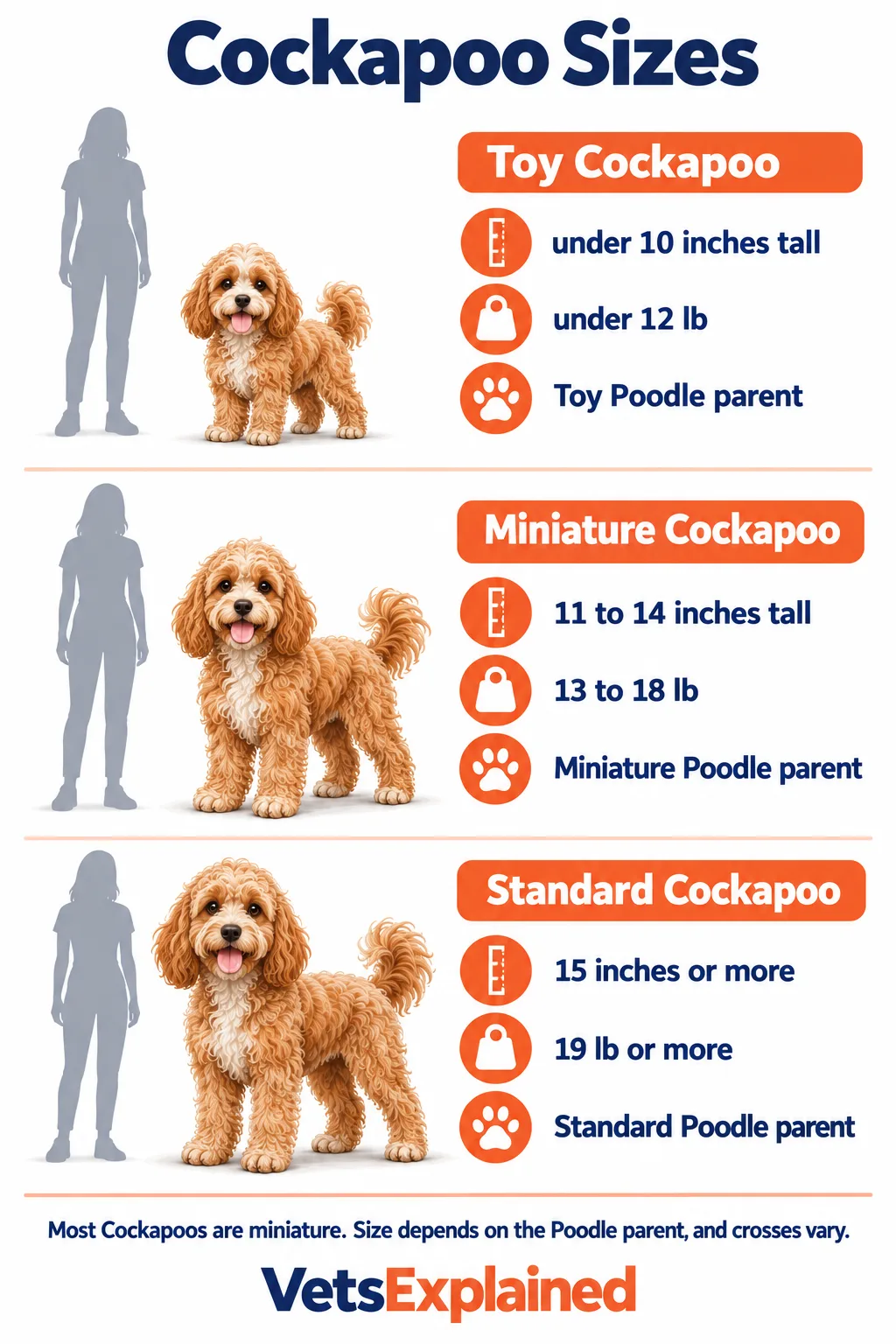
Weight bands vary between clubs and breeders, and a first-generation cross between a 28 lb Cocker and a 12 lb Miniature Poodle can produce puppies across the whole range. The Cockapoo Club of GB also points out that an F1 Cockapoo can end up an inch taller than either parent. Ignore marketing words such as "teacup" and "micro", which have no agreed definition and often describe runts or dogs bred from undersized Toy Poodles with their own health problems. Ask for the measured height and weight of both parents instead.
5What Does a Cockapoo Look Like?
Most Cockapoos are small, slightly longer than tall, with a soft rounded head, dark eyes, floppy ears and a tail carried level or above the back. Colours cover almost everything the parents carry: apricot, red, cream, white, chocolate, black, sable, roan, parti, phantom and merle. Many red and apricot Cockapoos fade to a paler shade by two or three years old. Merle is not a natural Cocker or Poodle colour and usually indicates another breed in the pedigree; breeding two merles together risks deaf and blind puppies, so treat a merle litter with caution.
6Cockapoo Coat Types

Coat matters more than colour because it decides how much the dog sheds and how much work it needs. Cockapoo coats fall into three broad groups, and all three can appear in one first-generation litter.
- Straight or flat coat: closest to the Cocker. Silky, with feathering on the ears, legs and belly. Sheds the most of the three and needs the least de-matting, but tangles behind the ears and in the feathering.
- Wavy coat: the "classic" Cockapoo look. Loose waves or soft ringlets, low to moderate shedding, and the coat most prone to matting if brushing is skipped.
- Curly coat: closest to the Poodle. Tight curls, very low shedding, and the highest grooming load, because shed hair stays trapped in the curls.
The adult coat often does not settle until the dog is 8 to 12 months old, when the soft puppy coat is replaced by the adult one. This "coat change" is when mats form fastest and when most owners first discover what they have signed up for.
7Do Cockapoos Shed?
Yes, to varying degrees. No Cockapoo is non-shedding. Straight-coated Cockapoos shed much like a Spaniel; wavy and curly coats shed little, but the loose hair comes out on the brush rather than the sofa. The Cockapoo Club of GB is explicit that coat types vary even between littermates and that shedding is possible in any generation.
If you need low shedding, choose a breeder who can show you the coats of previous litters from the same pairing, and consider an F1B (three-quarters Poodle) line, which tilts the odds towards a curly coat. It still does not guarantee one.
8Are Cockapoos Hypoallergenic?
No dog is truly hypoallergenic, Cockapoos included. People react to proteins in a dog's dander, saliva and urine, and every dog produces them. A low-shedding coat spreads less hair and attached dander around the house, which helps some allergic people a little and others not at all.
If allergy is the reason you are considering a Cockapoo, spend time with the specific puppy or adult dog, more than once and indoors, and discuss it with your doctor. Be wary of any breeder who guarantees an allergy-free puppy, because the Cockapoo's own breed clubs say that cannot be promised. Our guide to whether Doodles are hypoallergenic goes into the evidence.
9Cockapoo Temperament
Most Cockapoos are affectionate, playful, sociable and very people-focused. They want to be with you, they are usually enthusiastic about visitors, and they enjoy learning. Those are the traits that made the cross popular, and a well-bred, well-socialised Cockapoo lives up to them.
Common traits:
- Strong attachment to the family and a dislike of being alone
- Bright, quick to pick up cues, and food-motivated
- Lively and bouncy, especially between six months and two years
- A Spaniel's love of sniffing, carrying things and getting wet
- Sensitivity: Cockapoos tend to notice tone of voice and household tension
The research is more cautious than the reputation. In a 2026 Royal Veterinary College study of 9,402 UK dogs using the validated C-BARQ behaviour questionnaire, Cockapoos were compared with Cocker Spaniels and Poodles across 12 behaviour scales. Of the 24 comparisons, 16 showed a significant difference, and in every one of the 16 the Cockapoo scored worse. Compared with Cocker Spaniels, owners reported more owner-directed, stranger-directed and dog-directed aggression, more fear, more separation-related problems, more excitability and lower trainability. Compared with Poodles, Cockapoos scored higher for owner- and stranger-directed aggression, dog rivalry, non-social fear, separation problems and excitability. Of the three crosses studied, the Cockapoo showed the most undesirable behaviour; the Labradoodle showed the least.
Two cautions: the data are owners' reports, not observed behaviour, and the differences are averages across thousands of dogs, so plenty of individual Cockapoos are calm and easy. But the finding that a Cockapoo is not, on average, easier than a Cocker Spaniel or a Poodle points to the two things an owner controls: the breeder's choice of parents, and early socialisation.
Do Cockapoos bark a lot?
Cockapoos are moderately vocal. Both parents are alert, and a Cockapoo will usually announce the doorbell, the postman and the neighbour's cat. Persistent barking is most often a sign of boredom, excitement or distress at being left alone rather than a breed trait in itself. Teach a "quiet" cue early, reward calm behaviour around triggers, and make sure the dog has enough to do. A dog that starts barking at night or when alone in adulthood should be checked for pain, hearing loss or anxiety before it is treated as a training issue.
10Are Cockapoos Good Family Dogs?
Usually, yes, and the Cockapoo's size is one of its advantages: a 15 to 20 lb dog is far less likely to knock over a toddler than a Standard Labradoodle. Cockapoos tend to be playful and tolerant, and they enjoy a busy household.
Three things decide the fit:
Supervision. Small dogs are easily hurt by small children and may snap when cornered, squeezed or woken suddenly. The 2026 behaviour study's finding of higher owner-directed aggression in Cockapoos is a reason to teach children the rules early: no climbing on the dog, no disturbing it when eating or sleeping, and no chasing.
Energy. A young Cockapoo is bouncy and mouthy. Families with very young children sometimes underestimate the work of the first 18 months.
Company. Cockapoos do badly when left alone for long days. A family that is out from eight to six needs a plan.
A Cockapoo from well-chosen parents, socialised well and given company, is one of the best small family dogs available.
11Are Cockapoos Easy to Train?
Cockapoos are generally quick learners that enjoy reward-based training. The 2026 study found owners rated Cockapoos as less trainable than Cocker Spaniels on average, though not less than Poodles, so "easy" should not be taken for granted. Harsh handling backfires with this sensitive cross; a Cockapoo that is shouted at tends to shut down or become anxious rather than comply.
Start with name response, settle, recall (the Spaniel nose will lead the dog away), loose-lead walking, "drop" and "leave it", calm greetings, handling tolerance for ears, paws and brushing, and short periods alone.
Socialisation between roughly 3 and 14 weeks shapes the adult dog more than anything else, and the behaviour findings make it more important for Cockapoos, not less. Introduce people of all ages, calm dogs, traffic, car journeys, the vet's waiting room and grooming equipment, keeping each experience positive and short. A puppy that is overwhelmed learns fear, which is exactly the trait the study flagged.
12How Much Exercise Does a Cockapoo Need?
An adult Cockapoo needs around 45 to 60 minutes of activity a day, split into two outings, plus mental work at home. Working-Cocker crosses and Standard Cockapoos need more; a Toy Cockapoo needs somewhat less, but still a proper walk rather than a garden.
Good options:
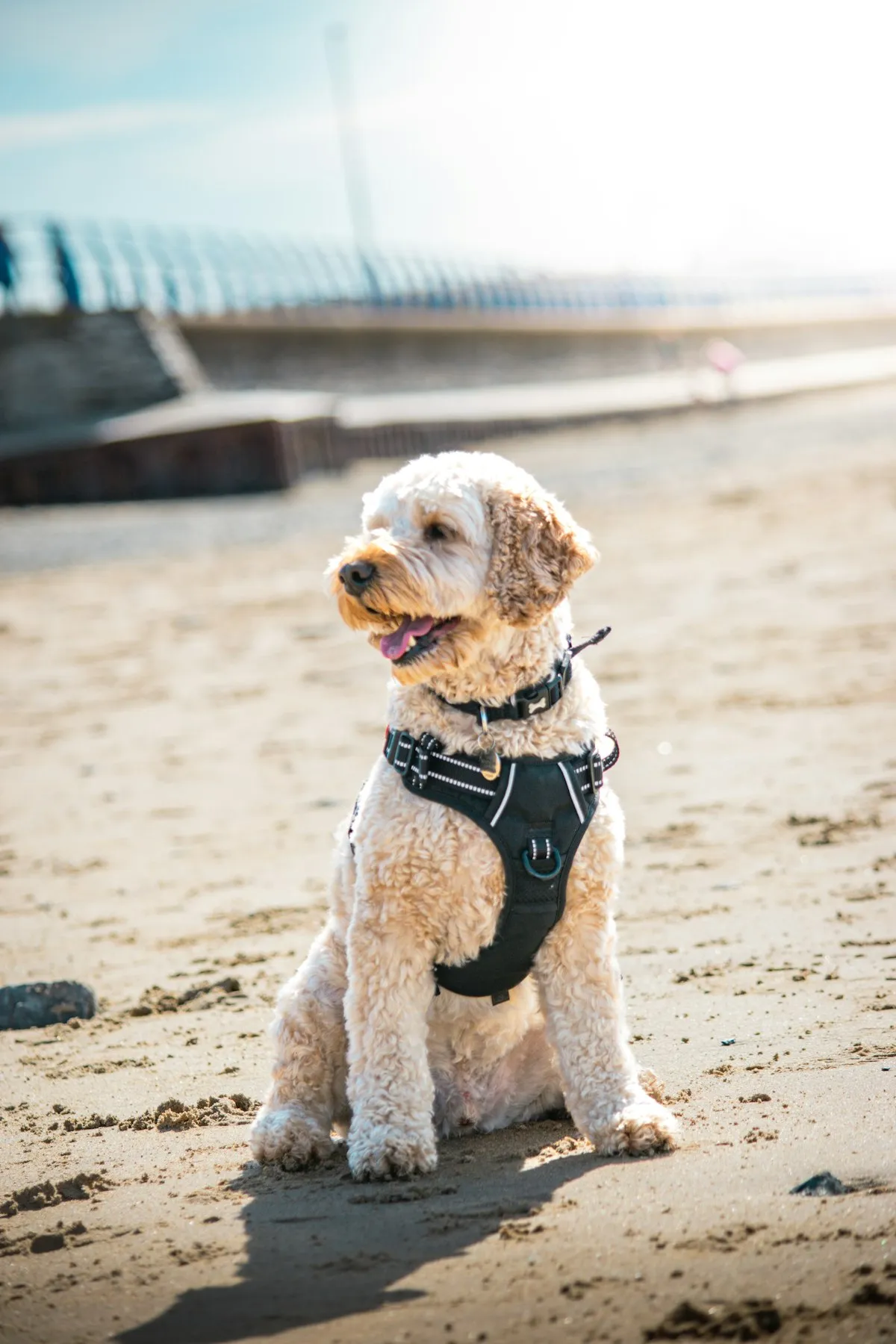
- Sniffing walks, which tire a Spaniel cross more than brisk mileage
- Retrieving and scent games, which both parents were bred for
- Short training sessions through the day
- Puzzle feeders and chews for rainy days
- Agility, hoopers or scent work for adults
Puppy exercise
Puppies should not be walked like adults. A common guide is five minutes of lead walking per month of age, twice a day, until the dog is fully grown at around 10 to 12 months. Avoid stairs, jumping from furniture and repetitive ball-throwing, which load growing joints and kneecaps.
13Cockapoo Grooming Requirements
Grooming is the part of Cockapoo ownership most people underestimate, and the reason so many Cockapoos arrive at the groomer matted to the skin and leave with a full shave-down.
A wavy or curly Cockapoo needs:
- Brushing to the skin three or four times a week, daily during the coat change at 8 to 12 months
- Combing after brushing with a metal comb, to find mats the slicker brush slides over
- Professional clipping every six to eight weeks
- Bathing every four to eight weeks, followed by thorough drying and brushing
- Nail trims every three to four weeks
- Ear checks weekly, and drying after every swim or bath
- Eye wiping daily for dogs with tear staining
- Tooth brushing daily if you can; small dogs are prone to dental disease
A straight-coated Cockapoo needs less de-matting but sheds more, and still needs ears, eyes, nails and teeth attended to.
How to brush a Cockapoo properly
Part the coat in small sections, brush from the skin outwards with a slicker, then run a metal comb through the same section; if the comb snags, there is a tangle to work out gently. Check behind the ears, under the collar, the armpits, inner thighs and between the toes. If you find tight mats against the skin, book a groomer rather than cutting them out: a short clip and a fresh start is kinder than de-matting. Our Doodle grooming guide goes through tools and techniques.
14Cockapoo Ear Care
Ear disease is the Cockapoo's best-documented health problem, and it deserves its own routine. Both parents are prone to ear infections: the Cocker Spaniel for its long, heavy, low-set ears and tendency to allergic skin disease, the Poodle for the hair that grows inside the ear canal. The Cockapoo gets both.
The figures bear this out. A 2021 Royal Veterinary College VetCompass study of 22,333 UK dogs found that 7.3 per cent had otitis externa (inflammation of the outer ear canal) in one year, and that Cockapoos had 2.22 times the odds of a crossbred dog, higher than the Cocker Spaniel's 1.67. Dogs with pendulous ears had 1.76 times the odds of dogs with erect ears. The 2024 study of Poodle crosses found the same pattern: Cockapoos had 2.13 times the odds of ear infection compared with Cocker Spaniels, and were the only one of the three crosses with higher odds than both parents in that comparison.
Practical care:
- Check ears weekly for redness, odour, discharge, head shaking or scratching
- Dry the ears after swimming or bathing
- Ask your groomer or vet whether the hair in the canal should be trimmed or plucked for your dog; opinion differs and it depends on the ear
- Never push cotton buds into the canal
- A smelly, painful or waxy ear needs a vet, not repeated home cleaning. The right treatment depends on what is growing in it, and chronic untreated otitis can narrow the canal permanently.
Because itchy skin (pruritus) was also markedly more common in Cockapoos than in Cocker Spaniels in the 2024 study, repeated ear infections in a Cockapoo are often a sign of an underlying allergy rather than a stand-alone problem. If the ears keep flaring, ask your vet about allergy work-up rather than just another course of drops.
15Cockapoo Health: What the Evidence Shows
For decades Cockapoos were sold on the promise of "hybrid vigour", the idea that crossing two breeds produces healthier dogs. The best evidence available does not support that claim, and it does not support the opposite either.
In 2024, the Royal Veterinary College published "The doodle dilemma" in PLoS One, an owner survey comparing the health of 1,856 Cockapoos with 2,237 Cocker Spaniels and 927 Poodles across 57 common disorders. The Cockapoo findings were:
- No difference from Cocker Spaniels for 49 of the 57 disorders (86 per cent), and no difference from Poodles for 45 of 57 (79 per cent).
- Compared with Cocker Spaniels, Cockapoos had lower odds of eye disorders, lameness, multiple lumps, wounds and dietary indiscretion, but higher odds of itchy skin (2.67 times), ear infections (2.13 times) and vomiting (1.41 times).
- Compared with Poodles, Cockapoos had lower odds of eye disorders, patellar luxation (roughly half the odds), food intolerance, weight loss and dental disease, but higher odds of swallowing foreign bodies, roundworm, anal sac problems, diarrhoea, dietary indiscretion, itchy skin and vomiting.
The authors concluded there was no strong evidence that Cockapoos are healthier than their parents, and none that they are less healthy. In plain terms, a Cockapoo is about as healthy as a Cocker Spaniel or a Poodle, and which problems it is prone to depends on which parent it takes after. The survey relied on owners' reports and unverified parentage, so the individual odds should be treated as indicative rather than exact.
Conditions to know about
- Ear infections (otitis externa): see above. The most common reason a Cockapoo sees a vet.
- Allergic skin disease: itchy skin, paw licking, recurrent ear and skin infections. Common on both sides, and the 2024 study found Cockapoos had more than double the odds of itchiness compared with Cocker Spaniels. Managed with diet trials, flea control, medicated washes and, often, long-term anti-itch medication.
- Progressive retinal atrophy (PRA): an inherited, painless degeneration of the retina that starts with night blindness and progresses to total blindness, usually from 3 to 7 years old. The common form, prcd-PRA, is autosomal recessive and occurs in both Cocker Spaniels and Miniature and Toy Poodles. A DNA test identifies clear, carrier and affected dogs; two carriers should never be bred together. There is no treatment, though blind dogs adapt well.
- Other eye disease: primary glaucoma, a painful rise in pressure inside the eye that can cause blindness within days, occurs in both American and English Cockers and is screened by gonioscopy under the BVA/KC eye scheme. Cataracts and retinal pigment epithelial dystrophy (RPED) also occur in Cockers. The 2024 study found Cockapoos had lower odds of eye disorders than either parent, which is encouraging, but a sudden red, cloudy or painful eye is always an emergency.
- Patellar luxation: the kneecap slips out of its groove, causing a characteristic skipping gait where the dog holds a hind leg up for a few strides. It is common in Toy and Miniature Poodles and other small breeds, and the OFA grades it from 1 (slips but returns) to 4 (permanently out). Cockapoos had about half the odds of Poodles in the 2024 study, but Toy and Miniature Cockapoos are still at risk. Mild cases are managed with weight control and muscle strengthening; higher grades need surgery.
- Hip dysplasia: an abnormal hip joint leading to arthritis. Less common in small dogs than large ones, but seen in Cocker Spaniels, whose UK breed median hip score is 10. See our guide to hip dysplasia in dogs.
- Familial nephropathy (FN): a fatal inherited kidney disease of English Cocker Spaniels that causes kidney failure between six months and two years of age. It is recessive, and a DNA test exists; UFAW notes that careful testing has reduced the number of affected dogs. An English-type Cockapoo from an untested Cocker is at risk.
- Phosphofructokinase (PFK) deficiency: an inherited enzyme defect of American Cocker Spaniels causing episodes of weakness, dark urine and anaemia after exertion. Recessive and DNA-testable.
- Von Willebrand disease: an inherited bleeding disorder in Poodles. DNA-testable.
- Dental disease: common in all small dogs. Daily brushing and regular dental checks matter more than in a larger Doodle.
- Immune-mediated disease, chronic pancreatitis and epilepsy: all reported at above-average rates in Cocker Spaniels, with no screening test. Know the signs of pancreatitis: vomiting, abdominal pain and loss of appetite.
How long do Cockapoos live?
Most Cockapoos live 12 to 15 years, and some reach 17 or 18. Published figures vary, partly because no registry tracks Cockapoos as a breed. Toy and Miniature Cockapoos generally outlive Standards, as smaller dogs usually do. Keeping the dog lean, brushing its teeth and treating ear and skin disease promptly are the things an owner can control.
16Health Testing Before Buying a Cockapoo Puppy
Because a Cockapoo can inherit problems from either parent, both parents should be tested for the conditions that matter in their own breed. "Vet-checked" is not health testing; it means a vet looked at a healthy-seeming dog. Ask to see certificates and check them against the registries (OFA in the US, BVA/KC schemes in the UK, or the Cockapoo Club of GB database).
For the Cocker Spaniel parent, the Cocker Spaniel Club recommends prcd-PRA and FN DNA tests for English Cockers, annual eye examination under the BVA/KC scheme including gonioscopy for glaucoma, and hip scoring. Working lines should also be tested for acral mutilation syndrome (AMS). For American Cockers, prcd-PRA and PFK DNA tests plus annual eye examination are the minimum.
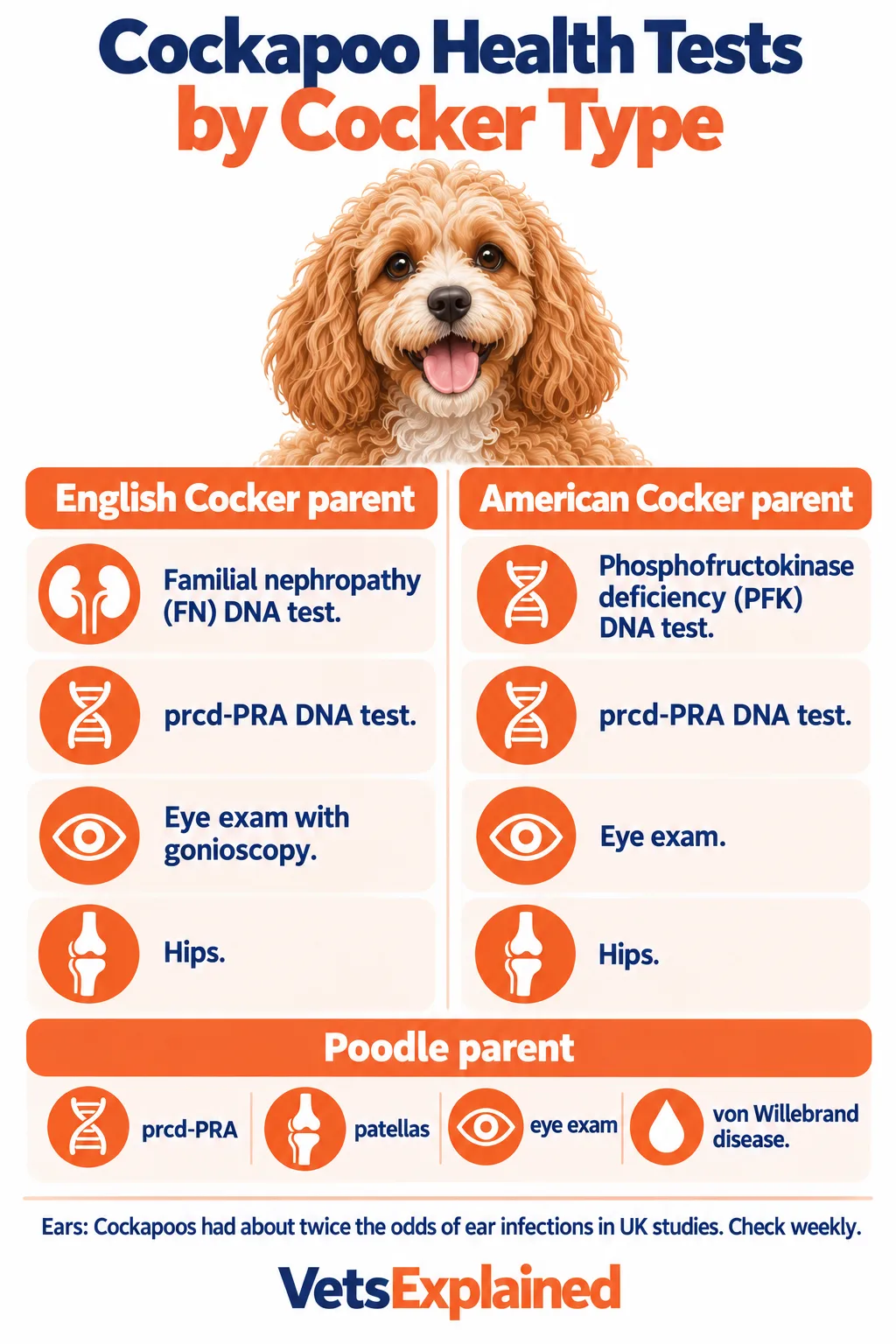
For the Poodle parent, the United Poodle Association lists prcd-PRA DNA testing, an eye examination and a patellar luxation evaluation as standard for Toy and Miniature Poodles, with von Willebrand disease DNA testing widely done.
The Cockapoo Club of GB requires its approved breeders to test for FN or PFK (depending on the Cocker type), prcd-PRA on both sides, von Willebrand disease on the Poodle side, and to hip score both parents, with annual eye examinations recommended. Breeders registered with such a scheme have at least shown their work.
Questions to ask a breeder
- Which type of Cocker Spaniel (American, English show, English working) and which size of Poodle are the parents?
- Which health tests have been done on each parent, and can I see the certificates?
- How tall and heavy is each parent, and what size have previous puppies reached?
- What coat type does each parent have, and what coats did previous litters produce?
- Can I meet the mother, and see where the puppies are being raised?
- How are the puppies being socialised before eight weeks?
- What generation is the litter, and what happens if I can no longer keep the dog?
A breeder with puppies available in every colour all year round is almost certainly a dealer, not a breeder. The Cockapoo's popularity has made it a favourite of puppy farms, and a poorly reared, under-socialised Cockapoo is exactly the dog that goes on to show the fear and aggression the behaviour research describes.
17F1, F1B, F2 and Multigenerational Cockapoos
- F1: Cocker Spaniel × Poodle. The Cockapoo Club of GB regards this as the most predictable cross, though coat type still varies within a litter.
- F1B: F1 Cockapoo × Poodle (or, less often, × Cocker). Three-quarters Poodle, so more likely to be curly and low-shedding, and more Poodle in size and temperament.
- F2: F1 × F1. The widest range of all; "throwbacks" that look fully Spaniel or fully Poodle can appear.
- F2B and multigenerational: Cockapoo × Cockapoo over several generations. Coat becomes more predictable, but inbreeding is a real risk in a cross with no studbook.
Generation labels describe ancestry, not outcomes. An F1B is more likely to shed little, but it is not guaranteed, and no generation is guaranteed to be allergy-friendly.
18What Should a Cockapoo Eat?
A Cockapoo needs a complete and balanced food for its life stage and size. The WSAVA Global Nutrition Guidelines recommend choosing a manufacturer that employs qualified nutritionists, runs feeding trials and can answer questions about its products; those basics matter more than the brand or the marketing.
Three points specific to Cockapoos:
- Small-breed formulas suit Toy and Miniature Cockapoos: smaller kibble and higher energy density for a small stomach.
- Cocker Spaniels are greedy, and most Cockapoos inherit the appetite. The 2024 study found Cockapoos had higher odds than Poodles of scavenging, swallowing foreign bodies, vomiting and diarrhoea. Measure meals, count treats within the daily total, and keep bins and counters out of reach.
- Allergy-prone dogs sometimes need a diet trial, which must be done properly under veterinary guidance over 8 to 12 weeks to mean anything.
Our feeding guide by life stage explains how much to feed as the dog grows.
19Can Cockapoos Be Left Alone?
Not for long, and this is the most common reason Cockapoos are given up. The 2026 behaviour study found more separation-related problems in Cockapoos than in either parent breed. An adult that has been taught gradually can usually manage four hours; a puppy cannot, and a dog that has never practised will not cope with a working day.
Build it from the first week: short absences while the dog is tired and settled, a safe resting space, something to chew, calm departures and returns, and a predictable routine. If an adult dog howls continuously, injures itself or destroys doors when left, that is separation-related distress and needs a vet or a qualified behaviourist, not more time to "get used to it". Day care, a dog walker or a family member at home are realistic requirements for many Cockapoo households.
20How Much Does a Cockapoo Cost?
Prices vary widely by country, region, breeder and generation, so treat these as rough guides.
- Puppy from a breeder: in the UK, typically 1,000 to 2,500 pounds in 2026, with prices having roughly doubled during the 2020 lockdown demand and only partly fallen since. In the US, commonly 1,500 to 3,500 dollars, more from breeders with full health testing and documented lines.
- Rescue: usually a few hundred pounds or dollars in adoption fees. Cockapoos aged one to three are common in rescue, often surrendered for separation problems and grooming costs. The Cockapoo Club of GB runs its own rescue.
- Ongoing: professional grooming at roughly 40 to 70 pounds or 60 to 100 dollars every six to eight weeks is the cost that surprises owners, plus food, insurance (ear and skin claims are frequent), routine vet care and training.
A very cheap Cockapoo puppy is a warning sign. Health testing, proper rearing and socialisation cost money, and a breeder who has skipped them has passed the risk to you.
21Cockapoo vs Cavapoo vs Cocker Spaniel
Cockapoo vs Cavapoo. The Cavalier King Charles Spaniel parent gives the Cavapoo a gentler, quieter, more sedentary temperament and a smaller average size, but also the Cavalier's serious heart disease (mitral valve disease) and syringomyelia risks. Cockapoos are livelier, need more exercise and are more prone to ear and skin disease. The 2024 health study compared both crosses and the 2026 behaviour study found Cavapoos showed fewer undesirable behaviours than Cockapoos. Our Cavapoo breed guide covers the other side of that comparison, and our Cavapoo vs Cockapoo comparison sets the two side by side.
Cockapoo vs Cocker Spaniel. A Cocker Spaniel gives you a recognised breed with a written standard, a long health-testing record and a known temperament, at the cost of a coat that sheds and still needs clipping. Given that the research shows the Cockapoo is neither healthier nor, on average, better behaved than the Cocker, people drawn to the Spaniel personality may be better served by a well-bred Cocker. People drawn mainly to the curly, low-shedding coat may be better served by a Miniature Poodle. The Cockapoo makes sense when you want something in between and have found a breeder who tests both parents.
22Cockapoo Pros and Cons
Potential advantages
- Affectionate, playful and people-focused
- Small enough for apartments and for older owners to handle
- Intelligent and usually enjoys training
- Low-shedding in wavy and curly coats
- Lower odds of eye disease than either parent, and of patellar luxation than Poodles, in the 2024 study
- A long track record: Cockapoos have been family pets since the 1950s
- Usually long-lived at 12 to 15 years
Potential challenges
- High grooming needs and professional grooming costs
- Ear infections at more than twice the odds of a crossbred dog
- Itchy, allergic skin at more than double the odds of a Cocker Spaniel
- Separation-related problems are common
- Coat, size and temperament vary within a litter
- Not shown to be healthier or easier than its parent breeds
- No recognised standard, so buyer research matters more
23Is a Cockapoo Right for You?
A Cockapoo suits you if you want a small, affectionate, lively dog that joins in with family life, you are home for much of the day or can arrange company, you can give it an hour of exercise and some mental work daily, and you will brush it several times a week and pay a groomer every couple of months for 12 to 15 years.
It is probably not the right dog if you work long days away from home, want something low-maintenance, need a guarantee of no shedding, or are hoping for a dog that is calmer or healthier than a Cocker Spaniel, because the evidence says it is neither.
Before you buy, ask yourself whether you can afford and manage the coat, the ears and the skin for the dog's whole life, whether someone is home for most of the day, whether you have seen health test results for both parents, and whether you know which Cocker type and Poodle size went into the litter.
If the answers are yes, a Cockapoo can be a wonderful companion, and many owners would not have any other dog.
24Final Thoughts
The Cockapoo is the grandparent of the Doodle family. It was being bred in America when the Labradoodle's creator was still at school, and the best examples show why it endured: a bright, affectionate, portable dog with a coat that many people find easier to live with.
What the research of the last two years has added is honesty. A Cockapoo is about as healthy as its parents, not healthier; it has a well-documented weakness in its ears and skin; and on average its behaviour is no easier than a Cocker Spaniel's or a Poodle's, and in several respects harder. None of that makes the Cockapoo a bad dog. It makes the breeder, the parents' health tests and the first four months of socialisation the things that decide whether yours is a good one.
For the wider picture on Poodle crosses, including how the Cockapoo compares with the Cavapoo, Labradoodle and Goldendoodle, read our complete Doodle Dog guide.
Sources
- Bryson GT, O'Neill DG, Brand CL, Belshaw Z, Packer RMA. The doodle dilemma: how the physical health of "designer-crossbreed" Cockapoo, Labradoodle and Cavapoo dogs compares to their purebred progenitor breeds. PLoS One. 2024;19(8):e0306350. pmc.ncbi.nlm.nih.gov
- Bryson GT, O'Neill DG, Belshaw Z, Brand CL, Packer RMA. Comparing undesirable behaviours between "designer" Poodle-cross dogs and their purebred progenitor breeds. PLoS One. 2026;21(3):e0342847. journals.plos.org
- O'Neill DG, Volk AV, Soares T, Church DB, Brodbelt DC, Pegram C. Frequency and predisposing factors for canine otitis externa in the UK: a primary veterinary care epidemiological view. Canine Medicine and Genetics. 2021;8:7. pmc.ncbi.nlm.nih.gov
- The Cockapoo Club of GB. What is a Cockapoo? cockapooclubgb.co.uk
- The Cockapoo Club of GB. Health testing. cockapooclubgb.co.uk
- The Cocker Spaniel Club (UK). Health. thecockerspanielclub.co.uk
- Universities Federation for Animal Welfare. Genetic welfare problems of companion animals: Cocker Spaniel, familial nephropathy. ufaw.org.uk
- The Kennel Club. DNA test: prcd-PRA (progressive retinal atrophy). thekennelclub.org.uk
- Orthopedic Foundation for Animals. Patellar luxation. ofa.org
- United Poodle Association. Health testing for puppy buyers. 2024. unitedpoodleassociation.org
- WSAVA Global Nutrition Committee. Global nutrition guidelines. wsava.org
Frequently Asked Questions
?What two breeds make a Cockapoo?
A Cockapoo is a Cocker Spaniel crossed with a Poodle. The Cocker may be American or English, show or working line, and the Poodle is usually a Toy or Miniature, which is why most Cockapoos weigh 10 to 20 lb. A Standard Poodle parent produces a larger "Maxi" Cockapoo.
?How big does a Cockapoo get?
Toy Cockapoos are under about 11 inches and 12 lb, Miniatures 11 to 15 inches and 12 to 20 lb, and Standards up to 18 inches and 20 to 30 lb or more. The measured size of both parents predicts a puppy's adult size better than any label.
?Do Cockapoos shed?
Yes, to varying degrees. Straight-coated Cockapoos shed much like a Spaniel, while wavy and curly coats shed little and need brushing instead. No Cockapoo is non-shedding, and the adult coat type is often not clear until 8 to 12 months old.
?Are Cockapoos hypoallergenic?
No dog is truly hypoallergenic. Low-shedding Cockapoos spread less dander, which helps some allergic people and not others. Spend time with the individual dog before committing, and do not rely on a breeder's guarantee, which the Cockapoo clubs themselves say cannot be given.
?How long do Cockapoos live?
Most live 12 to 15 years, and some reach 17 or 18. Smaller Cockapoos tend to live longer than Standards. Keeping the dog lean, caring for its teeth and treating ear and skin problems early make the biggest difference an owner can control.
?Do Cockapoos bark a lot?
Moderately. They are alert and will announce visitors, but persistent barking usually means boredom, over-excitement or distress at being alone. Daily exercise, mental work, a "quiet" cue and gradual alone-time training prevent most problems.
?Are Cockapoos good for first-time owners?
They can be, provided the owner is home for much of the day and prepared for the grooming. A 2026 study found Cockapoos showed more fear, excitability and separation problems than their parent breeds on average, so choose a breeder who health tests and socialises puppies well, and start training early.
?What health problems do Cockapoos have?
Ear infections and itchy, allergic skin are the most common. Inherited conditions to test for include progressive retinal atrophy, familial nephropathy (English Cocker side), PFK deficiency (American Cocker side), patellar luxation and glaucoma. A 2024 study found Cockapoo health otherwise similar to the parent breeds.
?Is a Cockapoo healthier than a Cocker Spaniel?
No. A 2024 Royal Veterinary College study of 1,856 Cockapoos found no difference from Cocker Spaniels for 49 of 57 disorders, lower odds for five and higher odds for three, including ear infections and itchy skin. The parents' health testing matters far more than the cross.
?What is the difference between an American and an English Cockapoo?
An American Cockapoo has an American Cocker Spaniel parent: smaller, with a rounder head and softer coat. An English Cockapoo has an English Cocker parent and is usually a little larger and heavier in coat; working-line English Cockapoos are leaner and more energetic. The health tests differ too, with FN for English and PFK for American Cockers.
Help us do better!
Was this article helpful and relevant?
Thanks for your feedback!
About Sofia Marin
Sofia Marin is VetsExplained's senior editor. She has edited pet and consumer titles for fifteen years and is responsible for the site's editorial standards and breed coverage.
View all posts by Sofia Marin →