Goldendoodle Dog Breed Guide: Temperament, Size, Grooming, Health and Care
 Written by Sofia Marin
 Fact checked by Dr. Tomas Ellery, DVM
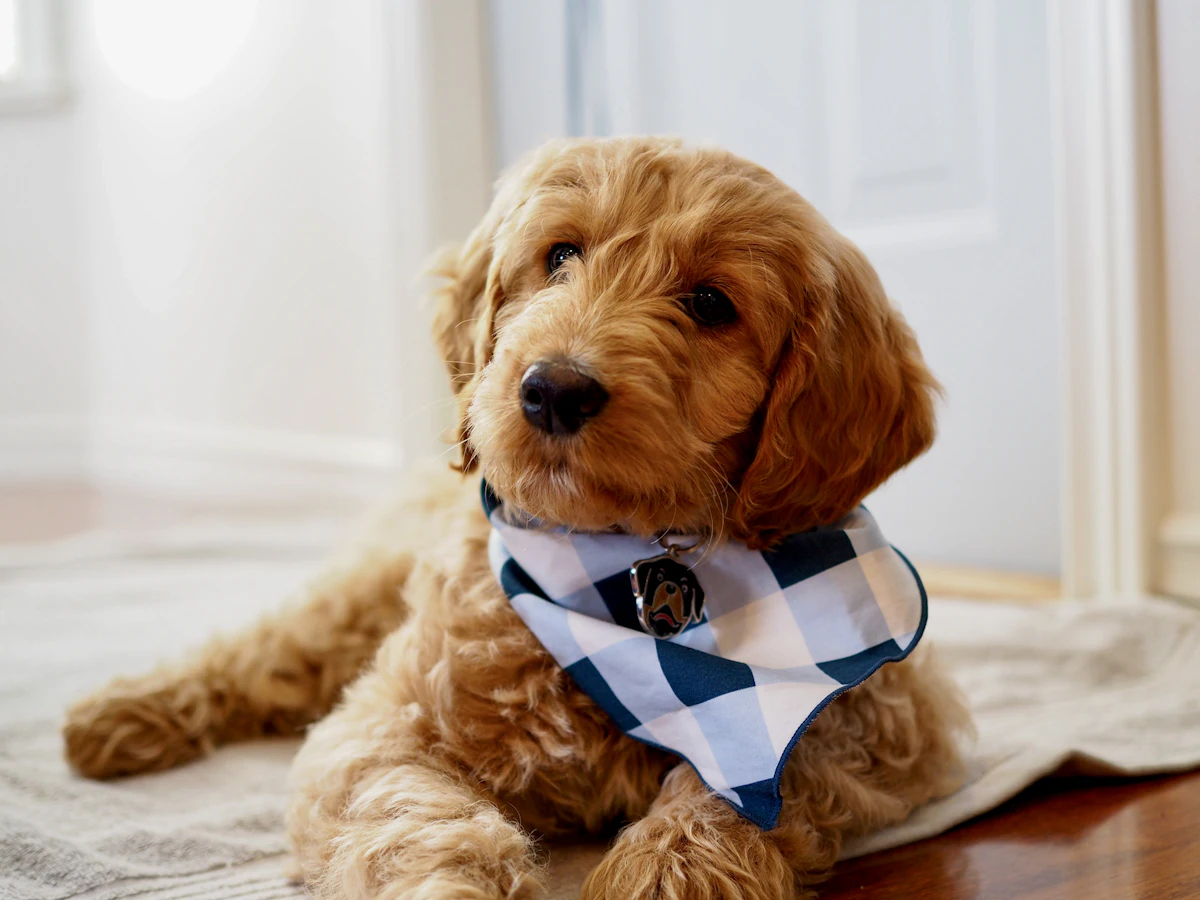
A Goldendoodle is a Golden Retriever crossed with a Poodle. Most are intelligent, active and people-oriented, but size (petite mini to standard), coat, shedding and temperament vary from dog to dog, so judge the individual puppy and its health-tested parents rather than the label.
The information is current and up-to-date in accordance with the latest veterinary research. Learn more »
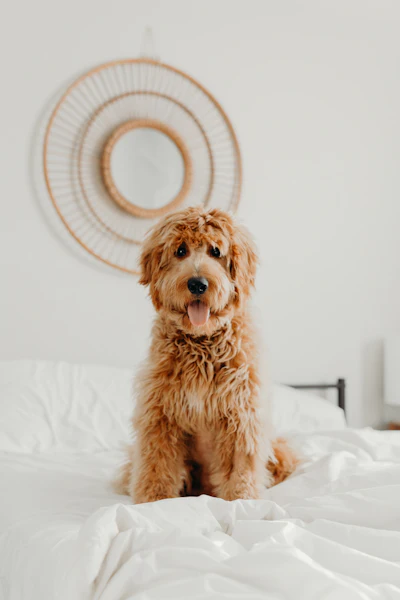
Goldendoodles are friendly-looking, curly or wavy-coated dogs created by crossing a Golden Retriever with a Poodle. Their affectionate appearance and reputation for intelligence have made them one of the best-known Doodle dogs.
But Goldendoodles are not all alike.
Depending on their parents, a Goldendoodle can be small or large, have a straight, wavy or tightly curled coat, shed very little or noticeably, and inherit different personality traits from either side of its family.
If you're considering a Goldendoodle, understanding this variation is more important than choosing one simply because of its fluffy "teddy bear" appearance.
This Goldendoodle dog breed guide explains their temperament, size, coat, grooming requirements, exercise needs, training, health considerations and what prospective owners should know before bringing one home.
Key Takeaways
- A Goldendoodle is a Golden Retriever and Poodle cross, so size, coat, shedding and temperament vary even within one litter.
- Ask for the height and weight of both parents; labels like mini and petite are not standardised.
- No Goldendoodle is guaranteed non-shedding or hypoallergenic. Spend time with the individual dog first.
- Wavy and curly coats need thorough brushing several times a week plus regular professional grooming.
- Insist on documented health tests for hips, elbows, eyes, heart and patellas before buying a puppy.
1Goldendoodle at a Glance
The table below is a quick summary. The rest of this guide explains each point and where individual dogs differ.
- Parent breeds: Golden Retriever × Poodle
- Size: Petite/mini to standard
- Coat: Straight, wavy or curly
- Common colours: Cream, gold, apricot, red, brown, black and combinations
- Shedding: Low to moderate; varies by dog
- Grooming: Moderate to high
- Exercise needs: Moderate to high
- Trainability: Generally high
- Family suitability: Often good for active families
- First-time owners: Can be suitable if grooming and exercise needs are understood
- Temperament: Often social, intelligent and affectionate, but individual dogs vary
2What Is a Goldendoodle?
A Goldendoodle is a dog developed from Golden Retriever and Poodle ancestry.
The Goldendoodle belongs to the broader group commonly called Doodle dogs, which includes Labradoodles, Cockapoos, Cavapoos, Bernedoodles and other Poodle crosses.
If you are new to these dogs, read our Doodle Dog guide first to understand how Poodle crosses differ from standardized pure breeds.
Unlike a dog produced from generations of one established breed, a Goldendoodle can inherit different combinations of characteristics from its Golden Retriever and Poodle ancestry.
Traits that can differ between individual Goldendoodles include:
- adult size
- coat texture
- shedding
- colouring
- energy level
- behaviour
- grooming requirements
- potential inherited health risks
Even puppies from the same litter may not grow into identical-looking or identical-behaving adults.
3Goldendoodle Size
One reason Goldendoodles vary so much is that Poodles themselves come in different sizes.
A Golden Retriever crossed with a Standard Poodle can produce a very different adult dog from one with Miniature Poodle ancestry.
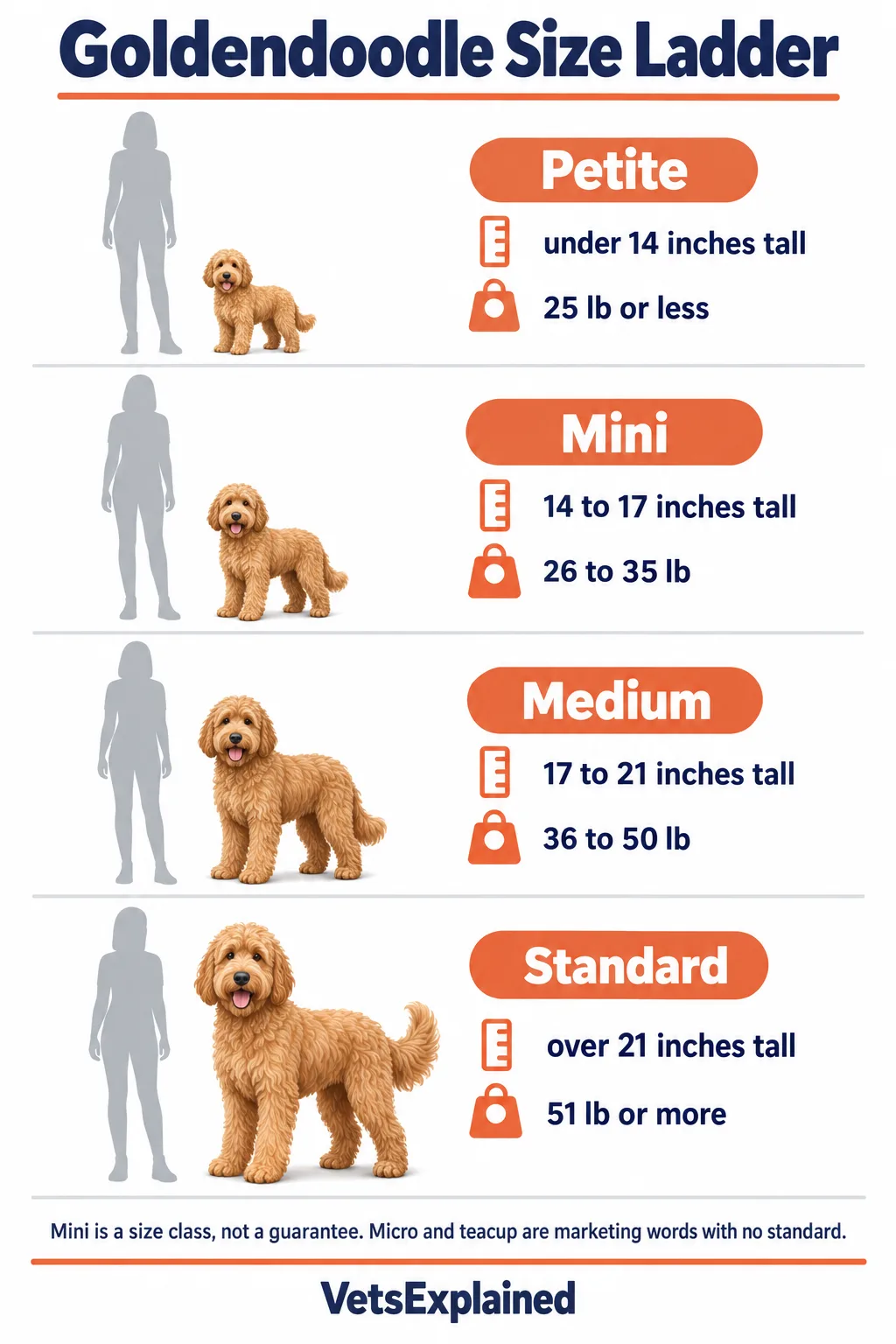
- Petite Mini Goldendoodle: under 14 inches tall at the shoulder, usually 25 lb or less
- Mini Goldendoodle: over 14 to under 17 inches tall at the shoulder, about 26-35 lb
- Medium Goldendoodle: over 17 to under 21 inches tall at the shoulder, about 36-50 lb
- Standard Goldendoodle: over 21 inches tall at the shoulder, usually 51 lb or more
These are guidelines rather than guarantees. The size of both parents is one of the best clues to a puppy's likely adult size, but crossbred puppies can still develop differently.
Mini Goldendoodle
A Mini Goldendoodle generally has Miniature Poodle ancestry and is bred to produce a smaller companion than the standard version.
"Mini," however, does not automatically mean tiny. Prospective owners should ask for the actual height and weight of both parents rather than relying only on terms such as:
- mini
- petite
- micro
- medium
- standard
These labels can sometimes be used differently by different breeders.
4What Does a Goldendoodle Look Like?
Goldendoodles are often recognized by their shaggy faces, floppy ears and soft-looking coats. However, there is no single Goldendoodle appearance.
A dog may inherit more of the broad, retriever-like appearance of the Golden Retriever or display stronger Poodle characteristics.
Common Goldendoodle colours include:
- cream
- golden
- apricot
- red
- brown
- chocolate
- black
- white
- parti-coloured combinations
Coats may be relatively straight, loose and wavy, or tightly curled. This genetic variety is part of the appeal of Goldendoodles, but it also means owners should avoid expecting a puppy to look exactly like a particular photograph found online.
5Goldendoodle Coat Types
Straight Coat
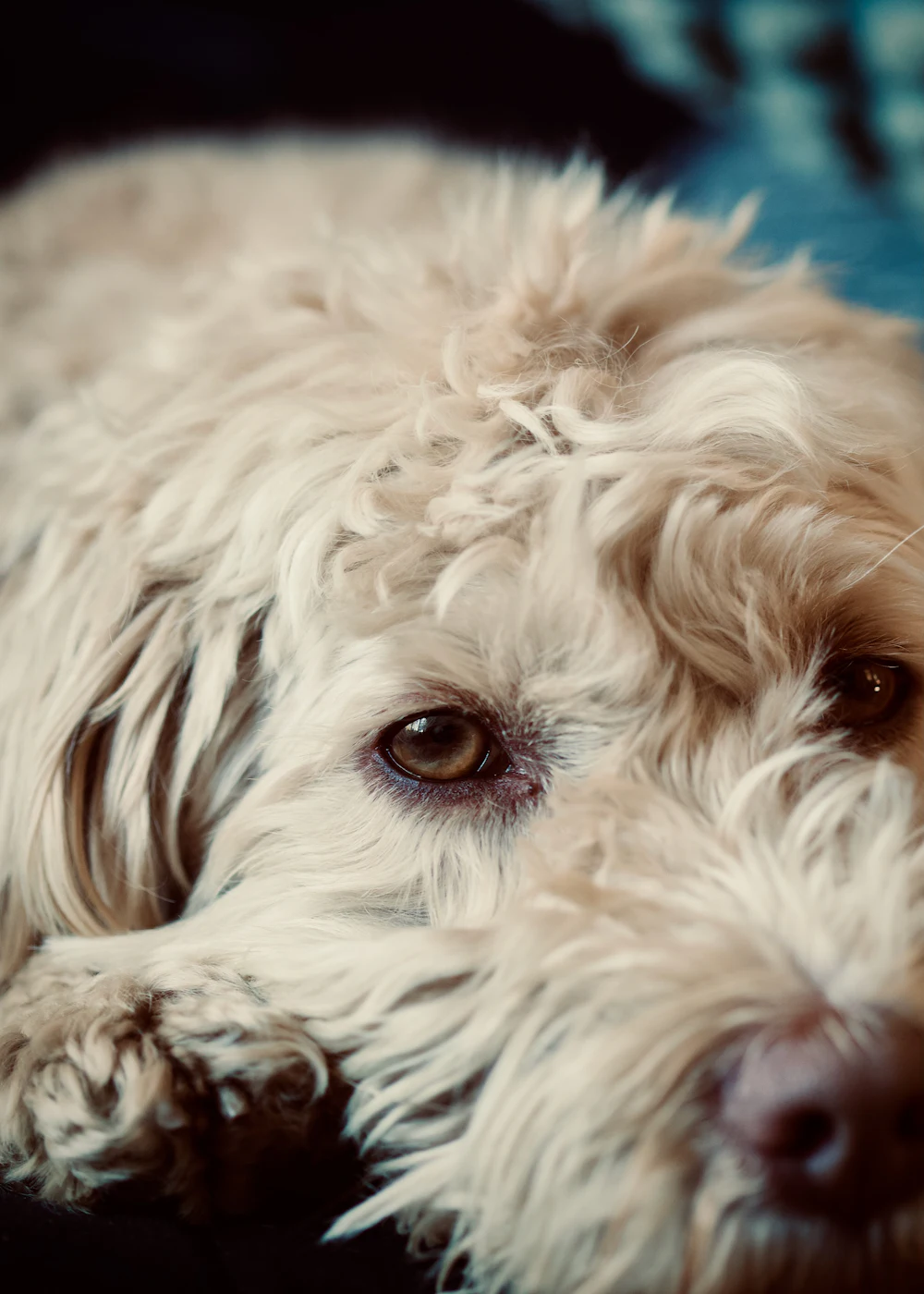
A straighter coat may resemble the Golden Retriever side more closely. These dogs can have looser hair, less curl, a more retriever-like appearance and potentially more noticeable shedding. A straight coat does not mean the dog will necessarily be easier to groom.
Wavy or Fleece Coat
The wavy coat creates the classic shaggy appearance many people associate with Goldendoodles. It generally falls somewhere between the coats of the Golden Retriever and Poodle.
Wavy coats can easily:
- tangle
- mat
- trap debris
- require frequent brushing
- shed to varying degrees
Curly Coat
A curly Goldendoodle coat tends to resemble a Poodle more closely. These dogs may shed less visibly than straighter-coated individuals, but curly coats can require substantial maintenance because loose hair can remain trapped within the curls.
6Do Goldendoodles Shed?
Yes, Goldendoodles can shed. The amount varies.
Some Goldendoodles shed very little, while others may shed considerably more. A Poodle-heavy coat can make low shedding more likely, but no breeder can responsibly guarantee that every Goldendoodle puppy will be completely non-shedding.
This is particularly important for owners choosing a Goldendoodle specifically because they do not want dog hair around the home. Coat genetics are more complicated than simply saying: Poodle parent = non-shedding puppy.
7Are Goldendoodles Hypoallergenic?
Goldendoodles are frequently described as hypoallergenic, but that term can be misleading.
People with dog allergies can react to proteins found in dander, saliva and urine, not simply loose hair.
A low-shedding coat may reduce the amount of hair released around the home, but it does not guarantee that a person with allergies will not react to the dog.
If allergies are an important consideration, spend meaningful time around the individual dog before adoption and discuss significant allergies with an appropriate medical professional. Never purchase a puppy solely because someone promises that it is "100% hypoallergenic."
8Goldendoodle Temperament
Many Goldendoodles are affectionate, social and enthusiastic companions. That makes sense when considering their ancestry.
Golden Retrievers and Poodles were both developed to work closely with people, and characteristics commonly seen in Goldendoodles can include:
- intelligence
- enthusiasm
- affection
- playfulness
- sociability
- curiosity
- eagerness to interact
- interest in retrieving
However, temperament is influenced by more than breed ancestry. It also depends on genetics, parent temperament, early experiences, socialisation, training, environment, physical health and individual personality.
So while a Goldendoodle can be an excellent companion, buying one does not guarantee a perfectly social, calm or easy-to-train dog.
9Are Goldendoodles Good Family Dogs?
Goldendoodles can be very good family companions when their temperament, size and activity level fit the household. They often enjoy participating in family life rather than being left alone for extended periods.
Size
A Standard Goldendoodle may be strong and energetic enough to accidentally knock over a small child during enthusiastic play.
Energy
Young Goldendoodles can be lively and may need considerable physical and mental activity.
Training
Polite behaviour around children does not develop automatically. Dogs need to learn skills such as:
- not jumping
- settling calmly
- giving up objects
- walking politely
- responding to recall
- respecting boundaries
Supervision
Young children and dogs should always be appropriately supervised together regardless of breed.
Teach children to:
- do not pull ears or tails
- do not climb on the dog
- do not disturb a sleeping dog
- do not interfere while the dog is eating
- do not corner a dog that wants space
Choosing a good family dog requires evaluating the individual dog's temperament, not simply selecting a popular breed name.
10Are Goldendoodles Good With Other Dogs?
Many Goldendoodles enjoy interacting with other dogs. Early positive social experiences can help them develop appropriate communication and confidence.
But being a Goldendoodle does not automatically make a dog friendly with every animal. Individual dogs may be outgoing, cautious, excitable, selective, nervous or overly enthusiastic. Introductions should therefore be managed carefully.
11Are Goldendoodles Intelligent?
Both Golden Retrievers and Poodles have histories as working dogs, so many Goldendoodles are quick learners. That can make training enjoyable.
It also creates another requirement: intelligent dogs need something constructive to do.
Without enough to do, a Goldendoodle may turn to:
- stealing household objects
- chewing
- digging
- attention-seeking
- excessive excitement
- barking
Mental enrichment should therefore be considered part of routine care.
12Are Goldendoodles Easy to Train?
Many Goldendoodles respond very well to reward-based training. Start early with practical household behaviours such as:
- name response
- recall
- loose-lead walking
- sit
- settle
- leave it
- drop
- polite greetings
- handling tolerance
- grooming tolerance
- being comfortable alone for reasonable periods
Training should not involve only obedience commands. A Goldendoodle puppy should also gradually experience the world in positive, controlled ways.
Positive, gradual exposure should include:
- different people
- appropriate dogs
- household noises
- traffic
- veterinary handling
- grooming equipment
- different surfaces
- car journeys
- unfamiliar environments
Early socialisation should build confidence rather than overwhelm the puppy.
13How Much Exercise Does a Goldendoodle Need?
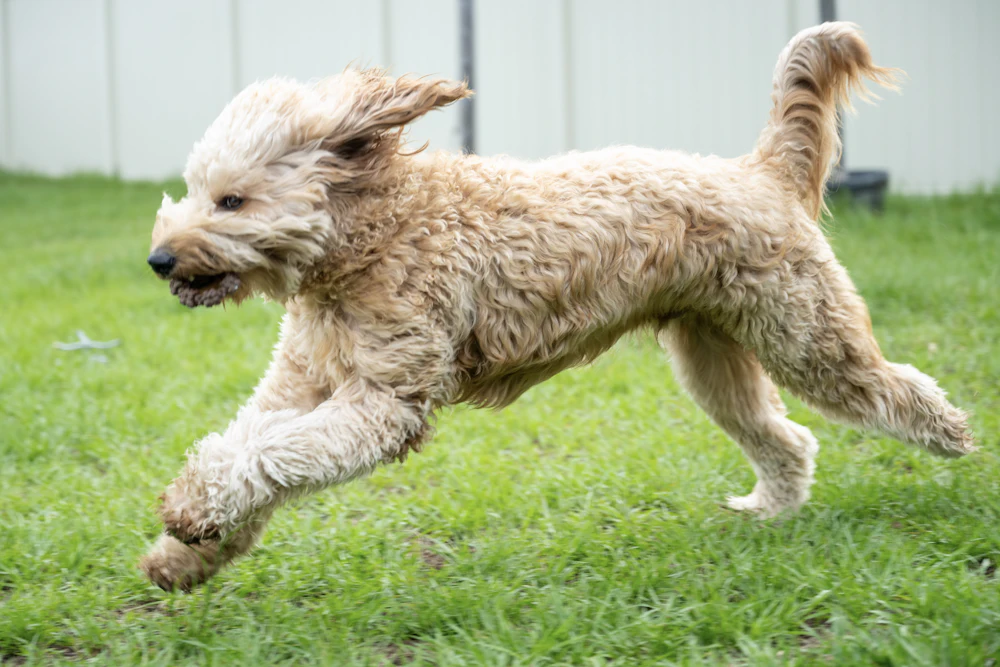
Goldendoodles tend to be active dogs, especially when young. Their exercise requirements depend on age, size, health, genetics and individual energy level.
Daily physical activity is important, but exercise should involve more than simply walking the same route.
Good ways to exercise a Goldendoodle include:
- sniffing walks
- retrieving games
- scent work
- puzzle feeders
- training sessions
- appropriate swimming
- controlled play
- hiking for physically mature dogs
- canine sports
Mental exercise can sometimes tire an intelligent dog more effectively than simply adding another fast walk.
Goldendoodle Puppy Exercise
Puppies are still developing. Avoid assuming a puppy needs the same exercise duration or intensity as an adult dog.
Rather than focusing on exhausting the puppy, prioritise short exploration, play, age-appropriate training, enrichment, sleep and positive socialisation. Ask your veterinarian for advice if you are uncertain about appropriate exercise during growth.
14Goldendoodle Grooming Requirements
This is one area where prospective owners often underestimate Goldendoodles. A fluffy, low-shedding-looking coat is not a low-maintenance coat.
Hair can tangle particularly easily around:
- behind the ears
- neck
- collar area
- armpits
- legs
- paws
- tail
- chest
Mats can eventually tighten against the skin and become uncomfortable.
Goldendoodle Grooming Schedule
A practical routine might look like:
- Daily or every few days: check high-friction areas for tangles.
- Several times per week: thoroughly brush and comb the coat down to the skin.
- Weekly: check ears, teeth, paws, nails and skin.
- As required: bathe using appropriate dog products.
- Regular professional grooming: longer or curlier coats generally require professional trimming on an ongoing schedule.
Exact frequency depends on coat texture, coat length, lifestyle, owner's preferred style and how thoroughly the coat is maintained at home.
15How to Brush a Goldendoodle Correctly
Running a brush only across the surface can leave tangles close to the skin. Instead, work through the coat methodically in small sections.
Useful grooming tools include:
- slicker brush
- metal comb
- appropriate detangling product
- nail clippers or grinder
- dog toothbrush
- dog-safe toothpaste
After brushing a section, a comb should be able to move through the hair without becoming caught. If matting is severe or close to the skin, consult a professional groomer rather than attempting painful de-matting at home.
16Goldendoodle Ear Care
Goldendoodles commonly have floppy, hair-covered ears. Regularly check for:
- redness
- strong odour
- discharge
- excessive wax
- persistent scratching
- head shaking
- signs of discomfort
Do not repeatedly put cleaning solutions or home remedies into a painful ear without knowing what is causing the problem. Ear infections require veterinary assessment because different causes may need different treatment.
17Goldendoodle Dental Care
Dental care is another important part of routine ownership. Regular tooth brushing using dog-safe toothpaste is one of the most useful habits owners can establish.
Never use human toothpaste unless a veterinarian specifically tells you a product is safe for dogs. Introduce tooth brushing gradually and positively while the dog is young whenever possible.
18Goldendoodle Health Considerations
Crossbreeding does not automatically eliminate inherited health problems. A Goldendoodle can inherit health risks associated with either Golden Retriever or Poodle ancestry.
Potential areas breeders and owners should pay attention to include:
- hips (hip dysplasia occurs in both Golden Retrievers and Standard Poodles)
- elbows
- eyes
- heart
- patellas
- inherited eye disorders
- certain inherited genetic conditions
The exact risk differs according to the dog's ancestry, size and genetic background. This is why health screening of breeding dogs matters.
19Health Testing Before Buying a Goldendoodle Puppy
Do not accept "The parents are healthy" as a substitute for documented health testing. Ask to see the actual results.
Responsible breeding programs may screen hips, elbows, eyes, heart, patellas and relevant inherited genetic conditions depending on ancestry and size.
Ask a Breeder These Questions
- What health tests have been performed on the mother?
- What health tests have been performed on the father?
- Can I see the official results?
- What size are both parents?
- What are their temperaments like?
- Why were these particular dogs selected for breeding?
- Can I meet the mother?
- Where are the puppies raised?
- How are the puppies socialised?
- What veterinary care have they received?
- What happens if I can no longer keep the dog?
- What support will you provide after purchase?
A responsible breeder should be more interested in finding suitable homes than making an immediate sale.
20F1, F1B and F2 Goldendoodles Explained
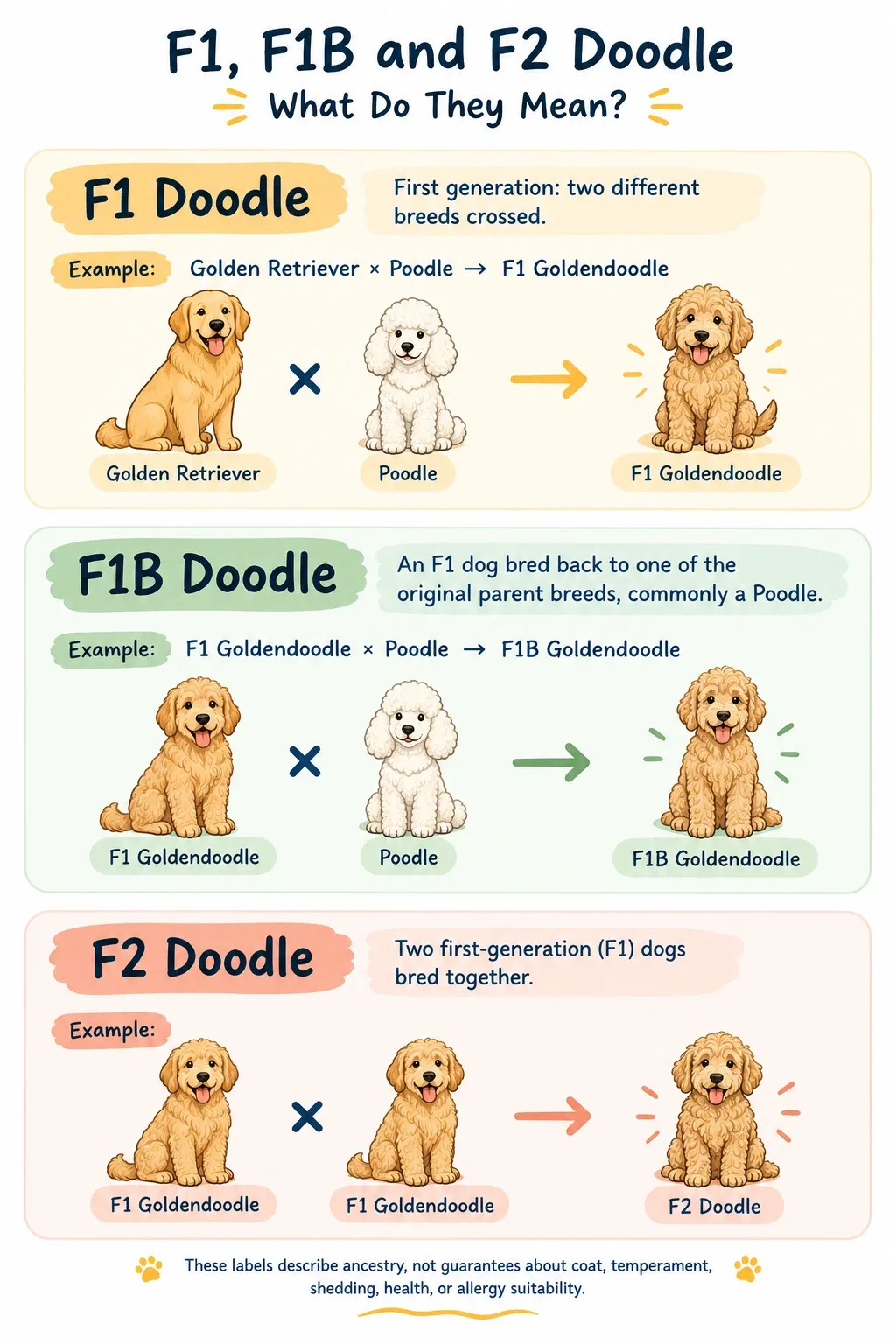
F1 Goldendoodle
Typically: Golden Retriever × Poodle. This is the first-generation cross.
F1B Goldendoodle
Typically: F1 Goldendoodle × Poodle. Some breeders use this generation when aiming for stronger Poodle coat characteristics.
F2 Goldendoodle
Typically: F1 Goldendoodle × F1 Goldendoodle.
There are also additional multigenerational terms. However, generation labels should not be interpreted as absolute guarantees of coat texture, shedding, allergy suitability, temperament, adult size or health. Look at the actual dogs and health information rather than choosing solely based on generation terminology.
21What Should a Goldendoodle Eat?
Goldendoodles should receive a complete and balanced diet appropriate for their life stage, body size and health needs.
Food choice should consider:
- age
- adult-size expectation
- body condition
- activity
- health conditions
- veterinary advice
Portion recommendations on a food package are starting points rather than perfect prescriptions for every dog. Our feeding guide by life stage explains how to set and adjust portions. Monitor your dog's body condition and adjust food appropriately with veterinary guidance. Treats should also be counted as part of total calorie intake.
22Goldendoodle Weight Management
Maintaining an appropriate body condition matters throughout a Goldendoodle's life. Excess weight increases stress on the body, especially the hips and elbows, and can make exercise more difficult. For older or arthritic dogs, a supportive orthopedic bed takes pressure off sore joints overnight.
Rather than judging healthy weight only by the number on a scale, learn to assess body condition. You should generally be able to:
- feel the ribs without pressing through a thick layer of fat
- see a waist when looking from above
- notice an abdominal tuck from the side
Ask your veterinarian to show you how to use a canine body-condition scoring system.
23Can Goldendoodles Be Left Alone?
Goldendoodles are often highly people-oriented dogs. Some individuals may struggle when suddenly expected to spend long periods alone.
Teach independence gradually from puppyhood. Useful habits include:
- short periods apart while you are home
- calm departures
- safe resting areas
- enrichment
- predictable routines
- gradually increasing alone time
If a dog panics when left alone, destroys escape points, howls continuously, salivates excessively or injures itself, seek professional veterinary or qualified behavioural advice. This is different from simple boredom.
24Do Goldendoodles Bark a Lot?
Barking varies considerably. A Goldendoodle may bark because of excitement, unfamiliar visitors, frustration, boredom, fear, separation distress, environmental sounds or learned attention-seeking.
Rather than asking whether Goldendoodles "are barkers," identify why an individual dog is barking. Training, appropriate stimulation and environmental management can help with many common causes.
25Are Goldendoodles Good for First-Time Dog Owners?
They can be. A Goldendoodle may suit a first-time owner who is prepared for:
- consistent training
- frequent grooming
- professional grooming expenses
- daily activity
- mental stimulation
- social interaction
- veterinary costs
They may be less appropriate for someone looking for an extremely low-maintenance dog. Their friendly appearance sometimes causes prospective owners to underestimate how much time grooming and training can require.
26Goldendoodle Pros and Cons
Potential advantages
- Often affectionate
- Usually intelligent
- Often highly trainable
- Can be excellent active companions
- Different size options
- Often enjoys family activities
- Can enjoy training and dog sports
Potential challenges
- Grooming can be demanding
- Professional grooming adds ongoing cost
- Coat and shedding are not fully predictable
- Young dogs may be very energetic
- Adult size can vary
- May dislike long periods alone
- Health testing of both parent lines matters
27Is a Goldendoodle Right for You?
A Goldendoodle may be a good fit if you want an interactive dog and can provide companionship, training, exercise, enrichment, frequent grooming, veterinary care and financial commitment.
Before adopting or buying one, ask yourself:
- Can I manage the coat?
- Can I afford grooming throughout the dog's life?
- Do I have enough time for exercise and training?
- Can I cope if my puppy grows larger than expected?
- Am I choosing based on temperament and health rather than appearance?
- Have the parents received appropriate health screening?
If the answers are yes, a Goldendoodle can be a rewarding companion.
28Final Thoughts
Goldendoodles combine ancestry from two intelligent and people-oriented dogs: the Golden Retriever and the Poodle.
That combination can produce affectionate, energetic and highly trainable companions, but it also produces considerable variation.
That variation shows up in:
- size
- coat
- shedding
- temperament
- exercise requirements
- grooming needs
These cannot be predicted perfectly from the word "Goldendoodle" alone.
Before choosing one, investigate both parents, verify health testing, understand the grooming commitment and consider whether the dog's likely activity level fits your household.
Choose health and temperament before coat colour, size labels or social-media appearance.
For a broader explanation of Poodle crosses, read our complete Doodle Dog guide next.
Frequently Asked Questions
?What breeds make a Goldendoodle?
A Goldendoodle is developed from Golden Retriever and Poodle ancestry.
?Is a Goldendoodle a Poodle?
No. A Goldendoodle has Poodle ancestry combined with Golden Retriever ancestry.
?Do Goldendoodles shed?
They can. Some shed very little, while others shed noticeably. Coat genetics differ between individual dogs.
?Are Goldendoodles hypoallergenic?
No Goldendoodle should be guaranteed as completely hypoallergenic. Low shedding does not mean a dog produces no allergens.
?How big does a Goldendoodle get?
Size varies from small Goldendoodles with Miniature Poodle ancestry to large Standard Goldendoodles. Parent size provides a better indication than marketing labels alone.
?Are Goldendoodles good with children?
Many can be excellent family companions, but suitability depends on the individual dog's temperament, socialisation, training, size and energy level. Children and dogs should be supervised appropriately.
?Are Goldendoodles easy to train?
Many respond well to positive, reward-based training because both parent breeds are intelligent and accustomed to working with people.
?Do Goldendoodles need professional grooming?
Many do. Wavy and curly coats can mat if not maintained properly, and regular professional grooming may be necessary in addition to home brushing.
?How often should you brush a Goldendoodle?
Many Goldendoodles benefit from thorough brushing several times per week, with curlier or longer coats potentially needing attention most days.
?What is the difference between an F1 and F1B Goldendoodle?
An F1 Goldendoodle is generally a Golden Retriever crossed with a Poodle. An F1B is generally an F1 Goldendoodle bred back to a Poodle.
?Are Mini Goldendoodles easier to care for?
Not necessarily. A smaller dog may require less space, but Mini Goldendoodles can still have significant grooming, training, exercise and veterinary needs.
?Are Goldendoodles good apartment dogs?
Some can live successfully in apartments if their exercise, enrichment and training needs are consistently met. Size alone does not determine whether a dog can live comfortably in an apartment.
Help us do better!
Was this article helpful and relevant?
Thanks for your feedback!
About Sofia Marin
Sofia Marin is VetsExplained's senior editor. She has edited pet and consumer titles for fifteen years and is responsible for the site's editorial standards and breed coverage.
View all posts by Sofia Marin →