Bernedoodle Dog Breed Guide: Temperament, Size, Coat, Health and Cost
 Written by Sofia Marin
 Fact checked by Dr. Tomas Ellery, DVM
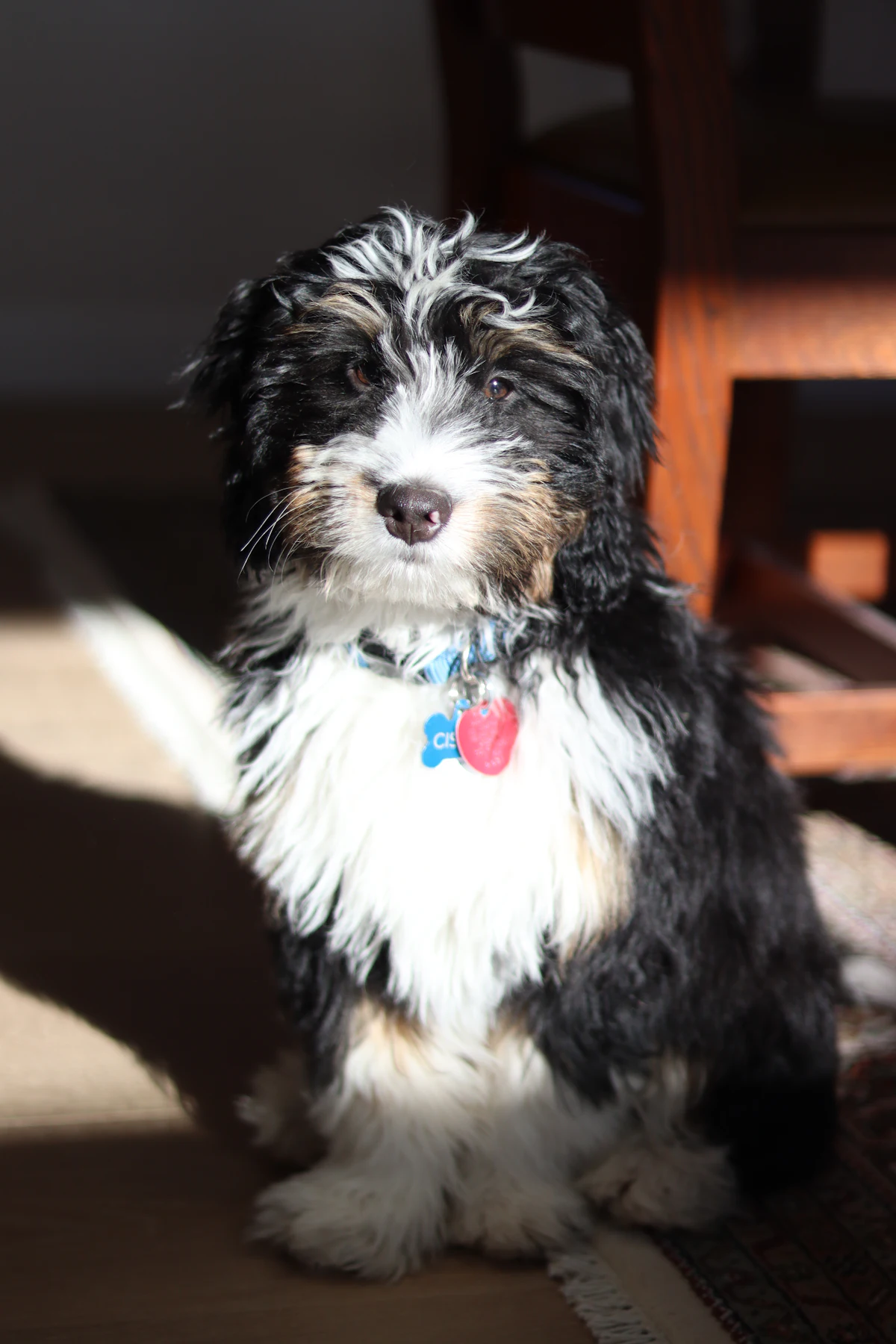
A Bernedoodle is a Bernese Mountain Dog crossed with a Poodle, first bred deliberately in 2003. Most are gentle, loyal and low-shedding, and they come in tiny (10 to 24 lb), mini (25 to 49 lb) and standard (50 to 90 lb) sizes. The Bernese parent has a median lifespan of about 8.4 years and a 15 to 25 per cent rate of histiocytic sarcoma, so health testing matters.
The information is current and up-to-date in accordance with the latest veterinary research. Learn more »
The Bernedoodle is a Bernese Mountain Dog and Poodle cross, and it has become one of the most sought-after Doodles in North America and the UK in a remarkably short time. The appeal is easy to understand: the Bernese is a gentle, devoted, strikingly marked giant, and the Poodle brings a low-shedding coat, a longer life and a sharper mind.
That combination is also the reason to read this guide carefully before buying one. The Bernese Mountain Dog has one of the shortest lifespans of any popular breed and a well-documented cancer problem, and a Bernedoodle can inherit those risks as easily as it inherits the tri-colour coat. Marketing tends to mention the colours and skip the cancer.
This guide covers what a Bernedoodle is, the three sizes and what "mini" really means, the coat types and colours, how much they shed, temperament and training, exercise, the grooming routine, what the evidence says about Bernese and Poodle health, the tests to ask a breeder for, cost, and whether a Bernedoodle fits your household. If you are still weighing up Poodle crosses in general, our Doodle Dog guide explains how they compare.
Key Takeaways
- A Bernedoodle is a Bernese Mountain Dog and Poodle cross, first bred deliberately in 2003; it is not a recognised breed and varies in size, coat and temperament.
- Sizes run from 10 lb tinies to 90 lb standards; the measured size of both parents predicts a puppy better than any label.
- Wavy and curly coats shed little but need brushing to the skin several times a week and clipping every six to eight weeks; straight coats shed heavily.
- The Bernese parent has a median lifespan of about 8.4 years and a 15 to 25 per cent rate of histiocytic sarcoma, plus hip and elbow dysplasia and bloat; no study has yet shown how much of that the cross inherits.
- Insist on hip, elbow, eye, cardiac and DM testing on the Bernese side, hip and eye testing on the Poodle side, and ask what the Bernese parent's relatives died of.
1Bernedoodle at a Glance
- Parent breeds: Bernese Mountain Dog × Poodle (Standard, Miniature or Toy)
- Origin: Deliberately bred from 2003, usually credited to Swissridge Kennels in Ontario, Canada
- Size: Tiny (10 to 24 lb), Mini (25 to 49 lb) and Standard (50 to 90 lb); figures vary by breeder
- Height: Roughly 12 to 17 inches (tiny), 18 to 22 inches (mini) and 23 to 29 inches (standard)
- Coat: Straight, wavy or curly; wavy is the most common
- Common colours: Tri-colour (black, white and rust), black and white, sable, phantom, merle, and solid black
- Shedding: Low to moderate; straight coats shed the most
- Grooming: High; brushing to the skin several times a week and clipping every 6 to 8 weeks
- Exercise needs: Moderate; 45 to 60 minutes a day for most adults
- Trainability: Good, with a stubborn streak from the Bernese side
- Lifespan: Often quoted as 12 to 18 years, but no large study has measured it; the Bernese parent's median is about 8.4 years
- Recognition: Not recognised by the AKC or the Kennel Club
- Best for: Families and calm households that can commit to grooming and want a gentle, people-focused dog
2What Is a Bernedoodle?
A Bernedoodle is any dog with Bernese Mountain Dog and Poodle ancestry. It is not a recognised breed, there is no breed standard, and two Bernedoodles can differ considerably in size, coat and character.
The Bernese Mountain Dog was a Swiss farm dog, bred to pull carts, drive cattle and watch the farm. It is large, calm, slow to mature and deeply attached to its family. The Poodle was a water retriever: athletic, quick-witted and carrying the dense, curly, low-shedding coat that Doodles are bought for. A Bernedoodle puppy can land anywhere between those two templates.
A short history
The cross is generally credited to Sherry Rupke of Swissridge Kennels in Ontario, who bred the first deliberate litter in 2003 after years of breeding Goldendoodles. Her stated aim was to keep the Bernese temperament while improving on its short lifespan and heavy shedding. Accidental Bernese and Poodle litters almost certainly existed before that, but 2003 is the date the Bernedoodle became a planned cross with a name.
It is much younger than the Labradoodle (1989) and the Goldendoodle (1990s), which matters for one practical reason: there is far less data. No peer-reviewed study has yet looked at Bernedoodle health or lifespan specifically, so much of what follows is drawn from the parent breeds.
3Bernedoodle Sizes: Tiny, Mini and Standard
Size is set mainly by the Poodle parent, and the three categories most breeders use overlap at the edges. Treat the figures below as typical ranges rather than promises; a 2024 UK study of more than 580,000 dogs confirms that even in pure breeds adult size varies, and in a first-generation cross it varies more.
- Tiny Bernedoodle (also sold as toy or micro): Toy Poodle × mini Bernedoodle, or multigenerational tiny lines. Roughly 12 to 17 inches tall and 10 to 24 lb. Full size by 9 to 11 months.
- Mini Bernedoodle: Miniature Poodle × Bernese Mountain Dog, usually by artificial insemination because of the size difference. Roughly 18 to 22 inches and 25 to 49 lb. Full size by 11 to 13 months.
- Standard Bernedoodle: Standard Poodle × Bernese Mountain Dog. Roughly 23 to 29 inches and 50 to 90 lb, with some males heavier. Full size by 14 to 24 months.
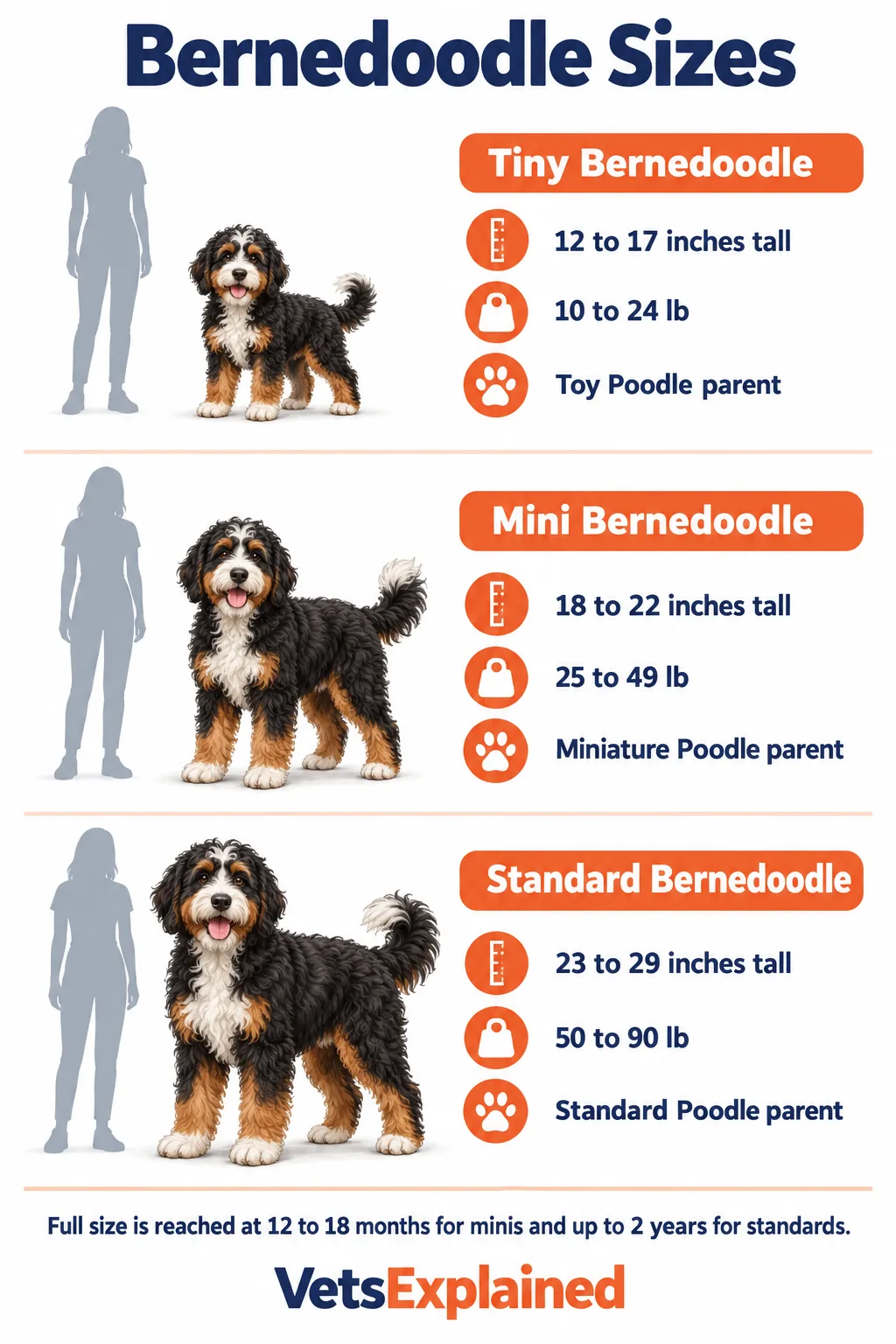
A large mini and a small standard can weigh almost the same, and breeders use the labels differently. Ask for the measured adult height and weight of both parents and the recorded sizes of previous litters. That predicts your puppy far better than the word on the website.
Mini Bernedoodle
The Mini Bernedoodle is the most popular size because it keeps the tri-colour look in a dog that fits a car and a sofa. Two cautions. First, "mini" does not mean low-maintenance: the coat, the brain and the attachment to people are the same. Second, a mini carries the same Bernese ancestry as a standard, and the same inherited risks. Smaller dogs tend to live longer in general, and the lower weight is kinder to joints, but a mini is not a health shortcut.
4What Does a Bernedoodle Look Like?
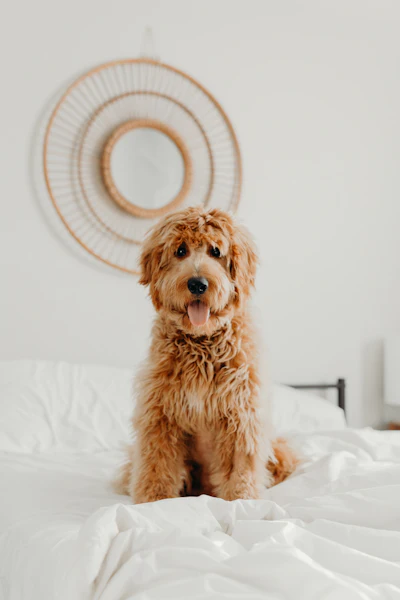
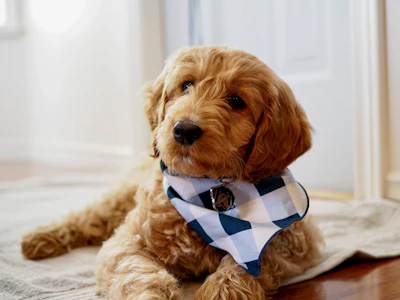
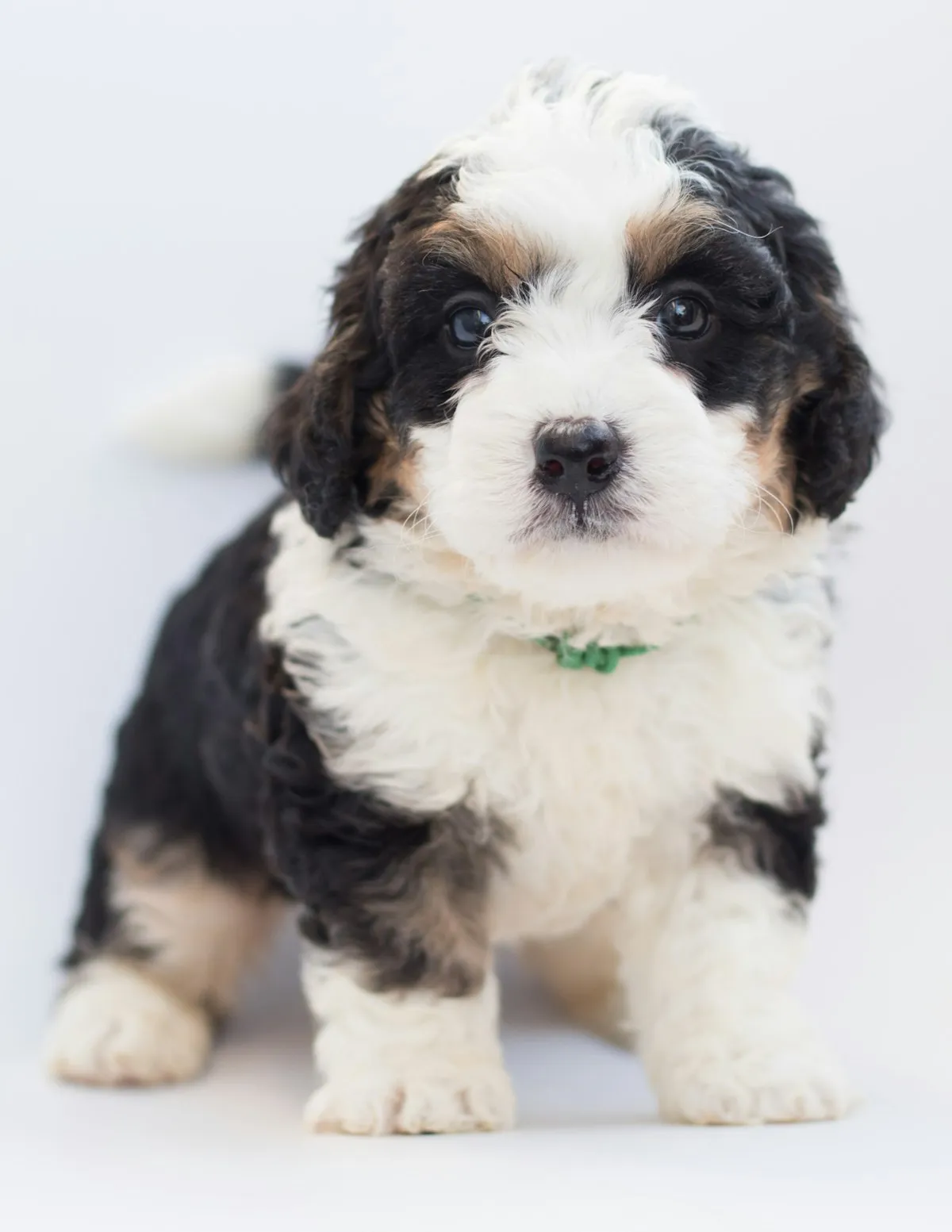
Most Bernedoodles are stocky, soft-coated dogs with a broad head, floppy ears, dark eyes and a plumed tail. First-generation puppies often look like a Bernese with a wavy coat; F1B and multigenerational dogs lean towards the Poodle's lighter build and curlier coat.
The tri-colour coat
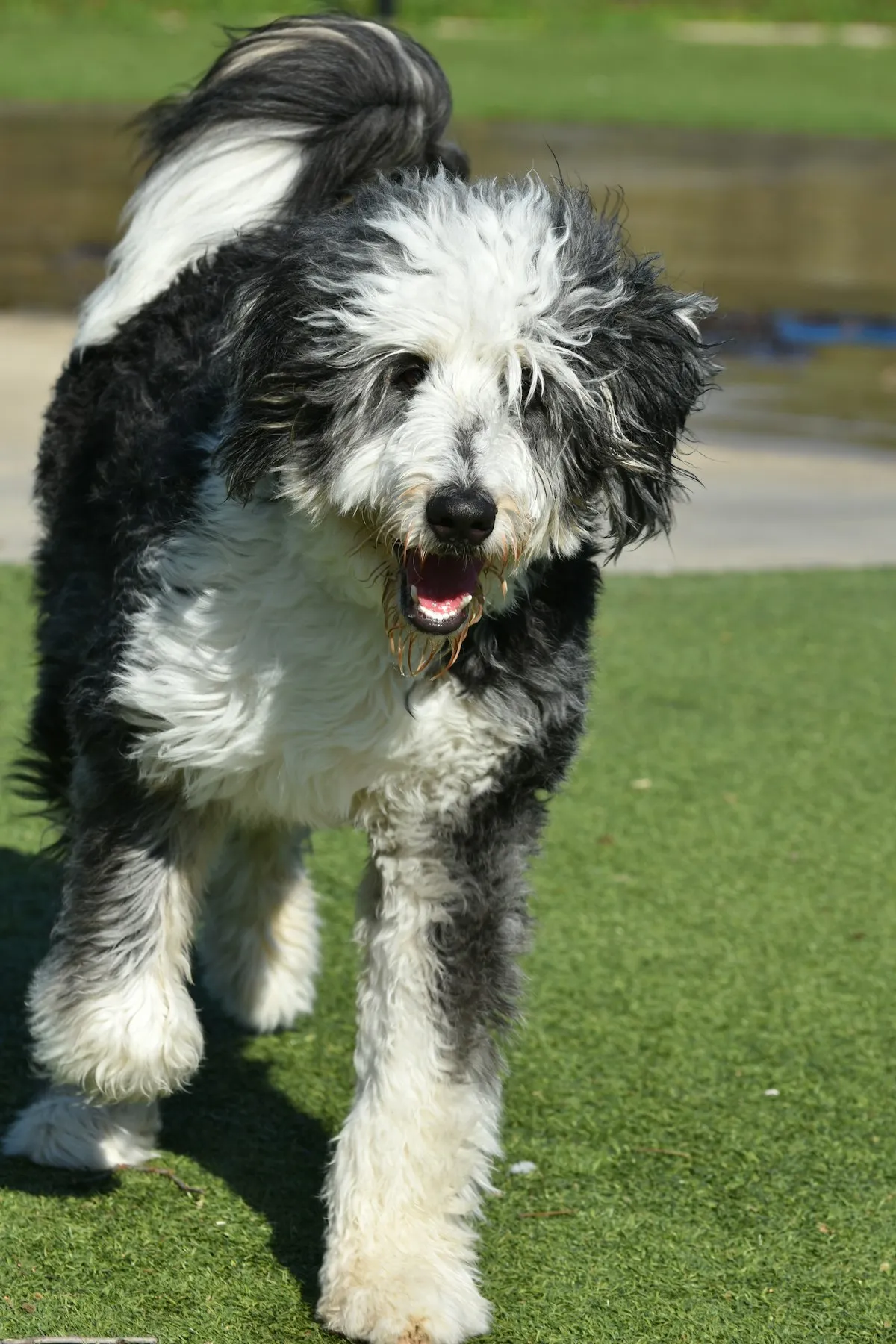
The classic Bernedoodle is tri-colour: a black body with white on the chest, muzzle, blaze and feet, and rust or tan points above the eyes, on the cheeks and legs. It is the Bernese pattern, and it is the single biggest reason people choose this cross over a Goldendoodle. Puppies with the full, symmetrical tri-colour markings are usually the most expensive in a litter.
Other colours are common and often cheaper:
- Black and white (bi-colour): the Bernese pattern without the rust points
- Sable: tan or red hairs tipped with black, often lightening with age
- Phantom: black with tan points but little or no white
- Merle: a mottled pattern introduced from the Poodle side. Breeding two merle dogs together can produce puppies with serious eye and hearing defects, so a responsible breeder never mates merle to merle.
- Solid black, chocolate or cream in some lines
Colours can fade. A black puppy from a Poodle carrying the silver or "fading" gene can be grey by three. Ask what colour the parents and grandparents were as adults, not as puppies.
5Bernedoodle Coat Types
The coat matters more than the colour, because it decides shedding, grooming time and cost.
- Straight coat: closest to the Bernese. Long, thick, often with a dense undercoat. Sheds the most, mats the least, and is the coat least likely to suit someone with allergies. Most common in F1 litters.
- Wavy coat: the typical Bernedoodle coat, loose waves that are soft to the touch. Low-shedding in most dogs, mats readily behind the ears, under the collar and in the armpits.
- Curly coat: closest to the Poodle. Tight curls, the least shedding and the most demanding to maintain, because shed hair stays trapped in the curls and felts unless brushed to the skin.
A breeder cannot reliably promise coat type at eight weeks. The adult coat often does not settle until 10 to 14 months, during which a dense "coat change" makes matting worse than at any other time.
6Do Bernedoodles Shed?
Yes, to varying degrees. A straight-coated Bernedoodle can shed almost as much as a Bernese Mountain Dog, which is a lot. Wavy and curly coats shed little, but no Bernedoodle is non-shedding. Generation shifts the odds: an F1B (three-quarters Poodle) is more likely to have a low-shedding wavy or curly coat than an F1.
7Are Bernedoodles Hypoallergenic?
No dog is hypoallergenic. People react to proteins in dander, saliva and urine, which every dog produces, not to the hair itself. A low-shedding coat spreads less dander around the home, and some allergic people find that helps; others react to a curly-coated Bernedoodle as much as to a Labrador.
If allergies are the reason for choosing this cross, spend time with the actual puppy or an adult relative, more than once and indoors, and talk to your doctor. Be suspicious of any breeder who guarantees an allergy-free dog.
8Bernedoodle Temperament
Most Bernedoodles are gentle, affectionate, loyal and a little clownish. The Bernese contributes calm, patience and a strong attachment to family; the Poodle adds playfulness, quick learning and more energy than the Bernese alone. Owners often describe them as "velcro dogs" that follow you from room to room.
Common traits include:
- Deep attachment to the household and a dislike of being left alone for long
- A calmer adult energy level than most Labradoodles or Goldendoodles
- A tendency to be reserved or wary with strangers, inherited from the Bernese
- A stubborn streak, especially in adolescence, which is also Bernese
- A long puppyhood; standards can be bouncy and mouthy until two or three years old
- Sensitivity to harsh handling; they shut down rather than push back
Temperament is not guaranteed. The Bernese is a watchful farm breed, and some Bernedoodles are shy or nervous with new people and noises unless socialised thoroughly as puppies. Meeting both parents, or at least the mother, tells you more than any description.
Do Bernedoodles bark a lot?
Not usually. Bernedoodles are moderate barkers: most will bark to announce a visitor and then stop, which is the Bernese watchdog instinct without much follow-through. Boredom, anxiety and being left alone for long periods are the usual causes of a Bernedoodle that barks persistently. Exercise, mental work and a gradual introduction to time alone prevent most of it.
9Are Bernedoodles Good Family Dogs?
Usually, yes, and the calm Bernese side makes them one of the better Doodles for families with children. They tend to be patient, tolerant and gentle once mature. Three things decide whether a particular dog fits a particular family.
Size. A 70 lb adolescent Bernedoodle that leans on a toddler will knock the child over without meaning to. Standards need early training in calm greetings, and young children should not walk them alone.
Maturity. Standard Bernedoodles grow slowly and act like puppies for two to three years. A family that expects a calm dog at twelve months can be disappointed.
Supervision. Any dog and any young child should be supervised together. Teach children not to climb on, corner or disturb a sleeping or eating dog.
10Are Bernedoodles Good With Other Dogs and Cats?
Most are. Neither parent breed is typically dog-aggressive, and Bernedoodles socialised with other dogs as puppies usually grow into easygoing adults. Standards can be too boisterous for small or elderly dogs while young. Bernedoodles generally live well with cats if raised with them; the Poodle's retrieving drive is milder than a terrier's chase instinct, but introduce them slowly.
11Are Bernedoodles Easy to Train?
Bernedoodles are moderately easy to train. The Poodle side learns fast and enjoys working for food; the Bernese side can be slow to respond and occasionally decides a request is not worth the effort. Reward-based training with short, upbeat sessions works best. Harsh corrections produce a worried, shut-down dog.
Start with the behaviours that make life with a large, soft, people-loving dog easier:
- Name response, sit and settling on a mat
- Recall, practised daily and rewarded generously
- Loose-lead walking before the dog weighs 50 lb
- Calm greetings without jumping or leaning
- Handling tolerance: paws, ears, mouth and being brushed, from the first week home
- Being alone for short, gradually lengthening periods
Socialisation between roughly 3 and 14 weeks shapes the adult dog, and it matters more for a Bernedoodle than for many Doodles because of the Bernese tendency to be reserved. Introduce people of different ages, calm vaccinated dogs, traffic, car journeys, the vet's waiting room and grooming equipment, always keeping the experience positive.
12How Much Exercise Does a Bernedoodle Need?
Most adult Bernedoodles need 45 to 60 minutes of activity a day, which is less than a Labradoodle and more than a Bernese Mountain Dog. Minis and tinies need a little less, but still a proper daily outing. Young adults with more Poodle in them may want more.
Good options:
- Walks with plenty of sniffing, which tire a dog more than mileage does
- Short training sessions through the day
- Fetch, scent games and puzzle feeders
- Hiking at a moderate pace, once joints are mature
- Swimming, which many Bernedoodles enjoy and which is kind to joints
Two cautions. Bernedoodles, especially those with the Bernese coat, overheat easily; walk early and late in hot weather and watch for heavy panting. And a Bernedoodle is a companion dog first; it would rather do a little with you than a lot without you.
Puppy exercise
Puppies should not be exercised like adults. Growth plates in a standard Bernedoodle do not close until roughly 14 to 18 months, and repeated high-impact activity before then is linked to joint problems, which both parent breeds are already prone to. Keep walks short, let the puppy choose the pace, avoid stairs and jumping from height, and skip running or long hikes until your vet confirms the dog is mature.
13Bernedoodle Grooming Requirements
Grooming is the part of Bernedoodle ownership most people underestimate, and the most common reason a Bernedoodle arrives at the groomer to be shaved to the skin.
A wavy or curly coat needs:
- Brushing to the skin three or four times a week, daily during the coat change at around a year old
- Combing after brushing with a metal comb to find the mats the brush slides over
- Professional clipping every six to eight weeks
- Bathing every four to eight weeks, followed by thorough drying and brushing
- Nail trims every three to four weeks
- Ear checks weekly, and after swimming; floppy ears with hair inside the canal trap moisture
- Tooth brushing daily if you can, several times a week at minimum
A straight-coated Bernedoodle needs less de-matting but sheds heavily and still needs weekly brushing to remove undercoat. Our Doodle grooming guide covers the technique in detail.
How to brush a Bernedoodle properly
Surface brushing is why Bernedoodles arrive at the groomer "brushed every day" and matted underneath. Work in small sections. Part the coat, brush from the skin outwards with a slicker brush, then run a comb through the same section. If the comb catches, there is a tangle to work out with a detangling spray and patience. Pay particular attention to behind the ears, under the collar, the armpits, inner thighs, the base of the tail and between the toes. If you find mats tight against the skin, book a groomer rather than cutting them out with scissors; a short clip and a fresh start is kinder than de-matting a felted coat.
14Bernedoodle Health: What the Evidence Shows
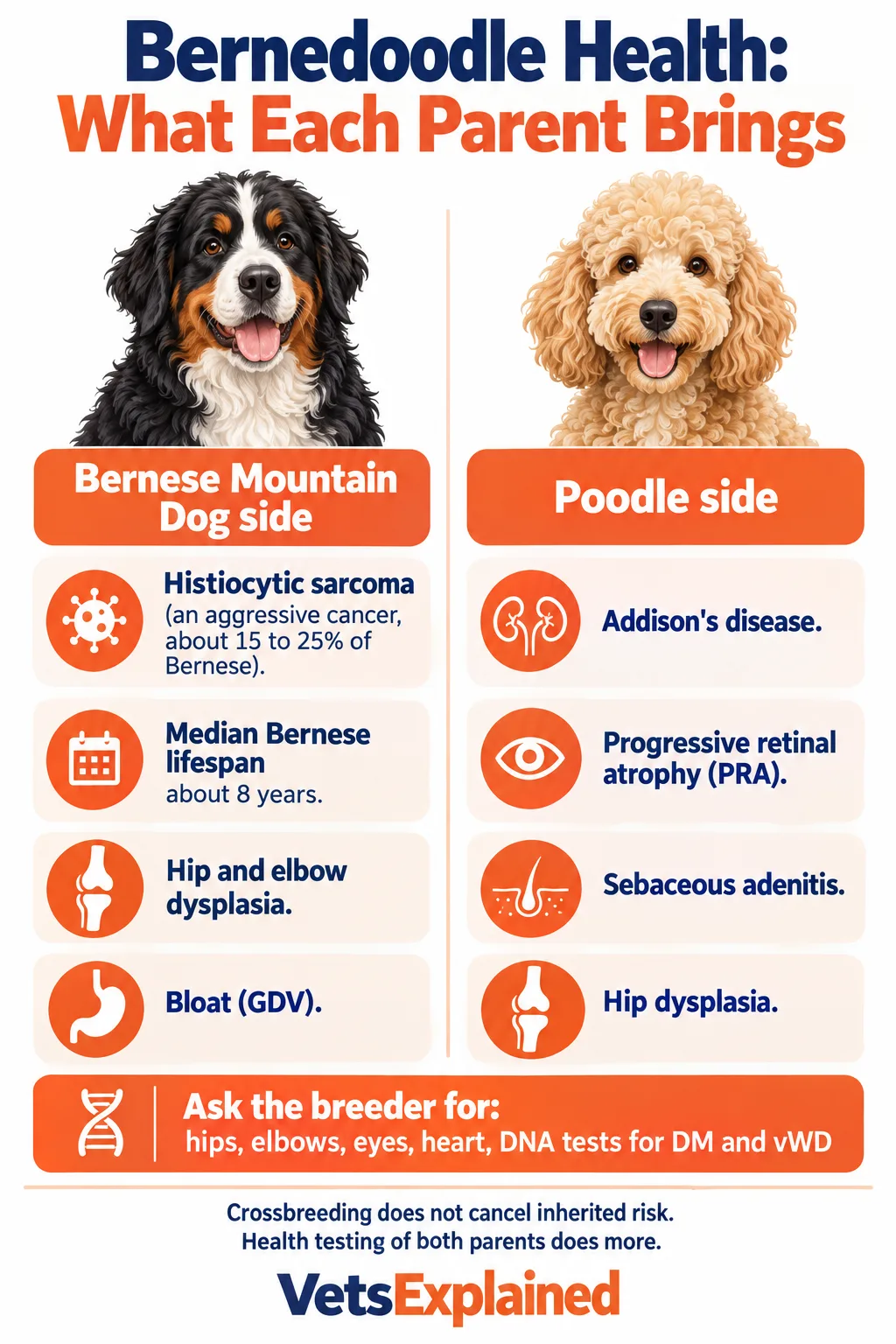
This is the section that most Bernedoodle guides soften, and it should not be. The Bernese Mountain Dog has serious, well-documented health problems, and the honest position is that a Bernedoodle may inherit some, all or none of them. Nobody has yet studied the cross well enough to say which.
What we do know from Doodles in general is not reassuring about "hybrid vigour". A 2024 Royal Veterinary College study comparing Labradoodles, Cockapoos and Cavapoos with their parent breeds found no significant difference for the large majority of 57 common disorders. Doodles were about as healthy as their parents, not healthier. There is no reason to expect the Bernedoodle to be different.
The Bernese Mountain Dog's short lifespan
The Bernese Mountain Dog lives a short life for its size. A 2016 Swiss study followed 389 Bernese born in 2001 and 2002 until almost all had died and found a median lifespan of 8.4 years (females 8.8, males 7.7). Neoplasia, meaning cancer, accounted for 58 per cent of the deaths where a cause was known. The Bernese Mountain Dog Club of America describes the breed's typical lifespan as 7 to 8 years and calls it too short for a large breed.
The Poodle side pulls the other way. In the 2024 UK longevity study of 584,734 dogs, purebred dogs had a median lifespan of 12.7 years and crossbreds 12.0 years, with large breeds at 11.9. Standard Poodles typically reach 12 years or more and Miniature and Toy Poodles longer still.
Breeders often quote 12 to 18 years for Bernedoodles. That is a hope based on the Poodle, not a measurement. A realistic expectation is probably somewhere between the two parents: perhaps 10 to 14 years for a standard and longer for minis and tinies, with wide variation depending on which cancers the individual dog inherits a predisposition to.
Histiocytic sarcoma and other cancers
Histiocytic sarcoma is the disease that defines the Bernese Mountain Dog's health reputation. It is an aggressive cancer of immune cells that can appear in the spleen, lungs, bone marrow, joints or skin. Research from the French and American groups who have studied it for two decades puts its frequency at roughly 25 per cent of Bernese Mountain Dogs, with an average age of onset of 6.5 years and a survival after diagnosis measured in weeks. A 2012 genome study that identified the main risk locus, near the CDKN2A tumour-suppressor gene, gives the range as 15 to 25 per cent of the breed. Inheritance appears to involve a small number of genes rather than one, and a commercial risk test (sold through Antagene) now estimates a dog's genetic risk. The Swiss study also recorded lymphoma and osteosarcoma (bone cancer) as frequent causes of death.
For a Bernedoodle, this means:
- The cancer-predisposing genes are inherited from the Bernese parent, and the cross does not remove them. A first-generation Bernedoodle carries roughly half its genome from a breed in which a quarter of dogs develop one specific cancer.
- Ask whether the Bernese parent has had the histiocytic sarcoma risk test and what its pedigree shows. Berner-Garde, the breed's open health database, lets you look up the cause of death of a dog's relatives.
- Any Bernedoodle that becomes lethargic, loses weight, goes off food, develops a lameness that does not resolve, or breathes faster than normal in middle age needs a prompt vet visit. Early cancers are far easier to treat.
- Pet insurance taken out as a puppy, before any symptoms, is worth serious thought for this cross.
Hip and elbow dysplasia
Both parent breeds are prone to hip dysplasia, and the Bernese is also one of the breeds most affected by elbow dysplasia. Historical OFA data put the Bernese hip dysplasia rate around 15 per cent of submitted X-rays, falling over the decades as breeders screened, but submitted X-rays are a biased sample because dogs that are obviously lame are often not sent in. Degenerative joint disease was the second most common cause of death in the Swiss study.
Dysplasia is partly inherited and partly environmental: rapid growth, excess weight and over-exercise in puppyhood all make it worse. It is diagnosed by X-ray and managed with weight control, controlled exercise, physiotherapy, pain relief and, in severe cases, surgery. Our guide to hip dysplasia in dogs covers early signs and treatment. The best prevention is choosing a puppy whose parents both have OFA, PennHIP or BVA hip scores and OFA elbow grades, then keeping the dog lean and letting it grow slowly.
Bloat (gastric dilatation-volvulus)
Standard Bernedoodles are deep-chested, large dogs with a Standard Poodle parent, and both of those put them at risk of bloat, in which the stomach fills with gas and twists. The Merck Veterinary Manual lists Standard Poodles among the breeds affected and gives the mortality as about 25 to 30 per cent even with treatment. Gastric and mesenteric volvulus also appeared among the causes of death in the Swiss Bernese study.
Know the signs: a swollen, tight abdomen, repeated unproductive retching, drooling, restlessness and pacing, pale gums and collapse. This is an emergency that cannot wait until morning. To reduce the risk, feed two or three smaller meals a day rather than one, avoid exercise for an hour either side of meals, and ask your vet about a preventive gastropexy (stitching the stomach to the body wall), which is often done at the time of neutering in large, at-risk dogs.
Other conditions to know about
- Degenerative myelopathy (DM): a progressive spinal cord disease causing hind-leg weakness in older dogs. The Bernese carries the SOD1 mutations and the BMDCA requires DNA testing for them; ask for the result.
- Von Willebrand's disease: an inherited bleeding disorder in both parent breeds. A DNA test exists.
- Eye disease: progressive retinal atrophy and cataracts occur in both breeds; breeding dogs should have an annual eye examination by a veterinary ophthalmologist.
- Addison's disease (hypoadrenocorticism): Standard Poodles are strongly predisposed. Signs are vague and intermittent: lethargy, poor appetite, vomiting and weakness. A Bernedoodle with repeated unexplained "off" days should be blood-tested for it.
- Sebaceous adenitis: an inflammatory skin disease from the Poodle side, diagnosed by skin biopsy.
- Hypothyroidism and allergies: common in both parents.
- Ear infections: floppy ears, hair in the canal and a love of water make Doodles generally prone to otitis. Check and dry the ears weekly.
- Heat intolerance: the Bernese coat and bulk make hot weather genuinely dangerous for straight-coated standards.
15Health Testing Before Buying a Bernedoodle Puppy
Because the Bernese side carries so much, health testing on both parents is more important for this cross than for almost any other Doodle. "Vet-checked" is not health testing. Ask to see the certificates and check them against the registries (OFA or PennHIP in the US, BVA/KC schemes in the UK).
For the Bernese Mountain Dog parent, the Bernese Mountain Dog Club of America's CHIC requirements are hip evaluation (OFA, PennHIP or OVC), elbow evaluation, an eye examination by a boarded ophthalmologist, a cardiac evaluation by a boarded cardiologist, and DNA testing for degenerative myelopathy (SOD1A and SOD1B), plus one of a von Willebrand's DNA test, a thyroid profile or the histiocytic sarcoma risk test. A good breeder will have done most or all of these, and should be able to show you the pedigree on Berner-Garde with the ages and causes of death of the dog's relatives.
For the Poodle parent, the minimum for a Standard Poodle is hips (OFA at 24 months or PennHIP), an eye examination, and at least one of thyroid, sebaceous adenitis or cardiac evaluation. For Miniature and Toy Poodles, patellar luxation and PRA DNA testing are standard.
For a multigenerational Bernedoodle, both Bernedoodle parents should have the same tests.
Questions to ask a breeder
- Which health tests have been done on the mother and the father, and can I see the results?
- How old are the Bernese parent's own parents and grandparents, and what did any that have died die of?
- Has the Bernese parent had the histiocytic sarcoma risk test?
- How tall and heavy is each parent?
- What coat type does each parent have, and what coats have previous litters produced?
- Are either of the parents merle?
- Can I meet the mother and see where the puppies are raised?
- What generation is this litter?
- What happens if I can no longer keep the dog?
A breeder who answers "Bernedoodles don't get the Bernese problems because of hybrid vigour" is telling you they have not read the research.
16F1, F1B and Multigenerational Bernedoodles
- F1: Bernese × Poodle. The most variable generation: straight, wavy and curly coats can appear in one litter, and the straight coats shed heavily. Also the generation with the most Bernese look and temperament.
- F1B: F1 Bernedoodle × Poodle. Three-quarters Poodle, so more likely to be wavy or curly and low-shedding, and often a little more energetic. Tri-colour markings are less predictable.
- F2 and multigenerational: Bernedoodle × Bernedoodle. Coats and sizes become more consistent in well-run programmes, and the full tri-colour pattern can be stabilised, but it takes several generations and careful selection.
Generation describes ancestry, not outcomes. No generation is guaranteed non-shedding, allergy-friendly or free of Bernese health risks. Our guide to F1 vs F1B vs F2 Doodles goes into the trade-offs.
17What Should a Bernedoodle Eat?
A Bernedoodle needs a complete and balanced diet for its life stage and expected adult size. The WSAVA Global Nutrition Guidelines recommend choosing a food from a manufacturer that employs qualified nutritionists, runs feeding trials and can answer questions about its products; those basics matter more than the brand or the marketing.
Three points are specific to Bernedoodles:
- Standard puppies should eat a large-breed puppy food. These control calcium and slow growth slightly, which lowers the risk of joint disease in dogs expected to exceed about 50 lb. Minis and tinies do fine on a regular puppy food.
- Feed two or three meals a day, not one, to reduce bloat risk in standards.
- Keep the dog lean. Both parent breeds gain weight easily, and every extra pound loads joints that are already at risk.
Our feeding guide by life stage explains how much to feed as your dog grows.
18Bernedoodle Weight Management
On a fluffy dog you need your hands, not your eyes. You should feel the ribs easily under a thin layer of fat, see a waist behind the ribs from above, and see the belly tuck up from the side. Ask your vet to show you the body-condition score at a routine visit, and adjust food by about 10 per cent at a time if the dog is drifting. For a breed combination prone to dysplasia and short-lived from cancer, leanness is the single most useful thing an owner controls.
19Can Bernedoodles Be Left Alone?
Not for long, and not without practice. Bernedoodles are companion dogs on both sides of the family and many struggle with separation. An adult that has been taught gradually can usually manage four to six hours. A puppy cannot, and a dog that has never practised being alone will not suddenly cope with a working day.
Build it up from the first week: short absences while the dog is tired and settled, a safe resting space, something to chew, calm departures and returns, and a predictable routine. If an adult panics when left, howls continuously, injures itself or destroys doors and windows, that is separation-related distress and needs a vet or a qualified behaviourist.
20How Much Does a Bernedoodle Cost?
Prices vary widely by country, region, breeder, size and colour, so treat any figure as a rough guide.
- Puppy from a breeder: in the US, commonly 2,500 to 5,000 dollars in 2026, with tri-colour and tiny puppies from well-known programmes often above that and bi-colour or sable puppies below. UK prices follow a similar pattern in pounds. Bernedoodles are, on average, among the more expensive Doodles.
- Rescue: usually a few hundred dollars in adoption fees. Bernedoodles between one and three years old appear in rescue more often than people expect, usually for size, grooming or separation reasons.
- Ongoing: professional grooming at roughly 90 to 180 dollars every six to eight weeks for a standard, plus food for a large dog, insurance (worth having for this cross), routine vet care and training.
A very cheap Bernedoodle is a warning sign. Health testing, the artificial insemination often needed for minis, proper rearing and socialisation all cost money.
21Bernedoodle vs Goldendoodle vs Bernese Mountain Dog
Bernedoodle vs Goldendoodle. The Goldendoodle is usually the more outgoing, more energetic and more trainable of the two, and it is more likely to be friendly with strangers. The Bernedoodle is calmer, more loyal to its own family, more likely to be reserved with new people and a little more stubborn. Both carry a cancer risk from the non-Poodle parent: the Golden Retriever's lymphoma and haemangiosarcoma, the Bernese's histiocytic sarcoma. Our Goldendoodle guide covers the other side.
Bernedoodle vs Bernese Mountain Dog. The pure Bernese gives you the predictable look and temperament, a recognised breed with a written standard and decades of health data, but also the full weight of the breed's cancer and joint problems and a lifespan of around eight years. The Bernedoodle may live longer and shed less, and both of those are "may". It is also less predictable in everything from size to coat.
22What Are the Disadvantages of a Bernedoodle?
- The Bernese parent carries a high cancer risk and a short lifespan, and nobody has yet shown how much of that the cross inherits.
- Hip and elbow dysplasia and bloat are real risks in standards.
- Grooming is demanding and expensive for life, and coat type cannot be promised at purchase.
- Shedding and allergy outcomes are not guaranteed.
- They dislike being left alone and can develop separation problems.
- Some are shy or wary with strangers without thorough socialisation.
- Standards take two to three years to mature and are heavy, strong adolescents.
- They are among the most expensive Doodles, and popularity attracts puppy farms.
23Bernedoodle Pros and Cons
Potential advantages
- Gentle, patient and devoted; one of the calmer Doodles for families
- Striking tri-colour coat
- Low-shedding in wavy and curly coats
- Three sizes, from 10 lb to 90 lb
- Moderate exercise needs compared with Labradoodles and Goldendoodles
- Intelligent and food-motivated, so usually trainable
- Likely to outlive a pure Bernese, which is one of the main reasons the cross exists
Potential challenges
- Inherits the Bernese risk of histiocytic sarcoma and other cancers
- Prone to hip and elbow dysplasia, and standards to bloat
- High grooming needs and professional grooming costs
- Coat and shedding unpredictable in early generations
- Can be stubborn, slow to mature and reserved with strangers
- Struggles when left alone for long periods
- Expensive to buy and to insure
24Is a Bernedoodle Right for You?
A Bernedoodle suits you if you want a calm, affectionate, family-centred dog that is happy with an hour of moderate exercise, you can brush it several times a week and pay a groomer every couple of months, you are rarely out for a full working day, and you accept, with your eyes open, that it may inherit a serious cancer risk from its Bernese side.
It is probably not the right dog if you want a long-lived, low-maintenance dog, a guaranteed non-shedding coat, a running partner, or a dog that greets every stranger like a friend. If a gentle temperament is the main attraction, our list of gentle dog breeds for first-time owners includes options with better health records.
Before you buy, ask yourself:
- Have I seen hip, elbow, eye, cardiac and DM results for the Bernese parent, and hip and eye results for the Poodle?
- Do I know what the Bernese parent's relatives died of, and at what age?
- Can I afford the coat, the insurance and a large dog's vet bills for its whole life?
- Can I cope if the puppy sheds more, grows bigger or is shyer than expected?
- Am I choosing this dog for its temperament, or for the tri-colour photos?
25Final Thoughts
The Bernedoodle exists because people loved the Bernese Mountain Dog and wanted it to live longer and shed less. The best examples deliver on the temperament: gentle, loyal, funny dogs that are genuinely good with children. Whether they deliver on lifespan is still unproven, and the honest answer is that a Bernedoodle carries the Bernese cancer and joint risks in its genes and may or may not express them.
That makes the breeder the most important decision you will make. Choose one who tests both parents, can show you the Bernese pedigree's health history, never breeds merle to merle, and talks about histiocytic sarcoma before you ask. Then keep the dog lean, brush it properly, insure it early and enjoy a very good companion.
For how the Bernedoodle compares with Goldendoodles, Labradoodles, Cavapoos and the rest, read our complete Doodle Dog guide.
Sources
- Klopfenstein M, Howard J, Rossetti M, Geissbühler U. Life expectancy and causes of death in Bernese mountain dogs in Switzerland. BMC Veterinary Research. 2016;12:153. pmc.ncbi.nlm.nih.gov
- Abadie J, Hédan B, Cadieu E, et al. Epidemiology, pathology, and genetics of histiocytic sarcoma in the Bernese mountain dog breed. Journal of Heredity. 2009;100(Suppl 1):S19-27. pubmed.ncbi.nlm.nih.gov
- Shearin AL, Hédan B, Cadieu E, et al. The MTAP-CDKN2A locus confers susceptibility to a naturally occurring canine cancer. Cancer Epidemiology, Biomarkers & Prevention. 2012;21(7):1019-27. pubmed.ncbi.nlm.nih.gov
- McMillan KM, Bielby J, Williams CL, Upjohn MM, Casey RA, Christley RM. Longevity of companion dog breeds: those at risk from early death. Scientific Reports. 2024;14:531. pmc.ncbi.nlm.nih.gov
- Bryson GT, O'Neill DG, Brand CL, Belshaw Z, Packer RMA. The doodle dilemma: how the physical health of "designer-crossbreed" Cockapoo, Labradoodle and Cavapoo dogs compares to their purebred progenitor breeds. PLoS One. 2024;19(8):e0306350. pmc.ncbi.nlm.nih.gov
- Bernese Mountain Dog Club of America. Health statement and CHIC requirements. 2017. akc.org
- Bernese Mountain Dog Club of America. Health: lifespan, Berner-Garde database and histiocytic sarcoma risk test. bmdca.org
- Merck Veterinary Manual. Disorders of the stomach and intestines in dogs: bloat. merckvetmanual.com
- Orthopedic Foundation for Animals. Hip dysplasia. ofa.org
- WSAVA Global Nutrition Committee. Global nutrition guidelines. wsava.org
Frequently Asked Questions
?What breeds make a Bernedoodle?
A Bernedoodle is a Bernese Mountain Dog crossed with a Poodle. The Poodle may be Standard, Miniature or Toy, which is what produces the standard, mini and tiny Bernedoodle sizes. The cross was first bred deliberately in 2003 in Ontario, Canada.
?How big does a Bernedoodle get?
Tinies are roughly 12 to 17 inches and 10 to 24 lb, minis 18 to 22 inches and 25 to 49 lb, and standards 23 to 29 inches and 50 to 90 lb. Figures vary by breeder, and the measured size of both parents is the best predictor for an individual puppy.
?How long do Bernedoodles live?
Nobody has measured it in a large study. Breeders quote 12 to 18 years, but the Bernese parent's median lifespan is about 8.4 years and the Poodle's 12 or more. A realistic range is perhaps 10 to 14 years for standards and longer for minis, depending on the cancers an individual inherits.
?Do Bernedoodles shed?
Yes, to varying degrees. Straight-coated Bernedoodles shed heavily, much like a Bernese. Wavy and curly coats shed little, but no Bernedoodle is non-shedding, and the adult coat type is often not clear until the dog is around a year old.
?Are Bernedoodles hypoallergenic?
No dog is hypoallergenic. Low-shedding coats spread less dander, which helps some allergic people and not others. Spend time with the individual dog before committing, and never rely on a breeder's guarantee.
?Do Bernedoodles get cancer like Bernese Mountain Dogs?
They can. Histiocytic sarcoma affects an estimated 15 to 25 per cent of Bernese Mountain Dogs and the predisposing genes pass to the cross. No study has yet measured the rate in Bernedoodles. Ask about the Bernese parent's risk test and family history, and insure the puppy early.
?Are Bernedoodles good family dogs?
Usually, yes. The Bernese side makes them one of the calmer, more patient Doodles with children once mature. Standards are large and slow to mature, so they need early training in calm greetings and supervision around small children.
?Are Bernedoodles stubborn?
Somewhat. The Bernese contributes a streak of independence, especially in adolescence, while the Poodle side learns quickly. Short, reward-based sessions and patience work far better than pressure, which tends to make a Bernedoodle shut down.
?What is the difference between a Bernedoodle and a Goldendoodle?
A Goldendoodle is usually more outgoing, more energetic and friendlier with strangers. A Bernedoodle is calmer, more attached to its own family, more reserved with new people and a little more stubborn. Each inherits a cancer risk from its non-Poodle parent.
?How much exercise does a Bernedoodle need?
Most adults need 45 to 60 minutes a day, less than a Labradoodle or Goldendoodle. Mental work and sniffing walks tire them well. Avoid hard exercise in hot weather, and keep puppies' exercise short and low-impact until the growth plates close.
?How much does a Bernedoodle cost?
In the US, breeder puppies commonly cost 2,500 to 5,000 dollars in 2026, with tri-colour and tiny puppies often more; prices vary by region. Add grooming every six to eight weeks, insurance and the running costs of a large dog.
?Are Mini Bernedoodles healthier than standards?
Not necessarily. A mini carries the same Bernese ancestry and the same inherited cancer and joint risks. Smaller dogs do tend to live longer and put less load on their joints, and minis are less prone to bloat, but the breeder's health testing matters more than the size.
Help us do better!
Was this article helpful and relevant?
Thanks for your feedback!
About Sofia Marin
Sofia Marin is VetsExplained's senior editor. She has edited pet and consumer titles for fifteen years and is responsible for the site's editorial standards and breed coverage.
View all posts by Sofia Marin →