How Big Do Doodles Get? Size by Cross, From Maltipoo to Bernedoodle
 Written by Sofia Marin
 Fact checked by Dr. Tomas Ellery, DVM
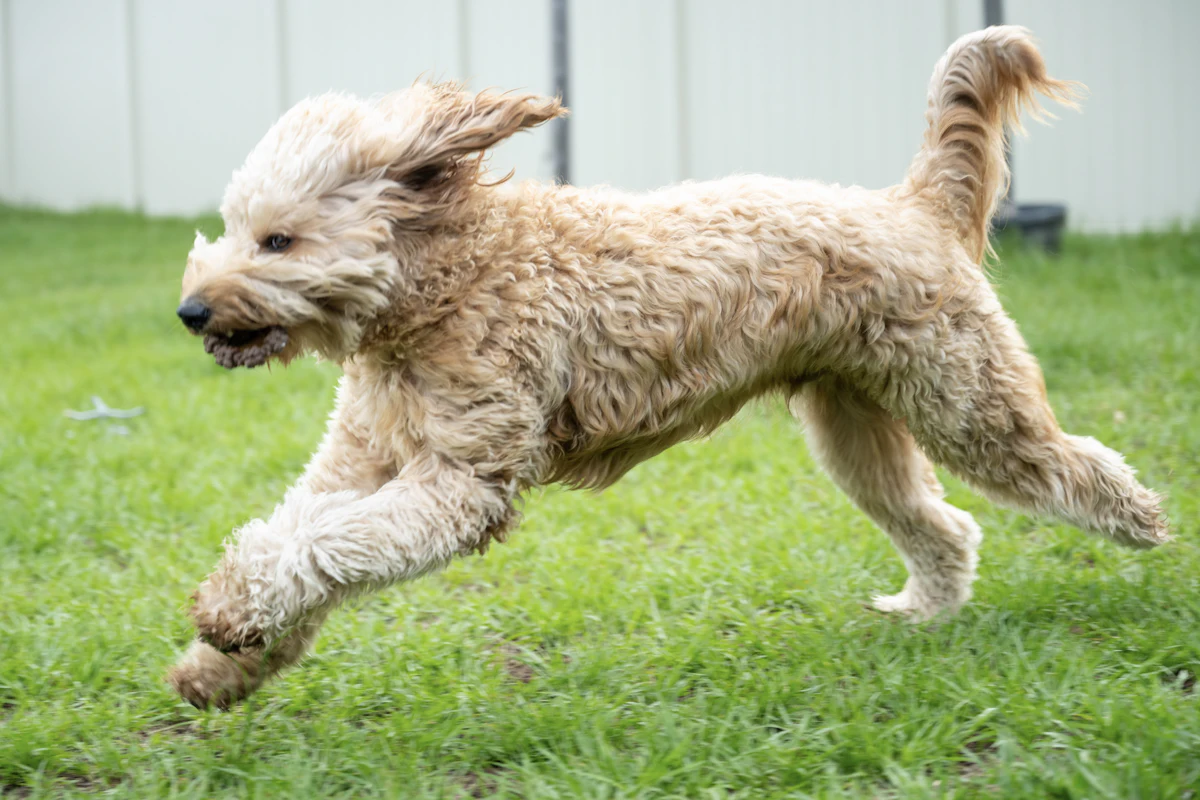
Doodles range from under 10 lb (Maltipoo, Toy Poodle cross) to over 100 lb (Standard Bernedoodle). The Poodle parent sets the category: Toy under 10 inches, Miniature 10 to 15 inches, Standard over 15 inches. Most Doodles reach full height by 12 months and full weight by 12 to 24 months.
The information is current and up-to-date in accordance with the latest veterinary research. Learn more »
Doodles get anywhere from under 10 lb to well over 100 lb. "Doodle" is not a size; it is a label for any Poodle cross, and because the Poodle comes in three varieties and the other parent can be a 6 lb Maltese or a 110 lb Bernese Mountain Dog, the answer depends on which cross, which Poodle variety and which two individual dogs.
A Doodle that grows into a 70 lb dog when the household planned for 35 lb is one of the most common stories Doodle rescues hear, and it is avoidable with a little arithmetic. For the wider picture on Poodle crosses, start with our Doodle Dog guide.
Key Takeaways
- Doodles range from about 5 lb (Maltipoo) to 100 lb or more (Standard Bernedoodle); the Poodle variety, Toy, Miniature or Standard, sets the size category.
- No Doodle has a kennel-club standard, and F1 litters can spread 20 to 30 lb either side of the average.
- Most Doodles reach adult height by 12 months; growth plates close at roughly 8 months in small dogs and up to 18 months in giant-leaning crosses.
- Doubling the 4-month weight is a rough rule of thumb; the parents' measured weights and a vet's growth chart are far more reliable.
- "Teacup" and "micro" have no definition; a bigger-than-expected dog is a leading reason Doodles are rehomed, so plan for the top of the range.
1Why Does Poodle Size Decide How Big a Doodle Gets?
The Poodle parent sets a Doodle's size category because the Poodle is the only parent that comes in three sizes. The American Kennel Club Poodle standard defines them by height at the shoulder, not weight:
- Toy Poodle: 10 inches or under; typically 4 to 6 lb
- Miniature Poodle: over 10 inches and up to 15 inches; typically 10 to 15 lb
- Standard Poodle: over 15 inches; most are 21 to 27 inches and roughly 40 to 70 lb
So a Golden Retriever crossed with a Standard Poodle produces a large dog and the same Golden Retriever crossed with a Miniature Poodle produces a medium one.
Two cautions apply to every cross below:
- Crosses vary. In a first-generation (F1) litter, puppies can land anywhere between the two parents and occasionally outside that range. A 15 lb Miniature Poodle bred to a 65 lb Golden Retriever produces a spread from perhaps 25 to 55 lb.
- No Doodle has a kennel-club standard. The ranges below are anchored to the AKC parent-breed standards and, where they exist, to Doodle breed clubs' size categories. They are typical ranges, not promises.
2Doodle Sizes by Cross
Height is measured at the withers (top of the shoulder). Weights are for lean adults.
- Maltipoo (Maltese × Toy or Miniature Poodle): 8 to 14 inches, 5 to 20 lb. A Toy Poodle cross usually lands at 5 to 12 lb, a Miniature cross at 10 to 20 lb; the Maltese is under 7 lb, so there is no "standard" Maltipoo. See our Maltipoo guide.
- Cavapoo (Cavalier King Charles Spaniel × Toy or Miniature Poodle): 9 to 14 inches, 9 to 25 lb; most cluster between 12 and 20 lb. See our Cavapoo guide.
- Cockapoo (Cocker Spaniel × Toy, Miniature or, rarely, Standard Poodle): Toy 10 inches and under, 6 to 12 lb; Mini 11 to 14 inches, 13 to 18 lb; Medium 15 to 18 inches, 19 to 30 lb; Standard over 18 inches, 30 lb or more. See our Cockapoo guide.
- Mini Goldendoodle (Golden Retriever × Miniature Poodle, or multigenerational mini lines): the Goldendoodle Association of North America (GANA) defines a Petite as under 14 inches and typically 25 lb or less, and a Mini as 14 to 17 inches and 26 to 35 lb. F1 Mini Goldendoodles often outgrow those ranges and land at 35 to 45 lb. See our Mini Goldendoodle guide.
- Aussiedoodle (Australian Shepherd × Poodle): Mini 12 to 18 inches, 15 to 35 lb; Standard 19 to 23 inches, 40 to 70 lb. See our Aussiedoodle guide.
- Labradoodle (Labrador Retriever × Poodle): the Australian Labradoodle clubs use Mini 14 to 16 inches and roughly 15 to 30 lb, Medium 17 to 20 inches and 30 to 50 lb, and Standard 21 to 24 inches and 50 to 80 lb. See our Labradoodle guide.
- Goldendoodle (Golden Retriever × Poodle): GANA's categories are Petite under 14 inches, Mini 14 to 17 inches, Medium 17 to 21 inches and typically 36 to 50 lb, and Standard over 21 inches and 51 lb or more; most standards weigh 50 to 80 lb. See our Goldendoodle guide.
- Sheepadoodle (Old English Sheepdog × Poodle): Mini 15 to 20 inches, 25 to 50 lb; Standard 21 to 27 inches, 55 to 85 lb. The Old English Sheepdog weighs 60 to 100 lb. See our Sheepadoodle guide.
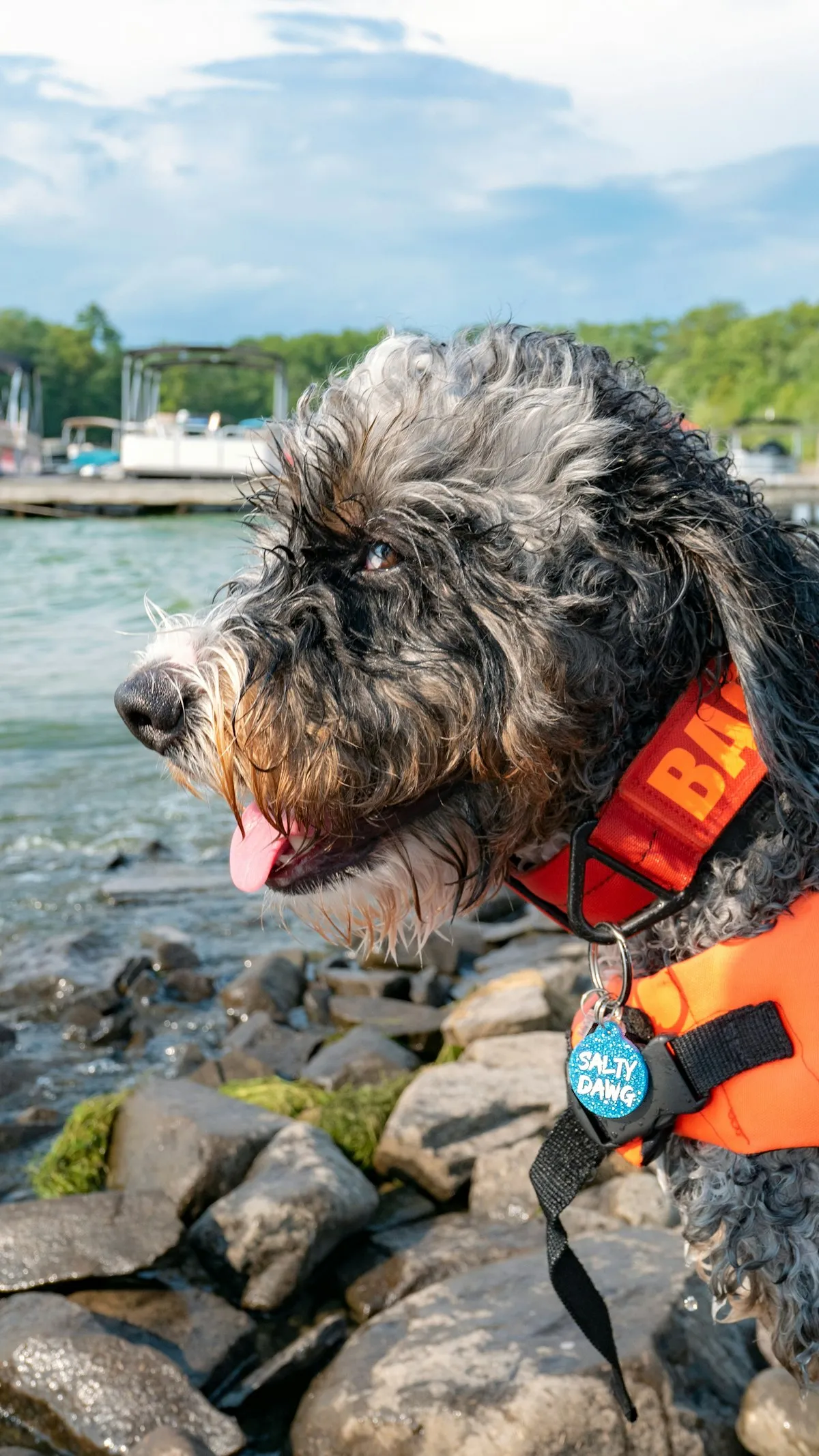
- Bernedoodle (Bernese Mountain Dog × Poodle): Tiny (Toy Poodle cross, usually via an F1B) 12 to 17 inches, 10 to 25 lb; Mini 18 to 22 inches, 25 to 50 lb; Standard 23 to 29 inches, 60 to 100 lb and occasionally more. The Bernese Mountain Dog is 70 to 115 lb, which makes this the largest common Doodle. See our Bernedoodle guide.
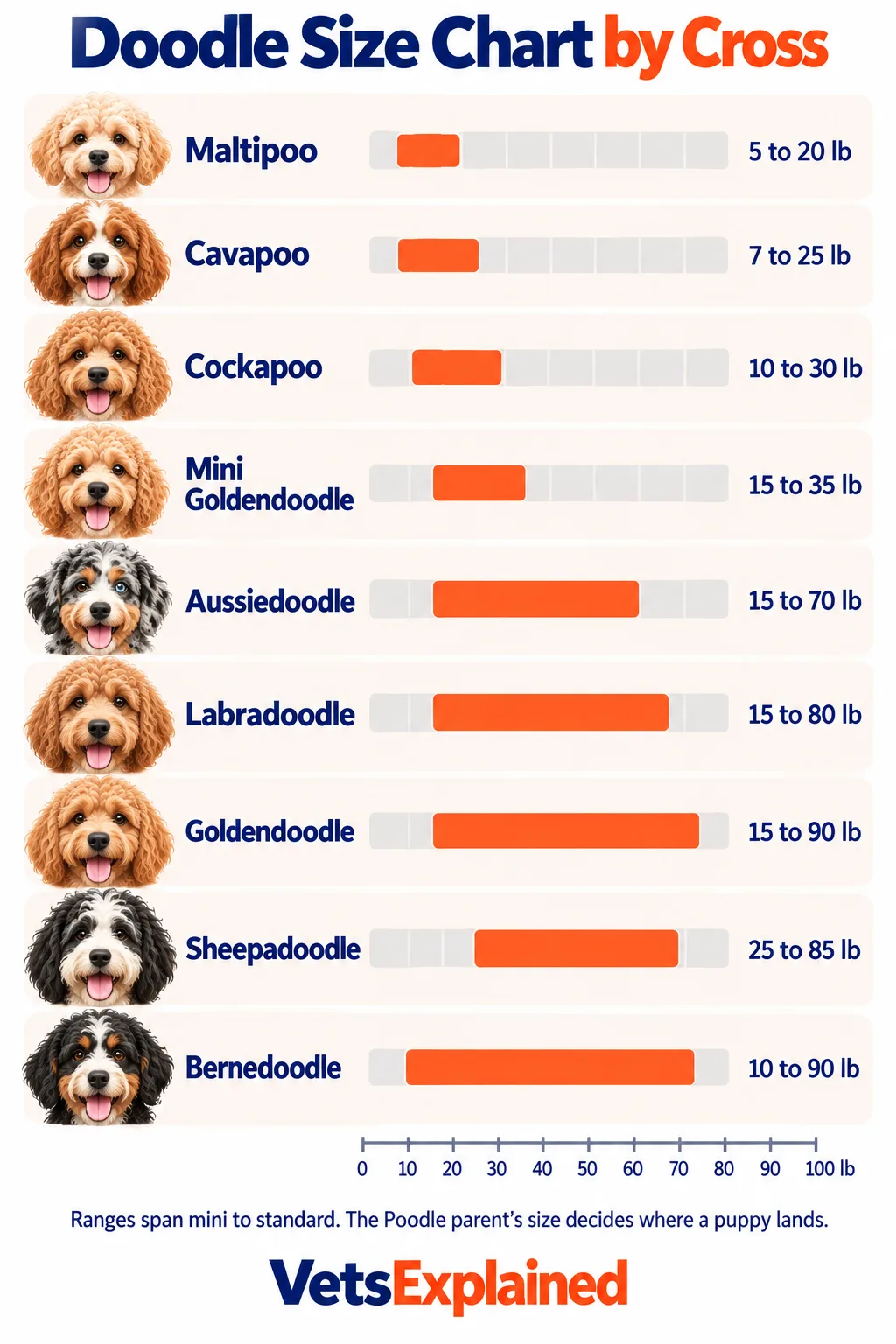
Within each cross, Mini and Standard versions can differ by 40 lb or more, so ask which size a breeder actually produces and what the parents weigh.
3When Do Doodles Stop Growing?
Most Doodles reach adult height by about 12 months and adult weight between 12 and 24 months; the smaller the dog, the earlier it finishes. Height growth stops when the growth plates (physes) near the ends of the long bones close and turn to bone. A veterinary orthopaedic review by von Pfeil and DeCamp sets out the closure times of the different growth plates; a Mississippi State University veterinary teaching case drawing on it gives the range as roughly 8 months in small dogs to 18 months in giant breeds.
- Toy and small Doodles (under about 20 lb): most height by 6 to 8 months, finished by 8 to 12 months.
- Medium Doodles (20 to 50 lb): most height by 9 to 11 months, filling out until 12 to 15 months.
- Large Doodles (50 to 85 lb): height largely done by 12 months, weight continuing to 18 months.
- Giant-leaning Doodles (Standard Bernedoodle): growth plates may not close until 18 months, and weight can climb to 2 years.
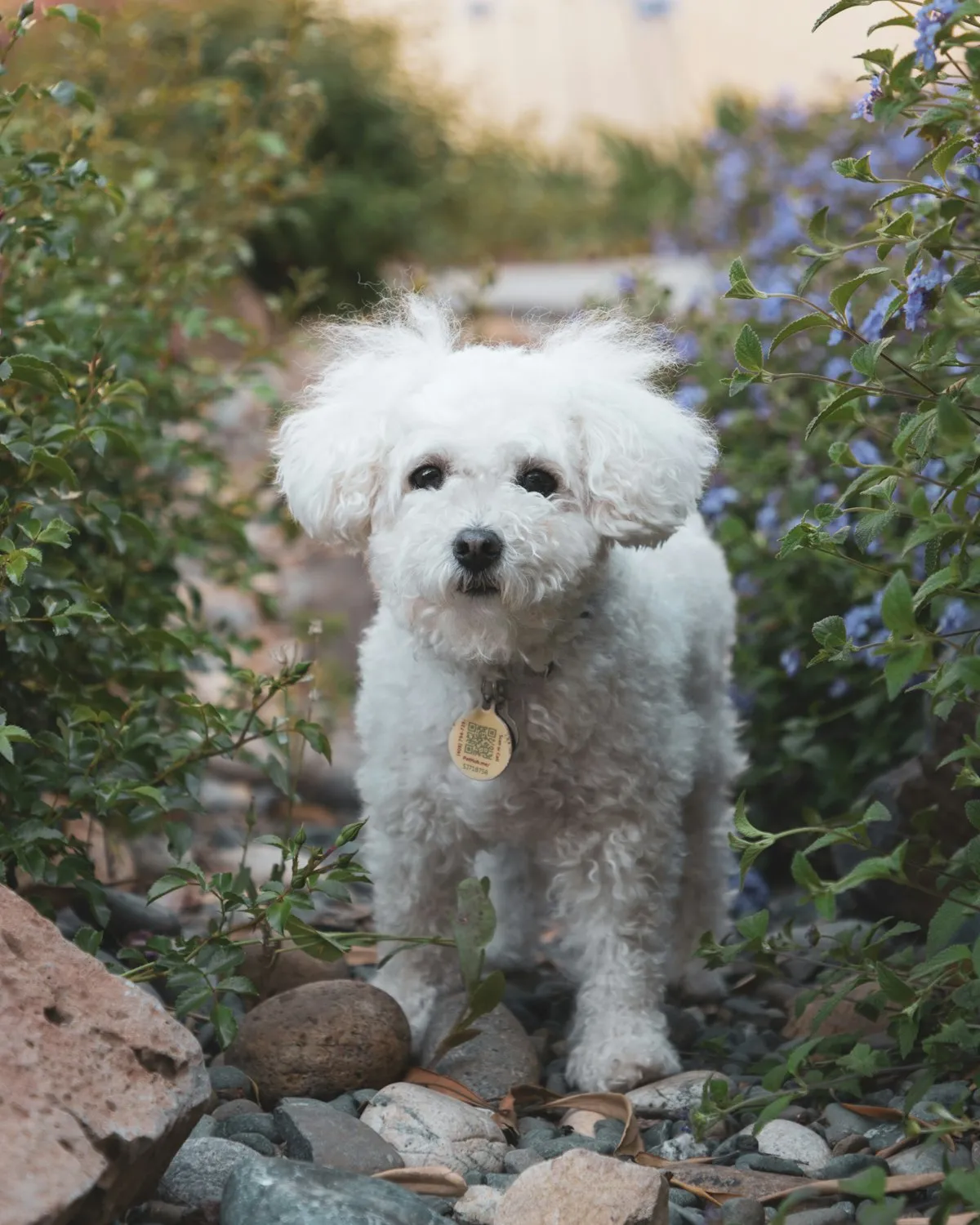
Open growth plates are softer than mature bone. The American College of Veterinary Surgeons notes that tibial growth plate fractures usually follow minor trauma such as a fall or rough play and are most common in active medium and large puppies around 4 to 8 months old, and a fracture through a growth plate can stop that bone growing. That is why vets advise against forced running, long hikes and jumping until the plates have closed, and why large Doodle puppies should eat a large-breed puppy food, which lowers the risk of joint disease such as hip dysplasia. Our feeding guide by life stage covers how much to feed as a puppy grows.
4How Do You Estimate a Doodle Puppy's Adult Weight?
The most reliable way is to look at the measured adult weights of both parents and of previous litters, then plot the puppy on a growth chart matched to its expected size. Everything else is a rule of thumb.
Rules of thumb (approximate only)
These formulas are rough guides, not predictions, and they work less well for crosses than for pure breeds because a Doodle's growth rate depends on which parent it takes after.
- Small Doodles (expected under 20 lb): roughly the 12-week weight × 2, or the 4-month weight × 1.5 to 1.7.
- Medium Doodles (20 to 50 lb): roughly the 4-month weight × 2.
- Large Doodles (over 50 lb): roughly the 6-month weight × 1.5 to 1.7. Doubling the 4-month weight underestimates a large Doodle, because large dogs keep gaining for longer.
- Treat any result as a range of plus or minus 10 lb.
A worked example: a Goldendoodle weighing 22 lb at 4 months is probably heading for 45 to 55 lb, a Medium, not the 30 lb Mini the household may have expected.
The better method: growth charts
Growth standard charts published by Salt and colleagues in 2017, built from the records of millions of dogs seen at Banfield hospitals, give centile curves, much like those used for children, for dogs in five size categories from under 6.5 kg (14 lb) to 40 kg (88 lb). The same paper notes that very small breeds generally reach maturity at about 8 to 12 months while larger breeds can take up to 24 months. A puppy that tracks along one centile line usually stays on it; one that keeps crossing lines upwards is growing into a bigger dog than estimated or being overfed. Ask your vet to plot your Doodle at each puppy visit.
Ask the breeder for the measured height and weight of both parents and the adult weights of previous litters from the same pairing. An 8-week weight estimate is a guess; reputable breeders say so and give a range. If a small adult matters, choose a cross where both parents are small, a multigenerational mini line with documented adult weights, or an adult rescue dog whose size is already known. Our guide to the best Doodles for apartments weighs size against energy and noise.
5What Do "Teacup" and "Micro" Doodle Labels Mean?
They mean whatever the seller wants them to mean, because no breed club defines them. "Toy" at least maps loosely onto the AKC Toy Poodle variety; "teacup" and "micro" correspond to nothing.
- How the size is achieved. Very small Doodles come from breeding the smallest dogs together or from runts, which concentrates the problems of extreme smallness: hypoglycaemia in puppies, fragile bones, luxating kneecaps, collapsing tracheas, dental crowding and difficult whelping.
- The price premium. "Teacup" puppies are often sold above the price of ordinary minis for what is, at best, the smallest of a normal litter and, at worst, an underfed puppy.
- They often are not tiny. A puppy sold as a "micro" at 8 weeks regularly matures to 15 or 20 lb.
A breeder advertising "teacup" Doodles is selling to a market, not breeding to a standard.
6Why Is a Bigger-Than-Expected Doodle So Often Rehomed?
Size runs through most Doodle rehoming stories because every other problem gets harder as the dog gets bigger, even though shelters rarely record "too big" as a reason. In a 2022 analysis of 32,081 dogs relinquished to shelters in British Columbia, housing issues were the second most common reason (17 per cent) and behaviour accounted for 10 per cent, with larger dogs (over 20 kg) significantly more likely than smaller dogs to be given up for behaviour. Landlords and insurers set weight limits, and a Doodle that was going to be "about 30 lb" and grew to 55 lb can fall foul of a lease.
A larger dog in a wool or fleece coat is also a larger grooming bill, and a matted big dog is far more work to shave down; when Dogs Trust took in 159 of the 250 Doodles rescued from a single UK home in 2026, matted coats needing a full shave were the first problem to solve.
The fix: decide the maximum adult size your home, car, budget and lease can handle, add 15 lb to the breeder's estimate for any F1 puppy, and if that number does not work, choose a smaller cross or an adult dog. Our checklist on bringing home a dog covers the other questions to settle first.
7Final Thoughts
How big a Doodle gets comes down to which cross, which Poodle variety, and which two individual parents. The parents' measured weights and a growth chart at the vet's tell you more than any label.
Plan for the top of the range rather than the bottom, treat "teacup" and "micro" as warnings, and give the bones until 12 to 18 months to finish before the dog runs beside a bike. For everything else about choosing a Poodle cross, see our complete Doodle Dog guide.
Sources
- American Kennel Club. Official standard of the Poodle. akc.org
- American Kennel Club. Breed pages with standard height and weight for the Doodle parent breeds. akc.org
- Goldendoodle Association of North America. Goldendoodle breed standard. goldendoodleassociation.com
- Salt C, Morris PJ, German AJ, et al. Growth standard charts for monitoring bodyweight in dogs of different sizes. PLoS One. 2017;12(9):e0182064. journals.plos.org
- von Pfeil DJ, DeCamp CE. The epiphyseal plate: physiology, anatomy, and trauma. Compend Contin Educ Vet. 2009;31(8):E1-E11. pubmed.ncbi.nlm.nih.gov
- Mississippi State University College of Veterinary Medicine. One small step for Mags: physeal fracture case presentation. 2017. vetmed.msstate.edu
- American College of Veterinary Surgeons. Tibial fractures in growing dogs. acvs.org
- Eagan BH, Gordon E, Protopopova A. Reasons for guardian-relinquishment of dogs to shelters: animal and regional predictors in British Columbia, Canada. Front Vet Sci. 2022;9:857634. frontiersin.org
- Dogs Trust. Dogs Trust finds homes for 125 Doodle dogs. 2026. dogstrust.org.uk
Frequently Asked Questions
?How big do Doodles get on average?
There is no single average. Small crosses such as the Maltipoo and Cavapoo mature at 5 to 25 lb, medium Doodles at 25 to 50 lb, and Standard Goldendoodles, Labradoodles, Sheepadoodles and Bernedoodles at 50 to 100 lb.
?What is the smallest Doodle?
The Maltipoo from a Toy Poodle is usually the smallest common Doodle, at 5 to 12 lb and 8 to 12 inches, with Toy Poodle Cavapoos and Toy Cockapoos close behind. Anything advertised as smaller, under a "teacup" or "micro" label, deserves suspicion.
?What is the biggest Doodle?
The Standard Bernedoodle, at 60 to 100 lb and 23 to 29 inches, is the largest of the popular Doodles. Rarer giant crosses such as the Newfypoo and Saint Berdoodle can pass 100 lb. Standard Sheepadoodles and large Goldendoodles follow at 60 to 85 lb.
?At what age is a Doodle fully grown?
Small Doodles are usually fully grown by 8 to 12 months, medium Doodles by 12 to 15 months and large Doodles by 18 months, with Standard Bernedoodles sometimes gaining weight until 2 years. Height finishes first; chest, muscle and weight keep developing afterwards.
?How can I tell how big my Doodle puppy will get?
Ask for the measured adult weights of both parents and of previous litters, then have your vet plot the puppy's weight on a growth chart at each visit. As a rough rule of thumb, doubling the 4-month weight gives a ballpark for a medium Doodle; add more for large crosses.
?Does the F1B generation make a Doodle smaller?
Only if the Poodle used is small. An F1B is an F1 Doodle bred back to a Poodle, so pairing a 45 lb F1 Goldendoodle with a 15 lb Miniature Poodle usually produces smaller puppies; pairing with a Standard Poodle does not. Generation describes ancestry, not size.
?Does neutering affect how big a Doodle gets?
Neutering before the growth plates close tends to delay closure slightly, so early-neutered dogs can end up marginally taller, but the effect on weight is small. The 2017 growth-chart study found neutering made only minor differences compared with normal individual variation.
?Is a 60 lb Goldendoodle a Mini or a Standard?
A Standard. Under the GANA standard, a Standard Goldendoodle is over 21 inches and typically 51 lb or more, a Medium is 17 to 21 inches and 36 to 50 lb, and a Mini is 14 to 17 inches and 26 to 35 lb. Many dogs sold as minis mature into mediums.
Help us do better!
Was this article helpful and relevant?
Thanks for your feedback!
About Sofia Marin
Sofia Marin is VetsExplained's senior editor. She has edited pet and consumer titles for fifteen years and is responsible for the site's editorial standards and breed coverage.
View all posts by Sofia Marin →