Best Doodle Dogs for Allergy Sufferers (and Why None Is Hypoallergenic)
 Written by Sofia Marin
 Fact checked by Dr. Tomas Ellery, DVM
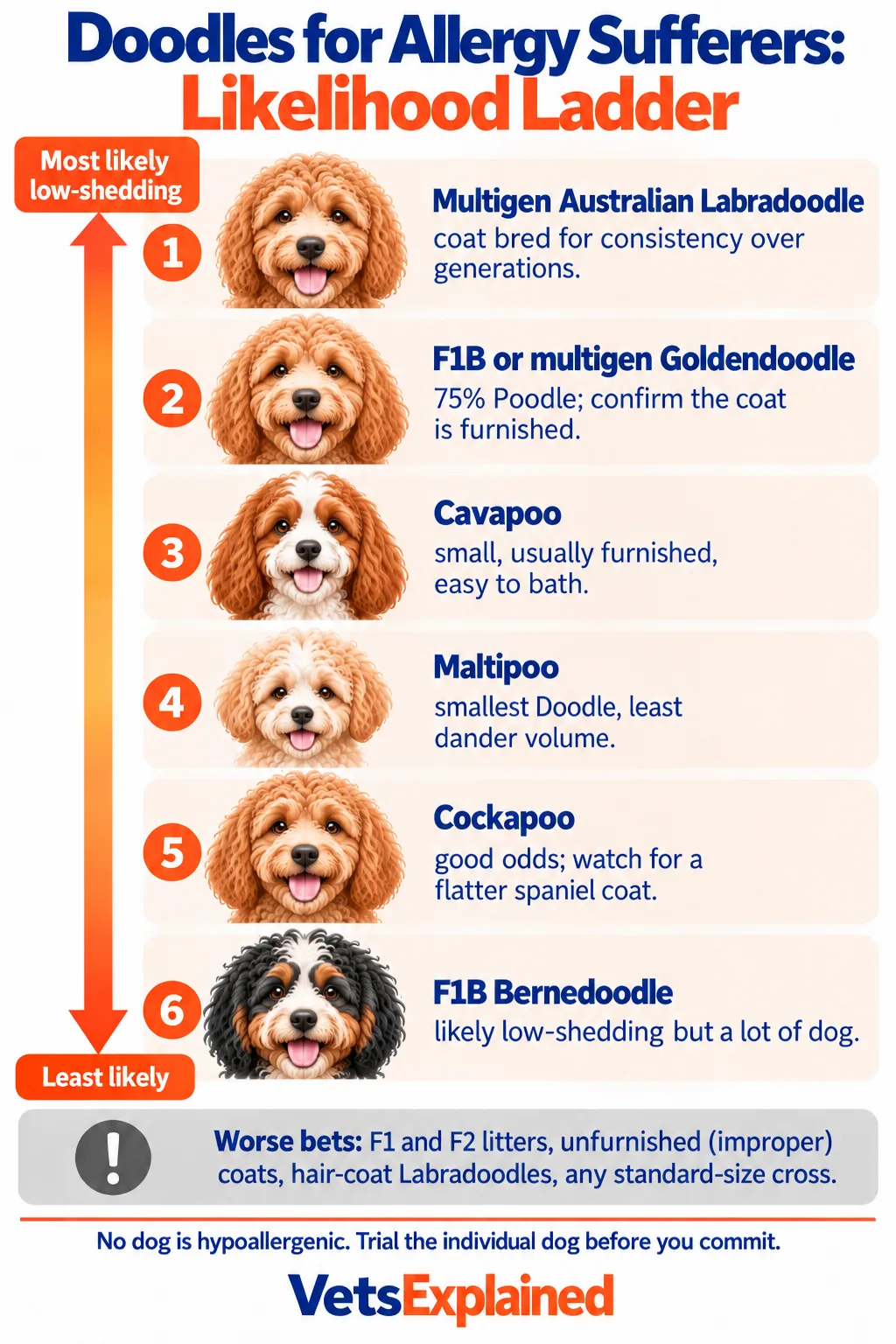
No Doodle is hypoallergenic, but the best bets for a mildly allergic household are small, multigenerational or F1B crosses with a confirmed furnished, curly coat: a multigen Australian Labradoodle, F1B Goldendoodle, Cavapoo, Maltipoo or Cockapoo. Choose a female if you react to Can f 5, and trial the actual dog for 30 days.
The information is current and up-to-date in accordance with the latest veterinary research. Learn more »
The best Doodle for allergy sufferers is a small, multigenerational or F1B cross with a confirmed furnished, curly coat, bought from a breeder who refuses to call it hypoallergenic. That is the honest version of a question most breeder websites answer with a guarantee.
No Doodle is hypoallergenic: the studies that measured allergen in homes with "hypoallergenic" breeds, Labradoodles included, found no less of it in the air than with ordinary dogs. We go through that research in Are Doodles hypoallergenic?, the evidence page behind everything here. This article is the practical shortlist: which crosses and generations are most likely to be low-shedding and furnished, which are poor bets, why the dog's sex can matter, and how to trial a dog before you commit. For the wider picture, see our Doodle Dog guide.
Key Takeaways
- No Doodle is hypoallergenic: the 2011 and 2012 studies found no lower home or airborne allergen with "hypoallergenic" breeds.
- Best bets: small, furnished, curly crosses with predictable coats, led by the multigen Australian Labradoodle, F1B Goldendoodle, Cavapoo and Maltipoo.
- Worst bets: untested F1 and F2 litters, unfurnished coats and 60 to 90 lb crosses such as the Sheepadoodle.
- Can f 5-only reactors (about one in six) may do far better with a female dog.
- Trial the adult dog, run a 30-day diary with twice-weekly baths and a dog-free bedroom, and reject any "hypoallergenic guarantee".
1What "Best for Allergies" Can Honestly Mean
"Best for allergies" means most likely to shed little hair, small enough to bath often, and an individual you have tested and tolerated; it cannot mean allergen-free.
People with dog allergy react to proteins, mainly Can f 1 in saliva and dander and Can f 5 in male dog urine, not to hair. In the 2012 Utrecht study of 356 dogs, Labradoodles and Poodles carried more Can f 1 on their coats than Labradors, and airborne Can f 1 in their homes was no different; the 2011 Henry Ford study found no difference in home dust allergen either. The American Academy of Allergy, Asthma and Immunology says there are no truly hypoallergenic breeds.
So the ranking below ranks the probability of a furnished (bearded), non-shedding coat, which keeps saliva-coated hair off your floors (see whether Doodles shed for the genes); size, because a small dog can be bathed twice a week, which the 1999 Manchester washing study found is what keeps coat allergen down; and predictability. Anyone with dog-triggered asthma should take this list to an allergist, not a breeder.
21. Multigenerational Australian Labradoodle: The Most Predictable Coat
A multigenerational Australian Labradoodle from a club-registered breeder is the Doodle most likely to have a non-shedding coat, because it is the only one bred to a written coat standard for decades. Choose a Mini or Medium with a wool or dense fleece coat.
It is a line developed in Australia from Labrador, Poodle, Cocker Spaniel and a few other breeds, bred to each other for many generations under clubs such as WALA and the ALAA, whose standards call for a single fleece or wool coat and treat the shedding "hair" coat as a fault. After generations of selecting against shedding, almost every puppy in a well-run programme is furnished and low-shedding, and breeders can usually show coat DNA results on both parents. Our Labradoodle guide explains how it differs from the ordinary Labrador-Poodle cross, which sits much further down this list.
- Size: Mini 15 to 30 lb, Medium 30 to 45 lb, Standard 45 to 65 lb; figures vary by club
- Trade-off: price, waiting lists and clipping every 6 to 8 weeks
32. F1B or Multigenerational Goldendoodle: Reliable If the Coat Is Confirmed
An F1B Goldendoodle, an F1 bred back to a Poodle, is about three-quarters Poodle; nearly every F1B puppy is furnished and most are wavy to curly. Choose a Petite or Mini with a curly coat from DNA-tested parents.
The F1 parent carries one copy of the furnishings gene and the Poodle two, so every F1B inherits at least one and a smooth-faced, heavy-shedding "improper coat" cannot occur; curl and the MC5R shedding alleles still vary, so a litter ranges from low-shedding wavy to non-shedding curly. The Goldendoodle Association of North America's breed standard calls low to no shedding the ideal rather than a guarantee, which is the right wording. Our F1 vs F1B vs F2 page explains the labels.
- Size: Petite under 25 lb, Mini 26 to 35 lb, Medium 36 to 50 lb, Standard 51 lb and up, by the GANA standard
- Trade-off: curly F1Bs mat fast and need professional grooming every 6 to 8 weeks
43. Cavapoo: Small, Usually Furnished and Easy to Bath
The Cavapoo ranks high because it is small, most are wavy to curly with furnishings, and a 12 to 20 lb dog can genuinely be washed twice a week.
Cavalier King Charles Spaniels have feathered coats with no furnishings and shed moderately, so some F1 Cavapoos are flatter-coated and shed noticeably; an F1B or multigen with a curly coat is more reliable. Less dog means less dander and saliva, and bathing takes ten minutes in a sink.
- Size: Toy 8 to 14 lb, Miniature 12 to 25 lb
- Trade-off: Cavaliers bring heart disease risk; ask for a cardiologist's clearance on the Cavalier parent
54. Maltipoo: The Smallest Doodle and the Least Dander Volume
The Maltipoo is the smallest common Doodle at 5 to 20 lb, and because both parents are low-shedding single-coated breeds, nearly all Maltipoos shed very little whatever the generation.
The Maltese has a silky coat that drops little hair, and the Toy or Miniature Poodle adds curl and furnishings, so even an F1 is a safe bet for low shedding. A 7 lb dog produces a small fraction of the dander of a Standard Doodle and takes minutes to wash, but lap dogs are near you more, so a dog-free bedroom matters even more.
- Size: 5 to 20 lb, 8 to 14 inches at the shoulder
- Trade-off: fine coats mat quickly, and daily tear-stain cleaning puts your hands in saliva-rich fur
65. Cockapoo: Good Odds, but Watch the Spaniel Coat
The Cockapoo is a reasonable choice when it has a curly or dense wavy coat, but it is more variable than the Cavapoo or Maltipoo because Cocker Spaniels shed moderately and carry a silky, unfurnished coat.
In the UK, where the Cockapoo is probably the most popular Doodle, many are bred without coat DNA testing, and flat-coated, shedding Cockapoos are not rare. A curly-coated Toy or Miniature from furnished parents sheds very little and is small enough for frequent bathing; judge the coat in front of you, not the name.
- Size: Toy under 12 lb, Miniature 12 to 20 lb, Standard 20 to 30 lb or more
- Trade-off: heavy ears and ear infections, which mean more hands-on cleaning
76. F1B Bernedoodle: Likely Low-Shedding, but a Lot of Dog
An F1B Bernedoodle is a good bet for a non-shedding coat and a poor bet on volume: a Standard can weigh 70 to 90 lb, with proportionate skin, saliva and bathing effort.
The Bernese Mountain Dog has a heavy, double, shedding coat and no furnishings, so an F1 Bernedoodle is a coat lottery; breeding back to a Poodle fixes furnishings and shifts most puppies to wavy or curly. Owner surveys on Doodle websites rate Bernedoodles well for allergies, but they are self-reported and say nothing about allergen. In an allergic home, choose a Tiny or Mini F1B with a curly coat.
- Size: Tiny 10 to 24 lb, Mini 25 to 49 lb, Standard 50 to 90 lb
- Trade-off: size, drool in some lines, and the cost of grooming a big curly coat
8The Worse Bets: F1, F2, Unfurnished Coats and Big Crosses
The worst Doodles for an allergic household are first- and second-generation crosses bought as puppies without coat testing, because nobody can tell at eight weeks whether the adult coat will be Poodle wool or a flat retriever coat.
- F1 Goldendoodles and F1 Labradoodles. Every puppy is furnished, but each carries one high-shedding retriever allele, so most shed lightly to moderately and some a great deal; in a 2022 survey of 689 Doodle owners, unexpected shedding was among the commonest complaints.
- F2 Doodles. An F1 bred to an F1: roughly a quarter of puppies inherit no furnishings and grow a smooth-faced, flat, heavily shedding "improper" coat. An untested F2 is the single worst choice.
- Any unfurnished "hair" coat, whatever the generation, sheds like its non-Poodle parent.
- Large crosses. A 60 to 85 lb Sheepadoodle or Standard Bernedoodle makes several times the dander and saliva of a Cavapoo, few owners bath one twice a week, and the Old English Sheepdog's double coat leaves many F1 Sheepadoodles with a shedding undercoat.
9Why a Female Doodle May Matter More Than the Cross
If component testing shows you are sensitised mainly to Can f 5, a female of any cross is likely to be a better choice than a male of the "best" one.
Can f 5 is a prostatic protein made only by male dogs. In a 2023 study of 313 dog-sensitised adults, about one in six reacted to Can f 5 alone. In a 2020 randomised trial, children sensitised only to Can f 5 all reacted to male dog extract on skin-prick testing and only one of seven reacted to female extract; children sensitised to several dog proteins reacted to both.
Ask your allergist for component-resolved testing before you shortlist a breed. A Can f 5-only reactor should choose a female, or at least avoid an intact male; whether neutering helps has not been studied. A Can f 1 reactor gains nothing from the dog's sex.
10How to Trial a Doodle Before You Commit
The only reliable test is time with the specific adult dog, in an enclosed space, after you know what you react to.
1. Get tested first, with skin-prick and component blood tests. 2. Meet the adult dog, not just the puppy. Spend an hour in a closed room with the mother or an adult from the same lines, then wait; late-phase reactions take 4 to 8 hours. Repeat on another day, and keep a blanket the dog has slept on in your bedroom for a week. 3. Foster or borrow if you can. The Asthma and Allergy Foundation of America suggests fostering before adopting; many rescues and some breeders will arrange a two to four week trial. 4. Agree the return terms in writing, along with the other decisions in our checklist on bringing home a dog.
11A 30-Day Home Protocol for the First Month
Treat the first 30 days with a new Doodle as a controlled trial: keep the house as low-allergen as you ever intend to, and keep a symptom diary so the decision rests on data rather than attachment.
- Before the dog arrives: HEPA vacuum every soft surface, remove bedroom rugs, run a HEPA air cleaner in the bedroom and living room, fix the dog-free zones (bedroom always) and start any recommended medication a week early to learn your baseline.
- Bath the dog twice a week with a mild shampoo. The Manchester study found washing removed about 85 per cent of recoverable Can f 1, but levels were back to baseline by day three.
- Brush outdoors, by a non-allergic person, wash your hands after handling, wash the dog's bedding weekly at 60°C and damp-mop floors twice a week.
- Score symptoms every evening from 0 to 10 for nose, eyes, chest and skin, and at day 30 compare the second fortnight with the first and with your baseline. Flat or improving scores are a pass; rising scores, any chest symptoms or needing more medication are a fail, and the kindest time to return the dog is now, not at 14 months. Repeat the diary at 12 months, once the adult coat and male Can f 5 production have arrived.
12Breeder "Hypoallergenic Guarantee" Red Flags
Any breeder who guarantees a puppy is hypoallergenic is promising what the research says they cannot deliver. Walk away from:
- "100 per cent hypoallergenic", "non-allergenic" or "allergy-free" puppies. No such dog exists.
- "Guaranteed non-shedding" F1 or F2 litters, or a premium price attached to the word "hypoallergenic".
- Coat DNA results or "allergy-tested" puppies presented as allergy proof. Coat tests predict shedding; no validated test measures allergen output.
- Refusing an adult-dog visit, or no return policy for allergy. The honest wording is "many mildly allergic owners do well, we cannot promise it, and we will take the dog back if not."
13Pros and Cons of Choosing a Doodle for an Allergic Home
Potential advantages
- Furnished, curly Doodles drop very little allergen-coated hair
- Small crosses such as the Cavapoo and Maltipoo can realistically be bathed twice a week
- A female may suit a Can f 5-only reactor
Potential challenges
- Not hypoallergenic: airborne Can f 1 was no lower in "hypoallergenic" breed homes in two studies
- F1 and F2 coats cannot be confirmed until 10 to 14 months
- Twice-weekly bathing, grooming every 6 to 8 weeks and a lifelong dog-free bedroom
14Final Thoughts
The odds favour a small, furnished, curly-coated dog from a multigenerational or F1B programme, and are worst for untested F1 and F2 litters, unfurnished coats and the big crosses. But the breed is the smallest part of the decision: get component testing, trial the actual adult dog more than once, run the first 30 days with a diary and a return clause, and buy only from a breeder who will say out loud that no dog is hypoallergenic. For everything else about Poodle crosses, see our complete Doodle Dog guide.
Sources
- Vredegoor DW, Willemse T, Chapman MD, et al. Can f 1 levels in hair and homes of different dog breeds: lack of evidence to describe any dog breed as hypoallergenic. J Allergy Clin Immunol. 2012;130(4):904-9. pubmed.ncbi.nlm.nih.gov
- Nicholas CE, Wegienka GR, Havstad SL, et al. Dog allergen levels in homes with hypoallergenic compared with nonhypoallergenic dogs. Am J Rhinol Allergy. 2011;25(4):252-6. pubmed.ncbi.nlm.nih.gov
- Schoos AM, Chawes BL, Bloch J, et al. Children monosensitized to Can f 5 show different reactions to male and female dog allergen extract provocation: a randomized controlled trial. J Allergy Clin Immunol Pract. 2020;8(5):1592-7. pubmed.ncbi.nlm.nih.gov
- Özuygur Ermis SS, Borres MP, Basna R, et al. Sensitization to molecular dog allergens in an adult population: results from the West Sweden Asthma Study. Clin Exp Allergy. 2023;53(1):88-104. pmc.ncbi.nlm.nih.gov
- Hodson T, Custovic A, Simpson A, et al. Washing the dog reduces dog allergen levels, but the dog needs to be washed twice a week. J Allergy Clin Immunol. 1999;103(4):581-5. pubmed.ncbi.nlm.nih.gov
- Hladky-Krage B, Hoffman CL. Expectations versus reality of designer dog ownership in the United States. Animals. 2022;12(23):3247. pmc.ncbi.nlm.nih.gov
- Goldendoodle Association of North America. Goldendoodle breed standard. goldendoodleassociation.com
- American Academy of Allergy, Asthma and Immunology. Pet allergy. aaaai.org
- Asthma and Allergy Foundation of America. Pet allergy: are you allergic to dogs or cats? aafa.org
Frequently Asked Questions
?Which Doodle is best for allergy sufferers?
None is hypoallergenic, but the best odds are a small, furnished, curly-coated dog from a predictable programme: a multigenerational Australian Labradoodle, a Mini F1B Goldendoodle, a Cavapoo or a Maltipoo. The individual dog, its sex and home management matter more than the cross.
?Is an F1B Doodle better than an F1 for allergies?
Usually. An F1B is about three-quarters Poodle, every puppy is furnished, and most are wavy to curly and low-shedding. An F1 carries one high-shedding retriever allele and sheds lightly to moderately. Neither produces less allergen; the F1B simply drops less hair.
?Are F2 Doodles bad for allergies?
Untested F2 litters are the worst choice, because around a quarter of puppies inherit no furnishings and grow a flat, heavily shedding coat that cannot be identified at eight weeks. A DNA-tested F2 from furnished parents is a different matter.
?Is a Cavapoo or a Maltipoo better for allergies?
Both are small enough to bath twice a week. The Maltipoo is more reliably low-shedding because both parents are low-shedding breeds; some F1 Cavapoos inherit the Cavalier's flatter, shedding coat. Test the individual dog either way.
?Are Bernedoodles hypoallergenic?
No. F1B and multigen Bernedoodles are likely to have furnished, low-shedding coats, but an F1 is a coat lottery because the Bernese parent sheds heavily. Standards are also large, so they make more dander and are hard to bath often. Choose a Tiny or Mini F1B.
?Does a female Doodle help with allergies?
It can, if you are sensitised mainly to Can f 5, a protein made only by male dogs. In a 2020 trial, six of seven children sensitised only to Can f 5 tolerated female dog extract. If you react to Can f 1, the dog's sex makes no difference.
?Can I rely on a coat DNA test to pick an allergy-friendly puppy?
Only for shedding. Furnishings and MC5R results predict how much hair a puppy will drop, but no commercial test measures how much Can f 1 or Can f 5 a dog produces. Use DNA results to avoid shedding coats, then test the dog itself.
?Do puppies cause fewer allergy symptoms than adult dogs?
Yes, which is a trap. Puppies produce less allergen, the adult coat has not come in, and males are not yet making Can f 5. A puppy that causes no symptoms at eight weeks can be a problem at a year old, so test an adult from the same lines.
Help us do better!
Was this article helpful and relevant?
Thanks for your feedback!
About Sofia Marin
Sofia Marin is VetsExplained's senior editor. She has edited pet and consumer titles for fifteen years and is responsible for the site's editorial standards and breed coverage.
View all posts by Sofia Marin →