F1 vs F1B vs F2 Doodle: What the Generations Mean and Which to Choose
 Written by Sofia Marin
 Fact checked by Dr. Tomas Ellery, DVM
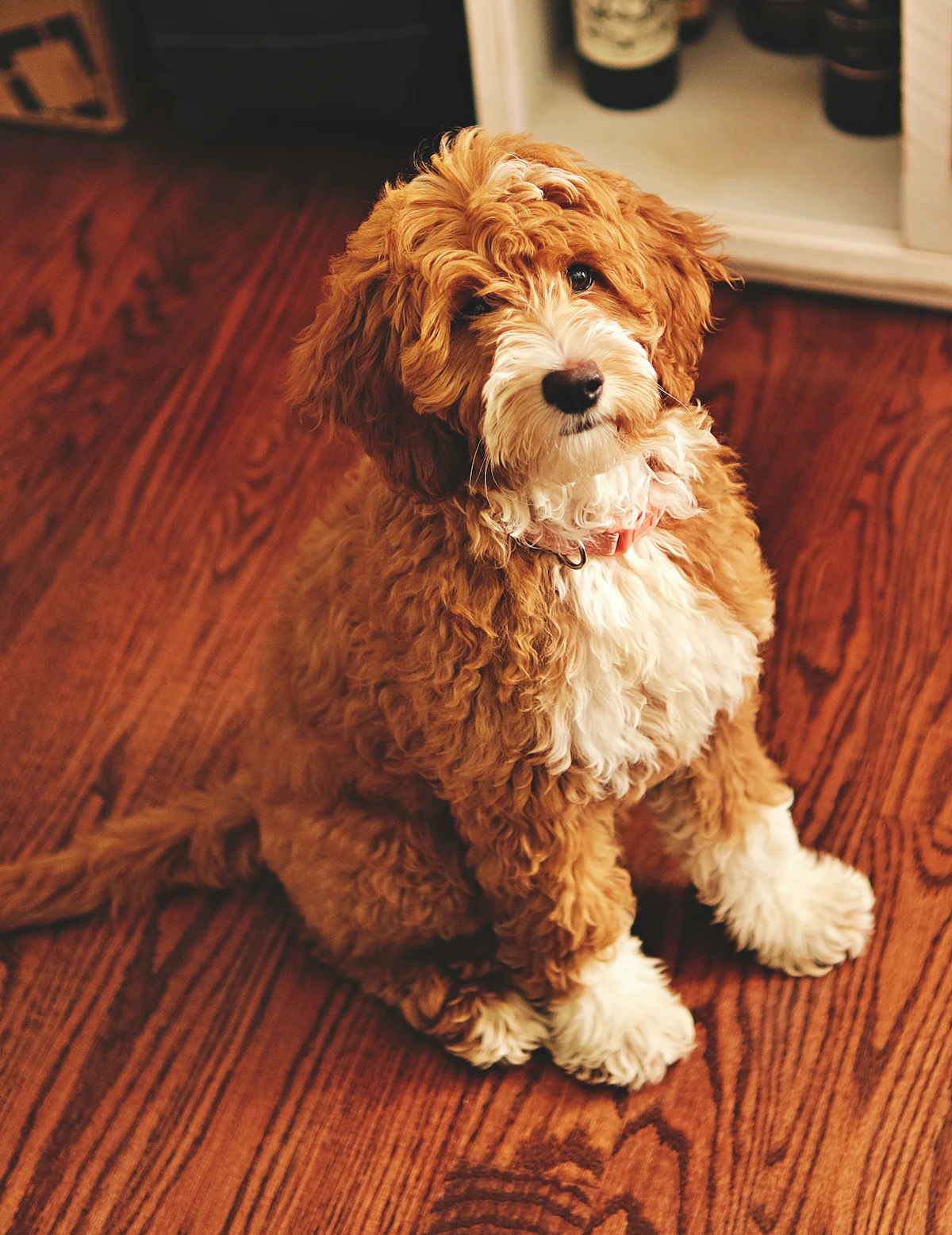
F1 means purebred × Poodle (about 50% Poodle), F1B means F1 × Poodle (about 75%), F2 means F1 × F1 (about 50%, but the most variable). More Poodle makes a curly, low-shedding coat more likely but never guaranteed, and no generation is healthier or hypoallergenic.
The information is current and up-to-date in accordance with the latest veterinary research. Learn more »
Any Doodle breeder's website comes with a small alphabet: F1, F1B, F1BB, F2, F2B, F3, multigen. The letters look scientific, and breeders often price puppies by them. In reality they describe one thing: how many times, and in which direction, a line has been crossed back towards the Poodle. They say something about the odds of a curly, low-shedding coat and nothing certain about any individual puppy.
This guide explains what each label means, what it does to coat, shedding, size, temperament and health, which generation suits which buyer, how to check a breeder's claim, and why the price gaps are often larger than the real differences. It applies to every Poodle cross, from the Goldendoodle and Labradoodle to the Cavapoo and Bernedoodle. If you are new to Poodle crosses, start with our Doodle Dog guide.
Key Takeaways
- F1 is purebred × Poodle (50% Poodle), F1B is F1 × Poodle (about 75%), F1BB about 87.5%, F2 is F1 × F1 (about 50% but the most variable), and multigen means Doodle × Doodle for three or more generations.
- Coat follows two testable genes, furnishings (RSPO2) and curl (KRT71): every F1 is furnished and usually wavy, about half of F1Bs are curly, and about one F2 in four has no furnishings and sheds.
- Generation does not predict temperament or health: a 2024 study found no difference in 87% of health comparisons between Doodles and their parents, and a 2026 study found more undesirable behaviours in Doodles in 32 of 72 comparisons.
- No generation is hypoallergenic.
- Verify claims with both parents' pedigrees, health certificates and coat DNA results; F1Bs typically cost 500 to 1,500 dollars more than F1s in the US, but prices vary by region.
1What Do F1, F1B and F2 Mean in Doodles?
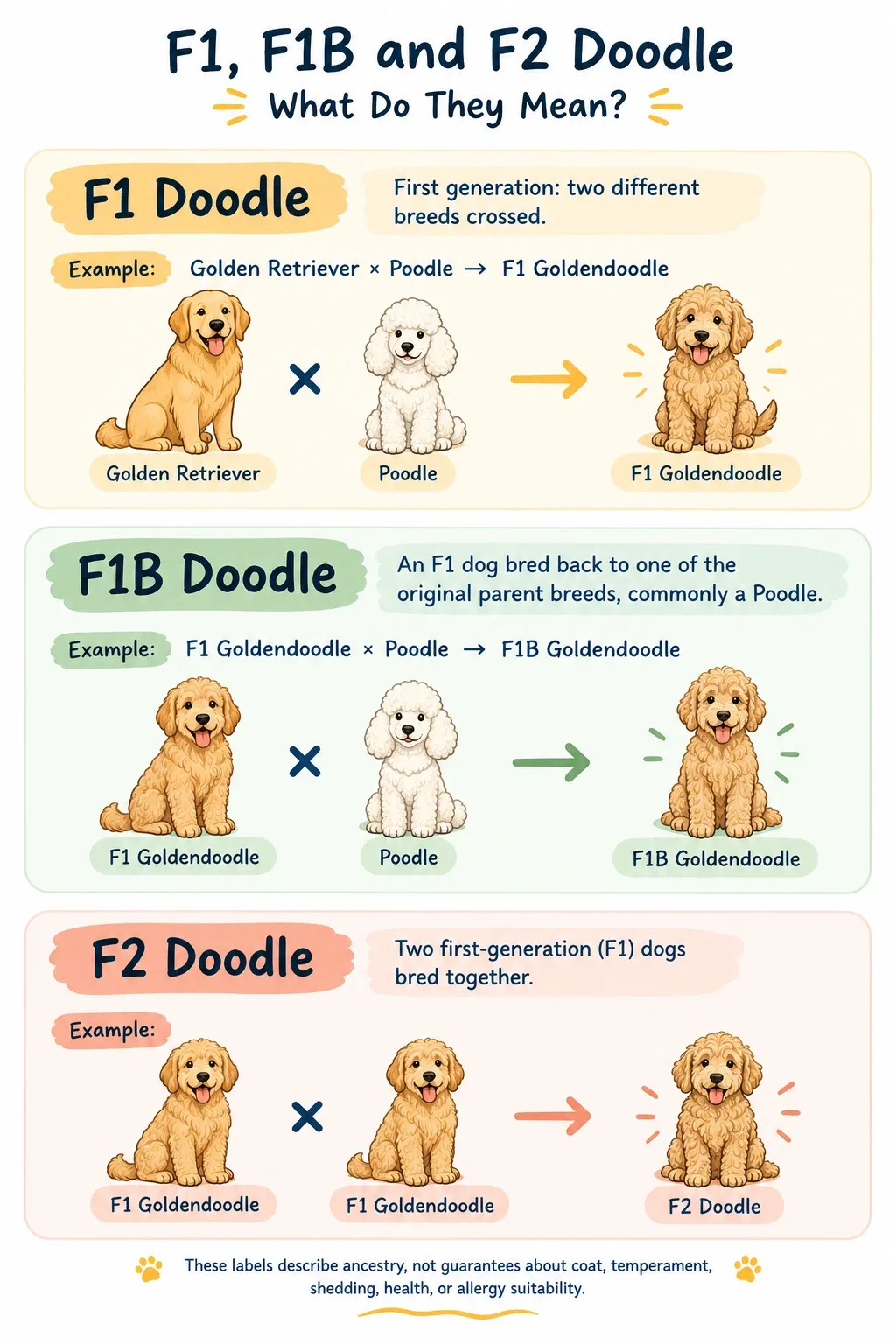
The "F" stands for filial generation, a term from classical genetics, and the number counts how many generations the line is from the two original purebred parents. A "B" means backcross: a Doodle bred back to one of the parent breeds, almost always the Poodle.
- F1: purebred (for example Golden Retriever) × purebred Poodle. 50% Poodle.
- F1B: F1 Doodle × Poodle. About 75% Poodle. If the backcross is to the other breed it is still called F1B but is about 25% Poodle, so ask which.
- F1BB: F1B × Poodle. About 87.5% Poodle.
- F2: F1 × F1. About 50% Poodle on average, but the widest spread of any generation.
- F2B: F2 × Poodle (about 75%) or, in some breeders' usage, F1 × F1B (about 62.5%). The two definitions are not the same dog.
- F3: F2 × F2, or any pairing of two second-generation-or-later Doodles. Usually 50 to 60% Poodle.
- Multigen: Doodle × Doodle for three or more generations. Most established lines sit between 50 and 75% Poodle.
No kennel club or scientific body defines these labels, so "F2B" can mean two pedigrees and "multigen" almost anything. And the percentages are averages, not measurements of any one puppy.
2Why "75% Poodle" Is Not Really 75%
Only the F1 figure is exact, because an F1 receives half its chromosomes from each parent. After that, each egg or sperm carries a random shuffle of retriever and Poodle chromosomes, so two F1B littermates can differ noticeably in Poodle content and two F2 littermates can differ enormously: one near 70% Poodle and curly, its sibling near 30% and looking like a wavy Golden. This is why experienced breeders avoid F2 litters, and why a commercial DNA test so often disagrees with the paperwork.
3How Generation Affects Coat and Shedding
Dog coat type is controlled largely by three genes, identified in a 2009 study in Science of more than 1,000 dogs across 80 breeds. Two matter for Doodles:
- RSPO2 controls "furnishings", the longer muzzle and eyebrow hair that gives a Doodle its teddy-bear face. The variant is dominant, so one copy is enough. Poodles carry two copies; retrievers, spaniels and most other parent breeds carry none.
- KRT71 controls curl. Poodles carry two copies; most other parent breeds none. One copy usually gives a wavy coat, two curly, none straight.
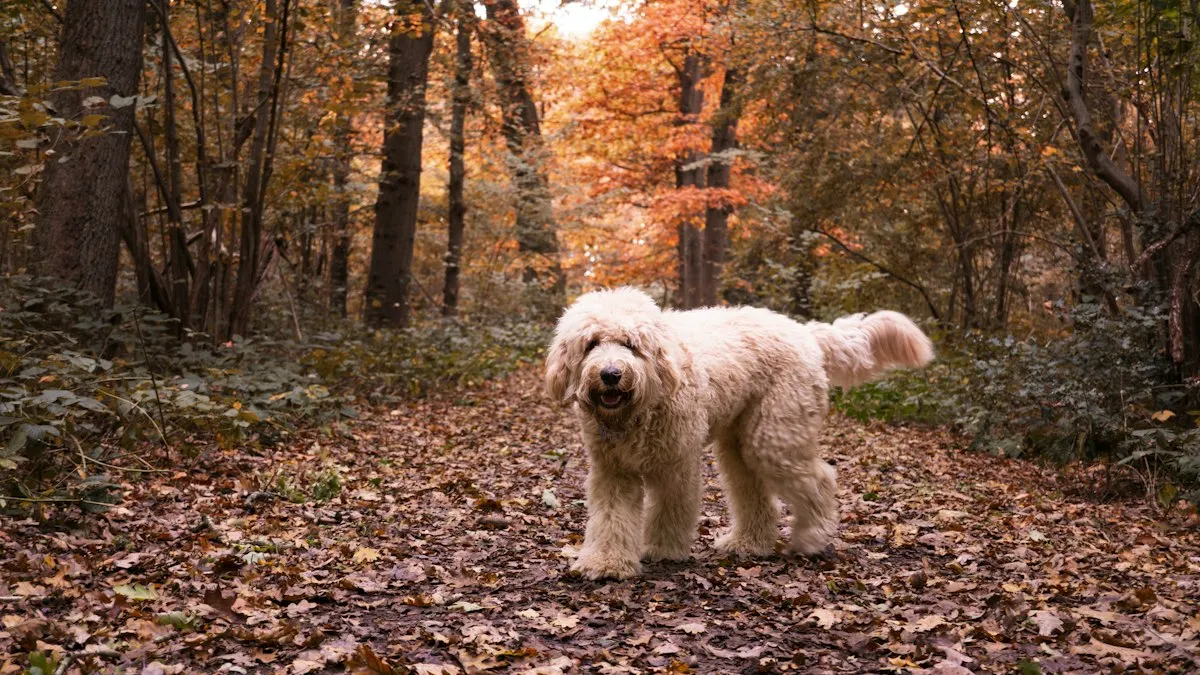
Run the generations through those two genes:
- F1: every puppy gets one furnishings copy and one curl copy from the Poodle. Nearly every F1 is furnished and most are wavy, which is why F1 litters look uniform and shed less than the retriever parent but more than a Poodle.
- F1B (to Poodle): the F1 parent passes on a curl copy half the time; the Poodle always does. Roughly half the litter is curly, half wavy, all furnished. Shedding is lower on average than F1, which is the real reason F1Bs are sold to allergy-conscious buyers.
- F1BB: around three-quarters curly; essentially a Poodle coat with Poodle grooming.
- F2 (F1 × F1): each parent passes each gene on half the time, so on average one puppy in four has no furnishings at all. These "improper coat" Doodles look like a smooth-faced retriever and shed like one. The rest range from straight-with-beard to curly.
- Multigen: depends on the breeder. Good ones DNA-test for furnishings and curl and pair accordingly; poor ones produce the same lottery as an F2.
Furnished, curly coats trap loose hair instead of dropping it, which is why they appear not to shed and why they mat so easily; a curlier F1B sheds less but needs more brushing, as our guide to whether Doodle dogs shed explains. Because both genes are cheaply testable, the honest way to promise a coat is to show the parents' RSPO2 and KRT71 results, not a generation label.
4Does Generation Affect Size?
Only indirectly. Size comes from the size of the Poodle used (Toy, Miniature or Standard) and of the other parent, not from the generation number; an F1B backcrossed to a Miniature Poodle will usually be smaller than its F1 parent, one backcrossed to a Standard Poodle will not. What generation changes is predictability: an F1 litter from a 70 lb Golden and a 45 lb Standard Poodle usually lands between those figures, F2 litters spread wider, and multigen lines bred to a consistent size are the most predictable. The parents' measured height and weight always predict a puppy better than the label.
5Does Generation Affect Temperament?
Not in any way that has been demonstrated. The common claim is that F1s balance a retriever's easygoing nature with a Poodle's intelligence, while F1Bs are more "Poodle-like": sharper, more sensitive, more reserved with strangers. That is plausible but untested, and individual variation within a generation dwarfs any average difference between generations.
What has been tested is whether Doodles land between their parents at all. In 2026 the Royal Veterinary College published a study of 9,402 UK dogs comparing owner-reported behaviour (C-BARQ) in Cockapoos, Cavapoos and Labradoodles with their parent breeds. Across 72 comparisons the Doodles scored worse than a parent breed in 32, better in 7 and no different in 33. Cockapoos scored worse in all 16 comparisons where they differed, including owner-directed aggression; Labradoodles came out best, worse in 5 and better in 6. The authors found "little support" for the idea that crosses land neatly between their parents.
The study recorded generation but did not analyse it. A generation label is not a temperament guarantee; the parents' temperaments, early socialisation and training matter far more.
6Does Generation Affect Health? The Hybrid Vigour Question
No generation has been shown to be healthier than another, and the broader claim that Doodles are healthier than purebreds because of "hybrid vigour" is not supported by the best available evidence.
Hybrid vigour, or heterosis, is real in livestock breeding: an F1 between unrelated lines is unlikely to inherit the same recessive disease genes from both sides. In theory the effect is strongest in F1s and fades in F1B, F1BB and multigen dogs, which are bred back towards one breed or within a closed Doodle population.
In practice, a 2024 Royal Veterinary College study of 9,402 UK dogs under five years old compared 57 common disorders in 1,856 Cockapoos, 583 Labradoodles and 985 Cavapoos against their parent breeds. In 296 of 342 comparisons (87%) there was no significant difference; the crosses had higher odds in 24 and lower odds in 22. Labradoodles had lower odds of hip and elbow dysplasia than Labradors but higher odds of ear infections, and all three crosses had higher odds of vomiting and diarrhoea than Poodles. The authors concluded that the results "offer little support" for hybrid vigour.
The study did not analyse by generation, and only 20% of the dogs were confirmed F1s, so mixed generations may have diluted any F1 advantage. But the lesson holds: a Doodle of any generation inherits the risks of both parents. An F1B Goldendoodle still carries the Golden Retriever's cancer and heart risks, now with a larger dose of the Poodle's, including Addison's disease, sebaceous adenitis and patellar luxation. Our guides to Doodle health problems and hip dysplasia cover what to watch for.
Health comes from testing, not from a letter and a number. The Goldendoodle Association of North America requires breeder members to test breeding dogs for hips, elbows, eyes, heart and patellas plus a DNA panel (prcd-PRA, GR-PRA1 and GR-PRA2, von Willebrand's disease, ichthyosis, degenerative myelopathy), with results on the Orthopedic Foundation for Animals registry; the United Poodle Association publishes a similar minimum for Poodles. Ask for those certificates for both parents, whatever the generation.
7Which Generation Is Best for Allergies?
None is hypoallergenic, and no breeder can promise one will be. People react to proteins in dander, saliva and urine, which every Doodle produces whatever its coat. Curly, furnished coats drop less dander around the home, so some allergic people find a curly F1B or F1BB easier to live with; others react just as badly. If allergies drive the decision, choose a breeder who DNA-tests for curl and furnishings, then spend time with the actual puppy, more than once, before paying. Our article on whether Doodles are hypoallergenic covers the research.
8Which Generation Suits Which Buyer?
Match the generation to what you need rather than to the breeder's price list.
- F1: you want the classic shaggy, wavy look, accept moderate shedding and want the easiest Doodle coat to maintain.
- F1B (to Poodle): you want the lowest-shedding coat you can reasonably get, accept that about half the litter will be wavy, and are ready for Poodle-level grooming: brushing to the skin several times a week and clipping every six to eight weeks.
- F1BB: you really want a Poodle coat; ask whether a well-bred Poodle would serve you better.
- F2, F2B and F3: only if you do not mind which coat you get, or the breeder can show coat DNA results for both parents.
- Multigen: you want the most predictable coat, size and type, will pay for it, and will insist on registered pedigrees and documented testing. The Australian Labradoodle, bred to a written standard under the Australian Labradoodle Association of America, is the best-developed example.
9How to Verify a Breeder's Generation Claim
Ask for both parents' pedigrees and health certificates and check them yourself; a label is only as reliable as the paperwork behind it.
- See both parents' registrations. For an F1, both parents should be kennel-club registered; for an F1B, the Doodle parent's parents should be. Multigen breeders should hold pedigrees registered with GANA, ALAA, WALA or a similar club.
- Ask which breed the "B" refers to. An F1B backcrossed to a Golden Retriever is 75% Golden and will almost certainly shed.
- Ask for coat DNA results. A breeder promising a low-shedding litter should show furnishings (RSPO2) and curl (KRT71) results for both parents. If they do not know what those are, the promise is a guess.
- Check health certificates against the registries. OFA results are searchable online by registered name. "Vet-checked" is not health testing.
- Consider a DNA test after purchase. Ancestry tests estimate the Poodle percentage, though Embark cautions that a percentage cannot settle registered purebred status. Because littermates vary, 68% does not mean an F1B was mislabelled; near 50% on a puppy sold as F1BB would be.
10How Much Do F1, F1B and F2 Doodles Cost?
Prices vary widely by country, region, cross, size and breeder, so treat every figure as a rough guide; the generation premium is often larger than the real difference between the dogs.
- F1: usually the baseline. In the United States, F1 Goldendoodles and Labradoodles from health-tested parents commonly list at around 1,500 to 3,000 dollars in 2026, with miniatures and fashionable colours at the upper end.
- F1B and F1BB: typically 500 to 1,500 dollars above an equivalent F1 from the same breeder. The extra buys better odds of a curly coat, not a healthier or better-tempered dog.
- F2: sources disagree; some breeders price F2 litters below F1s because of the coat lottery, others above. There is no good reason to pay a premium for an F2.
- Multigen and Australian Labradoodle: usually the most expensive, often 3,000 to 5,000 dollars or more in the US, when registered pedigrees and multi-generation testing are actually present.
UK, Australian and European prices follow the same pattern in local currency. A very low price for any generation is a warning sign.
11F1 vs F1B vs F2 Doodle: Pros and Cons
Potential advantages
- F1: uniform wavy look, the easiest Doodle coat to groom, usually the lowest price
- F1B: about half the litter curly, the lowest shedding of the common generations
- F1BB: nearly Poodle-level coat consistency
- Multigen: the most predictable coat, size and type from a club-registered, tested breeder
Potential challenges
- F1: sheds more than people expect
- F1B and F1BB: Poodle-level grooming for life, a higher price for a coat that is still not guaranteed, more Poodle health risks
- F2: about one puppy in four with no furnishings and a shedding coat; the least predictable generation
- Multigen: expensive, unregulated as a term, and quality varies enormously between breeders
12Final Thoughts
The generation system is useful for one thing: estimating the odds of a furnished, curly, low-shedding coat. F1 gives a wavy coat almost every time; F1B improves the odds of curl at the cost of more grooming; F2 is a gamble; multigen is only as good as the breeder behind it. None of it predicts health, temperament or allergy suitability.
Choose the breeder first, then the parents, then the generation. Ask for coat DNA results if the coat matters, health certificates in every case, and the parents' measured sizes. Judged that way, a well-bred F1 beats a badly bred multigen every time. For the wider picture, our complete Doodle Dog guide is the place to go next.
Sources
- Bryson GT, O'Neill DG, Brand CL, Belshaw Z, Packer RMA. The doodle dilemma: how the physical health of "designer-crossbreed" Cockapoo, Labradoodle and Cavapoo dogs compares to their purebred progenitor breeds. PLoS One. 2024;19(8):e0306350. pmc.ncbi.nlm.nih.gov
- Bryson GT, O'Neill DG, Belshaw Z, Brand CL, Packer RMA. Comparing undesirable behaviours between "designer" Poodle-cross dogs and their purebred progenitor breeds. PLoS One. 2026;21(2):e0342847. journals.plos.org
- Cadieu E, Neff MW, Quignon P, et al. Coat variation in the domestic dog is governed by variants in three genes. Science. 2009;326(5949):150-153. pmc.ncbi.nlm.nih.gov
- Goldendoodle Association of North America. Health testing standards and ethical breeding. goldendoodleassociation.com
- United Poodle Association. Health testing for puppy buyers. 2024. unitedpoodleassociation.org
- Orthopedic Foundation for Animals. Health testing registry and CHIC programme. ofa.org
- Australian Labradoodle Association of America. Breed standard, pedigree registration and health testing requirements. alaa-labradoodles.com
- Embark Veterinary. Why does my registered purebred dog have mixed-breed ancestry? help.embarkvet.com
Frequently Asked Questions
?What does F1B mean in a Doodle?
F1B means a first-generation Doodle bred back to one of the original breeds, almost always a Poodle, giving a puppy about 75% Poodle on average. The "B" stands for backcross. Ask which breed was used, because an F1B bred back to a Golden Retriever is 75% Golden and will usually shed.
?Is F1 or F1B better?
Neither is better overall. An F1 has a more predictable wavy coat that is easier to groom but sheds moderately. An F1B is more likely to be curly and low-shedding but needs Poodle-level grooming and costs more. Health and temperament have not been shown to differ.
?Which Doodle generation sheds the least?
On average F1BB and well-bred multigen Doodles shed least, then F1B, then F1. F2 litters can contain both the lowest- and highest-shedding puppies, because shedding follows the furnishings and curl genes rather than the label.
?Is an F2 Doodle a bad choice?
Not bad, but unpredictable. Because both F1 parents carry one copy each of the furnishings and curl genes, roughly a quarter of F2 puppies have no furnishings and shed like the retriever or spaniel parent, while others are curly. Choose an F2 only if you do not mind which coat you get.
?Are F1B Doodles hypoallergenic?
No. No dog is hypoallergenic, because allergy sufferers react to proteins in dander, saliva and urine that every dog produces. Curly F1B coats drop less dander around the home, which helps some people. Spend time with the specific puppy before buying, and treat any "hypoallergenic guarantee" as a red flag.
?Are F1 Doodles healthier because of hybrid vigour?
Not according to current evidence. A 2024 Royal Veterinary College study of 9,402 dogs found no significant difference between Doodles and their parent breeds in 87% of 342 health comparisons, and the authors said the results offered little support for hybrid vigour.
?How can I check whether my Doodle is really an F1B?
Ask for both parents' pedigrees, the grandparents' registrations and coat DNA results. After purchase, an ancestry DNA test estimates the Poodle percentage; because littermates vary, roughly 60 to 85% is consistent with F1B, while near 50% on a puppy sold as F1BB is a genuine discrepancy.
?Why do F1B Doodles cost more than F1s?
Breeders charge for the higher odds of a curly, low-shedding coat, the trait most buyers ask for. In the US the premium is typically 500 to 1,500 dollars, though prices vary by region and breeder. The extra buys better coat odds, not a healthier or better-behaved dog.
Help us do better!
Was this article helpful and relevant?
Thanks for your feedback!
About Sofia Marin
Sofia Marin is VetsExplained's senior editor. She has edited pet and consumer titles for fifteen years and is responsible for the site's editorial standards and breed coverage.
View all posts by Sofia Marin →