Doodle Coat Types: Straight, Wavy and Curly Coats Explained
 Written by Sofia Marin
 Fact checked by Dr. Tomas Ellery, DVM
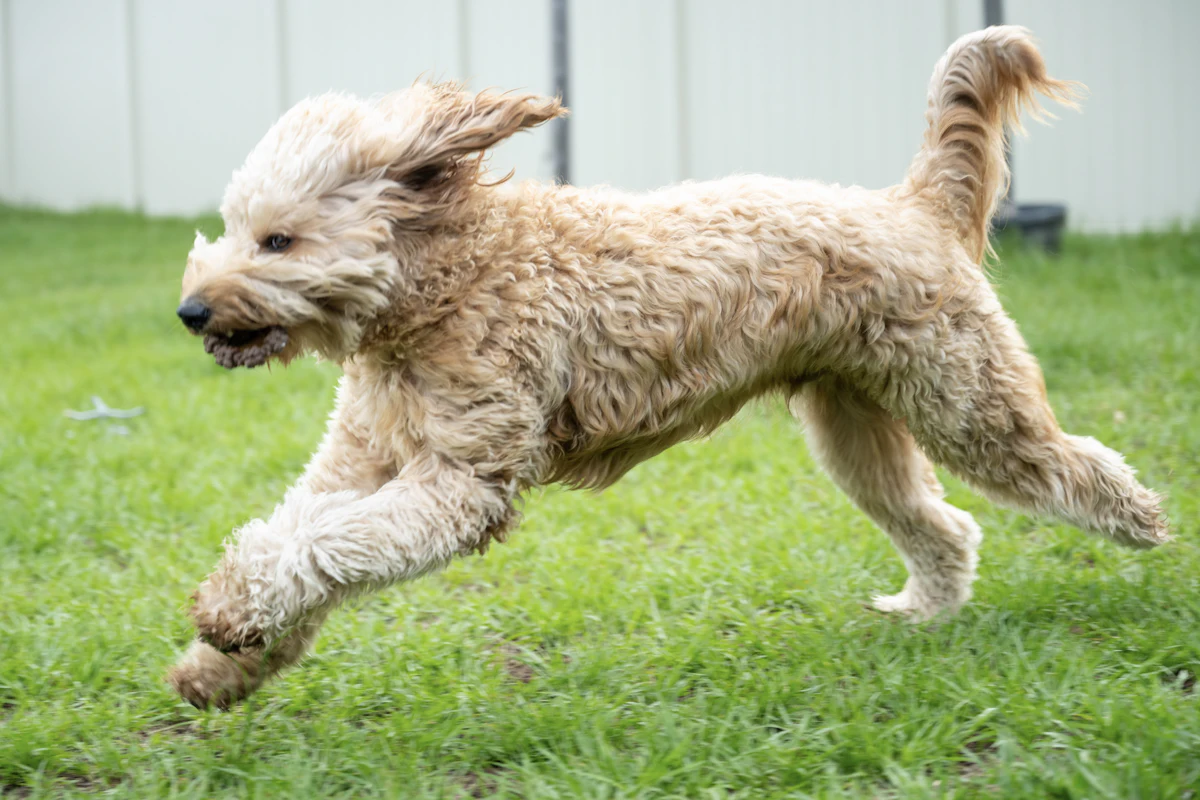
Doodles have three coat types: straight (hair), wavy (fleece) and curly (wool). Curl is set by the KRT71 gene, with one copy giving a wavy coat and two a curly one. Furnishings (RSPO2) and the MC5R gene decide shedding. The adult coat settles at 6 to 14 months.
The information is current and up-to-date in accordance with the latest veterinary research. Learn more »
Two puppies from the same Doodle litter can grow up with coats so different that strangers assume they are different breeds. One sheds like a retriever and needs a brush once a week. The other never seems to drop a hair, mats in days and needs a groomer every six weeks. The difference is three genes, and a breeder with a DNA test can tell you a great deal about a puppy's adult coat before it is eight weeks old.
This guide covers the three coat types, the genetics behind them, furnished and unfurnished faces, how to predict a puppy's adult coat, coat by generation, and what each coat means for shedding, grooming and colour. It applies to every Poodle cross, from the Goldendoodle and Labradoodle to Cavapoos and Bernedoodles, because the genes are the same. For the bigger picture, start with our Doodle Dog guide.
Key Takeaways
- Doodles have straight (hair), wavy (fleece) and curly (wool) coats; one copy of the KRT71 curl variant gives wavy, two give curly.
- Furnishings come from a dominant RSPO2 variant; an unfurnished "improper coat" Doodle has a smooth face and sheds like its retriever or spaniel parent.
- MC5R and RSPO2 together predict shedding; testing both parents predicts a litter's coats far better than the generation label.
- The adult coat does not settle until roughly 6 to 14 months, and matting peaks during that change.
- Curly coats need brushing daily, wavy three or four times a week, straight once or twice; most Doodles fade in colour over their first two years.
1What Are the Three Doodle Coat Types?
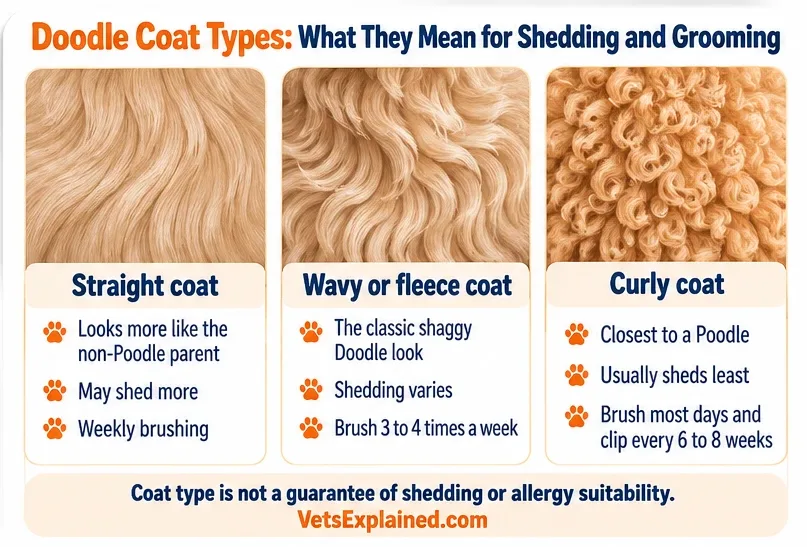
Doodle coats are grouped as straight, wavy or curly, and many breeders also use an older naming system of hair, fleece and wool. The two systems overlap but do not match exactly.
- Straight coat ("hair" or "flat" coat): lies flat or with a slight wave, closest to the non-Poodle parent. Usually long and shaggy rather than short. This is the coat that sheds most.
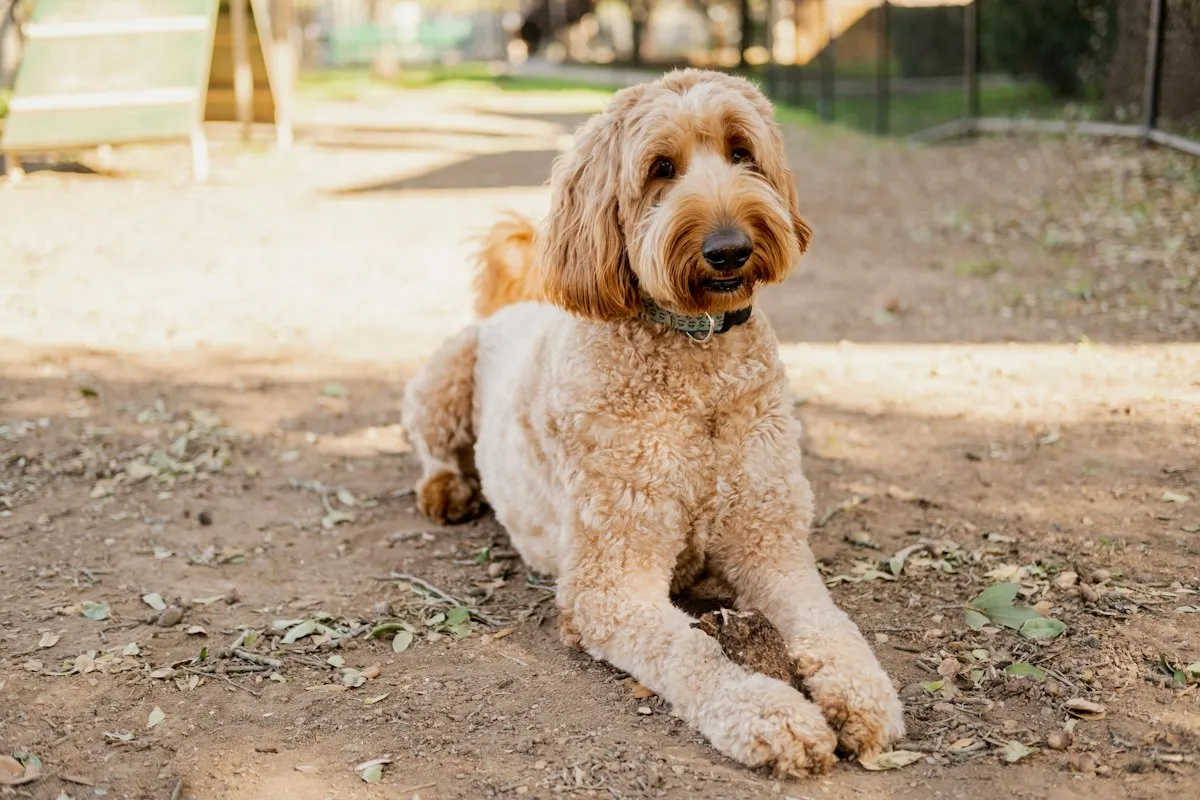
- Wavy coat ("fleece" coat): loose waves to loose curls, soft, usually with a beard and eyebrows. The most common Doodle coat and the one most buyers picture. Shedding is low to moderate.
- Curly coat ("wool" coat): tight, dense curls like a Poodle's. Sheds least but needs the most brushing, because loose hair is held in the curls instead of falling out.
Hair, fleece and wool came from Australian Labradoodle breeders and describe texture as much as curl: fleece is soft and silky, wool denser and springier. Ask a breeder to show you an adult dog with the coat they mean.
2What Genes Control a Doodle's Coat?
Three genes explain most of what you see on a Doodle: KRT71 for curl, RSPO2 for furnishings, and MC5R for shedding. In a 2009 study in Science, Cadieu and colleagues compared more than 1,000 dogs from 80 breeds and found that variants in RSPO2, FGF5 (hair length) and KRT71 accounted for the coat of about 95 per cent of them. A 2016 study of more than 4,200 dogs, published in Nature Communications by Hayward and colleagues at Cornell, added MC5R as a major shedding gene.
KRT71: the curl gene
KRT71 codes for a keratin protein in the hair follicle, and its curl variant is incompletely dominant. According to the UC Davis Veterinary Genetics Laboratory, no copies gives a straight coat, one copy usually a wavy coat and two a curly coat. Poodles carry two copies and retrievers and spaniels usually none, so a first-generation Doodle inherits one copy and is most often wavy.
RSPO2: furnishings and the "Doodle face"
RSPO2 carries an insertion that produces furnishings: the longer hair on the muzzle, eyebrows and legs that gives Doodles their look. It is dominant, so one copy is enough. The UC Davis VGL furnishings test describes a dog with no copies as having an "improper coat": short, smooth hair on the face and legs even if the body coat is long. Furnishings also matter for shedding: the 2016 study found the furnishings variant strongly associated with low shedding, and minimal-shedding breeds such as Poodles carry two copies.
MC5R: the shedding gene
A variant in MC5R (A237T) is associated with reduced shedding, and the UC Davis VGL shedding test reports it with RSPO2 because the two interact. In broad terms, a furnished dog sheds little whatever its MC5R result; an unfurnished dog sheds moderately with two copies of the low-shedding variant and heavily with none. The lab is open that shedding was not measured in the original study, so the test predicts a tendency, not a number of hairs on your sofa.
3Furnished vs Unfurnished: What Is an Improper Coat?
A furnished Doodle has a beard and eyebrows; an unfurnished Doodle has a smooth face like its retriever or spaniel parent, and that smooth face is the most reliable sign that the dog will shed. Breeders call it an "improper coat" or "flat coat", and the Goldendoodle Association of North America breed standard lists furnishings as a requirement and classes coats without them as incorrect because they shed.
Because furnishings are dominant and Poodles carry two copies, every F1 Doodle is furnished. Unfurnished puppies appear when two carriers are bred together: about one in four in an F1 × F1 (F2) litter, about half in an F1 × retriever litter, and none if both parents test with two copies.
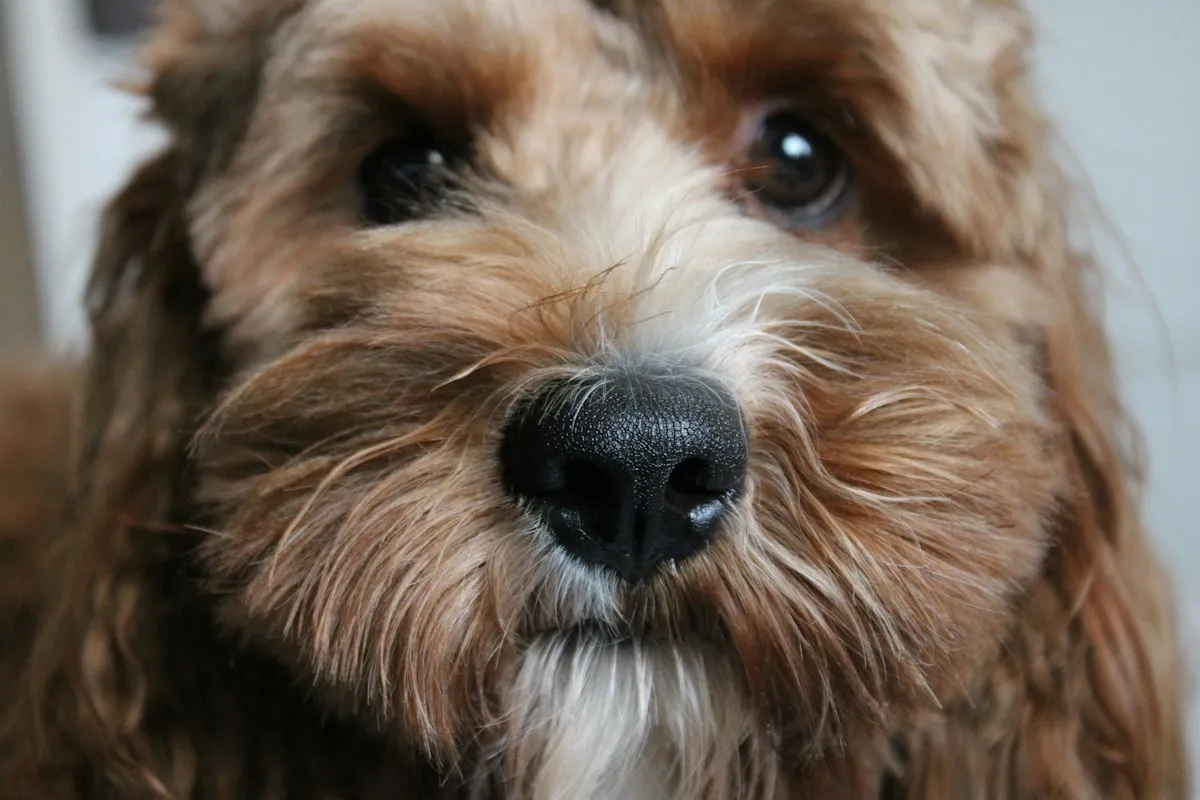
An unfurnished Doodle is not a lesser dog; it is often a handsome, easy-care animal that rarely mats. It simply does not deliver the low-shedding coat and teddy-bear face most buyers want, so a breeder should say so before you choose.
4How Do You Predict a Puppy's Adult Coat From the Parents?
The parents' genotypes predict a puppy's coat better than anything else. If both parents have been tested for KRT71, the odds are simple:
- Curly × curly: all puppies curly.
- Curly × wavy: roughly half curly, half wavy.
- Curly × straight (Poodle × retriever, an F1 litter): all puppies wavy.
- Wavy × wavy (F1 × F1): about one in four curly, half wavy, one in four straight.
- Wavy × straight: half wavy, half straight.
The same arithmetic applies to furnishings. If the parents are untested, ask for photographs of adult dogs from the same pairing, not puppies. Testing is cheap (UC Davis lists each test at around 55 US dollars; prices vary by lab and region), and our F1 vs F1B vs F2 guide explains how results fit with generation labels.
5Can You Tell a Puppy's Coat at 8 Weeks?
Only partly. The soft puppy coat tells you less than people hope, but three clues hold up reasonably well:
- The face. By six to eight weeks, furnished puppies have visible fuzz on the muzzle and above the eyes; an unfurnished puppy has a smooth, short-haired muzzle. This clue is reliable because furnishings are present or absent.
- The muzzle hair. Tight kinks and crimping on top of the muzzle usually mean a curly adult coat; neat, straight-lying fuzz tends to mean wavy; a smoother muzzle with a parting suggests straight.
- The body coat. Visible waves or ringlets on the back, ears and legs almost always become a wavy or curly adult coat.
What you cannot judge is texture or shedding. The adult coat usually comes in between about 6 and 12 months, and some dogs are not settled until 14 months; figures vary. During the change, puppy hair tangles with the incoming adult coat and matting is at its worst, so brush to the skin daily for those months; our Doodle grooming guide shows the technique.
6Doodle Coat by Generation
Generation tells you the odds of each coat, not the result:
- F1 (retriever × Poodle): one curl copy and one furnishings copy in every puppy. Nearly all are wavy and furnished; shedding is low to moderate.
- F1B (F1 × Poodle): half curly, half wavy, all furnished. Often recommended for allergy-conscious homes, though no Doodle is hypoallergenic, as our guide to whether Doodles are hypoallergenic explains.
- F2 (F1 × F1): the widest spread. Straight, wavy and curly puppies in one litter, and about one in four unfurnished.
- F2B and multigeneration: depends on the parents chosen. Well-run multigen programmes select tested parents, which is why their litters are far more uniform.
7How Much Does Each Coat Type Shed?
Straight coats shed most, wavy coats shed a little and curly coats shed least, but every Doodle sheds something.
- Straight, unfurnished: sheds like the non-Poodle parent, which for a Golden Retriever or Bernese Mountain Dog means heavily, with seasonal "blow-outs".
- Straight, furnished: sheds moderately.
- Wavy: low shedding. Dead hair catches in the waves, so you find it in the brush rather than on the carpet.
- Curly: minimal visible shedding. Dead hair stays trapped in the curls, which is why these dogs look non-shedding and felt up so quickly without brushing.
Shedding and allergy are different questions: people react to proteins in dander and saliva, which every coat produces. See do Doodle dogs shed.
8How Does Grooming Differ Between Coat Types?
Curly coats need the most work, straight coats the least, and wavy coats mat more easily than people expect. Realistic routines for an adult coat kept at two to three inches:
- Straight coat: brush once or twice a week with a slicker and comb, more during seasonal shedding; bath every six to eight weeks; tidy feet and ears every couple of months.
- Wavy coat: brush to the skin three or four times a week, then comb; check behind the ears, under the collar and in the armpits, where friction mats form; a professional clip every six to eight weeks.
- Curly coat: brush to the skin daily or every other day, comb after, and bathe only after a full brush-out; a professional groom every four to six weeks.
Whatever the coat, if the comb will not pass to the skin the dog is matted, however fluffy the surface looks; mats pull the skin, trap moisture and cause hot spots. Grooming costs vary by region and size, but a standard curly Doodle on a six-week schedule can cost more in grooming over its life than it did to buy.
9Why Do Doodle Coats Change Colour?
Many Doodles lighten with age because of a fading trait inherited from the Poodle, and the gene behind it has not been identified. Poodle breeders have described it for decades: a black puppy turns silver, a deep red becomes apricot, a chocolate becomes cafe au lait, usually over the first two years. A 2025 review by a veterinarian at the Animal Medical Center in New York could find no scientific description of a specific "Poodle fading gene" and notes that online claims about its inheritance contradict each other. Progressive greying (the G locus) and dilution (the D locus) are often blamed, but no DNA test for fading exists.
In practice, reds and apricots usually fade towards cream, chocolates fade most noticeably, blacks may develop a silver cast, and creams change least. Sun and clipping lighten a coat further. Nobody can promise an adult colour from a puppy; if colour matters, ask to see adult dogs from earlier litters.
10Which Doodle Coat Type Is Best?
The best coat is the one whose maintenance you will actually do. Each type is a trade-off.
Potential advantages
- Straight: the least brushing and the lowest grooming bills
- Wavy: the classic Doodle look, low shedding, and a coat that forgives a missed brush better than curls
- Curly: the least hair in the house and the most Poodle-like for allergy-conscious homes
Potential challenges
- Straight: moderate to heavy shedding and, if unfurnished, none of the look most buyers want
- Wavy: mats in the friction zones if brushing is skipped; still needs clipping every six to eight weeks
- Curly: daily brushing, the highest grooming cost, and the fastest route to a matted, shaved dog
11Final Thoughts
A Doodle's coat is decided by a handful of genes that can be tested cheaply, so the "coat lottery" is avoidable. Ask a breeder for the KRT71, RSPO2 and MC5R results of both parents, look at the puppy's muzzle for furnishings, and work out the odds before you fall for a face. Then plan for the coat you are likely to get.
For how coat fits with size, temperament and health across the Poodle crosses, our complete Doodle Dog guide is the place to start.
Sources
- Cadieu E, Neff MW, Quignon P, et al. Coat variation in the domestic dog is governed by variants in three genes. Science. 2009;326(5949):150-153. pmc.ncbi.nlm.nih.gov
- Hayward JJ, Castelhano MG, Oliveira KC, et al. Complex disease and phenotype mapping in the domestic dog. Nature Communications. 2016;7:10460. pmc.ncbi.nlm.nih.gov
- University of California, Davis, Veterinary Genetics Laboratory. Curl (C1, C2). vgl.ucdavis.edu
- University of California, Davis, Veterinary Genetics Laboratory. Furnishings and improper coat. vgl.ucdavis.edu
- University of California, Davis, Veterinary Genetics Laboratory. Shedding (MC5R and RSPO2). vgl.ucdavis.edu
- Goldendoodle Association of North America. Goldendoodle breed standard. goldendoodleassociation.com
- Hohenhaus A, Animal Medical Center. Poodle fading gene: what we know about coat colour genetics in dogs. 2025. amcny.org
Frequently Asked Questions
?What is the difference between a fleece and a wool Doodle coat?
Fleece is a soft, silky, loosely wavy coat; wool is denser, springier and tightly curled like a Poodle's. Both are furnished and low shedding. Wool needs daily brushing and more frequent clipping; fleece mats a little less readily.
?Are straight-coated Doodles rare?
In F1 litters they are uncommon, because every puppy inherits one curl copy and is usually wavy. They become common in F2 litters, where about a quarter of puppies carry no curl copy. Unfurnished straight coats appear only when both parents carry the improper-coat variant.
?Do wavy Doodles shed?
A little. Wavy coats release dead hair slowly, and most of it catches in the coat and comes out in the brush rather than on furniture. Furnished wavy dogs shed less than unfurnished ones.
?At what age does a Doodle get its adult coat?
Most Doodles start the change between about 6 and 8 months and finish by 12 to 14 months, though figures vary by cross and individual. Matting is at its worst during the change, so brush to the skin daily for those months.
?Can a DNA test tell me what coat my Doodle will have?
Largely, yes. Tests for KRT71 (curl), RSPO2 (furnishings) and MC5R (shedding) predict curl, furnishings and shedding tendency reliably. They do not predict texture or softness. Testing the parents is more useful than testing the puppy.
?What does "improper coat" mean in a Doodle?
An improper coat means the dog has no copy of the furnishings variant of RSPO2, so it has short, smooth hair on the face and legs and sheds more. It is also called a flat or unfurnished coat. It is purely cosmetic and has no health implications.
?Which Doodle coat is best for allergies?
Curly, furnished coats release the least dander, and F1B or multigeneration Doodles are most likely to have them. Even so, no Doodle is hypoallergenic, because allergens come from skin and saliva rather than hair. Spend time with the specific dog indoors before deciding.
?Why is my Doodle's coat getting lighter?
Most Doodles inherit a fading trait from the Poodle side that lightens red, apricot, chocolate and sometimes black coats over the first two years. The gene has not been identified and cannot be tested for. Sun and clipping also lighten the coat. It is normal and not a sign of illness.
Help us do better!
Was this article helpful and relevant?
Thanks for your feedback!
About Sofia Marin
Sofia Marin is VetsExplained's senior editor. She has edited pet and consumer titles for fifteen years and is responsible for the site's editorial standards and breed coverage.
View all posts by Sofia Marin →