Mini Goldendoodle: Size, Temperament, Grooming, Health and Cost
 Written by Sofia Marin
 Fact checked by Dr. Tomas Ellery, DVM
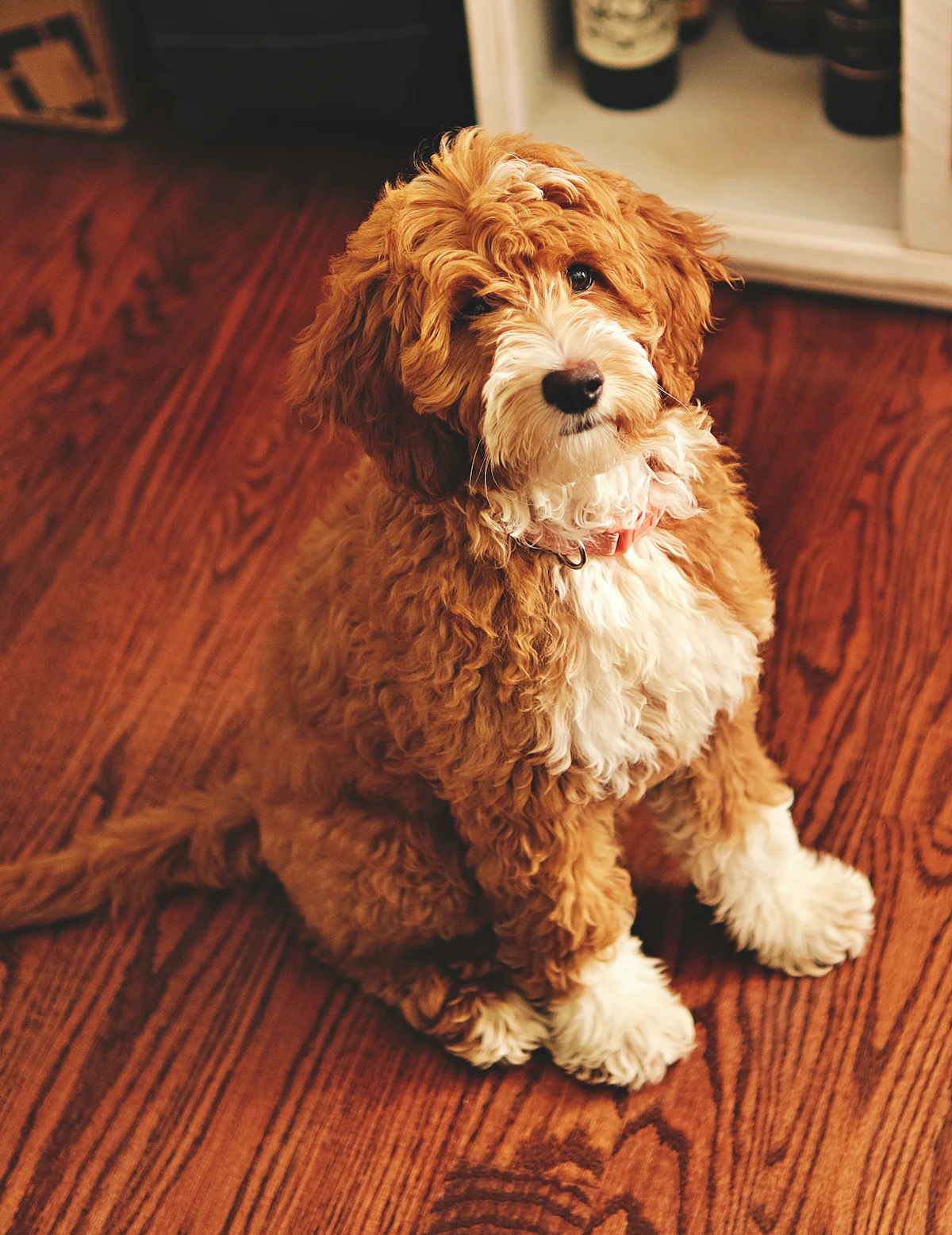
A Mini Goldendoodle is a Goldendoodle bred with Miniature Poodle ancestry, usually 14 to 17 inches tall and 26 to 35 lb as an adult, though "mini" is not a regulated term and dogs sold as minis range from 15 to 40 lb. Expect the same grooming as a standard, plus small-dog risks such as kneecap and dental problems.
The information is current and up-to-date in accordance with the latest veterinary research. Learn more »
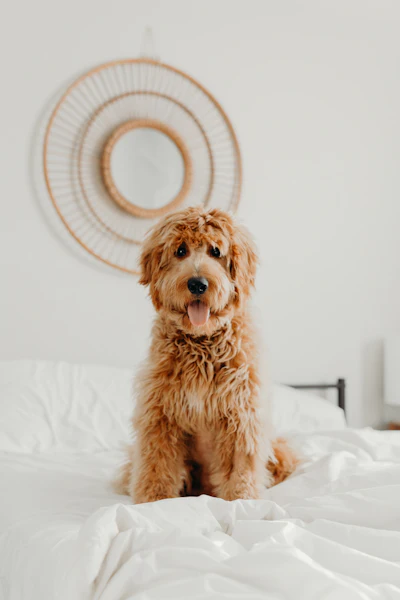
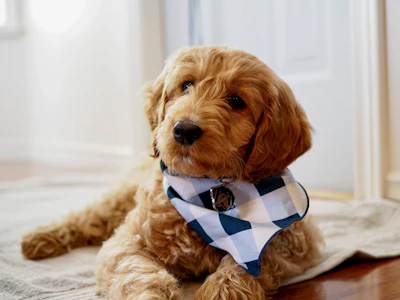
The Mini Goldendoodle is the small version of the Golden Retriever and Poodle cross, produced by using a Miniature Poodle rather than a Standard Poodle somewhere in the pedigree. It has become the most searched-for Goldendoodle size, and for understandable reasons: the same friendly, curly-coated dog in a package that fits a flat, a car boot and a lap.
The trouble is that "mini" is a marketing word, not a breed standard. Two breeders can both sell "Mini Goldendoodles" and hand over puppies that grow into a 16 lb dog and a 40 lb dog. Smaller size also brings its own health profile, which is different from the hip-and-elbow concerns of a standard.
This guide covers what is specific to the mini: how minis are actually bred, what size to realistically expect, what petite, micro and teacup labels mean, how exercise, grooming and health differ from a full-size Goldendoodle, what one costs and whether a mini suits an apartment. For everything the sizes share, including coat types, shedding, temperament in depth and training, read our full Goldendoodle breed guide. For the wider family of Poodle crosses, start with the Doodle Dog guide.
Key Takeaways
- A Mini Goldendoodle gets its size from a Miniature Poodle, usually through F1B or multigen breeding; by the GANA definition it is 14 to 17 inches and 26 to 35 lb, but dogs sold as minis range from 15 to 40 lb.
- Petite is a club-defined size (under 14 inches, 25 lb or less); micro and teacup are marketing labels that usually mean Toy Poodle ancestry and extra health risk.
- Minis need the same grooming as a standard, about 45 to 60 minutes of exercise a day and more attention to barking and alone-time.
- The health priorities shift from hips to kneecaps and teeth: ask for patella evaluations and plan for tooth brushing and dental cleanings.
- Expect to pay $2,000 to $5,000 for a health-tested puppy, varying by region, and to spend $500 to $1,000 a year on grooming.
1Mini Goldendoodle at a Glance
- Parent breeds: Golden Retriever × Miniature Poodle, usually through one or more Goldendoodle generations
- Height: Over 14 to under 17 inches at the withers under the breed-club definition; dogs sold as minis range from about 13 to 20 inches
- Weight: Typically 26 to 35 lb by the club definition; 15 to 40 lb in practice
- Coat: Wavy or curly most often; straight is possible
- Shedding: Low to moderate, set by coat genetics, not by size
- Grooming: High; brushing several times a week and professional clipping every 6 to 8 weeks
- Exercise needs: Moderate; usually 45 to 60 minutes a day of walks and play as an adult
- Lifespan: Often 12 to 15 years; small dogs tend to outlive large ones
- Specific health watch-points: Patellar luxation, dental disease, inherited eye disease, hips
- Price: Roughly $2,000 to $5,000 from a health-testing breeder; varies by region
- Apartment suitability: Good if exercise and barking are managed
2How Are Mini Goldendoodles Bred?
A Mini Goldendoodle gets its size from a Miniature Poodle, and because a Golden Retriever weighs 55 to 75 lb while a Miniature Poodle stands 10 to 15 inches and weighs 10 to 15 lb, breeders have to be deliberate about how they combine them.
There are three common routes:
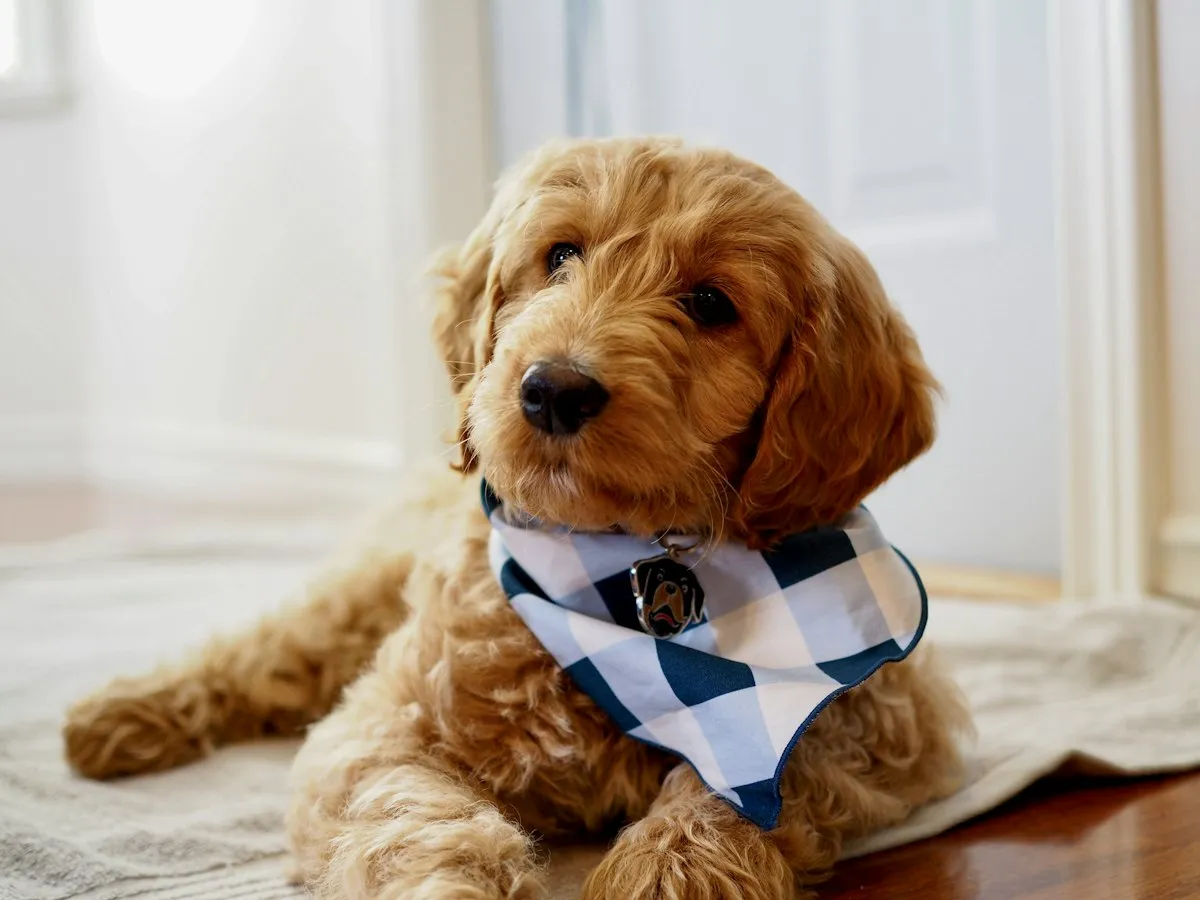
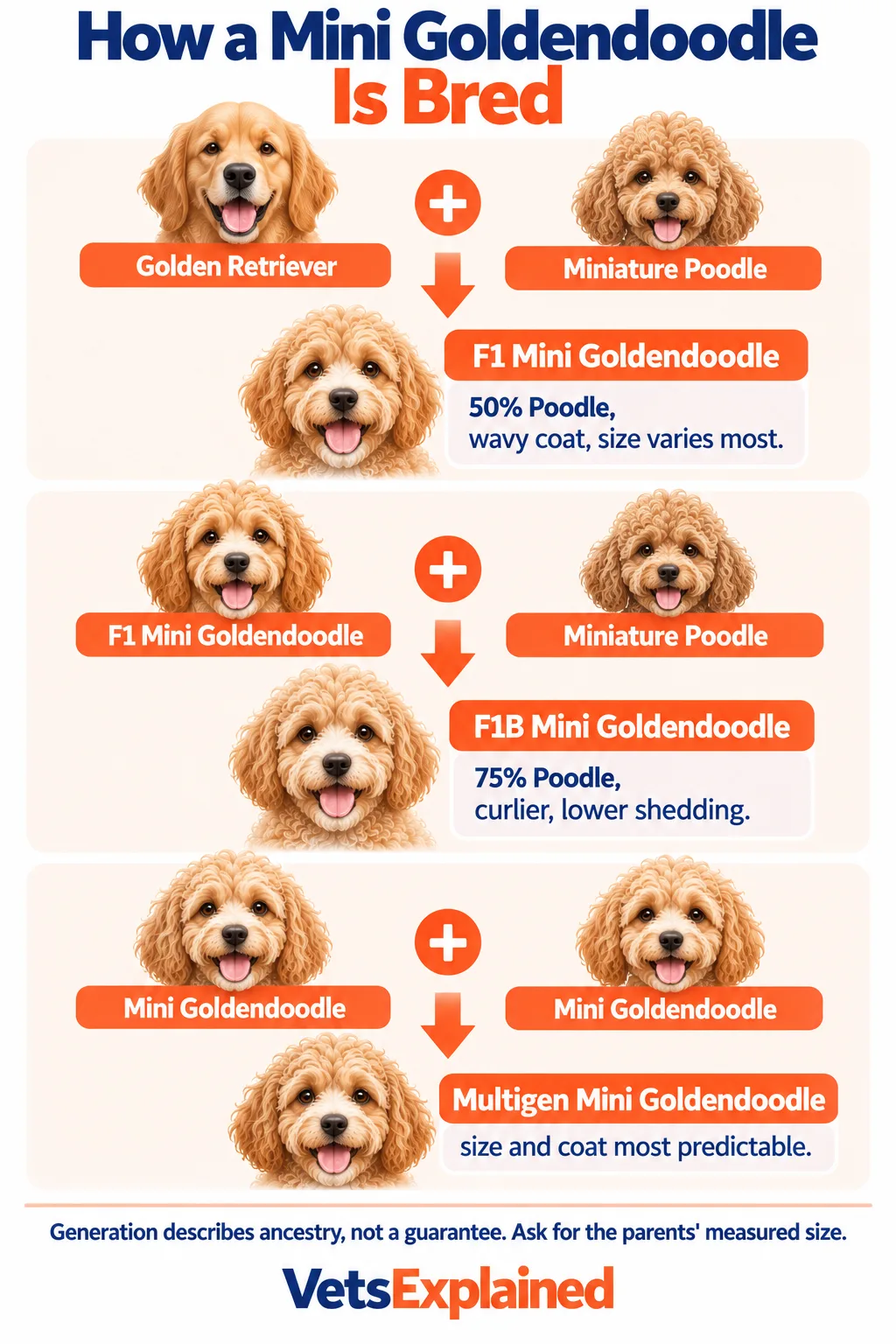
- F1 mini: A female Golden Retriever is bred to a male Miniature Poodle, usually by artificial insemination because of the size gap. Puppies inherit size genes from both sides and are the least predictable, often landing in the 30 to 45 lb "medium" band rather than true mini.
- F1B mini: An F1 Goldendoodle (often a medium-sized one) is bred back to a Miniature Poodle. The puppies are roughly three-quarters Poodle by ancestry, so they are more likely to be smaller, curlier and lower shedding. This is where most true minis come from.
- Multigen mini: Two Goldendoodles are bred together, at least one of them an F1B or later generation. The Goldendoodle Association of North America (GANA) defines a multigen this way. Over several generations a breeder can select for a consistent mini size, but each generation also dilutes the Golden Retriever contribution.
Some breeders push size down further by using Toy Poodles (under 10 inches) in F1B or multigen lines. That produces the dogs sold as petite, micro or teacup, and it carries trade-offs discussed below.
The generation label tells you ancestry, not outcome. What matters more than the letter is the measured height and weight of both parents and, for multigens, the grandparents.
3How Big Does a Mini Goldendoodle Get?
Under GANA's definition a Mini Goldendoodle stands over 14 and under 17 inches at the withers and typically weighs 26 to 35 lb. In practice, dogs sold as minis range from about 15 to 40 lb and 13 to 20 inches, because the term is not regulated and breeders draw the lines differently.
GANA's full size scale is:
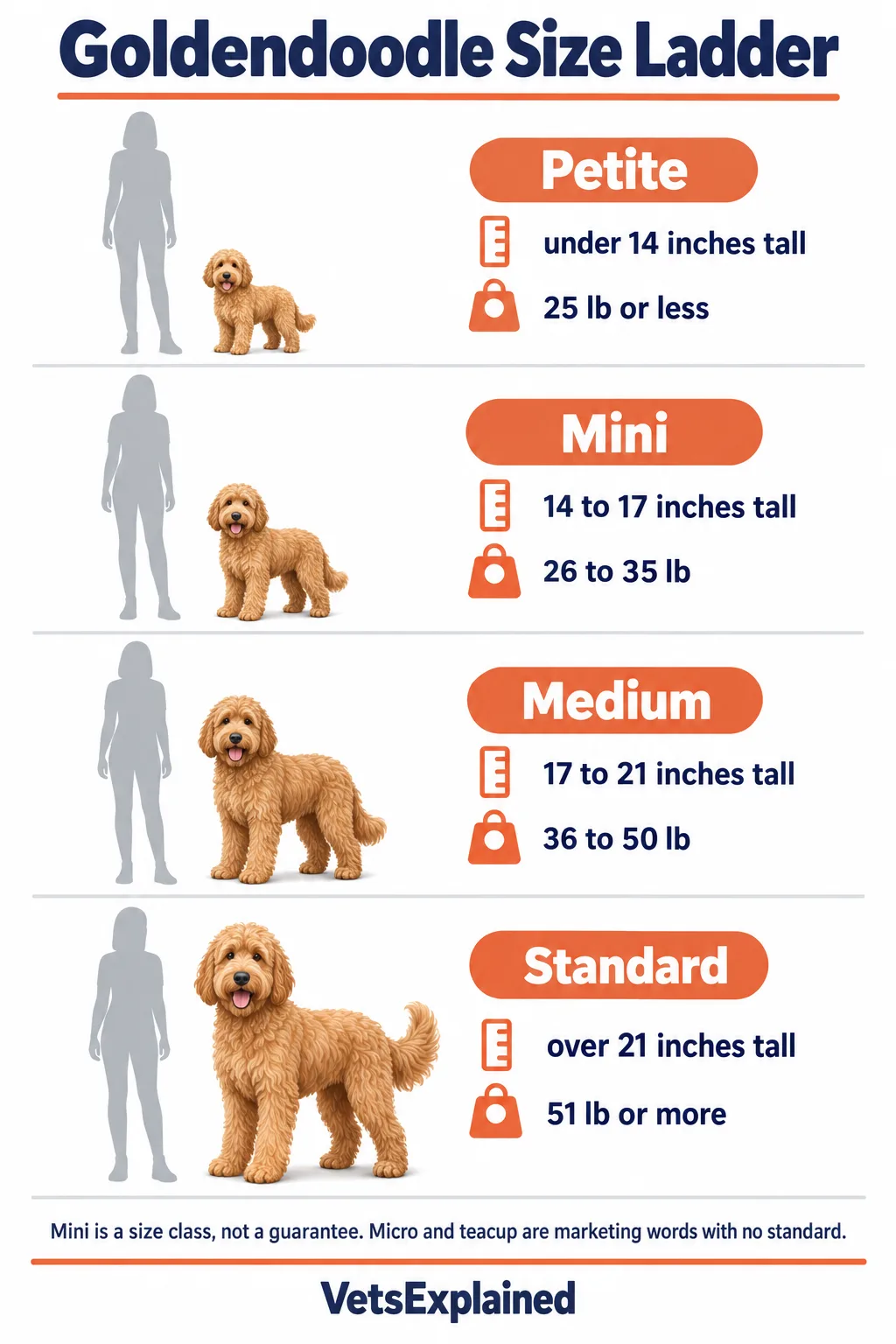
- Petite: Under 14 inches, typically 25 lb or less
- Miniature: Over 14 to under 17 inches, typically 26 to 35 lb
- Medium: Over 17 to under 21 inches, typically 36 to 50 lb
- Standard: Over 21 inches, typically 51 lb or more
GANA itself notes that a dog's category is set when it is fully grown and that a breeder's estimate is a best guess. Other published charts put the mini anywhere from 15 to 35 lb, and a few list 20 to 40 lb. Treat any single number as a guideline.
Why "Mini" Varies So Much
Size varies because a crossbred litter is drawing on two very different parents, and because a weight range that broad is easy to sell under one word.
- Parent size: An F1 from a 60 lb Golden and a 14 lb Miniature Poodle can throw puppies from 20 to 45 lb in one litter.
- Generation: F1B and multigen puppies from consistently small parents cluster more tightly.
- Which Poodle: A line built on Toy Poodles will run smaller than one built on Miniature Poodles, even if both are called "mini".
- Sex: Males usually finish an inch taller and a few pounds heavier than their sisters.
- Breeder labels: Some breeders call anything under 35 lb a mini; others call a 25 lb dog a "medium mini". The words are not standardised.
Minis usually reach most of their adult height by 8 to 10 months and fill out until 12 to 14 months. A rough rule many breeders use is that adult weight is about double the weight at 4 months, but this is a guess rather than a formula. If adult size matters to you, ask for the weight of both parents and photos of adult dogs from previous litters of the same pairing.
4What Do Petite, Micro and Teacup Goldendoodle Labels Mean?
Petite, micro and teacup are breeder terms for Goldendoodles bred below the mini range, and only "petite" has a club definition: GANA's petite is under 14 inches and typically 25 lb or less.
- Petite Mini Goldendoodle: The GANA term. Usually 15 to 25 lb, bred from small Miniature Poodles over several generations. Can be done responsibly.
- Micro Goldendoodle: No standard definition. Typically used for 10 to 20 lb dogs produced by bringing Toy Poodles into the line.
- Teacup Goldendoodle: Marketing language for dogs expected to stay under about 12 lb. There is no recognised teacup size in any Poodle or Goldendoodle standard.
The concern with the smallest labels is how the size is achieved. Pushing a cross well below the Miniature Poodle's own size range generally means selecting the smallest puppies from each litter or using very small Toy Poodles, and the smallest dogs in any population carry higher risks of low blood sugar as puppies, fragile bones, dental crowding, liver shunts and open fontanelles. A 10 lb dog from a 55 lb grandparent breed is also an odd genetic outcome, and the dog may have proportions that do not quite work.
Prices climb as the label shrinks, which gives breeders an incentive to promise sizes they cannot guarantee. If you want a very small Doodle, a Maltipoo or Cavapoo is bred from two small parents and is a more honest route to a 10 to 20 lb dog.
5Mini Goldendoodle Temperament
Most Mini Goldendoodles are affectionate, playful, people-focused dogs that want to be involved in everything, and the mini's temperament is broadly the same as the standard's with two practical differences.
The first is Poodle influence. Because most minis are F1B or multigen, they carry more Poodle ancestry than a typical F1 standard. Owners commonly describe minis as a little quicker to alert-bark, a little more sensitive and a little more attached to one person than their larger cousins. These are tendencies, not rules.
The second is how people treat small dogs. A 25 lb dog that jumps up, pulls on the lead or guards the sofa is often excused in a way a 65 lb dog would not be. Minis need the same training in polite greetings, settling and recall; they are simply easier to lift out of trouble, which can let bad habits slide.
Like all Goldendoodles, minis dislike long periods alone. If you work full days away from home, plan for a dog walker, daycare or a second dog, and teach alone-time gradually from puppyhood. Our Goldendoodle guide, linked above, covers temperament, family suitability and training in more depth.
6Are Mini Goldendoodles Good Family Dogs?
Yes, for most families, and the mini has one clear advantage over the standard: a 25 to 35 lb dog is far less likely to knock over a toddler or drag a child on the lead.
The flip side is that a mini is small enough to be hurt by rough handling. Children should be taught not to pick the dog up, sit on it or disturb it when it is sleeping or eating. Young puppies in particular can be injured by a fall from a child's arms.
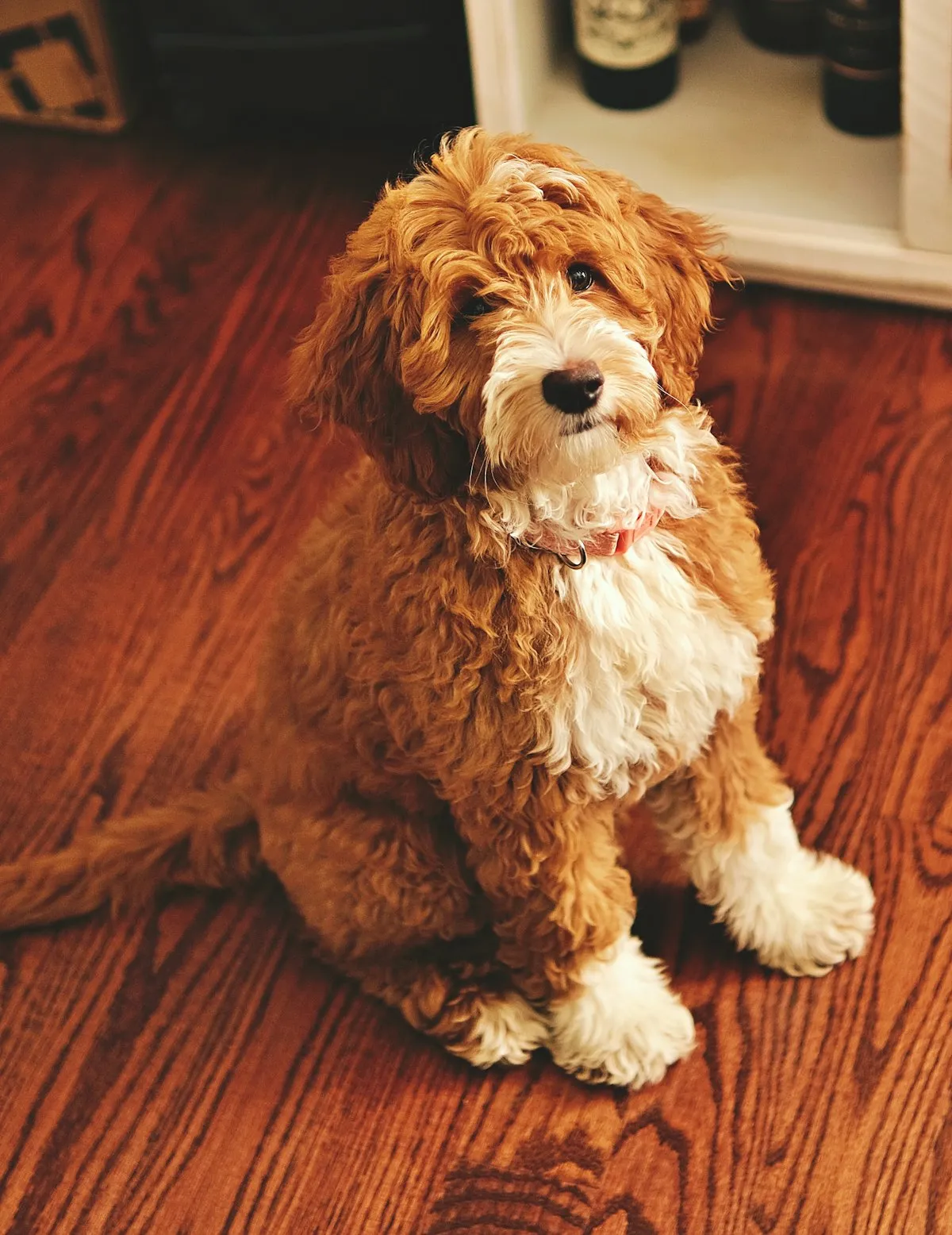
Minis tend to be good with other dogs and with cats they have been raised alongside. As with any Doodle, early socialisation matters more than the breed label.
7How Much Exercise Does a Mini Goldendoodle Need?
An adult Mini Goldendoodle usually needs 45 to 60 minutes of activity a day, which is less than the 60 to 90 minutes a standard needs, but it is not a low-energy dog.
Both parent breeds are working dogs and the mini inherits the same drive to retrieve, sniff and solve problems. The difference is that a mini tires sooner on a long walk and can burn off a lot of energy with a game of fetch in a hallway or a 20-minute training session.
A workable adult routine looks like:
- two walks of 20 to 30 minutes, at least one with off-lead or long-line time to sniff and run
- 10 to 15 minutes of training, scent games or a puzzle feeder
- free play with people or a compatible dog
Puppies need much less structured exercise and much more sleep. Short play sessions, exploring the garden and gentle lead training are plenty until the growth plates close, and a mini's close at a similar age to a larger dog's, around 10 to 12 months.
Weight control matters more in a mini than in a standard for one specific reason: extra weight on small knees raises the chance that a mild patellar problem becomes a lame one. Learn to assess body condition, follow our feeding guide by life stage and count treats in the daily total.
8Mini Goldendoodle Grooming
Grooming a mini takes the same tools, the same technique and almost the same time as grooming a standard, because the coat is the same; there is just less of it.
Expect to:
- brush and comb to the skin three or four times a week, every day if the coat is kept long
- have the coat clipped professionally every 6 to 8 weeks, at roughly $60 to $120 a visit in the US and £40 to £80 in the UK, varying by region and coat condition
- check and clean ears weekly, because the hairy, floppy ear is a trap for moisture and wax
- trim nails every 3 to 4 weeks
- brush teeth daily or at least several times a week (see dental disease below)
The high-friction areas are the same as on a larger dog: behind the ears, under the collar, armpits, groin and the feathering on the legs. One difference is that a mini's smaller face and tighter curls can mat faster around the eyes and muzzle, and tear-staining is more visible on cream and apricot dogs. Our Doodle grooming guide walks through the routine step by step.
Shedding is set by coat genetics, not by size. A mini with a wavy F1-type coat sheds as much as a standard with the same coat; a curly F1B mini sheds less. No mini is hypoallergenic, and the only reliable test is spending time with the individual dog.
9Mini Goldendoodle Health Problems
Mini Goldendoodles share the Goldendoodle's inherited risks, but the mix shifts: hip and elbow problems become less of a concern than in a standard, while small-dog problems, chiefly patellar luxation and dental disease, become more important.
Patellar Luxation
Patellar luxation, a kneecap that slips out of its groove, is the orthopaedic problem to ask about in any mini.
It is strongly linked to small size and to Poodle ancestry. A 2016 VetCompass study of 210,824 dogs in England found an overall prevalence of 1.3%, with the highest odds in small breeds and in dogs that weighed less than the average for their breed and sex. A 2019 Japanese study that examined 2,048 puppies found some degree of luxation in 38% of Toy Poodle puppies and showed that littermates of an affected puppy were about six times more likely to be affected, which is good evidence that the condition is inherited. That is the ancestry micro and teacup lines draw on.
The classic sign is a skipping gait: the dog holds a back leg up for a few strides, then carries on as normal. The Merck Veterinary Manual grades it from 1 (the kneecap can be pushed out but pops straight back) to 4 (permanently out of place, with a crouched gait). Grade 1 and mild grade 2 dogs are often managed with weight control and controlled exercise; higher grades usually need surgery, which typically costs $1,500 to $4,000 per knee in the US and varies by region. Untreated luxation leads to arthritis and raises the risk of a cruciate ligament tear.
The Poodle Club of America asks for a veterinary patella evaluation on breeding Miniature Poodles from 12 months of age, and GANA requires patella checks on all Poodles and Goldendoodles in its programme. Ask to see the result for both parents.
Dental Disease
Small dogs get periodontal disease earlier and more often than large dogs, and a mini's Poodle side is one of the worst-affected lines.
A 2021 VetCompass study of 22,333 UK dogs found periodontal disease diagnosed in 12.5% of dogs in a single year, with dogs under 10 kg (22 lb) having about three times the odds of dogs in the 30 to 40 kg range. The Toy Poodle had the highest odds of any breed, nearly four times that of crossbreds. The authors note that under anaesthetic examination the true prevalence is far higher than the diagnosed figure.
The cause is simple: the same 42 teeth are crammed into a much smaller jaw, so plaque builds up in crowded gaps and the gums recede. In practice that means a mini should have its teeth brushed from puppyhood, should be checked by a vet at every visit and will probably need a professional scale and polish under anaesthetic every one to three years from middle age. Budget for it; untreated dental disease is painful and is linked to heart, liver and kidney problems.
Hips, Elbows and Eyes
Hip dysplasia is less common in minis than in standards because of their weight, but it has not gone away: both parent breeds carry it, and the smallest dogs still need screened parents. Our guide to hip dysplasia in dogs explains what the OFA and PennHIP results mean.
Inherited eye disease is the other shared risk. Progressive retinal atrophy (prcd-PRA) is a DNA-testable condition in Poodles, and Golden Retrievers have their own forms (GR-PRA1 and GR-PRA2). GANA requires all of these DNA tests plus an annual eye examination on breeding dogs. Golden Retrievers also carry a risk of heart disease (subaortic stenosis) and the Golden Retriever Club of America's code of ethics asks for a cardiologist's examination before breeding.
Other Mini-Specific Points
- Hypoglycaemia: Very small puppies, especially under 5 lb, can develop low blood sugar if they miss meals. This is a petite and micro problem rather than a true mini one.
- Ear infections: Common across all Goldendoodles because of the hairy, pendulous ear. Weekly checks catch them early.
- Pancreatitis: Small, food-motivated dogs that are fed rich scraps are classic cases. Vomiting, a hunched back and refusing food after a rich meal need a same-day vet visit.
10How Long Do Mini Goldendoodles Live?
Most Mini Goldendoodles live 12 to 15 years, and the mini has a real longevity advantage over the standard.
A 2024 study of 584,734 UK dogs found median lifespans of 12.7 years for small breeds, 12.5 for medium and 11.9 for large, with small, long-nosed dogs living longest overall. The Miniature Poodle is one of the longer-lived breeds, with the AKC listing 10 to 18 years, while the Golden Retriever's cancer burden pulls the standard Goldendoodle's figure down. Minis sit between the two, and a well-bred, lean mini from long-lived parents can reasonably reach 15 or 16.
11What Health Tests Should a Mini Goldendoodle Breeder Have Done?
Ask for documented results, not a verbal assurance, on both parents. For a mini, the list is:
- Patellas: Veterinary evaluation at 12 months or older on all Poodles and Goldendoodles in the pedigree
- Hips: OFA, PennHIP or BVA score
- Elbows: OFA or BVA score
- Eyes: Annual eye examination by a veterinary ophthalmologist (CAER in the US)
- DNA: prcd-PRA, GR-PRA1, GR-PRA2, ichthyosis (ICH1), von Willebrand disease type 1, neonatal encephalopathy (NEwS) and degenerative myelopathy
- Heart: Cardiologist's examination on Golden Retriever and Goldendoodle parents
- Optional for small lines: The CDPA/CDDY test for the dwarfism gene that raises disc-disease risk, which GANA lists as optional for toy, mini and medium breeding dogs
These are the GANA requirements for its member breeders. A breeder who is not a member can still have done all of them. One who says "my vet checked them" has done none of them.
Also ask how the mini size was achieved. The answer you want is "Miniature Poodles over several generations", not "we pick the smallest puppies" or "we use Toy Poodles".
12How Much Does a Mini Goldendoodle Cost?
A Mini Goldendoodle puppy from a breeder who health-tests both parents usually costs $2,000 to $5,000 in the United States and £1,500 to £3,000 in the United Kingdom, and prices vary widely by region, colour and label.
Minis generally cost more than standards of the same quality, because they are harder to produce and in higher demand. Petite, micro and teacup labels add $1,000 to $3,000 on top, and red, parti and merle colours are also priced higher. A price well below the local range, with no health paperwork, is the classic sign of a puppy farm.
Lifetime costs are lower than for a standard in food and medication but not in grooming, which is the single biggest running cost:
- Professional grooming: Roughly $500 to $1,000 a year
- Food: $300 to $600 a year for a 25 to 35 lb dog on a good-quality diet
- Routine vet care, parasite control and insurance: $600 to $1,500 a year
- Dental cleanings: $300 to $800 per procedure, every one to three years from middle age
- One-off: Patellar surgery if needed, $1,500 to $4,000 per knee
All figures vary by region. Rescue Goldendoodles do exist and typically cost $100 to $500 in adoption fees, but minis are rarely surrendered and are usually rehomed quickly through breed-specific rescues.
13Are Mini Goldendoodles Good Apartment Dogs?
A Mini Goldendoodle can do well in an apartment or small home, provided it gets its 45 to 60 minutes outside every day and you address barking early.
In its favour: a 25 to 35 lb dog fits comfortably in a flat, is easy to carry in a lift or up stairs, can be exercised meaningfully in a small park and does not need a garden. Many minis live happily in city apartments.
Against it: minis alert-bark more than most standards, and a dog that announces every footstep in the corridor is a problem with shared walls. They also dislike being left alone for long periods, and a bored, lonely mini in a flat tends to bark, chew and scratch at the door. If you work long hours away from home, an apartment mini needs a dog walker or daycare.
Teach a "quiet" cue and settle-on-a-mat from the first week, reward calm behaviour when the dog hears noises outside and make sure the dog is genuinely tired, not just walked, before you leave. Our comparison of the best Doodles for apartments weighs the mini against the other small crosses.
14Mini Goldendoodle vs Standard Goldendoodle
The mini and the standard are the same cross at different sizes, and the practical differences are these:
- Size: 15 to 40 lb versus 50 to 90 lb
- Ancestry: Minis are usually F1B or multigen with Miniature Poodle; standards are often F1 with a Standard Poodle
- Exercise: 45 to 60 minutes versus 60 to 90 minutes a day
- Grooming: Same routine; a mini costs less per visit and takes less time at home
- Health emphasis: Patellas and teeth for the mini; hips, elbows and cancer risk for the standard
- Lifespan: Minis average a year or more longer
- Price: Minis usually cost more to buy, less to feed and medicate
- Housing: Minis suit apartments; standards need more space and a strong handler
- Children: Minis are less likely to knock a child over, more likely to be hurt by one
Neither is "better". A family with a garden and teenagers may be happier with a standard; a couple in a city flat will probably find a mini easier.
15Mini Goldendoodle Pros and Cons
Potential advantages
- Friendly, affectionate and trainable, with the same character as a standard
- Fits apartments, small cars and lifts
- Less exercise than a standard and easier to tire with play
- Lower food, medication and grooming bills than a standard
- Usually lives longer than a standard
- Less likely to knock over or overpower a child or an older person
Potential challenges
- "Mini" is not a standardised size; adult weight can be double what was promised
- Patellar luxation and dental disease are real risks that need screening and lifelong care
- Grooming is just as demanding as for a standard
- Tends to bark more and attach more intensely than a standard
- Dislikes being left alone
- Costs more to buy than a standard of the same quality
- Petite, micro and teacup lines carry extra health risks
16Is a Mini Goldendoodle Right for You?
A Mini Goldendoodle is a good fit if you want a sociable, trainable, medium-energy dog in a 20 to 35 lb body, can groom it several times a week and pay for clipping every six to eight weeks, will brush its teeth, and are home enough that it is not alone all day.
It is a poor fit if you want a genuinely tiny dog, a quiet dog, a dog that copes with eight-hour absences or a dog you can leave ungroomed between salon visits.
Before you commit, work through our questions to answer before bringing home a dog, then ask the breeder for parent weights, patella and eye results and an honest explanation of how the mini size was bred.
17Final Thoughts
The Mini Goldendoodle gives you the Goldendoodle's best qualities in a size that suits modern homes, and the mini's longer lifespan and lighter build are real advantages. What it does not give you is certainty: "mini" covers a 25 lb spread, and the smaller the label, the more carefully you should ask how it was achieved.
Buy from a breeder who uses Miniature Poodles over several generations, screens patellas, hips, eyes and the Poodle and Golden DNA conditions, and will tell you both parents' adult weights without hesitation. Then budget for grooming and dental care from day one.
For the full picture of coat, temperament and training that applies to every size, read our Goldendoodle breed guide, and for how the mini compares with every other Poodle cross, our Doodle Dog guide.
Sources
- Goldendoodle Association of North America, Goldendoodle Sizes, goldendoodleassociation.com
- Goldendoodle Association of North America, Health Standards and Ethical Breeding, goldendoodleassociation.com
- O'Neill DG, Meeson RL, Sheridan A, Church DB, Brodbelt DC, The epidemiology of patellar luxation in dogs attending primary-care veterinary practices in England, Canine Genetics and Epidemiology, 2016, cgejournal.biomedcentral.com
- Maeda K, Inoue M, Tanaka M, Momozawa Y, Evidence of genetic contribution to patellar luxation in Toy Poodle puppies, Journal of Veterinary Medical Science, 2019, pmc.ncbi.nlm.nih.gov
- O'Neill DG, Mitchell CE, Humphrey J, Church DB, Brodbelt DC, Pegram C, Epidemiology of periodontal disease in dogs in the UK primary-care veterinary setting, Journal of Small Animal Practice, 2021, pmc.ncbi.nlm.nih.gov
- Merck Veterinary Manual, Patellar Luxation in Dogs and Cats, merckvetmanual.com
- McMillan KM, Bielby J, Williams CL, et al., Longevity of companion dog breeds: those at risk from early death, Scientific Reports, 2024, pmc.ncbi.nlm.nih.gov
- Poodle Club of America, Health Statement for AKC Breed Health Testing Requirements, 2024, poodleclubofamerica.org
- American Kennel Club, Poodle (Miniature) breed page, akc.org
Frequently Asked Questions
?How big is a full-grown Mini Goldendoodle?
By the GANA definition, over 14 and under 17 inches at the withers and 26 to 35 lb. Because "mini" is not regulated, dogs sold as minis range from about 15 to 40 lb. Parent weights and adult dogs from previous litters are the best guide to what a puppy will become.
?What is the difference between a mini and a petite Mini Goldendoodle?
A petite is the size below mini: under 14 inches and typically 25 lb or less under the GANA scale. Petites are usually bred from small Miniature Poodles over several generations. Micro and teacup are smaller still and have no official definition.
?Are Mini Goldendoodles F1 or F1B?
They can be either, but most true minis are F1B or multigen. An F1 mini (Golden Retriever × Miniature Poodle) is less predictable and often lands at medium size. Breeding an F1 back to a Miniature Poodle produces smaller, curlier puppies more reliably.
?Do Mini Goldendoodles shed?
Some do. Shedding depends on coat genetics, not on size. A curly, Poodle-heavy F1B mini usually sheds very little; a wavy or straight-coated mini can shed noticeably. None is hypoallergenic, and allergy sufferers should spend time with the individual dog first.
?Do Mini Goldendoodles bark a lot?
More than most standards. Their heavier Poodle ancestry makes many minis quick to alert-bark at noises and visitors. It is manageable with early training of a "quiet" cue, enough exercise and not leaving the dog alone for long stretches.
?How much exercise does a Mini Goldendoodle need?
About 45 to 60 minutes a day for an adult, split into two walks plus play and training. That is less than a standard's 60 to 90 minutes, but a mini is still an active, working-bred dog that needs mental stimulation as well as walks.
?What health problems do Mini Goldendoodles have?
The ones to watch are patellar luxation (slipping kneecaps), dental disease, inherited eye disease and, less often than in standards, hip dysplasia. Ear infections are common across all Goldendoodles. Ask breeders for patella, hip, eye and DNA test results for both parents.
?How long do Mini Goldendoodles live?
Usually 12 to 15 years, and a lean, well-bred mini may reach 16. Small dogs live longer than large ones on average, and the mini inherits some of the Miniature Poodle's longevity. Weight control and dental care make a measurable difference.
?How much does a Mini Goldendoodle cost?
Typically $2,000 to $5,000 in the US and £1,500 to £3,000 in the UK from a breeder who health-tests both parents, varying by region, colour and size label. Petite and micro puppies cost more. Budget $500 to $1,000 a year for grooming on top.
?Are Mini Goldendoodles good for first-time owners?
Often yes. They are friendly, trainable and a manageable size. The commitments that catch first-time owners out are grooming every few days, professional clipping every six to eight weeks, daily tooth brushing and the dog's dislike of being left alone.
?Can a Mini Goldendoodle live in an apartment?
Yes, if it gets 45 to 60 minutes outside daily and you train it not to bark at corridor noise. The size is ideal for a flat; the barking and the need for company are the parts that need work.
?Is a Mini Goldendoodle a good choice if I want a very small dog?
Not if you want a dog under about 15 lb. Pushing a Golden Retriever cross that small requires Toy Poodles or selecting the smallest puppies, which raises health risks. A Maltipoo or Cavapoo is bred from two small parents and reaches that size more naturally.
Help us do better!
Was this article helpful and relevant?
Thanks for your feedback!
About Sofia Marin
Sofia Marin is VetsExplained's senior editor. She has edited pet and consumer titles for fifteen years and is responsible for the site's editorial standards and breed coverage.
View all posts by Sofia Marin →