Best Doodle Dogs for Apartments and Small Homes: A Vet-Reviewed Ranking
 Written by Sofia Marin
 Fact checked by Dr. Tomas Ellery, DVM

The Maltipoo (5 to 20 lb) and Cavapoo (8 to 25 lb) are the best Doodles for apartments, followed by the Cockapoo and Mini Goldendoodle. Floor area matters less than 30 to 60 minutes of daily exercise, training and company; a 2024 study found about 47 per cent of six-month-old puppies showed separation-related behaviour.
The information is current and up-to-date in accordance with the latest veterinary research. Learn more »
The best Doodle for an apartment is a small, moderately active cross that copes with a few hours alone and does not bark at every footstep in the corridor. On those measures the Maltipoo and Cavapoo come out on top, with the Cockapoo and Mini Goldendoodle close behind, and the Mini Labradoodle and Mini Bernedoodle workable for owners who can give them more exercise.
Size is the least important part of the decision. A bored 15 lb dog left alone for nine hours makes a worse neighbour than a 50 lb dog whose needs are met. This guide ranks six crosses and covers what only matters several floors above the nearest grass: toilet routines, lifts, stairs for puppies and separation anxiety. For the basics, start with our Doodle dog guide.
Key Takeaways
- The Maltipoo and Cavapoo are the best Doodles for apartments: 5 to 25 lb and 30 to 60 minutes of exercise a day. The Cockapoo and Mini Goldendoodle come next.
- Floor area is the least important factor; daily walks, nose work and training decide whether a Doodle is calm indoors.
- About 47 per cent of six-month-old puppies in the Generation Pup study showed separation-related behaviour; early house-training, enclosed overnight sleeping, nine hours of sleep and no punishment were linked to lower risk.
- Carry puppies on stairs until about three months; daily stair use in early life was linked to hip dysplasia in a 501-puppy study.
- Teach sit-and-wait at every door and lift, and record the dog when you are out.
1How We Ranked the Doodles for Apartment Living
We scored each cross on exercise and mental needs, separation tolerance, barking tendency, size and grooming, in that order. Two warnings: these are crosses, so individual dogs vary far more than the labels suggest, and a 2026 Royal Veterinary College study of 9,402 dogs found that Cockapoos, Cavapoos and Labradoodles scored worse than at least one parent breed on 32 of 72 behaviour comparisons, including separation-related problems and excitability.
21. Maltipoo: The Best Doodle for a Small Flat
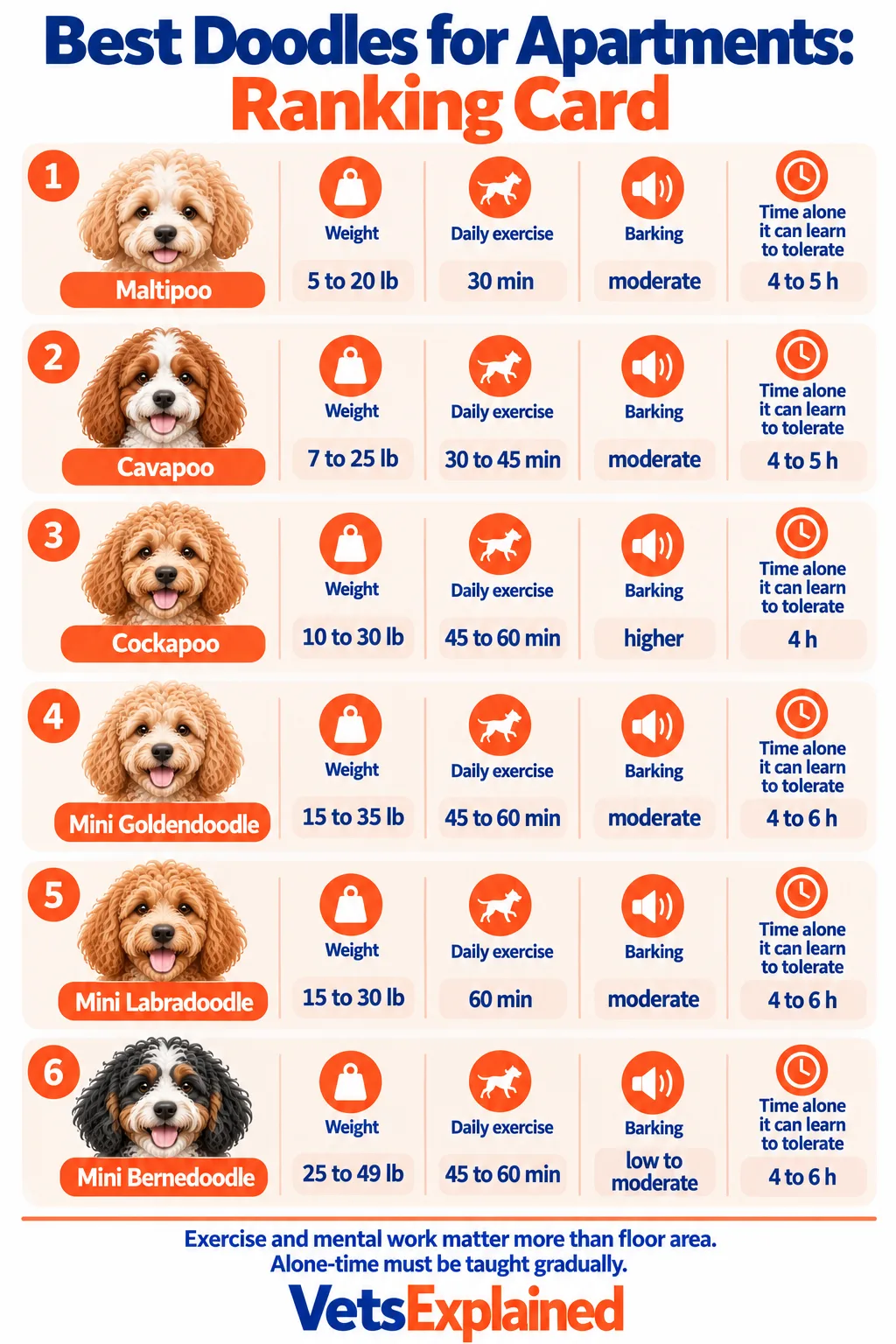
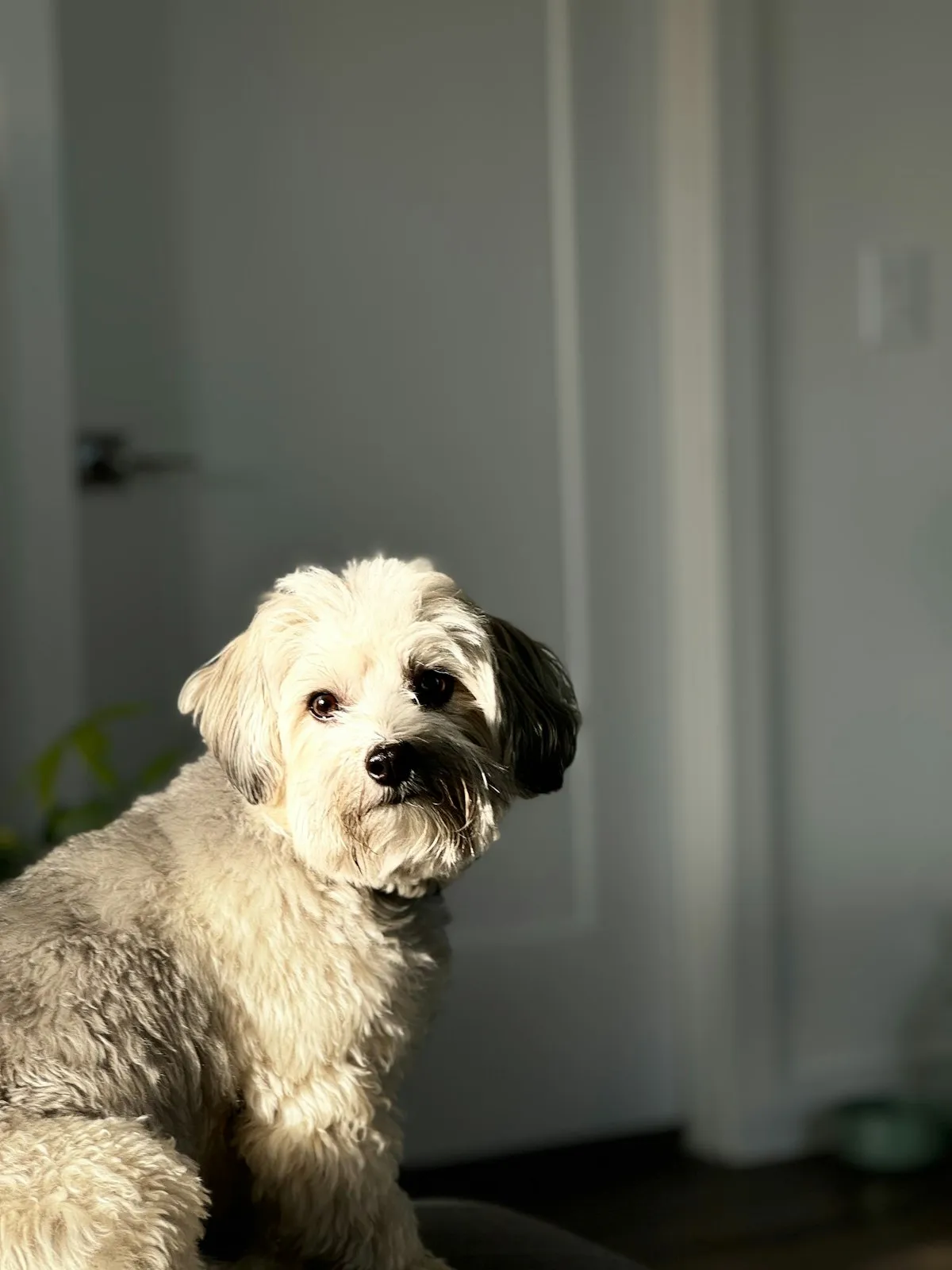
The Maltipoo is the best Doodle for apartments because it is tiny, needs the least exercise of any cross here, and comes from two companion breeds bred to live indoors.
- Size: 5 to 20 lb and 8 to 14 inches at the shoulder.
- Exercise needs: Low to moderate, around 30 to 45 minutes a day plus indoor play.
- Barking tendency: Moderate to high. Maltese and Toy Poodles are alert, vocal dogs; this is the cross's main apartment weakness.
- Separation tolerance: Fair. Most do best with a maximum of four hours alone.
- Grooming: High. The soft coat mats easily; brushing most days and clipping every four to eight weeks.
Full guide: Maltipoo.
32. Cavapoo: The Calmest Small Doodle
The Cavapoo ranks a close second: small, gentle and less inclined to bark than a Maltipoo, with slightly higher exercise needs.
- Size: Toy Cavapoos roughly 8 to 14 lb, Miniature Cavapoos 12 to 25 lb; 9 to 14 inches tall.
- Exercise needs: Moderate, around 30 to 60 minutes a day, then the sofa.
- Barking tendency: Low to moderate. The Cavalier is one of the quieter small breeds.
- Separation tolerance: Fair to poor. The 2026 study found Cavapoos scored higher for separation-related problems than Cavaliers.
- Grooming: High. Brushing several times a week and clipping every six to eight weeks.
Full guide: Cavapoo, including the Cavalier heart and spine tests to ask for.
43. Cockapoo: Small and Adaptable, but Busier
The Cockapoo suits an active owner but ranks third because it is more excitable and vocal than a Cavapoo and needs more exercise.
- Size: Toy under 12 lb, Miniature roughly 12 to 20 lb, Standard over 20 lb; choose a Toy or Miniature line.
- Exercise needs: Moderate, 45 to 60 minutes a day, plus scent games at home.
- Barking tendency: Moderate. The 2026 study found Cockapoos scored higher for excitability than both parent breeds.
- Separation tolerance: Fair. Cockapoos also scored higher for separation-related problems than Poodles and Cocker Spaniels.
- Grooming: High. The coat mats behind the ears and under the collar.
Full guide: Cockapoo.
54. Mini Goldendoodle: The Best Mid-Size Doodle for a Flat
The Mini Goldendoodle is the best choice if you want a slightly bigger, steadier dog and have a park within walking distance; it is too much dog for a studio with no off-lead time.
- Size: Roughly 15 to 40 lb and 14 to 17 inches; ask for the parents' measured sizes.
- Exercise needs: Moderate, 45 to 60 minutes a day plus puzzle feeding or training.
- Barking tendency: Low to moderate. Golden Retrievers are not big barkers.
- Separation tolerance: Fair to good. A well-exercised adult usually copes with four to five hours.
- Grooming: High. Brushing to the skin several times a week and clipping every six to eight weeks.
Full guide: Mini Goldendoodle. Ask for both parents' hip scores; see hip dysplasia in dogs.
65. Mini Labradoodle: Can Work With More Exercise
The Mini Labradoodle ranks fifth because the Labrador side brings a working-dog energy level that is hard to satisfy from a third-floor flat, although the cross is stable and relatively quiet.
- Size: 15 to 30 lb and 14 to 16 inches for a Miniature Poodle cross; mediums run 30 to 50 lb.
- Exercise needs: Moderate to high, about 60 minutes a day, ideally with off-lead running.
- Barking tendency: Low to moderate. Labradors are not alert barkers.
- Separation tolerance: Good for a Doodle. Labradoodles scored lower than Poodles for separation-related problems in the 2026 study, though higher than Labradors.
- Grooming: High for fleece and wool coats; hair coats shed more but need less clipping.
Full guide: Labradoodle.
76. Mini Bernedoodle: Calm but Heavier Than It Sounds
The Mini Bernedoodle is gentle and home-loving, but it ranks last because "mini" often means 25 to 49 lb, which many landlords will not consider small.
- Size: Tiny Bernedoodles 10 to 24 lb; Mini Bernedoodles 25 to 49 lb and 18 to 22 inches; figures vary by breeder.
- Exercise needs: Moderate, 45 to 60 minutes a day; Bernedoodles settle well between walks.
- Barking tendency: Low to moderate, but a deep Bernese bark carries through walls.
- Separation tolerance: Fair. Many Mini Bernedoodles are velcro dogs.
- Grooming: High. Thick undercoat plus Poodle curl mats quickly.
Full guide: Bernedoodle. A Tiny Bernedoodle under 25 lb suits a flat far better than a mini.
8Can a Standard Goldendoodle or Labradoodle Live in an Apartment?
Yes, if you can give a 50 to 80 lb dog 60 to 90 minutes of exercise a day, much of it off lead, and your building allows large dogs. The problems start when a big young retriever cross gets two 15-minute lead walks and nothing else; chewing, pacing and barking follow within weeks. A 70 lb adolescent that pulls in the lift is a daily hazard, and a standard puppy must be carried on stairs until about three months. The Goldendoodle guide explains how to find a genuine medium or mini line.
9Why Exercise and Mental Work Matter More Than Floor Area
A dog's calmness indoors depends on what it did outdoors and with its brain that day, not on how many square feet it has to pace.
- A real walk, 30 to 60 minutes depending on the cross, where the dog can sniff; nose work tires a dog faster than road walking.
- Training or puzzle feeding for 10 to 15 minutes, twice a day. Bored Poodle crosses invent jobs: barking at the window, chewing skirting boards.
- Off-lead time a few days a week for the retriever crosses.

10Noise and Neighbours: Which Doodles Bark Least?
The quietest Doodles for a flat are usually the Mini Goldendoodle, Mini Labradoodle and Cavapoo; the Maltipoo and Cockapoo are the most likely to alert-bark. Any cross becomes a problem barker if corridor barking is rewarded.
- Block the corridor view and leave a radio on in the first weeks.
- Teach "quiet" with a reward, not shouting. The Merck Veterinary Manual notes that attention of any kind, positive or negative, can reinforce barking.
- Record the dog when you are out. Barking you never hear is what neighbours complain about, and the first sign of separation distress.
- Talk to the neighbours early, before they talk to the building manager.
11Separation Anxiety: What the Evidence Says
Separation-related behaviour is common and partly preventable. The best evidence on prevention is the Dogs Trust "Generation Pup" study: Dale and colleagues (2024) followed puppies from under 16 weeks and found that 68 of 145, about 47 per cent, showed separation-related behaviour at six months: barking, howling, pacing, chewing, scratching at doors or toileting indoors when alone.
What the puppies that stayed calm had in common:
- They slept in an enclosed space overnight, a crate or puppy-proofed room, before 16 weeks; the strongest protective factor.
- They slept at least nine hours a night; ten or more was better still.
- They were house-trained early. Puppies still having four or more accidents a week at 16 weeks had much higher odds of later problems.
- Their owners did not use punishment, and did not fuss over the dog on return after "bad" behaviour; fussing carried roughly six times the odds.
Breed and cross were not significant in the final model: no Doodle is immune and none is doomed. The authors stress these are associations from owner reports, not proven causes.
A 2020 University of Lincoln study of 2,757 dogs, reported by the American Veterinary Medical Association, found that "separation anxiety" is several conditions, not one: panic, frustration at confinement, boredom or reaction to outside noises. Each needs a different plan, so a dog chewing the door frame needs a veterinary behaviour assessment, not a generic calming product. Signs are worst in the first 15 to 30 minutes after you leave; treatment is gradual desensitisation to departures, sometimes with medication, and a 2014 review found punishment makes things worse. Build up alone time in minutes, not hours, and video the first half hour.
12Toilet Routines for High-Rise Living
A puppy in a flat needs a toilet plan from the first night, because by the time it signals, a lift ride is too far, and the Generation Pup link between poor house-training and later separation problems makes this more than a convenience issue.
- Puppies under four months need to go out every one to two hours when awake and after every meal, nap and play. Carry the puppy to the exit.
- Use a fixed spot and a cue word, and reward the instant the puppy finishes.
- A balcony turf tray is a sensible bridge for the first weeks.
- Adults need at least three toilet trips a day; four is kinder for the small crosses.
- Do not restrict water to cut trips; small Doodles dehydrate quickly.
13Stairs, Heat and Puppies: Protecting Growth Plates
Puppies should not use flights of stairs daily before about three months old, and exercise should build gradually until the growth plates close, around 8 to 12 months in small crosses and up to 18 months in standards.
A Norwegian study of 501 puppies from four large breeds found that daily stair use from birth to three months was associated with a higher risk of hip dysplasia, while daily off-lead exercise on soft ground in the same period lowered it. Short, self-paced exercise on grass is good; repetitive loading on hard surfaces is not.
- Carry the puppy on stairs until about three months and use the lift where you can.
- Avoid long pavement walks as the only exercise, and repeated jumping off the sofa or bed.
- Heat: upper-floor flats get hot, and dense-coated or dark Doodles, especially Bernedoodles, overheat easily. Walk early and late in summer and keep the coat clipped.
14Elevator and Greeting Manners
Teach a Doodle to sit and wait in lifts and lobbies before six months old; a bouncy Poodle cross that leaps at every neighbour quickly loses the goodwill a dog in a shared building depends on.
- Sit at every threshold: the flat door, the lift door, the building door.
- Greeting on four feet: ask neighbours to pet the dog only when all four feet are on the floor.
- Lift etiquette: step in last, keep the dog on a short lead against your leg, and let others leave first.
- Socialisation: pair intercom buzzers, slamming doors and the lift's ping with food, and arrange calm meetings with adult dogs; the 2026 study found Cockapoos and Cavapoos scored higher for dog-directed fear than a parent breed.
15Is a Doodle Right for Your Apartment?
Standard Bernedoodles, Sheepadoodles and Aussiedoodles are poor matches for most apartments: the herding crosses bark at movement and a standard Bernedoodle can reach 90 lb. Our Doodle dog guide compares every cross.
Potential advantages:
- Low-shedding coats and toy or mini sizes that fit landlord weight limits, often 20 to 30 lb.
- Fast to train on lift, lead and quiet manners.
Potential challenges:
- Separation-related behaviour is common, and the smallest crosses are the most vocal.
- Grooming costs of roughly 50 to 150 dollars every four to eight weeks, varying by region.
- Toilet trips mean a lift ride at 6 a.m. in all weathers.
Sources
- Dale FC, Burn CC, Murray J, Casey R. Canine separation-related behaviour at six months of age: dog, owner and early-life risk factors identified using the 'Generation Pup' longitudinal study. Animal Welfare. 2024;33:e60. pmc.ncbi.nlm.nih.gov
- Bryson GT, O'Neill DG, Belshaw Z, Brand CL, Packer RMA. Comparing undesirable behaviours between 'designer' Poodle-cross dogs and their purebred progenitor breeds. PLoS One. 2026;21(2):e0342847. journals.plos.org
- Bryson GT, O'Neill DG, Brand CL, Belshaw Z, Packer RMA. The doodle dilemma: how the physical health of "designer-crossbreed" Cockapoo, Labradoodle and Cavapoo dogs compares to their purebred progenitor breeds. PLoS One. 2024;19(8):e0306350. pmc.ncbi.nlm.nih.gov
- de Assis LS, Matos R, Pike TW, Burman OHP, Mills DS. Developing diagnostic frameworks in veterinary behavioral medicine: disambiguating separation related problems in dogs. Frontiers in Veterinary Science. 2020;6:499. pmc.ncbi.nlm.nih.gov
- American Veterinary Medical Association, JAVMA News. New research identifies root causes of separation anxiety in dogs. 2020. avma.org
- Sargisson RJ. Canine separation anxiety: strategies for treatment and management. Veterinary Medicine: Research and Reports. 2014;5:143-151. pmc.ncbi.nlm.nih.gov
- Merck Veterinary Manual. Behavior problems in dogs. merckvetmanual.com
- Krontveit RI, Nødtvedt A, Sævik BK, Ropstad E, Trangerud C. Housing- and exercise-related risk factors associated with the development of hip dysplasia as determined by radiographic evaluation in a prospective cohort of Newfoundlands, Labrador Retrievers, Leonbergers, and Irish Wolfhounds in Norway. American Journal of Veterinary Research. 2012;73(6):838-846. pubmed.ncbi.nlm.nih.gov
Frequently Asked Questions
?What is the best Doodle for an apartment?
The Maltipoo, at 5 to 20 lb with 30 to 45 minutes of daily exercise, fits most flats best, with the Cavapoo a close and quieter second. Both need company most of the day and early training not to bark at corridor noise.
?Can a Goldendoodle live in an apartment?
A Mini Goldendoodle of 15 to 40 lb lives well in a flat with 45 to 60 minutes of exercise a day and a park nearby. A 50 to 90 lb standard needs 60 to 90 minutes daily and solid lift and lead manners.
?Which Doodle barks the least?
Mini Goldendoodles, Mini Labradoodles and Cavapoos tend to be quietest, because their non-Poodle parents are not alert barkers. Maltipoos and Cockapoos are the most likely to bark at footsteps and doors. Training matters more than the cross.
?Which Doodle is best at being left alone?
No Doodle is good at long days alone. Labradoodles scored lower for separation-related problems than Poodles in a 2026 study of 9,402 dogs, while Cockapoos and Cavapoos scored higher than a parent breed. Most adults cope with four to five hours if trained gradually.
?How do I toilet train a puppy in a high-rise?
Carry the puppy to a fixed spot outside every one to two hours when awake and after meals, naps and play, with a cue word and an immediate reward. A balcony turf tray helps in the first weeks.
?Can puppies use stairs in an apartment building?
Avoid daily flights of stairs before about three months; a Norwegian study of 501 puppies linked early stair use to hip dysplasia. Carry the puppy or use the lift, then introduce stairs gradually. Growth plates close at 8 to 18 months depending on size.
?What are the signs my Doodle has separation anxiety?
Barking, howling, scratching at the door, chewing, pacing, drooling or toileting indoors after you leave, usually worst in the first 15 to 30 minutes. Record the dog to check. A vet or veterinary behaviourist can tell panic from boredom or noise reactions.
?Is a Cavapoo or Cockapoo better for a flat?
A Cavapoo is usually the better flat dog: slightly smaller, calmer and less vocal. A Cockapoo is livelier, barks more and needs 45 to 60 minutes of exercise, but suits a more active owner. Both struggle with long hours alone.
Help us do better!
Was this article helpful and relevant?
Thanks for your feedback!
About Sofia Marin
Sofia Marin is VetsExplained's senior editor. She has edited pet and consumer titles for fifteen years and is responsible for the site's editorial standards and breed coverage.
View all posts by Sofia Marin →