Aussiedoodle Dog Breed Guide: Temperament, Size, Merle Genetics and Health
 Written by Sofia Marin
 Fact checked by Dr. Tomas Ellery, DVM
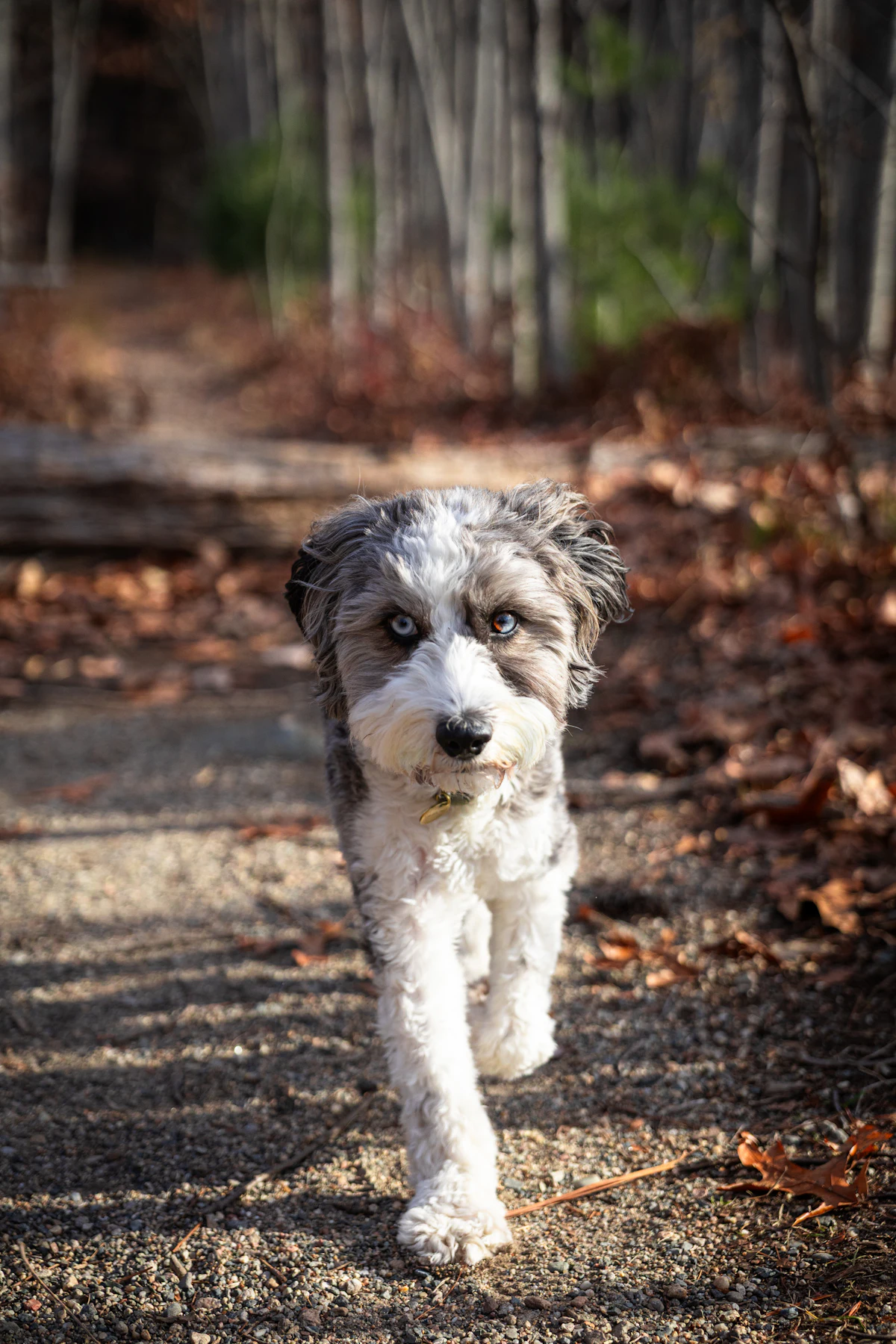
An Aussiedoodle is an Australian Shepherd crossed with a Poodle. Most weigh 15 to 70 lb, live 12 to 15 years and need 60 to 90 minutes of exercise plus daily mental work. About half of Australian Shepherds carry the MDR1 drug-sensitivity mutation, so ask for the DNA test.
The information is current and up-to-date in accordance with the latest veterinary research. Learn more »
The Aussiedoodle is an Australian Shepherd and Poodle cross, and it is the Doodle for people who want a dog that thinks. Both parent breeds sit near the top of most working-intelligence lists, and the result is a quick, athletic, often strikingly marked dog that learns a trick in an afternoon and will invent its own job if you do not provide one.
That same brain is the catch. Many Aussiedoodles are bought for their blue-merle coats and clever eyes and then struggle in homes that expected a fluffy lap dog. They also carry two genetic issues from the Australian Shepherd side that most breed guides gloss over: the merle gene, which is dangerous when two copies are inherited, and the MDR1 mutation, which makes some common veterinary drugs toxic.
This guide covers what an Aussiedoodle is, the sizes and coats, how the herding instinct shows up in a family home, how much exercise and mental work they really need, grooming, the merle and MDR1 genetics explained plainly, hip dysplasia and eye disease, the health tests to ask for, what one costs, and whether an Aussiedoodle is the right dog for you. If you are still deciding between Poodle crosses, our Doodle Dog guide compares the whole family.
Key Takeaways
- An Aussiedoodle is an Australian Shepherd and Poodle cross, not a recognised breed; sizes run from 10 lb Toys to 70 lb Standards, and the parents' measured size predicts a puppy best.
- They are among the most trainable dogs available but need 60 to 90 minutes of exercise plus daily mental work, and the herding instinct must be managed around children from the first week.
- Never buy from a merle-to-merle litter: each puppy has a 25 per cent chance of being a double merle, and a 2009 study found a quarter of double merles were deaf, with eye defects more common still.
- About half of Australian Shepherds carry the MDR1 mutation, which makes drugs such as loperamide and high-dose ivermectin toxic; ask for the parent's test or test the puppy, and tell your vet.
- Insist on hip, elbow and eye evaluations on both parents, plus HSF4 cataract, CEA, PRA and MDR1 DNA tests on the Australian Shepherd side.
1Aussiedoodle at a Glance
- Parent breeds: Australian Shepherd (or Miniature American Shepherd) × Poodle (Standard, Miniature or Toy)
- Other names: Aussiepoo, Aussiepoodle
- Origin: United States, late 1990s to early 2000s
- Size: Toy (10 to 15 lb), Mini (15 to 35 lb) and Standard (40 to 70 lb)
- Height: 10 to 23 inches at the shoulder depending on size
- Coat: Wavy to curly, occasionally straight; medium length
- Common colours: Blue merle, red merle, black tri, red tri, phantom, parti, sable, solid black, red and cream
- Shedding: Low to moderate; curlier coats shed least
- Grooming: High; brushing several times a week and clipping every 6 to 8 weeks
- Exercise needs: High, 60 to 90 minutes a day plus mental work
- Trainability: Very high; both parents are working breeds
- Lifespan: Usually 12 to 15 years; smaller dogs tend to live longer
- Recognition: Not recognised by the AKC or the Kennel Club
- Best for: Active, experienced owners who enjoy training and can give a dog a daily job
2What Is an Aussiedoodle?
An Aussiedoodle is any dog with Australian Shepherd and Poodle ancestry. It is not a breed. No major kennel club recognises it, there is no breed standard, and the dogs vary a great deal in size, coat and temperament depending on which parent each puppy takes after.
The two parents were built for different work. The Australian Shepherd, despite its name, was developed on ranches in the western United States as a herding and all-purpose farm dog. It is intense, watchful, fast and bred to control the movement of livestock. The Poodle was a water retriever that became a performer and companion, with a dense curly coat and a quick, people-focused mind. An Aussiedoodle can land anywhere between a sharp, reserved herding dog and a bouncy, sociable retriever type, and a single litter can contain both.
A short history
Aussiedoodles appeared in the United States as the Doodle boom spread beyond Labradoodles and Goldendoodles, most sources putting the first deliberate litters in the late 1990s or early 2000s. Unlike the Labradoodle, there was no founding programme or purpose beyond producing a low-shedding dog with Australian Shepherd looks and smarts. That means there is no club-run pedigree, no agreed testing requirement and wide variation between breeders.
3Aussiedoodle Size
Size follows the Poodle parent and, on the Australian Shepherd side, whether a standard Aussie or a Miniature American Shepherd was used. The three categories below are the ones most breeders quote, and the ranges are typical rather than guaranteed.
- Toy Aussiedoodle: 10 to 12 inches tall, roughly 10 to 15 lb. Toy Poodle crossed with a Miniature American Shepherd. The least common and the one to be most careful about, because very small Doodles are often bred for size rather than health.
- Mini Aussiedoodle: 12 to 18 inches tall, roughly 15 to 35 lb. Usually a Miniature Poodle with a Miniature American Shepherd or a small standard Aussie.
- Standard Aussiedoodle: 19 to 23 inches tall, roughly 40 to 70 lb. A Standard Poodle crossed with a standard Australian Shepherd.
Ask for the measured height and weight of both parents. A breeder's size label predicts a puppy's adult weight far less reliably than the parents do, and first-generation litters can produce puppies above and below both.
Mini Aussiedoodle
The Mini Aussiedoodle is the most popular size, and it is often sold as a compact, apartment-friendly dog. Compact, yes. Low-energy, no. A 25 lb Mini Aussiedoodle still carries a herding dog's drive and a Poodle's need to be involved in everything. Minis suit people who want a portable, intelligent companion for hiking, agility or trick training, not people who want a small dog so they can walk it less.
4What Does an Aussiedoodle Look Like?
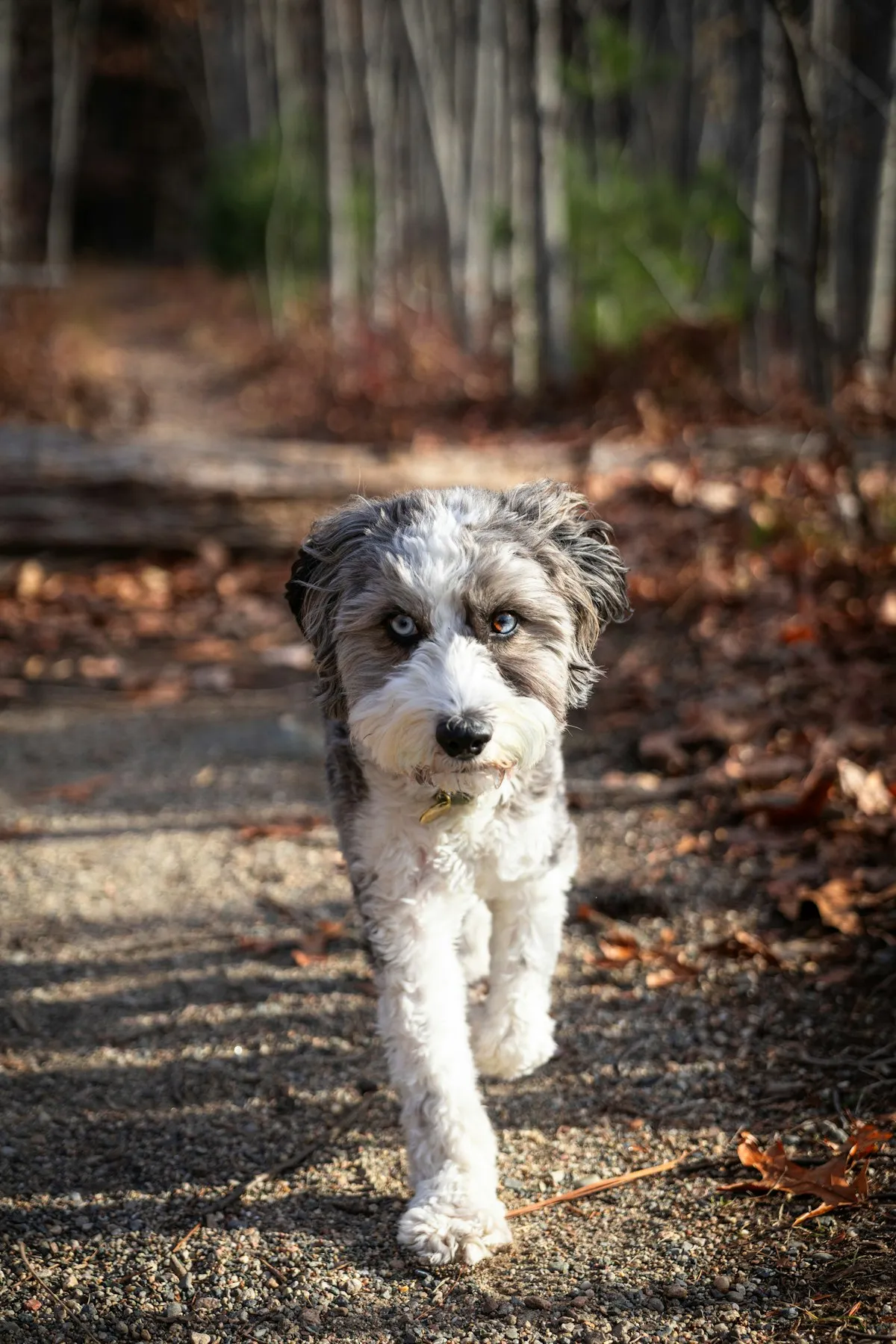
Most Aussiedoodles have a medium build, a moderately long muzzle, floppy ears and a wavy or curly coat that is a little shorter than a Goldendoodle's. Eyes are often brown, but blue eyes and odd-coloured eyes (one blue, one brown) are common in merles and in some non-merle dogs too.
The merle pattern is what sells most Aussiedoodles. Blue merle is a mottled grey and black, red merle a mottled cream and liver, and both usually come with white and tan trim. Tri-colour (black or red with white and copper), phantom (Poodle-style tan points), parti and solid colours also occur. Colour has no effect on temperament, but merle does have a genetic consequence covered below.
5Aussiedoodle Coat Types
Aussiedoodle coats are usually grouped into three types, and the type matters more than the colour because it drives shedding and grooming.
Straight coat
The straight coat is closest to the Australian Shepherd: a double coat of medium length with feathering on the legs and chest. It sheds the most of the three, often seasonally in large amounts, and is most common in first-generation (F1) puppies that take after the Aussie parent.
Wavy coat
The wavy coat is the most common Aussiedoodle coat and the one in most photos: soft, loose waves with some undercoat. It sheds a little and mats readily behind the ears, in the armpits and under the collar.
Curly coat
The curly coat is closest to the Poodle and is most common in F1B dogs. It sheds least, because loose hair is held in the curls rather than falling out, and for the same reason it mats fastest if brushing is skipped.
6Do Aussiedoodles Shed?
Yes, to a degree that depends on the coat. Straight-coated Aussiedoodles shed much like an Australian Shepherd, which is a lot. Wavy coats shed lightly, curly coats very little. No Aussiedoodle is non-shedding, and no breeder can promise a puppy's adult coat from how it looks at eight weeks. The adult coat usually comes in between 8 and 14 months, and that transition period, when the puppy coat is being replaced, is when matting is worst.
7Are Aussiedoodles Hypoallergenic?
No. No dog is hypoallergenic, because people who are allergic to dogs react to proteins in dander, saliva and urine rather than to hair. A low-shedding coat spreads less dander around a house, which helps some allergic people and does nothing for others. If allergies are the reason you are considering an Aussiedoodle, spend time with the individual dog, more than once and indoors, before committing, and treat any "hypoallergenic guarantee" as a reason to look elsewhere.
8Aussiedoodle Temperament
Most Aussiedoodles are intelligent, energetic, affectionate with their family and quick to learn. The traits that set them apart from other Doodles come from the Australian Shepherd: intensity, watchfulness, a tendency to bond strongly to one or two people, and a herding instinct that can surprise owners who have only lived with retriever crosses.
Common traits include:
- Very fast learning, of good habits and bad ones alike
- A strong need for a daily job: training, scent work, agility, fetch with rules
- Herding behaviour: circling, chasing and sometimes nipping at running children, bikes, other dogs or cars
- Devotion to the family and, in some dogs, reserve or wariness with strangers
- Sensitivity to tone, noise and change; harsh handling backfires
- Restlessness and problem behaviour when under-stimulated
Temperament is not guaranteed by the cross. A 2026 Royal Veterinary College study of more than 9,000 UK dogs found that Cockapoos, Labradoodles and Cavapoos were not better behaved than their parent breeds and in many comparisons scored worse for fear, separation-related problems and excitability. Aussiedoodles were not included, but the lesson carries: a Poodle cross inherits its parents' temperaments, not a calmer average of them. The parents' individual natures, early socialisation and training decide most of what you get.
The herding instinct in a family home
The Australian Shepherd was bred to move animals by staring, circling, pushing and, when needed, nipping heels. In an Aussiedoodle that instinct has nowhere to go, so it is redirected onto whatever moves: toddlers running in the garden, children on scooters, joggers, cyclists and the family cat. Nipping at heels is not aggression, but it frightens children and can escalate if it is laughed at.
Managing it is straightforward if you start early:
- Teach a rock-solid recall and a "settle" before the dog is six months old.
- Do not let children run and squeal around a young Aussiedoodle until it has learned to stay calm; supervise and separate instead.
- Give the dog a legitimate outlet: fetch with a "wait" and "release", flirt-pole games with rules, scent work, or herding-style sports such as Treibball.
- Interrupt chasing calmly and redirect; shouting adds excitement.
Do Aussiedoodles bark a lot?
Aussiedoodles can be vocal. Australian Shepherds are alert, watchful dogs that bark at anything unusual, and Poodles are not quiet either. Expect barking at visitors, passing dogs and noises, and more of it if the dog is bored. Early training in a "quiet" cue, plenty of exercise and mental work, and not rewarding alarm barking with attention keep it manageable. An adult Aussiedoodle that barks for long periods alone is usually anxious or under-stimulated rather than badly behaved.
9Are Aussiedoodles Good Family Dogs?
They can be excellent family dogs for the right family, and a poor fit for others. The deciding factors are honest ones.
Activity. An Aussiedoodle in a family that hikes, runs, trains and plays every day thrives. In a family that walks around the block twice a day, it becomes destructive, mouthy and anxious.
Children's ages. Aussiedoodles and children aged eight or older who can take part in training and games usually get on brilliantly. Families with toddlers need to manage the herding instinct from the first week and should expect to supervise every interaction for the first couple of years.
Experience. This is not the Doodle most trainers recommend for a first dog. A Goldendoodle or Bernedoodle is often an easier first Doodle; our Goldendoodle guide covers the more easygoing alternative.
10Are Aussiedoodles Good With Other Dogs and Cats?
Usually, with socialisation. Well-raised Aussiedoodles enjoy canine company and are popular at daycare and in dog sports. The two common problems are herding other dogs at the park, which some dogs resent, and a degree of wariness or bossiness with strange dogs inherited from the Australian Shepherd. Introduce a wide range of calm, friendly dogs during puppyhood and teach a reliable recall.
With cats, the herding instinct is the issue. An Aussiedoodle raised with a cat from puppyhood generally learns to leave it alone; an adult rehomed into a home with cats needs careful, gradual introductions and may never be trustworthy with a cat that runs.
11Are Aussiedoodles Easy to Train?
Aussiedoodles are among the easiest dogs to teach and among the hardest to live with if you do not teach them. They pick up cues in a handful of repetitions, enjoy working for food and toys, and excel at obedience, agility, rally, scent work and trick training. The flip side is that they learn unwanted behaviours just as fast: a puppy that gets a reaction for herding the children will repeat it.
Reward-based methods work best. Both parent breeds are sensitive, and harsh corrections produce a worried, shut-down or defensive dog rather than a compliant one.
Start with the behaviours that make daily life easier:
- Name response, sit and settle on a mat
- Recall, practised daily and rewarded generously
- "Leave it" and "drop", because clever dogs steal
- Loose-lead walking before the dog is strong enough to pull you over
- Calm greetings without jumping or nipping
- Handling for brushing, nail trims and ear checks from the first week home
- Being alone for short, gradually lengthening periods
Socialisation between roughly 3 and 14 weeks shapes the adult dog, and it matters more for an Aussiedoodle than for most Doodles because the Australian Shepherd side can be reserved with strangers. Introduce people of all ages and appearances, calm vaccinated dogs, traffic, car journeys, the vet's waiting room and grooming equipment, always keeping the experience positive.
12How Much Exercise Does an Aussiedoodle Need?
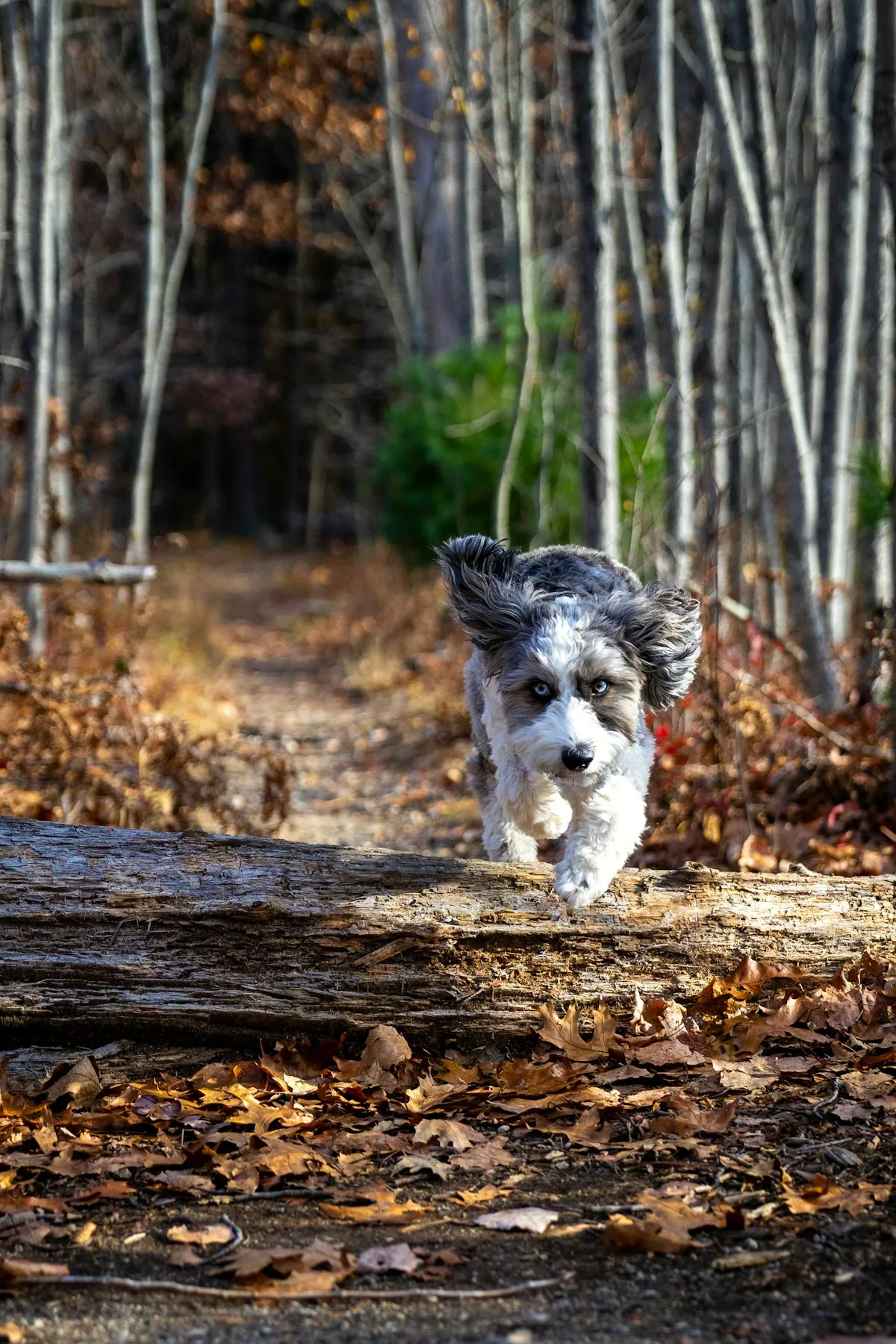
A standard adult Aussiedoodle needs around 60 to 90 minutes of real activity a day, and many need more. Minis need somewhat less walking but just as much mental work. A tired Aussiedoodle is a calm Aussiedoodle, and mileage alone does not tire this cross: the dog that has run beside a bike for an hour often comes home fitter and no calmer.
Mental stimulation matters as much as physical exercise. Good options:
- Short training sessions through the day, teaching new tricks and cues
- Scent games, snuffle mats and puzzle feeders at mealtimes
- Fetch and tug with rules, so the dog practises self-control as well as speed
- Off-lead running in a safe area once recall is reliable
- Dog sports: agility, flyball, rally, canicross, disc, herding trials and scent work
- Hiking and swimming with the family
A 20-minute training and scent-work session plus a good walk will settle most Aussiedoodles better than a two-hour walk alone. Leaving an Aussiedoodle in a garden to "burn off energy" by itself does not work; it teaches fence-running and barking.
Puppy exercise
Puppies should not be exercised like adults. Growth plates in a standard-sized Aussiedoodle close at roughly 12 to 18 months, and repeated high-impact activity before then is linked to joint problems. Keep walks short, avoid jumping and repetitive ball-chasing, and skip running and agility jumps until your vet confirms the dog is mature.
13Aussiedoodle Grooming Requirements
Grooming is demanding and lifelong. A wavy or curly Aussiedoodle coat needs:
- Brushing to the skin three or four times a week, daily during the coat change at around a year old
- Combing after brushing to find mats the brush slides over
- Professional clipping every six to eight weeks for most owners
- Bathing every four to eight weeks, followed by thorough drying and brushing
- Nail trims every three to four weeks
- Ear checks weekly and after swimming
- Tooth brushing daily if possible, several times a week at minimum
A straight-coated Aussiedoodle needs less brushing but sheds a good deal more and still needs regular attention to ears, nails and teeth.
Work in small sections, parting the coat and brushing from the skin outwards with a slicker, then running a metal comb through. Behind the ears, under the collar, the armpits, inner thighs and the base of the tail mat first. If you find mats tight against the skin, book a groomer rather than cutting them out; scissors near a wriggling dog cause more injuries than most owners expect. Our Doodle grooming guide goes through tools, technique and how to prevent matting in detail.
14Merle Genetics: What Every Aussiedoodle Buyer Should Understand
The merle pattern is the main reason many people choose an Aussiedoodle, so it is worth understanding what it is genetically, because it carries a real welfare risk when two merle dogs are bred together.
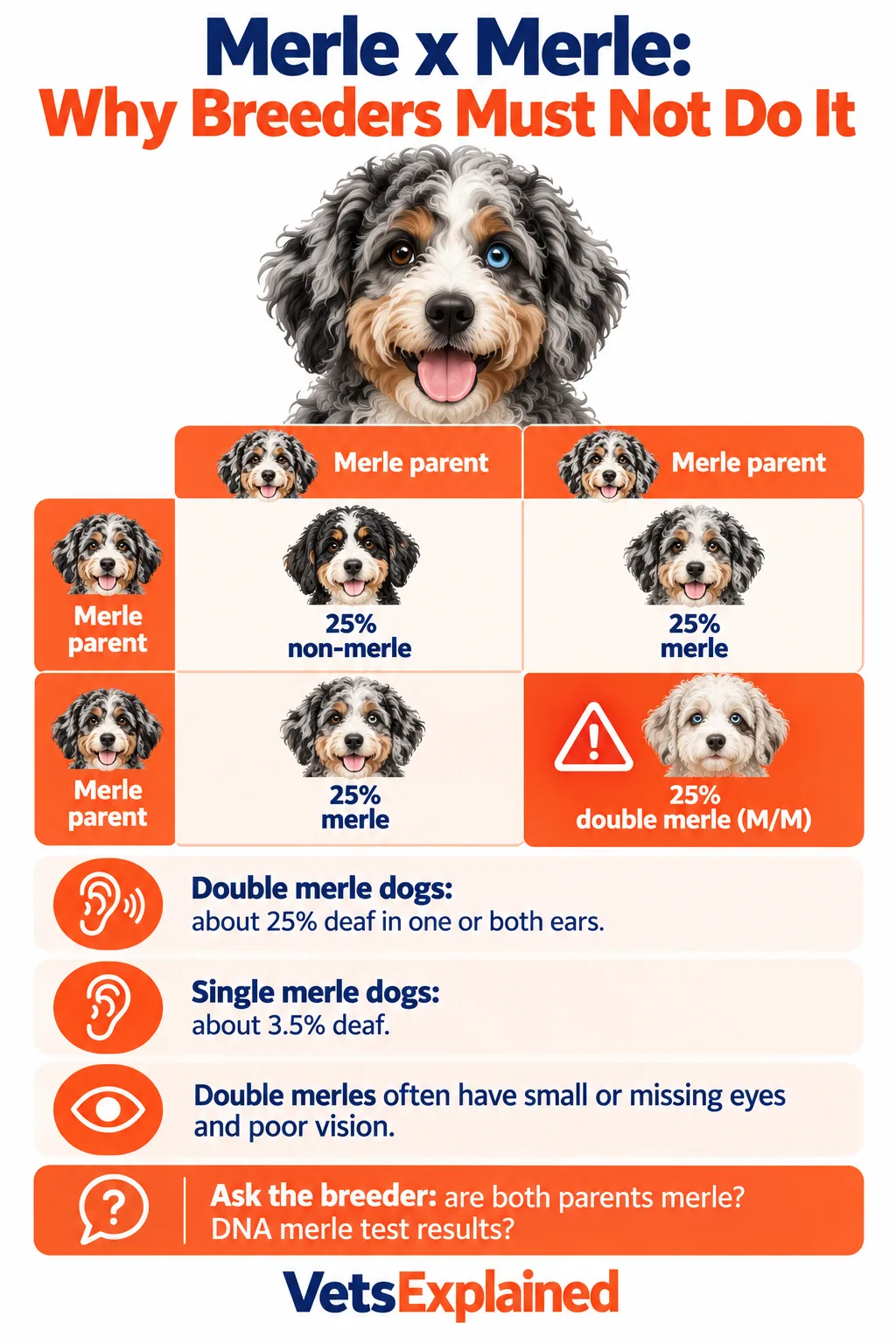
Merle is caused by a variant of the PMEL gene, as described in a 2020 review in the journal Genes. The variant is a small inserted sequence that disrupts pigment production in patches, producing the mottled coat and often blue or partly blue eyes. A dog with one copy of the merle variant (M/m) shows the pattern and is usually healthy. A dog with two copies (M/M), called a double merle, is usually mostly white and has a high rate of eye and ear defects.
The UC Davis Veterinary Genetics Laboratory, which runs one of the main DNA tests for merle, explains that the inserted sequence comes in different lengths, that the pattern varies along a continuum, and that some dogs with short merle alleles show almost no visible pattern. These "cryptic merles" matter because a dog that looks solid can still pass a merle allele to its puppies.
Why double merles go deaf and blind
Pigment cells are needed for the inner ear to develop and function, and the same gene affects the development of the eye. When both copies of PMEL are the merle variant, pigment loss is widespread, and the consequences go beyond coat colour. Double merles commonly have abnormally small eyes (microphthalmia), misshapen pupils, missing pieces of iris or retina (colobomas), and partial or complete deafness.
The numbers are stark. In a 2009 study published in the Journal of Veterinary Internal Medicine, Strain and colleagues BAER-tested 153 merle dogs and found that 25 per cent of double merles were deaf in one or both ears (10 per cent in one ear, 15 per cent in both), against 3.5 per cent of single merles. Eye defects in double merles are more frequent still, and often involve vision loss.
What this means when you buy
- Never buy from a merle-to-merle litter. Each puppy has a 25 per cent chance of being double merle. Kennel clubs in many countries refuse to register the offspring of merle-to-merle matings for this reason.
- Ask what colour both parents are and whether a solid-coloured parent has been DNA tested for merle, because cryptic merles exist.
- Be wary of mostly white Aussiedoodle puppies with blue eyes and little pattern, especially from a breeder who cannot show both parents.
- Blue eyes in a single merle are normal. They do not indicate blindness.
- Double merles that do exist deserve good homes, but they should be sold or rehomed as dogs with special needs, after a BAER hearing test and an ophthalmologist's examination, and never bred.
15MDR1 Drug Sensitivity: The Australian Shepherd Gene to Know About
The second inherited issue specific to this cross is the MDR1 mutation (also written ABCB1), which Australian Shepherds carry at a high rate and which can make ordinary veterinary drugs dangerous.
The MDR1 gene produces P-glycoprotein, a pump that keeps certain drugs out of the brain. Dogs with the mutation have a faulty pump, so some drugs build up in the brain and cause tremors, disorientation, blindness, coma and sometimes death at doses that are safe for other dogs. The mutation was identified by researchers at Washington State University, and according to the WSU Veterinary Clinical Pharmacology Laboratory, roughly 50 per cent of Australian Shepherds and 50 per cent of Miniature Australian Shepherds carry at least one copy. Poodles are not an affected breed, so an F1 Aussiedoodle has roughly a one in four chance of carrying a copy if the Aussie parent is a carrier; dogs with two copies are the most sensitive, but dogs with one copy can also react to high doses.
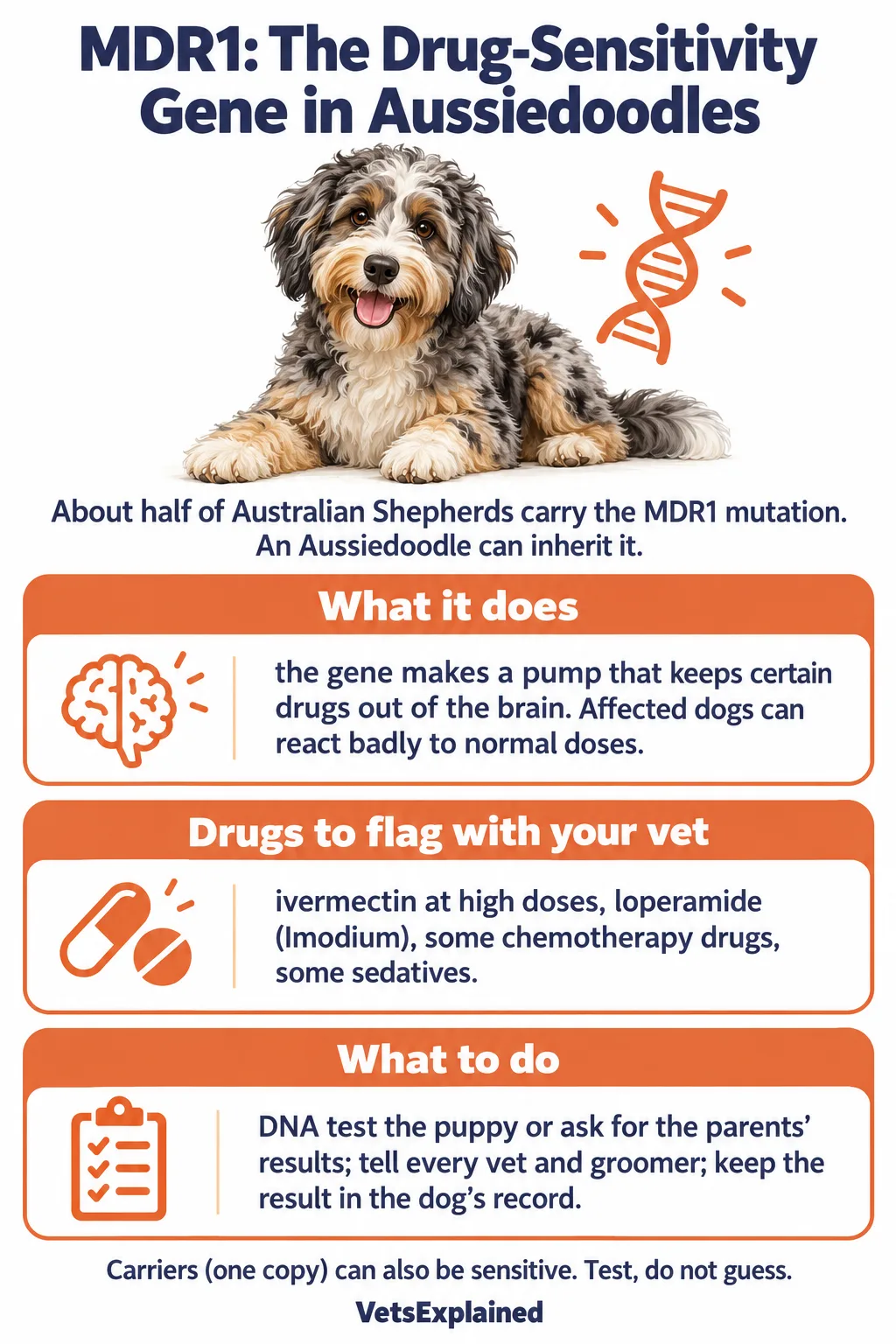
Drugs that WSU lists as a concern include:
- Loperamide (Imodium), which WSU advises avoiding in every dog with the mutation
- Ivermectin, milbemycin, moxidectin and selamectin at doses above the amounts used in licensed heartworm preventives; the label doses in products such as Heartgard, Interceptor and Revolution have been tested and are considered safe, but the much higher livestock doses are not
- Acepromazine and butorphanol, common sedatives, which need lower doses
- Several chemotherapy drugs (vincristine, vinblastine, doxorubicin)
- Cyclosporine, maropitant, ondansetron, apomorphine and grapiprant, which need dose adjustment or specialist advice
The practical steps are simple:
- Ask the breeder whether the Australian Shepherd parent has been DNA tested for MDR1 and ask to see the result.
- If the parent is a carrier or untested, test the puppy. The test is a cheek swab, inexpensive and available through WSU and most commercial canine DNA panels.
- Tell every vet, groomer and boarding kennel your dog's status and have it recorded on the clinical file.
- Keep your dog away from horse and livestock dewormer pastes and from the droppings of recently treated animals, a classic cause of ivermectin poisoning in farm dogs.
An MDR1-affected Aussiedoodle can live a completely normal life. The danger is only in not knowing.
16Aussiedoodle Health: Hip Dysplasia, Eye Disease and What the Evidence Shows
Aussiedoodles are generally healthy, athletic dogs, but the idea that crossbreeding makes Doodles healthier than their parents is not supported by the best evidence. A 2024 Royal Veterinary College study comparing Labradoodles, Cockapoos and Cavapoos with their parent breeds across 57 common disorders found no significant difference for the large majority. Aussiedoodles were not studied, but there is no reason to expect them to be the exception: they inherit the Australian Shepherd's and the Poodle's problems, and which ones show up depends on the parents.
Hip and elbow dysplasia
Hip dysplasia is an abnormal development of the hip joint that leaves it loose and leads to arthritis. It occurs in both parent breeds, more often in standard-sized dogs, and is worsened by rapid growth, excess weight and over-exercise in puppyhood. The Merck Veterinary Manual describes the typical signs as lameness that is worse after exercise, a "bunny-hopping" gait, stiffness and reduced range of motion. It is diagnosed by X-ray and managed with weight control, controlled exercise, physiotherapy, anti-inflammatories and, in severe cases, surgery up to total hip replacement. Elbow dysplasia is a related developmental problem of the front legs.
Our guide to hip dysplasia in dogs explains the early signs and treatment options in full. For an Aussiedoodle, the key prevention is choosing parents with hip and elbow evaluations and keeping the dog lean and sensibly exercised through its first 18 months.
Eye disease
Eye problems are the most important inherited group on the Australian Shepherd side, and the Poodle adds some of its own.
- Hereditary cataracts: Australian Shepherds carry a well-known variant of the HSF4 gene that greatly increases the risk of cataracts developing in both eyes, usually in young to middle-aged adults. A DNA test exists and is routinely used in Aussie and Miniature American Shepherd breeding programmes. Cataracts can be surgically removed in suitable dogs.
- Collie eye anomaly (CEA): a developmental defect of the back of the eye that ranges from mild and symptom-free to detachment and blindness. It is recessive, so both parents must carry it, and there is a DNA test.
- Progressive retinal atrophy (PRA): inherited degeneration of the retina leading to blindness, present in both parent breeds. The prcd form has a DNA test.
- Distichiasis and iris colobomas: extra eyelashes and gaps in the iris, both seen in Australian Shepherds and picked up on an eye examination.
- Double-merle eye defects: covered above.
Breeding dogs on the Australian Shepherd side should have an annual eye examination by a veterinary ophthalmologist as well as the relevant DNA tests.
Other conditions to know about
- Epilepsy: idiopathic epilepsy occurs in Australian Shepherds and Poodles. Seizures usually start between one and five years of age and are managed with medication. There is no DNA test, so ask about seizures in the parents' lines.
- Addison's disease (hypoadrenocorticism): Standard Poodles are strongly predisposed. Signs are vague and intermittent: lethargy, poor appetite, vomiting, weakness. It is diagnosed with a blood test and treated for life, usually very successfully. Any Aussiedoodle with repeated unexplained "off" days should be tested.
- Hypothyroidism: common in both parents; causes weight gain, lethargy and skin problems, and is treated with daily tablets.
- Sebaceous adenitis: an inflammatory skin disease seen in Standard Poodles, causing scaling and hair loss.
- Patellar luxation: slipping kneecaps, mainly in Toy and Mini Aussiedoodles from the small Poodle side.
- Bloat (GDV): a risk in deep-chested standard dogs. A swollen abdomen, unproductive retching and restlessness are an emergency.
- Ear infections: floppy, hairy ears plus swimming; check weekly.
How long do Aussiedoodles live?
Most Aussiedoodles live 12 to 15 years, with Minis and Toys often at the upper end and Standards nearer the lower. Keeping the dog lean is the single most effective thing an owner can do to add healthy years.
17Health Testing Before Buying an Aussiedoodle Puppy
Because an Aussiedoodle can inherit problems from either side, both parents should be tested for the conditions relevant to their breed. "Vet-checked" is not health testing. Ask to see certificates and check them against the registries: OFA or PennHIP in the United States, the BVA/KC schemes in the UK, and DNA lab reports for the genetic tests.
For the Australian Shepherd side, the AKC lists the national breed club's recommended tests as a hip evaluation, an elbow evaluation and an ophthalmologist's eye examination. For the Miniature American Shepherd, the recommendations add DNA tests for MDR1, HSF4 hereditary cataracts, prcd-PRA and neuroaxonal dystrophy. In practice, a careful Aussiedoodle breeder should have all of these on the Aussie parent regardless of size, plus a CEA DNA test and a merle status if the parent is not an obvious merle.
For the Poodle side, the minimum for a Standard Poodle is a hip evaluation, an eye examination and at least one of thyroid, sebaceous adenitis or cardiac evaluation; for a Miniature or Toy Poodle, patellar luxation and prcd-PRA testing.
Questions to ask a breeder
- Which health tests have been done on each parent, and can I see the results rather than be told about them?
- What is the MDR1 status of the Australian Shepherd parent?
- What colour is each parent, and is a solid-coloured parent DNA tested for merle?
- How tall and heavy is each parent?
- What coat type does each parent have, and what did earlier litters produce?
- Can I meet the mother and see where the puppies are raised?
- What generation is the litter (F1, F1B, multigen)?
- How are the puppies socialised before eight weeks?
- What happens if I can no longer keep the dog?
A good breeder will ask you as many questions as you ask them, and will be glad you raised merle and MDR1 rather than irritated.
18F1, F1B and Multigenerational Aussiedoodles
- F1: Australian Shepherd × Poodle. The most Aussie-like temperament and the most variable coat; straight, wavy and curly can all appear in one litter.
- F1B: F1 Aussiedoodle × Poodle. Three-quarters Poodle, so more likely to have a curly, low-shedding coat and often a slightly softer temperament, with more Poodle health risks.
- F2: F1 × F1. The widest range of all, from Aussie-like to Poodle-like puppies.
- Multigenerational: Aussiedoodle × Aussiedoodle over several generations. Coat becomes more predictable; temperament and health depend entirely on the breeder's selection.
Our guide to F1 vs F1B vs F2 Doodles explains what the labels can and cannot predict.
19What Should an Aussiedoodle Eat?
An Aussiedoodle needs a complete and balanced diet appropriate for its life stage and expected adult size. The WSAVA Global Nutrition Guidelines recommend choosing a food from a manufacturer that employs qualified nutritionists, runs feeding trials and can answer detailed questions about its products; those basics matter more than the brand name or the marketing.
Two points are specific to this cross: standard Aussiedoodle puppies expected to exceed about 50 lb should eat a large-breed puppy food, which controls growth rate and calcium and lowers the risk of joint disease; and food is a training tool, so measure the day's ration and use a good part of it for training and puzzle feeders rather than putting it all in a bowl.
Our feeding guide by life stage covers how much to feed as your dog grows.
Extra weight shortens lives and worsens hip and elbow disease, and a fluffy coat hides it. Judge your dog by feel: ribs easy to find under a thin layer of fat, a visible waist from above and a tucked belly from the side. Ask your vet to show you the body-condition score, and adjust food by about 10 per cent at a time if the dog is drifting.
20Can Aussiedoodles Be Left Alone?
Not for long, and not without practice. Both parent breeds are strongly people-oriented, and Aussiedoodles are prone to separation-related problems and to destructive boredom. An adult that has been taught gradually can usually manage four to five hours, provided it has been exercised and mentally worked first. A puppy cannot, and an Aussiedoodle in a home where everyone is out for nine hours a day is a poor match however much exercise it gets at weekends.
Build time alone up from the first week: short absences while the dog is tired and settled, a safe resting space, something to chew, calm departures and returns, and a predictable routine. If an adult panics when left, howls continuously, injures itself or destroys doors and windows, that is separation-related distress and needs a vet or qualified behaviourist rather than more time to "get used to it".
21How Much Does an Aussiedoodle Cost?
Prices vary widely by country, region, breeder, size and colour, so treat any figure as a rough guide.
- Puppy from a breeder: in the United States, typically 1,500 to 4,000 dollars in 2026, with merle and Mini puppies from well-tested parents often at the top of that range and above. UK, Canadian and Australian prices follow a similar pattern in local currency.
- Rescue: usually a few hundred dollars in adoption fees. Aussiedoodles between one and three years old appear regularly in Doodle and herding-breed rescue, very often surrendered for the energy, herding and barking reasons this guide describes.
- Ongoing: professional grooming at roughly 70 to 150 dollars every six to eight weeks, plus food, insurance, routine vet care, training classes and, ideally, a dog sport. Budget for an MDR1 test if the breeder has not done one.
A cheap merle Aussiedoodle puppy is a warning sign, not a bargain. Health testing, careful colour pairing and proper socialisation cost money, and a breeder who has skipped them has passed the risk to you.
22Aussiedoodle vs Goldendoodle vs Bernedoodle
Aussiedoodle vs Goldendoodle. The Goldendoodle is softer in every sense: a gentler, more universally sociable temperament, a longer and lighter coat, and less drive. It is the easier first Doodle and the better choice for a busy family that wants a dog to fit in rather than a dog to train. The Aussiedoodle is sharper, more athletic and more rewarding for someone who enjoys working with a dog, and it brings merle and MDR1 genetics the Goldendoodle does not. Both share hip dysplasia, eye disease and Poodle-side risks; the Goldendoodle adds the Golden Retriever's higher cancer rate.
Aussiedoodle vs Bernedoodle. The Bernedoodle is bigger, calmer and slower to mature, with a Bernese Mountain Dog's placid, home-loving nature and a shorter expected lifespan in the standard size. It suits a quieter household. The Aussiedoodle is the lighter, faster, busier dog and lives longer on average. Our Bernedoodle guide covers the other side of that comparison.
23What Are the Disadvantages of an Aussiedoodle?
The main disadvantages are very high exercise and mental-stimulation needs, a herding instinct that must be trained out early, barking, demanding grooming, a dislike of being left alone, and two pieces of genetics, merle and MDR1, that attract careless breeding and require an informed buyer. Being honest about them is the best way to keep a dog out of rescue.
24Aussiedoodle Pros and Cons
Potential advantages
- Exceptionally intelligent and quick to train
- Athletic, agile and outstanding at dog sports
- Devoted and affectionate with family
- Low-shedding in wavy and curly coats
- Three size options
- Striking merle, tri and phantom colours
- Usually long-lived, 12 to 15 years
- Good with children who are old enough to join in training
Potential challenges
- Needs 60 to 90 minutes of exercise plus daily mental work
- Herding and nipping instincts
- Can be vocal and watchful
- High grooming needs and professional grooming costs
- Coat and shedding unpredictable in early generations
- Prone to separation-related problems
- Merle and MDR1 genetics need an informed buyer
- Inherits hip, elbow and eye disease risks from both sides; health testing is essential
25Is an Aussiedoodle Right for You?
An Aussiedoodle suits you if you enjoy training and want a dog that will learn anything, you can give it a good hour or more of exercise and a daily job, you are prepared to brush it several times a week and pay a groomer every couple of months, your children are old enough to be partners rather than sheep, and you will not leave it alone for most of the day.
It is probably not the right dog if you want a calm companion from puppyhood, a low-maintenance coat, a dog that will fit in without much training, or a guaranteed non-shedding or allergy-safe pet.
Before you buy, ask yourself:
- Can I give this dog a job every day for 12 to 15 years, not just in the first exciting months?
- Can I manage and afford the coat?
- Will I train the herding instinct out from week one, and supervise it around small children?
- Have I seen hip, elbow, eye and MDR1 results for the parents, and confirmed the litter is not merle to merle?
- Am I choosing this dog for its mind and energy, or for how a blue-merle puppy looks online?
If the answers are yes, an Aussiedoodle is one of the most engaging dogs you could share a life with.
26Final Thoughts
The Aussiedoodle combines two of the brightest breeds in the dog world, and the best examples show it: a fast, funny, devoted dog that learns everything you teach and most of what you do not. It is also a herding dog in a Doodle coat, with a herding dog's need for work, and it brings two pieces of genetics, merle and MDR1, that a buyer has to understand before choosing a puppy.
Choose a breeder who tests both parents, who never pairs merle with merle and who can show you an MDR1 result. Meet the mother. Plan for the exercise, the training and the grooming, and judge the dog in front of you rather than the colour in the photograph.
For the wider picture on Poodle crosses, including the Goldendoodle, Bernedoodle, Cockapoo and Sheepadoodle, read our complete Doodle Dog guide.
Sources
- Washington State University Veterinary Clinical Pharmacology Laboratory. MDR1 in dogs: breeds affected and problem medications. waddl.vetmed.wsu.edu
- Strain GM, Clark LA, Wahl JM, Turner AE, Murphy KE. Prevalence of deafness in dogs heterozygous or homozygous for the merle allele. J Vet Intern Med. 2009;23(2):282-286. pubmed.ncbi.nlm.nih.gov
- Varga L, Lénárt X, Zenke P, et al. Being merle: the molecular genetic background of the canine merle mutation. Genes (Basel). 2020;11(6):660. pmc.ncbi.nlm.nih.gov
- University of California, Davis, Veterinary Genetics Laboratory. Merle (M locus) DNA test. vgl.ucdavis.edu
- American Kennel Club. Herding Group health testing requirements: Australian Shepherd and Miniature American Shepherd. akc.org
- Merck Veterinary Manual. Hip dysplasia in dogs (pet owner version). merckvetmanual.com
- Royal Veterinary College. New RVC study challenges common beliefs on desirable behaviours in designer "Doodle" crossbreeds. 2026. rvc.ac.uk
- Bryson GT, O'Neill DG, Brand CL, Belshaw Z, Packer RMA. The doodle dilemma: how the physical health of "designer-crossbreed" Cockapoo, Labradoodle and Cavapoo dogs compares to their purebred progenitor breeds. PLoS One. 2024;19(8):e0306350. pmc.ncbi.nlm.nih.gov
- WSAVA Global Nutrition Committee. Global nutrition guidelines. wsava.org
Frequently Asked Questions
?What two breeds make an Aussiedoodle?
An Aussiedoodle is an Australian Shepherd crossed with a Poodle. The Poodle may be Standard, Miniature or Toy, and the Aussie side may be a standard Australian Shepherd or a Miniature American Shepherd, which is what produces the Toy, Mini and Standard sizes.
?How big does an Aussiedoodle get?
Toys are around 10 to 15 lb, Minis 15 to 35 lb and Standards 40 to 70 lb, with heights from 10 to 23 inches. The measured size of both parents predicts a puppy's adult size far better than the breeder's label.
?Do Aussiedoodles shed?
Yes, to a degree that depends on the coat. Straight coats shed heavily like an Australian Shepherd, wavy coats shed lightly and curly coats very little. No Aussiedoodle is non-shedding, and the adult coat is often not clear until 8 to 14 months.
?Are Aussiedoodles hypoallergenic?
No dog is hypoallergenic. Allergic people react to dander and saliva proteins, not hair, so a low-shedding coat helps some people and not others. Spend time with the individual dog before committing and ignore any breeder's guarantee.
?Are Aussiedoodles good for first-time owners?
Usually not the easiest choice. They are highly trainable, but their energy, herding instinct, barking and need for daily mental work punish inconsistency. A Goldendoodle or Bernedoodle is generally a more forgiving first Doodle, unless the new owner is committed to training and dog sports.
?Do Aussiedoodles herd children?
Many do, especially as adolescents. Circling, chasing and nipping at running children is a redirected herding instinct, not aggression, but it needs managing from the first week with a strong recall, a settle cue, supervised play and a legitimate outlet such as fetch with rules or scent work.
?What is a double merle Aussiedoodle?
A double merle has inherited the merle gene from both parents, which happens in about a quarter of puppies from a merle-to-merle mating. Double merles are usually mostly white and have high rates of deafness and eye defects, including blindness. Responsible breeders never pair two merles.
?What is MDR1 and does it affect Aussiedoodles?
MDR1 is a mutation that lets certain drugs, including loperamide, high-dose ivermectin and some sedatives and chemotherapy agents, build up in the brain. About half of Australian Shepherds carry it, so Aussiedoodles can inherit it. A cheek-swab DNA test tells you, and your vet can then choose drugs and doses safely.
?How much exercise does an Aussiedoodle need?
A standard adult needs around 60 to 90 minutes of activity a day, plus training, scent games or puzzle work. Mental stimulation tires this cross more effectively than mileage alone, and a bored Aussiedoodle becomes destructive, vocal and anxious.
?How long do Aussiedoodles live?
Most live 12 to 15 years. Minis and Toys often reach the upper end and Standards the lower. Keeping the dog lean and choosing parents with hip, elbow and eye testing make the biggest difference an owner can control.
?Are Aussiedoodles healthier than Australian Shepherds?
No evidence shows that. A 2024 Royal Veterinary College study found other Doodles no healthier than their parent breeds for most disorders. An Aussiedoodle carries Australian Shepherd risks such as hip dysplasia, hereditary cataracts, MDR1 and merle defects, plus Poodle risks such as Addison's disease and PRA.
?Are Aussiedoodles good apartment dogs?
Minis can live in an apartment if they get a long daily outing and plenty of training and mental work, but they bark more than most Doodles and do not cope with being left alone for long. The exercise commitment matters far more than floor space.
Help us do better!
Was this article helpful and relevant?
Thanks for your feedback!
About Sofia Marin
Sofia Marin is VetsExplained's senior editor. She has edited pet and consumer titles for fifteen years and is responsible for the site's editorial standards and breed coverage.
View all posts by Sofia Marin →