Doodle Health Problems and the Health Tests to Ask a Breeder For
 Written by Sofia Marin
 Fact checked by Dr. Tomas Ellery, DVM
Doodles are about as healthy as their parent breeds, not healthier: a 2024 Royal Veterinary College study found no significant difference in 87 per cent of 342 disorder comparisons. Every Doodle can inherit Poodle problems such as Addison's disease, PRA and hip dysplasia, plus whatever the other parent carries, so ask for test certificates on both parents.
The information is current and up-to-date in accordance with the latest veterinary research. Learn more »
Doodles are sold on a health promise as much as a coat promise: cross a Poodle with a Labrador, Golden Retriever or Cavalier and "hybrid vigour" will make the puppy sturdier and longer-lived than either parent. Buyers pay a premium for that idea, and the evidence does not support it.
The two largest studies yet published, both from the Royal Veterinary College, found that Poodle crosses are roughly as healthy as their parent breeds for the great majority of conditions. A Doodle inherits two sets of breed risks, not neither. This guide covers the Poodle-side problems every Doodle can inherit, the extra conditions each cross adds, and the health-test checklist to put to any breeder. For an overview of the crosses themselves, start with our Doodle Dog guide.
Key Takeaways
- A 2024 RVC study of 9,402 dogs found no significant health difference between Doodles and their parent breeds in 86.6 per cent of comparisons; there is no meaningful hybrid vigour effect.
- Every Doodle can inherit Poodle problems: Addison's disease, PRA, sebaceous adenitis, patellas and teeth in small lines, hips and bloat in standards.
- The other parent adds its own: EIC in Labradoodles, cancer in Goldendoodles, histiocytic sarcoma in Bernedoodles, MVD and syringomyelia in Cavapoos, MDR1 in Aussiedoodles and Sheepadoodles.
- Ear infections are the signature Doodle problem, with Labradoodles at about three times the odds of crossbreds in a 2021 VetCompass study.
- Ask for each parent breed's OFA CHIC or BVA/KC tests, read the grades, verify them online, and treat "vet-checked" as no test at all.
1Are Doodles Healthier Than Purebred Dogs?
No. The best available evidence shows Doodles are about as healthy as their parent breeds, not healthier.
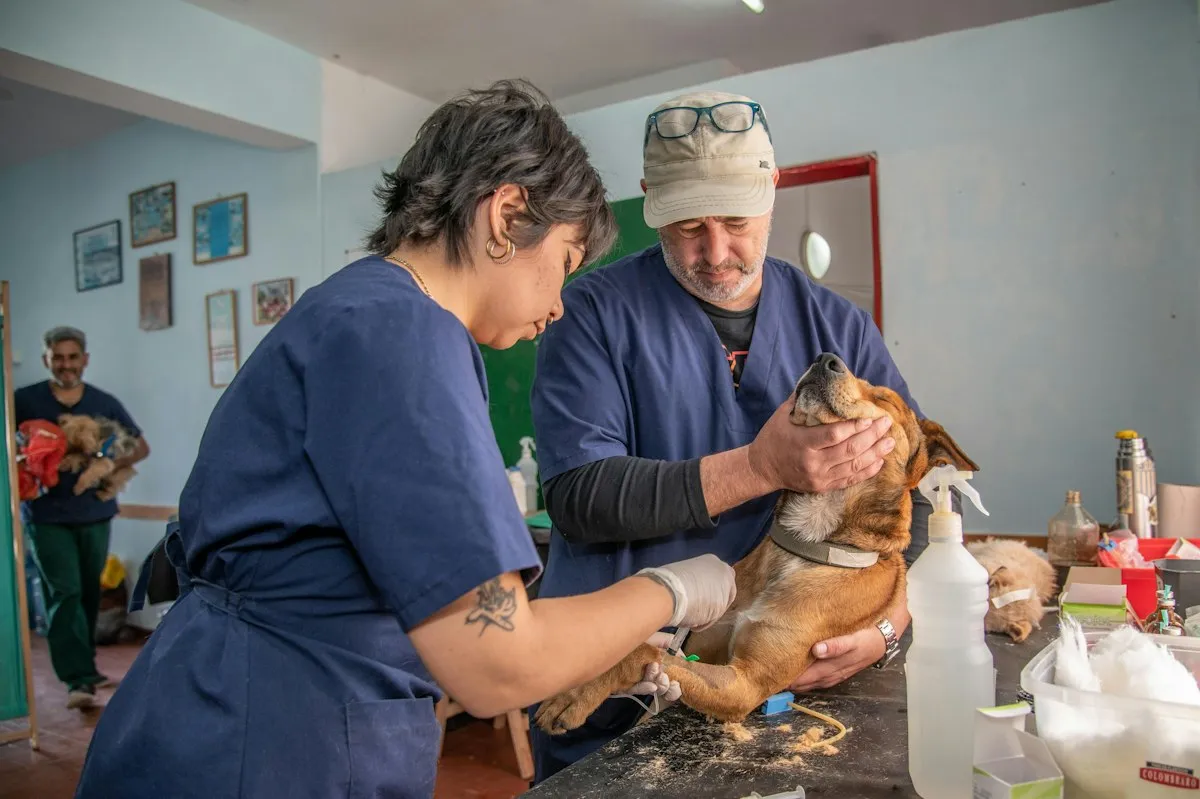
In 2024, the Royal Veterinary College published the "doodle dilemma" study in PLoS One. It compared owner-reported health in 9,402 UK dogs under five years old: 3,424 Cockapoos, Cavapoos and Labradoodles against 5,978 Cocker Spaniels, Cavaliers, Labradors and Poodles, across 57 common disorders, giving 342 comparisons.
- 86.6 per cent of comparisons showed no statistically significant difference between the cross and the parent breed.
- The crosses had higher odds of a disorder in 7 per cent of comparisons and lower odds in 6.4 per cent.
- The authors found little support for a meaningful hybrid vigour effect, and no evidence that Doodles are less healthy than purebreds.
Where differences appeared, they followed a pattern: all three crosses had higher odds of vomiting, diarrhoea and eating things they should not than Poodles, Cockapoos and Cavapoos had higher odds of ear infections than Cockers and Cavaliers, and Labradoodles had lower odds of hip and elbow dysplasia than Labradors. A Doodle takes after whichever parent it takes after.
What about behaviour?
The same team followed up in March 2026 with a behaviour study in PLOS ONE using the validated C-BARQ questionnaire on the same 9,402 dogs. Across 72 comparisons, Doodles showed more undesirable behaviour than a parent breed in 44.4 per cent and less in 9.7 per cent. Cockapoos were worse in all 16 comparisons where they differed, including owner-directed aggression and separation-related problems; Cavapoos were worse in 11 of 12; only Labradoodles were better than a parent on several scales. Fearful, anxious dogs are also harder to examine, groom and medicate.
Hybrid vigour is real in a narrow sense: crossing unrelated lines lowers the chance of doubling up on one recessive mutation. But most Doodle problems are polygenic and shared by both parents, and a cross between two untested parents is simply an untested dog.
2The Poodle-Side Problems Every Doodle Can Inherit
Every Doodle has a Poodle parent, so the Poodle's inherited conditions are the baseline risk for the whole group; which matter most depends on the size of Poodle used.
Addison's disease (hypoadrenocorticism)
Addison's is the Poodle condition most often missed. The adrenal glands stop producing cortisol and aldosterone, and the signs are vague and intermittent: lethargy, poor appetite, vomiting, diarrhoea and weakness, until a crisis brings collapse. Standard Poodles are strongly predisposed; a UK breed survey cited by UFAW found around 8 to 9 per cent affected. Diagnosis is by an ACTH stimulation blood test and treatment is lifelong hormone replacement, usually successful. There is no DNA test, so any Doodle with repeated unexplained "off" days deserves the blood test.
Progressive retinal atrophy (PRA)
PRA is a group of inherited diseases in which the retina degenerates, causing night blindness first and total blindness later. The prcd form is common in Miniature and Toy Poodles and in the Cocker Spaniel, Labrador and Australian Shepherd, and is recessive with a DNA test. Ask for the prcd-PRA result on both parents plus an annual ophthalmologist examination, because DNA tests do not cover every form.
Sebaceous adenitis
Sebaceous adenitis is an immune-mediated skin disease that destroys the oil glands, producing scaling and patchy hair loss. Standard Poodles are among the most affected breeds. It is diagnosed by skin biopsy and managed, not cured; breeders can submit annual biopsy results to the OFA registry.
Patellar luxation (small Poodles)
In Miniature and Toy Poodles the kneecap can slip out of its groove, giving a skipping gait. Mild cases need nothing; severe cases need surgery. The risk travels into every small Doodle, and breeding dogs should have an OFA or equivalent patella examination.
Hip dysplasia
Hip dysplasia affects Standard Poodles and nearly every large parent breed, so it is the main orthopaedic risk for standard Doodles. It is polygenic and worsened by rapid growth, overweight and over-exercise in puppies; see our guide to hip dysplasia in dogs. Both parents should have hip scores (OFA, PennHIP or BVA/KC).
Bloat (standard Poodles)
Gastric dilatation-volvulus is a deep-chested dog's emergency: the stomach fills with gas and twists. Signs are restlessness, a swollen abdomen and repeated unproductive retching, and Merck reports that roughly 25 to 30 per cent of affected dogs die even with treatment. Standard Poodles are a risk breed, so standard Doodles inherit it. Feed two or more meals a day and know the signs.
Dental disease (toy Poodles)
Toy and Miniature Poodles have crowded teeth and are among the breeds most prone to periodontal disease and retained baby teeth. The 2024 study found Cockapoos had far lower odds of dental disease than Poodles (odds ratio 0.16), probably because the Cocker's larger jaw spreads the teeth out. Daily tooth brushing is the most useful habit for a small Doodle. Other Poodle risks are hypothyroidism, epilepsy and von Willebrand's disease.
3The Extra Risk Each Doodle Cross Brings
The second parent decides which additional problems a Doodle is exposed to.
Labradoodle (Labrador): exercise-induced collapse and obesity
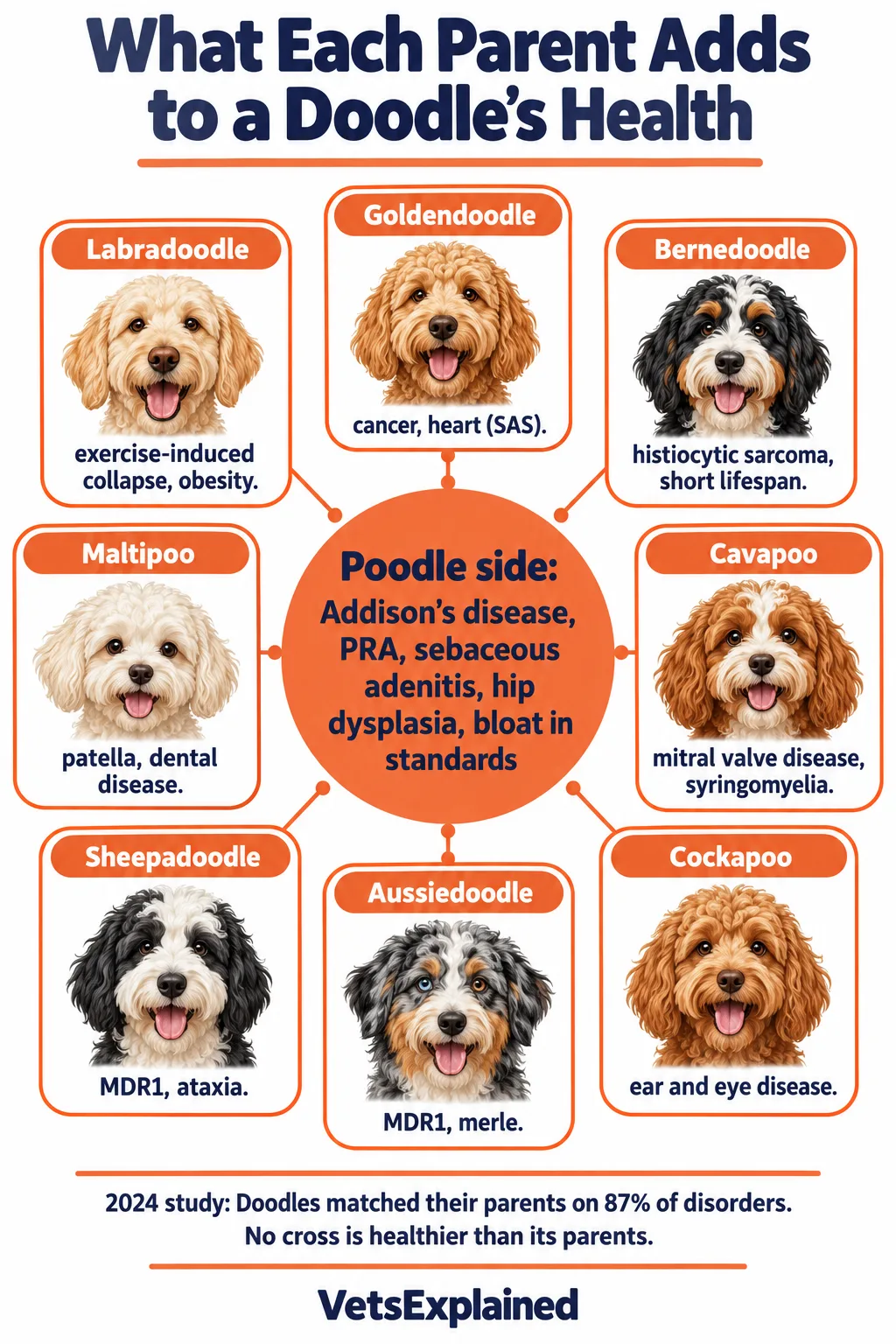
The Labrador adds exercise-induced collapse (EIC), a recessive, DNA-testable condition in which the hind legs become weak and wobbly after five to twenty minutes of intense exercise. It also brings its appetite: the 2024 study found Labradoodles had roughly double the odds of dietary indiscretion of Poodles. Keep a Labradoodle lean and ask for EIC, hip, elbow and eye results on the Labrador side.
Goldendoodle (Golden Retriever): cancer
The Golden Retriever's defining health problem is cancer. The Morris Animal Foundation's Golden Retriever Lifetime Study, following more than 3,000 Goldens since 2012, had recorded 500 diagnoses of haemangiosarcoma, lymphoma, high-grade mast cell tumour and osteosarcoma by 2023, with haemangiosarcoma more frequent than expected. No test predicts cancer, so with a Goldendoodle or mini Goldendoodle keep the dog lean and have any lump checked rather than watched. The Golden also contributes hip and elbow dysplasia, subaortic stenosis and allergic skin disease.
Bernedoodle (Bernese Mountain Dog): histiocytic sarcoma
The Bernese Mountain Dog is strongly predisposed to histiocytic sarcoma, an aggressive cancer of immune cells that is usually fatal within weeks of diagnosis and a main reason the breed's average lifespan is only around 7 to 8 years. The Bernese Mountain Dog Club of America now lists a DNA-based risk test alongside its standard clearances. A Bernedoodle also inherits high rates of elbow and hip dysplasia, degenerative myelopathy (DNA test) and bloat. The Poodle outcross probably helps with lifespan, but no study has measured it.
Cavapoo (Cavalier King Charles Spaniel): mitral valve disease and syringomyelia
The Cavalier brings two of the most serious inherited conditions in any breed, neither with a DNA test. Mitral valve disease is about 20 times more common in Cavaliers than in other breeds; roughly half have a murmur by five years old and nearly all by ten. Syringomyelia, where fluid-filled cavities form in the spinal cord because the skull is too small for the brain, causes neck pain, "phantom scratching" and yelping when touched; MRI surveys have found it in a large share of the breed, with estimates varying by population and age. For a Cavapoo, insist on a recent cardiologist examination of the Cavalier parent, ideally murmur-free at over 2.5 years old, and ask about MRI screening.
Cockapoo (Cocker Spaniel): ear and eye disease
The Cocker's long, heavy, hairy ears make it one of the breeds most prone to chronic ear infections, and the 2024 study found Cockapoos had more than twice the odds of otitis externa of Cocker Spaniels and 2.7 times the odds of itchy skin. The Cocker also contributes prcd-PRA, hereditary cataract and glaucoma, so ask for the prcd-PRA DNA test and an annual eye certificate on that side.
Aussiedoodle (Australian Shepherd): MDR1 and merle
The MDR1 (ABCB1) mutation, found in about 50 per cent of Australian Shepherds according to Washington State University, makes dogs dangerously sensitive to certain drugs, including some chemotherapy agents, loperamide and high-dose ivermectin; a cheap DNA test tells your vet whether to adjust dosing for life. The merle gene behind the marbled coat causes deafness and eye defects in puppies with two copies, so a breeder should never mate two merles. An Aussiedoodle also inherits hereditary cataract, hip dysplasia and epilepsy.
Sheepadoodle (Old English Sheepdog): MDR1 and ataxia
The Old English Sheepdog carries MDR1 at a lower frequency (around 5 per cent in WSU's data), so a Sheepadoodle should still be tested. More specific to the breed is hereditary cerebellar ataxia, a progressive loss of coordination beginning between six months and four years, recessive and DNA-testable. Add hip dysplasia, hypothyroidism, primary ciliary dyskinesia and bloat.
Maltipoo (Maltese): patella and dental disease
The Maltese doubles up on the Toy Poodle's weak points: both are prone to patellar luxation and periodontal disease, so a Maltipoo has no "other side" to dilute those risks. The Maltese also brings a liver shunt risk and white shaker syndrome, a tremor disorder of small white dogs.
4Why Doodles Get So Many Ear Infections
Ear infections are the most consistent Doodle complaint. A 2021 Royal Veterinary College VetCompass study of more than 22,000 UK dogs found otitis externa affected about 7 per cent of dogs in a year, with Labradoodles among the highest-risk breeds at roughly three times the odds of crossbreds. The 2024 study found higher odds in Labradoodles than Labradors, Cockapoos than Cockers, and Cavapoos than Cavaliers.
The causes stack up: drop ears that trap moisture, Poodle hair down the canal, allergic skin from both parents, and a love of water. Check ears weekly, dry them after swimming, and take a smelly or painful ear to a vet, because treatment depends on what is growing in it.
5Health Tests to Ask a Breeder For, by Parent Breed
A responsible breeder tests both parents to their own breed's OFA CHIC protocol or the UK BVA/KC equivalent. "Vet-checked" is not health testing. Ask for these results, by breed:
- Poodle (Standard): hips (OFA at 24 months or PennHIP), eyes, and at least one of thyroid, sebaceous adenitis biopsy or cardiac.
- Poodle (Miniature and Toy): patellas, eyes, prcd-PRA DNA test, and hips for Miniatures.
- Labrador Retriever: hips, elbows, eyes, EIC DNA test; often prcd-PRA.
- Golden Retriever: hips, elbows, eyes within 12 months, cardiologist examination; often NCL and ichthyosis DNA tests.
- Bernese Mountain Dog: hips, elbows, eyes, cardiac, degenerative myelopathy DNA test, plus one of von Willebrand's, thyroid or the histiocytic sarcoma risk test.
- Cavalier King Charles Spaniel: annual cardiologist examination, eyes, hips, patellas; ask about MRI screening.
- Cocker Spaniel: hips, eyes, prcd-PRA DNA test, patellas.
- Australian Shepherd: hips, elbows, eyes, MDR1 DNA test; often Collie eye anomaly and cataract DNA tests.
- Old English Sheepdog: hips, eyes, thyroid, and DNA tests for cerebellar ataxia, MDR1 and primary ciliary dyskinesia.
- Maltese: patellas, cardiac, eyes, and a bile acid test for liver shunt.
For a multigenerational Doodle, both Doodle parents need the tests relevant to their whole ancestry; our guide to F1, F1B and F2 Doodles explains what the generation labels mean.
How to read a health certificate
- OFA hips: Excellent, Good and Fair pass; Borderline, Mild, Moderate and Severe do not; results under 24 months are preliminary. PennHIP gives a distraction index from 0 to 1; lower is tighter.
- OFA elbows: Normal or Grade I to III. BVA/KC (UK): hips 0 to 106, lower is better, compared with the breed median; elbows 0 to 3, ideally 0.
- Eye certificates are valid for 12 months.
- Cardiac: an OFA Advanced Cardiac (echocardiogram by a cardiologist) outranks a Basic Cardiac (stethoscope only).
- DNA tests: Clear, Carrier or Affected. Carrier to Clear matings are acceptable; Carrier to Carrier are not.
- CHIC number: proves the required tests were done and made public, not that the dog passed them.
- Verify: OFA results are searchable by registered name at ofa.org. A breeder who will not give you that name has told you what you need to know.
6Red Flags When Buying a Doodle Puppy
Walk away if you see any of these.
- No test certificates for both parents, with "vet-checked" offered instead.
- Parents under two years old, too young for final hip and elbow results.
- "Hypoallergenic", "non-shedding" or "healthier than purebreds" presented as guarantees.
- Two merle parents, or puppies in every size and colour available all year round.
- You cannot meet the mother; the 2026 RVC study linked not seeing her with worse behaviour in several comparisons.
- A price far below the local range, which means someone skipped the testing.
7Doodle Health: Pros and Cons
Potential advantages
- No evidence that Doodles are less healthy than their parent breeds
- Some crosses show lower odds of specific parent-breed problems (hip and elbow dysplasia in Labradoodles, dental disease in Cockapoos)
- Most Poodle-side recessive diseases have DNA tests
Potential challenges
- No meaningful hybrid vigour effect in the largest study to date
- Two sets of breed risks, with hips, eyes, skin and ears often shared by both parents
- Higher odds of ear infections and stomach upsets than at least one parent in every cross studied
- Testing is voluntary, and MVD, syringomyelia, cancer and Addison's have no DNA test
8Final Thoughts
A Doodle is not a shortcut around breed health problems. The Royal Veterinary College studies show the crosses are about as healthy as their parents, so the breeder's testing matters more for a Doodle than for a registered purebred, not less. Learn which parent brings which risk, ask for the certificates by name, read them yourself, and judge the breeder before the puppy. Once the dog is home, keeping it lean, checking ears, brushing teeth and insuring early do the most; our guide to how long Doodles live covers what shortens a Doodle's life by cross.
For the full picture on each cross, including temperament, grooming and cost, see our Doodle Dog guide.
Sources
- Bryson GT, O'Neill DG, Brand CL, Belshaw Z, Packer RMA. The doodle dilemma: how the physical health of "designer-crossbreed" Cockapoo, Labradoodle and Cavapoo dogs compares to their purebred progenitor breeds. PLoS One. 2024;19(8):e0306350. pmc.ncbi.nlm.nih.gov
- Bryson GT, O'Neill DG, Belshaw Z, Brand CL, Packer RMA. Comparing undesirable behaviours between 'designer' Poodle-cross dogs and their purebred progenitor breeds. PLOS ONE. 2026. journals.plos.org
- Royal Veterinary College, VetCompass. Now listen ear: new RVC research reveals the dog breeds most affected by ear infections. 2021. rvc.ac.uk
- Merck Veterinary Manual. Disorders of the adrenal glands in dogs; Disorders of the stomach and intestines in dogs. merckvetmanual.com
- Universities Federation for Animal Welfare. Genetic welfare problems of companion animals: Standard Poodle, hypoadrenocorticism; Cavalier King Charles Spaniel, mitral valve disease. ufaw.org.uk
- Orthopedic Foundation for Animals. CHIC: Canine Health Information Center program. ofa.org
- Morris Animal Foundation. Golden Retriever Lifetime Study reaches 500 diagnoses of four major cancers. 2023. morrisanimalfoundation.org
- Washington State University, Program in Individualized Medicine. MDR1 in dogs: breed frequencies and problem drugs. waddl.vetmed.wsu.edu
- Bernese Mountain Dog Club of America. Berner recommended testing. bmdca.org
Frequently Asked Questions
?Are Doodles healthier than purebred dogs?
No. A 2024 Royal Veterinary College study of 9,402 dogs found no significant difference between Cockapoos, Labradoodles and Cavapoos and their parent breeds in 86.6 per cent of 342 comparisons. Doodles were neither healthier nor less healthy; they inherit the risks of both parents.
?What is the most common health problem in Doodles?
Ear infections. Every cross in the 2024 study had higher odds of otitis externa than at least one parent, and a 2021 VetCompass study put Labradoodles at about three times the odds of crossbreds. Allergic skin and stomach upsets came next.
?What health problems do Doodles get from the Poodle?
Addison's disease, progressive retinal atrophy, sebaceous adenitis, hypothyroidism and epilepsy across sizes; hip dysplasia and bloat in standards; patellar luxation and dental disease in Miniature and Toy lines. Most of the recessive conditions have DNA tests.
?Do Doodles have hybrid vigour?
Not meaningfully. Crossing reduces the chance of doubling up on one recessive mutation, but most Doodle problems are polygenic or shared by both parents. The 2024 RVC study found lower odds of a disorder in only 6.4 per cent of comparisons and higher odds in 7 per cent.
?What does a CHIC number mean?
It means the dog has had every test its breed's parent club requires and the results are public in the OFA database. It does not mean the dog passed. Look up the dog on ofa.org and read the individual grades, which can be Fair, Borderline or dysplastic.
?Should I test my Aussiedoodle for MDR1?
Yes. Around half of Australian Shepherds carry the MDR1 mutation, which makes dogs dangerously sensitive to certain drugs including some chemotherapy agents and loperamide. A cheap cheek-swab test tells your vet whether to adjust doses for life, and is best done before the dog ever needs those drugs.
?What are the signs of Addison's disease in a Doodle?
Vague, recurring illness: lethargy, poor appetite, vomiting, diarrhoea and weakness that improves and returns, sometimes ending in sudden collapse. Standard Poodles are strongly predisposed, so any Doodle with repeated unexplained "off" days should have an ACTH stimulation blood test.
Help us do better!
Was this article helpful and relevant?
Thanks for your feedback!
About Sofia Marin
Sofia Marin is VetsExplained's senior editor. She has edited pet and consumer titles for fifteen years and is responsible for the site's editorial standards and breed coverage.
View all posts by Sofia Marin →