Maltipoo Dog Breed Guide: Size, Temperament, Grooming, Health and Lifespan
 Written by Sofia Marin
 Fact checked by Dr. Tomas Ellery, DVM

A Maltipoo is a Maltese crossed with a Toy or Miniature Poodle, usually 5 to 20 lb and 8 to 14 inches tall. Most are affectionate, bright lapdogs that live 12 to 15 years, but small-dog problems such as dental disease, patellar luxation and tracheal collapse are common, and "teacup" puppies under 4 lb carry extra risk.
The information is current and up-to-date in accordance with the latest veterinary research. Learn more »
The Maltipoo is a Maltese crossed with a Toy or Miniature Poodle, and it is the smallest of the popular Doodles. Where the Labradoodle was bred for guide-dog work, the Maltipoo was bred from two companion breeds for one job: to live on a lap, in a flat or a family home, and to be good company for a long time.
It does that job well. Maltipoos are affectionate, quick to learn, light enough to carry and usually low-shedding. They are also tiny dogs, and tiny dogs come with health problems that bigger Doodles rarely see: crowded teeth that fall out early, kneecaps that slip, windpipes that flatten, and puppies so small that a missed meal can cause a collapse.
This guide covers what a Maltipoo is, how the Toy or Miniature Poodle parent changes the size, coat and grooming, temperament and training, the small-dog health problems and what the evidence says about them, why "teacup" is a warning rather than a selling point, lifespan, cost, and whether a Maltipoo suits your home. If you are new to Poodle crosses, start with our Doodle Dog guide.
Key Takeaways
- A Maltipoo is a Maltese crossed with a Toy or Miniature Poodle; the Poodle variety decides whether the adult is 5 to 10 lb or 10 to 20 lb.
- "Teacup" Maltipoos are a marketing label for very small, more fragile puppies and should be avoided.
- Dental disease is the biggest health problem: dogs under 10 kg have about three times the risk of larger dogs, and daily brushing from puppyhood matters.
- Patellar luxation, tracheal collapse and, in tiny puppies, hypoglycaemia are the other small-dog risks; use a harness, keep the dog lean and feed puppies frequent meals.
- Maltipoos usually live 12 to 15 years, longer than large Doodles; ask breeders for patella, cardiac, bile acid, eye and PRA results on the parents.
1Maltipoo at a Glance
- Parent breeds: Maltese × Poodle (Toy or Miniature)
- Origin: United States, 1990s, bred as a companion
- Size: Roughly 5 to 20 lb and 8 to 14 inches at the shoulder; Toy-parent dogs at the small end, Mini-parent dogs at the large end
- Coat: Soft single coat; straight, wavy or curly
- Common colours: White, cream, apricot, red, grey, black and parti; many lighten with age
- Shedding: Low, but never none
- Grooming: High; brushing most days and professional clipping every 4 to 8 weeks
- Exercise needs: Low to moderate, around 30 to 45 minutes a day plus play
- Trainability: High, but often slow to house-train
- Barking: Moderate to high
- Lifespan: Usually 12 to 15 years, often longer
- Recognition: Not recognised by the AKC or the Kennel Club
- Best for: Flats and small homes, older owners, first-time owners and families with gentle, older children
2What Is a Maltipoo?
A Maltipoo is any dog with Maltese and Poodle ancestry. It is not a breed: no major kennel club recognises it, there is no breed standard, and two Maltipoos can differ noticeably in size, coat and build. The cross appeared in the United States in the 1990s on the back of the Labradoodle's popularity and spread quickly because both parents were already popular small companions.
The Maltese is an ancient toy breed, usually under 7 lb, with a long, silky white coat and a gentle, clingy, playful character. The Poodle in the cross is nearly always the Toy (under 10 inches tall, around 4 to 6 lb) or the Miniature (10 to 15 inches, around 10 to 15 lb), bringing the curly, low-shedding coat, a sharp mind and a little more athleticism. A puppy can land anywhere between the two. You will also see the cross spelled Maltepoo, or sold as a Moodle in Australia; they are the same dog.
3Toy Poodle vs Miniature Poodle Parent: Why It Matters
The Poodle parent decides most of a Maltipoo's adult size, and a breeder should tell you which variety was used without being asked.
- Maltese × Toy Poodle: the most common pairing. Adults are typically 5 to 10 lb and 8 to 11 inches tall. These are the handbag-sized Maltipoos, and the ones most exposed to the small-dog health problems below.
- Maltese × Miniature Poodle: adults are typically 10 to 20 lb and 11 to 14 inches. Sturdier, slightly more active, usually easier to house-train and safer around children.
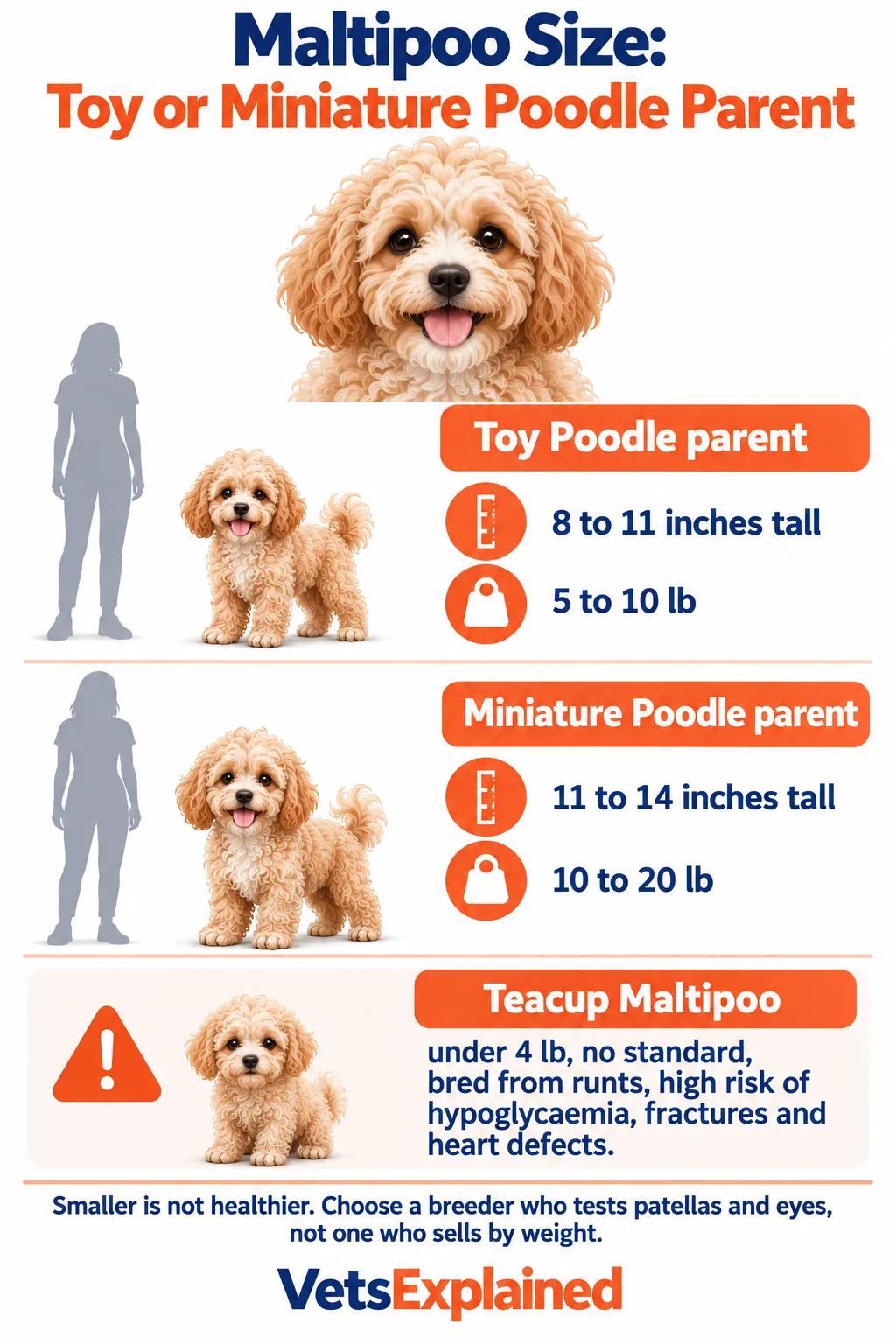
The parents' measured adult weights predict a puppy's size far better than any label. An F1B Maltipoo (Maltipoo × Poodle) leans towards the Poodle in size and coat; one bred back to a Maltese is smaller and silkier. Most Maltipoos reach adult weight by 10 to 12 months.
4The "Teacup" Maltipoo Warning
"Teacup", "micro" and "pocket" are marketing terms, not size categories, and they should make you cautious. There is no definition, but the label is usually attached to puppies expected to stay under about 4 lb.
Breeding for that size means selecting the runts of already tiny litters, breeding very small mothers who struggle to whelp safely, or selling puppies before eight weeks so they look smaller. The result is a dog with the same jaw crowding, slipping kneecaps and fragile windpipe as any Maltipoo, in a body with far less reserve. Very small puppies are the ones most likely to suffer the hypoglycaemic episodes described below, to break a leg jumping off a sofa, and to be injured by a toddler or a bigger dog. They are also, almost without exception, more expensive.
A normal Toy-parent Maltipoo of 6 to 9 lb is already a very small dog. If you want something smaller, think carefully about why, and about who bears the cost.
5What Does a Maltipoo Look Like?
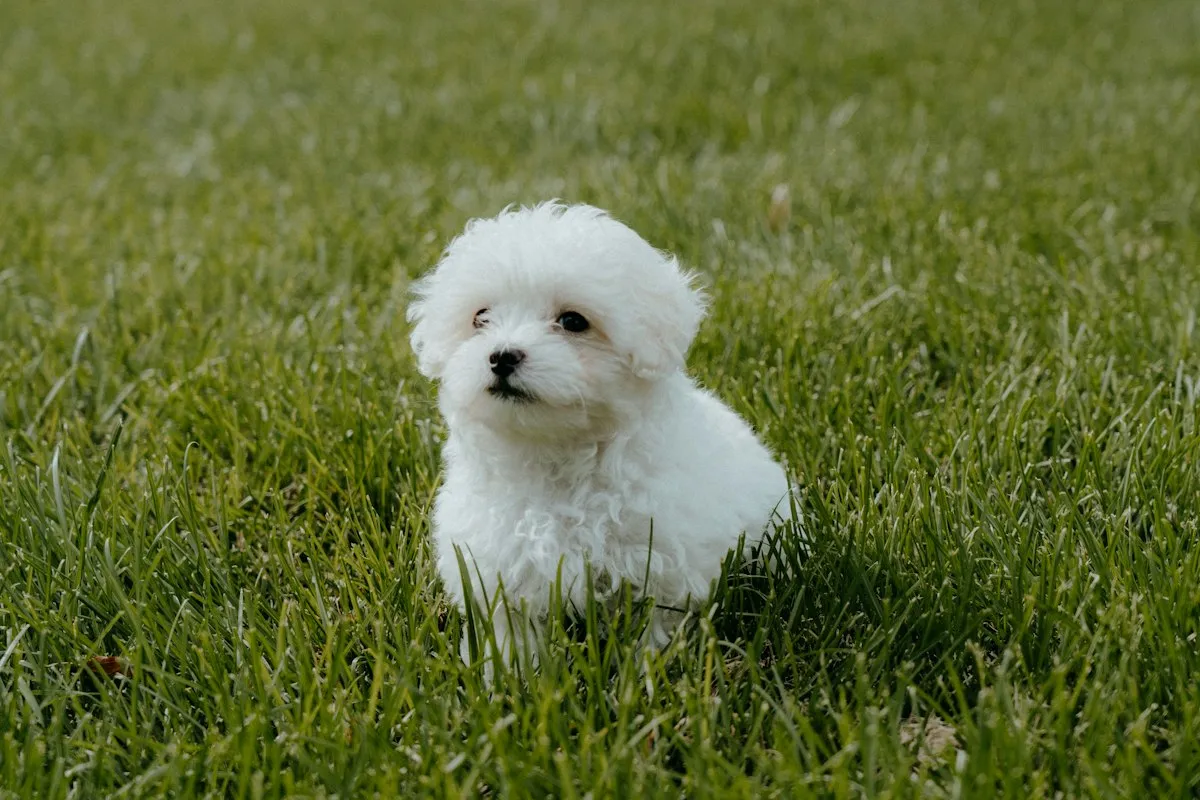
Most Maltipoos are compact and slightly longer than tall, with a rounded skull, a short to medium muzzle, dark round eyes, a dark nose and floppy ears that hang close to the cheeks. The tail usually curves up over the back.
The coat is soft and fluffy, ranging from the Maltese's straight silk to the Poodle's tight curl, with most dogs in between. White and cream dominate because the Maltese is always white, but apricot, red, grey, black and parti coats are common from the Poodle side. Like most Poodle crosses, Maltipoos often lighten over the first two to three years, so an apricot puppy may be cream by adulthood.
6Maltipoo Coat Types
The coat type matters more than the colour, because it decides how much you brush and how much hair you find on the sofa.
- Straight or silky: closest to the Maltese. Sheds a little more, tangles less, and needs brushing every other day.
- Wavy: the most common coat, soft and loosely curled. Low-shedding and the easiest to keep, but it mats behind the ears and under the legs.
- Curly: closest to the Poodle. Sheds the least and mats the most; daily brushing or a short clip is the only realistic option.
A breeder cannot promise which coat a first-generation puppy will have at eight weeks. The adult coat comes in between about 9 and 14 months, and that coat change is when most new owners meet their first serious mats.
7Do Maltipoos Shed?
A little. Both parents are low-shedding single-coated breeds, so most Maltipoos drop far less hair than a Labrador, and curly-coated dogs drop almost none you will notice. Loose hair stays caught in the coat instead of landing on the floor, which is exactly why it must be brushed out before it mats. No Maltipoo is non-shedding, and a straight-coated dog can shed noticeably.
8Are Maltipoos Hypoallergenic?
No dog is truly hypoallergenic. Allergic people react to proteins in dander, saliva and urine, and every dog makes them. A small, low-shedding dog spreads less of that protein around a home than a large heavy shedder, which is why some allergic people live happily with a Maltipoo and others react as badly as to any dog. If allergies are driving the choice, spend time with the particular dog, more than once, before you commit, and treat any "guaranteed hypoallergenic" claim as a reason to walk away.
9Maltipoo Temperament
Most Maltipoos are affectionate, playful, alert and strongly attached to their people. Both parents were bred purely for companionship, and it shows: a Maltipoo wants to be where you are, on your lap if possible.
Typical traits include:
- Devotion to one or two people, sometimes to the point of shadowing them from room to room
- Playfulness that lasts into old age
- Sensitivity: Maltipoos read moods and are easily upset by shouting, rough handling or chaos
- Alertness, which usually means barking at the door, the window and any sound in the corridor
- Quick learning, paired with a stubborn streak from the Maltese side
- Friendliness with strangers once introduced, though many are initially wary
Temperament is inherited and shaped, not guaranteed by the label. A 2024 Royal Veterinary College study of Poodle crosses found that Doodles were, on the whole, neither healthier nor more predictable than their parent breeds, and behaviour follows the same rule. Meet the mother, ask how the puppies are being socialised, and judge the dog in front of you.
Do Maltipoos bark a lot?
Yes, more than most Doodles. Both the Maltese and the Toy Poodle are alert, vocal breeds, and a Maltipoo in a flat will announce every footstep on the stairs unless taught otherwise. Start early: reward quiet, teach an "enough" cue, give the dog something to do, and never let barking become the way it gets attention. A Maltipoo that barks when left alone is usually anxious rather than naughty and needs gradual alone-time training.
10Are Maltipoos Good Family Dogs?
For the right family, yes. Maltipoos are gentle, playful and small enough for a flat, which makes them one of the better Doodles for first-time owners, older people and families with sensible older children; they feature in our list of gentle dog breeds for first-time owners.
The limit is size. A 7 lb dog can be badly hurt by a fall from a child's arms or a trodden paw, and a frightened small dog bites. Families with toddlers are usually better served by a Miniature-parent Maltipoo of 12 lb or more, or by a sturdier cross such as a Cavapoo. Whatever the size, children should play with the dog on the floor, never pick it up unsupervised, and leave it alone when it eats or sleeps. Maltipoos usually live comfortably with cats and other small dogs; the risk is a large, boisterous dog injuring them in play.
11Are Maltipoos Easy to Train?
Yes, with one well-known exception. Maltipoos learn cues quickly, enjoy reward-based training and do well at tricks and small-dog agility. House-training is the exception: toy breeds have small bladders, are easy to overlook when they signal, and are often carried outside rather than learning to ask. Expect four to six months of consistent work, with trips outside every hour or two at first.
Other priorities for a Maltipoo puppy:
- Handling tolerance: feet, ears, mouth and being brushed, from the first week home
- A reliable recall, because a small dog that runs off is in more danger than a large one
- Calm greetings instead of jumping and spinning
- Being alone for short, gradually lengthening periods
- Walking on a harness, not a collar (see tracheal collapse below)
Socialise between roughly 3 and 14 weeks with calm dogs of different sizes, people of all ages, traffic, the vet, the groomer's table and car journeys. A Maltipoo's sensitivity means experiences must be positive; a frightened puppy learns fear, not confidence.
12How Much Exercise Does a Maltipoo Need?
Around 30 to 45 minutes a day for an adult, split into two walks plus play, is enough for most Maltipoos. Miniature-parent dogs can take more and enjoy a proper hike; Toy-parent dogs tire sooner and feel the cold. Scent games, puzzle feeders and short training sessions do as much for a Maltipoo's mood as mileage.
Puppies should not be marched: free play and short outings until the growth plates close at around 8 to 10 months, and no jumping down from furniture at any age. Many small-dog leg fractures happen on the landing from a sofa or bed; a ramp or steps cost little.
13Maltipoo Grooming Requirements
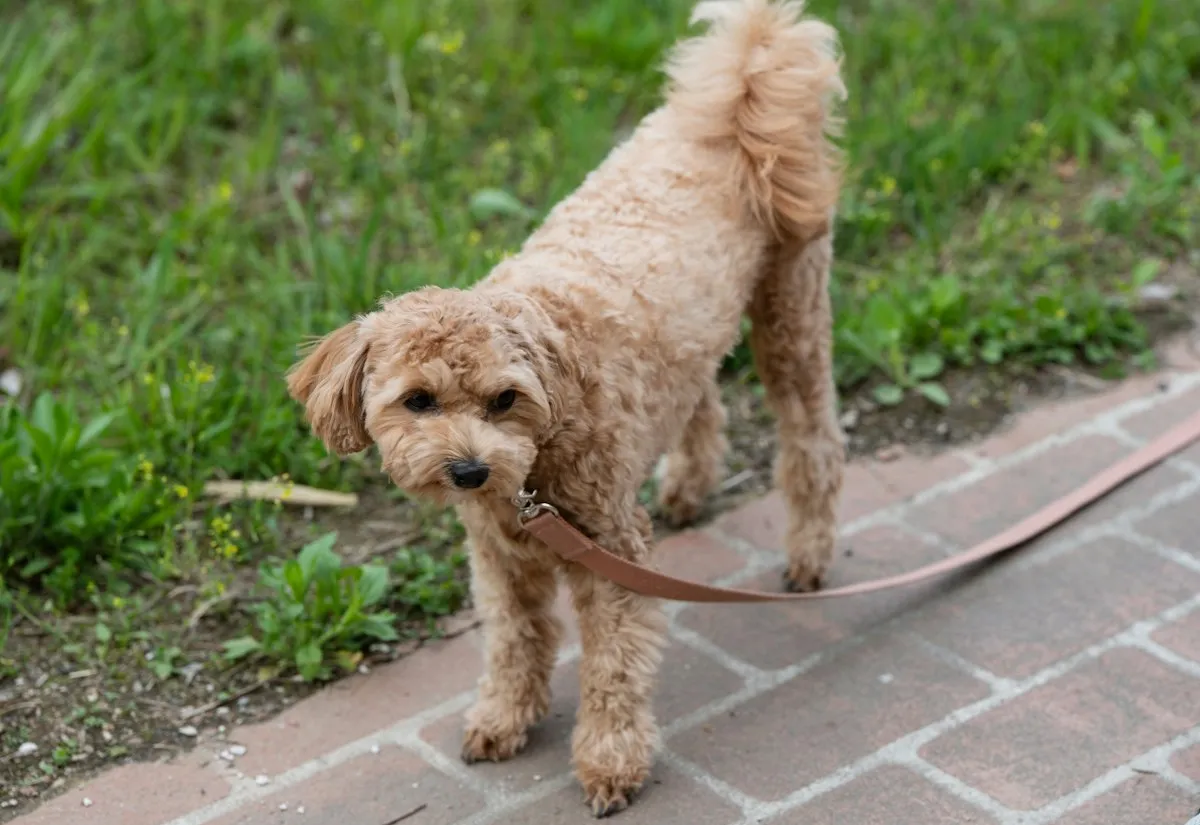
Grooming is the biggest ongoing commitment with a Maltipoo, and the reason many end up shaved short. A wavy or curly coat needs:
- Brushing to the skin three to four times a week, daily for a curly coat or a dog in full coat
- Combing after brushing to find the tangles the brush slides over, especially behind the ears, in the armpits and around the back legs
- Professional clipping every four to eight weeks
- Bathing every three to six weeks, followed by thorough drying and brushing
- Face trimming around the eyes and mouth, because hair irritates the eyes and traps food
- Nail trims every three to four weeks
- Ear checks weekly
- Tooth brushing daily, which for a Maltipoo is not optional
Our Doodle grooming guide shows how to line-brush properly and what to do about mats. For a Maltipoo, the simplest answer to a matted coat is a short "puppy clip" all over: it is comfortable for the dog and halves the brushing.
Tear staining
Many Maltipoos, especially white and cream ones, develop reddish-brown streaks under the eyes. The colour comes from pigments in tears that oxidise on light hair, and it shows because tears are spilling onto the face instead of draining through the tear ducts. VCA Animal Hospitals list the usual reasons: hair pressing on the eye, blocked or narrow tear ducts, eyelid or eyelash problems, allergies and eye infections. Staining that starts suddenly, or a dog that squints or rubs its eyes, needs a vet, because an ulcer or a blocked duct is treatable.
For cosmetic staining, keep the hair around the eyes short, wipe the area dry daily and avoid internet remedies. Low-dose antibiotic products once sold for staining are no longer recommended because of antibiotic resistance, and hydrogen peroxide near an eye is a bad idea.
14Maltipoo Health: What Owners Should Know
Maltipoos are generally sturdy, long-lived little dogs, but they are small dogs first and Doodles second, and most of their health problems are those of all toy breeds. The idea that a crossbreed is automatically healthier than its parents is not supported by evidence: the 2024 RVC study of Cockapoos, Labradoodles and Cavapoos found no significant difference from the parent breeds for most disorders. A Maltipoo inherits Maltese and Poodle risks, and a breeder who tests for them is the biggest influence on your dog's health.
Dental disease and tooth loss
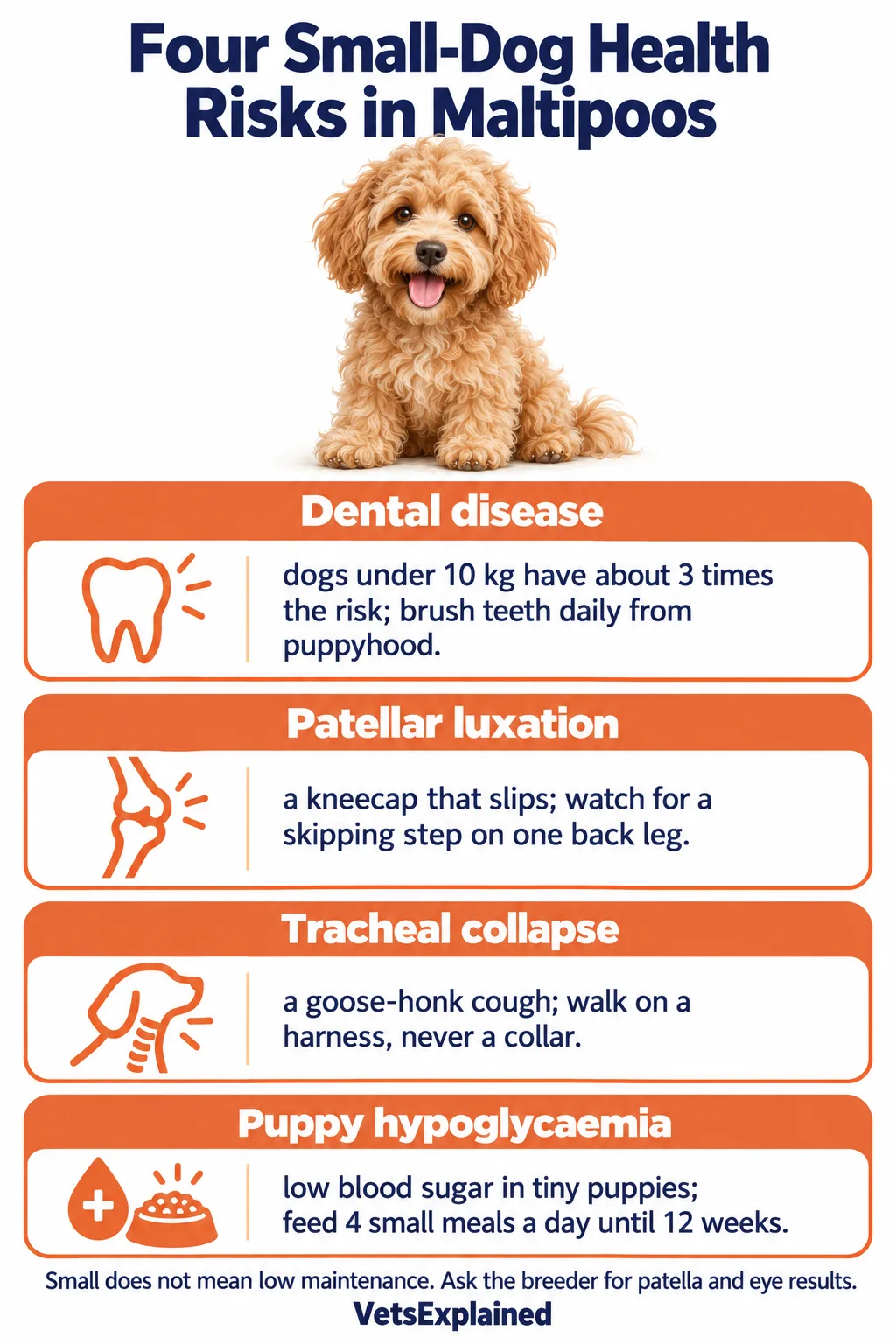
Dental disease is the most common health problem in Maltipoos and the one owners most underestimate. A 2021 VetCompass study of 22,333 dogs in UK practices found that 12.5 per cent were diagnosed with periodontal disease in a single year, that dogs under 10 kg had about three times the risk of dogs weighing 30 to 40 kg, and that the Toy Poodle was among the breeds most affected. The reason is simple: a full set of 42 teeth is crowded into a very small jaw, so plaque is trapped and hardens into tartar within days.
In practice:
- Retained baby teeth are common; double canines still present at six to seven months should be removed, usually at neutering.
- Gums recede, roots are exposed and teeth loosen. Many Maltipoos have lost teeth by middle age, and some are nearly toothless by ten.
- Infection from the mouth affects the whole dog: bad breath is the mild sign, a jaw fractured through diseased bone the severe one.
- Prevention is daily brushing with a dog toothpaste from puppyhood, plus professional scaling under anaesthetic when your vet recommends it. Anaesthesia-free "cleaning" removes visible tartar and nothing below the gum line, which is where the disease is.
Patellar luxation (slipping kneecaps)
Patellar luxation is a kneecap that slides out of its groove, usually towards the inside of the leg. The classic sign is a dog that skips a step or two on a back leg, then carries on as if nothing happened. A VetCompass study of 210,824 dogs found an overall prevalence of 1.3 per cent, with the highest odds in small breeds such as the Pomeranian, Chihuahua and Yorkshire Terrier, and higher risk in dogs lighter than average for their breed. Both the Maltese and the Toy and Miniature Poodle are predisposed, and both parent clubs recommend a patella evaluation on every breeding dog.
Luxation is graded 1 to 4. Grades 1 and 2 are often managed with weight control and muscle-building exercise; grades 3 and 4, or any grade causing pain and lameness, usually need surgery, which has a good outcome in small dogs. Left alone, a slipping kneecap wears the joint and leads to arthritis and sometimes a torn cruciate ligament.
Tracheal collapse
The windpipe is held open by rings of cartilage. In some toy breeds those rings weaken and flatten with age, and the airway narrows when the dog breathes in or gets excited. The sign is a dry, harsh, "goose-honk" cough, worse with excitement, pulling on a collar, heat and obesity. The Merck Veterinary Manual notes that the condition is most common in toy and miniature breeds, occurs more often in overweight dogs, and that weight loss is central to managing it.
Mild cases are managed with a harness instead of a collar, a lean body, avoiding smoke and heat, and cough suppressants or anti-inflammatories when needed; severe cases can be helped with a stent or surgical rings. Every Maltipoo should walk on a harness from the start, because collar pressure on a small windpipe is one of the few risk factors an owner controls. Do not assume a honking cough is kennel cough; a cough lasting more than a couple of weeks in a toy breed needs an X-ray.
Hypoglycaemia in small Maltipoo puppies
Toy-breed puppies have small liver stores of glycogen and a high demand for glucose, and in the first months of life they can run out of fuel between meals. The Merck Veterinary Manual describes this transient hypoglycaemia of toy breeds as a condition of the first six months of life, linked to the relative immaturity of the liver, and usually managed by feeding frequent meals of a commercial puppy food. Stress, cold, diarrhoea, worms, or a puppy too excited by a new home to eat can all trigger it.
The signs come on fast: a puppy that is suddenly wobbly, weak, glassy-eyed, trembling or limp, sometimes progressing to seizures. It is an emergency. Rub a little honey or glucose gel on the gums and get to a vet; never pour liquid into the mouth of a puppy that cannot swallow. Prevent it by feeding a Toy-parent puppy four small meals a day until around 12 weeks and three until six months, never letting a tiny puppy miss a meal, and keeping the first days at home calm. Repeated episodes, or any in a puppy over six months, need investigation for a liver shunt.
Other conditions to know about
- Portosystemic (liver) shunt: an abnormal vessel that lets blood bypass the liver, seen in both Maltese and Toy Poodles. Signs are poor growth, dullness after meals, drooling and sometimes seizures. A serum bile acid test screens for it, in breeding dogs and in puppies; surgery is often curative.
- Progressive retinal atrophy (PRA): inherited blindness from the Poodle side; a DNA test for the prcd form exists.
- Legg-Calvé-Perthes disease: the head of the femur loses its blood supply, causing hip pain in puppies of 4 to 12 months. Treated surgically, usually with a good outcome in dogs this size.
- Heart murmurs: the Maltese carries a risk of mitral valve disease in later life.
- White shaker syndrome: whole-body tremors, classically in small white dogs, appearing between one and five years and usually responding well to steroids.
- Epilepsy, ear infections, skin allergies and pancreatitis are all reported in the parent breeds or in small dogs generally.
15How Long Do Maltipoos Live?
Most Maltipoos live 12 to 15 years, and 16 or 17 is not unusual. That is longer than the larger Doodles, and the reason is size. A 2024 Dogs Trust study of 584,734 UK dogs in Scientific Reports found a median lifespan of 12.5 years across all dogs, with small breeds (median 12.7 years) outliving large breeds (11.9 years). The same study found purebreds had a slightly longer median survival (12.7 years) than crossbreds (12.0 years), another reason not to assume the Doodle label buys extra years.
What shortens a Maltipoo's life is mostly preventable: obesity, which worsens knees, windpipe and heart; untreated dental disease; and injuries from falls and larger dogs. Our guide to how long Doodles live compares the crosses.
16Health Testing Before Buying a Maltipoo Puppy
Because the cross is unregulated, the parents' test results are the only health assurance you can get. "Vet-checked" means the puppy was examined; it is not health testing.
For the Maltese parent, the American Maltese Association's recommended tests, as listed by the AKC, are a patella evaluation, a cardiac examination and a serum bile acid test for liver shunt. For the Toy or Miniature Poodle parent, the Poodle Club of America asks for a patella evaluation, an eye examination by a veterinary ophthalmologist and the prcd-PRA DNA test; many Miniature Poodle breeders add hip and Legg-Calvé-Perthes screening.
Ask to see certificates, and check them against the OFA (US) or BVA/KC (UK) registries by the parent's registered name. Then ask:
- Which Poodle variety is the parent, and how much does each parent weigh?
- Can I meet the mother, and see where the litter is raised?
- Will the puppies stay with their mother until at least eight weeks?
- How are the puppies being socialised, and what are they eating?
- What happens if I can no longer keep the dog?
A breeder who advertises "teacup" puppies, has litters in every colour all year, or wants to meet you in a car park is one to walk away from.
17What Should a Maltipoo Eat?
A Maltipoo needs a complete and balanced food for its life stage, and for most a small-breed formula is the right choice: the kibble is small enough to chew properly, which matters for crowded teeth, and the energy density suits a small dog's metabolism. Follow the WSAVA Global Nutrition Guidelines on choosing a manufacturer that employs qualified nutritionists and tests its food; brand matters less than those basics.
Two things are specific to Maltipoos. Puppies need frequent meals, four a day until about 12 weeks and three until six months, mainly to prevent hypoglycaemia in the tiny ones. And everything must be measured: a 7 lb dog needs roughly 200 to 300 calories a day, so one rich treat is a large share of its intake. Obesity is the most common nutritional problem in Maltipoos and it worsens every condition above. Our feeding guide by life stage gives amounts by weight.
18Can Maltipoos Be Left Alone?
Not for long, and not without practice. Maltipoos were bred to be with people, and separation-related distress is the most common behaviour problem in the cross. An adult taught gradually can usually manage four hours; a puppy cannot, and no Maltipoo copes with a full working day alone every day. Start in the first week with short absences while the dog is tired and fed, a safe pen, something to chew, and no fuss on leaving or returning. An adult that howls continuously, soils or destroys the door is distressed, not disobedient, and needs a vet or qualified behaviourist.
19How Much Does a Maltipoo Cost?
Prices vary widely by country, region, breeder, colour and size, so treat any figure as a rough guide.
- Puppy from a breeder: commonly 1,500 to 4,000 US dollars in 2026, with "rare" colours and so-called teacups priced higher. UK prices follow a similar pattern in pounds.
- Rescue: adoption fees are usually a few hundred dollars or pounds. Maltipoos surrendered for barking, house-training or matted coats are not unusual in small-breed rescues.
- Ongoing: professional grooming every four to eight weeks, often 50 to 100 dollars a visit for a dog this size; food, insurance and routine care; and a dental scale and polish under anaesthetic every one to three years, which can run to several hundred dollars.
A cheap Maltipoo is a warning sign. Health testing and proper rearing cost money, and a breeder who has skipped them has passed the risk to you.
20Maltipoo vs Cavapoo vs Toy Poodle
Maltipoo vs Cavapoo. The Cavapoo (Cavalier King Charles Spaniel × Poodle) is usually a little bigger at 10 to 20 lb, sturdier with children and slightly calmer, but it inherits the Cavalier's very high risk of mitral valve heart disease. The Maltipoo is smaller, longer-lived on average and more of a barker. Both need the same grooming.
Maltipoo vs Toy Poodle. A well-bred Toy Poodle gives you a predictable, genuinely low-shedding coat, a recognised breed with a written standard and a long record of health testing, for the same grooming effort. What you lose is the Maltese's softer, cuddlier character. People who want the coat without the lottery are often better served by the Poodle.
21Maltipoo Pros and Cons
Potential advantages
- Affectionate, playful and devoted to their people
- Small enough for a flat and light enough to carry, travel with and manage in old age
- Low-shedding in most coats
- Bright and quick to learn
- Modest exercise needs
- Long-lived, typically 12 to 15 years and often more
- Usually good with cats and other small dogs
Potential challenges
- High grooming needs and regular professional clipping
- Dental disease, patellar luxation and tracheal collapse are common
- Toy-parent puppies are at risk of hypoglycaemia and need frequent meals
- Fragile around toddlers and large dogs
- Prone to barking and separation distress
- Slow to house-train
- "Teacup" marketing attracts poor breeders; parent health testing is essential
22Is a Maltipoo Right for You?
A Maltipoo suits you if you want a small, affectionate companion that is happy in a flat, you are home most of the day or can arrange company, you will brush its coat several times a week and its teeth daily, you will pay a groomer every couple of months, and you can live with some barking.
It is probably not the right dog if you are out all day, have boisterous toddlers or a large bouncy dog, or want a dog that needs no grooming. Before you buy, ask whether a dog under 10 lb is safe in your household, whether you have seen patella, cardiac, bile acid and eye results for the parents, which Poodle variety the parent is, and whether you are choosing the dog for its character or because it looks like a toy.
23Final Thoughts
The Maltipoo was bred from two companion breeds to be a companion, and the best examples are exactly that: a bright, soft, devoted little dog that fits almost any home and often lives into its late teens.
What it is not is a toy, a guaranteed non-shedder or a dog that looks after itself. Its teeth, knees, windpipe and, in puppyhood, its blood sugar need an owner who pays attention, and its coat needs one who brushes. Choose a breeder who tests both parents and tells you which Poodle was used, avoid anything sold as "teacup", keep the dog lean and its teeth clean, and the Maltipoo will repay you for a very long time.
For the wider picture on Poodle crosses, from the Maltipoo up to the Bernedoodle, read our complete Doodle Dog guide.
Sources
- Bryson GT, O'Neill DG, Brand CL, Belshaw Z, Packer RMA. The doodle dilemma: how the physical health of "designer-crossbreed" Cockapoo, Labradoodle and Cavapoo dogs compares to their purebred progenitor breeds. PLoS One. 2024;19(8):e0306350. pmc.ncbi.nlm.nih.gov
- Royal Veterinary College, VetCompass. New RVC research gets to the root of dental disease in dogs (O'Neill DG et al., Journal of Small Animal Practice, 2021). rvc.ac.uk
- O'Neill DG, Meeson RL, Sheridan A, Church DB, Brodbelt DC. The epidemiology of patellar luxation in dogs attending primary-care veterinary practices in England. Canine Genetics and Epidemiology. 2016;3:4. cgejournal.biomedcentral.com
- McMillan KM, Bielby J, Williams CL, Upjohn MM, Casey RA, Christley RM. Longevity of companion dog breeds: those at risk from early death. Scientific Reports. 2024;14:531. pmc.ncbi.nlm.nih.gov
- Merck Veterinary Manual. Tracheal collapse in dogs. merckvetmanual.com
- Merck Veterinary Manual. Congenital and inherited disorders of the nervous system in dogs (transient hypoglycaemia of toy breeds). merckvetmanual.com
- VCA Animal Hospitals. Epiphora (excessive tearing) in dogs. vcahospitals.com
- American Kennel Club. Toy Group health testing requirements (Maltese and Toy Poodle parent club recommendations). akc.org
- WSAVA Global Nutrition Committee. Global nutrition guidelines. wsava.org
Frequently Asked Questions
?What two breeds make a Maltipoo?
A Maltipoo is a Maltese crossed with a Poodle, almost always a Toy or Miniature Poodle. The Poodle variety decides most of the adult size: a Toy parent produces dogs of roughly 5 to 10 lb, a Miniature parent dogs of roughly 10 to 20 lb.
?How big does a Maltipoo get?
Most Maltipoos are 8 to 14 inches tall and 5 to 20 lb, reaching adult size by 10 to 12 months. The parents' measured weights predict a puppy's adult size far better than any label, so ask which Poodle variety was used.
?Are Maltipoos hypoallergenic?
No dog is truly hypoallergenic. Maltipoos shed little and are small, so they spread less dander around a home, which helps some allergic people and not others. Spend time with the individual dog before committing and ignore any breeder's guarantee.
?Do Maltipoos shed?
A little. Curly-coated Maltipoos shed almost nothing you will notice, wavy coats shed very little, and straighter Maltese-type coats shed a bit more. Loose hair stays caught in the coat, which is why it must be brushed out before it mats.
?Do Maltipoos bark a lot?
Yes, more than most Doodles. Both parents are alert, vocal breeds, and most Maltipoos bark at doors, windows and corridor noises. Early training that rewards quiet, enough to do during the day, and gradual alone-time training keep it manageable.
?How long do Maltipoos live?
Usually 12 to 15 years, and often 16 or more. A 2024 study of 584,734 UK dogs found small breeds had a median lifespan of 12.7 years against 11.9 for large breeds. Keeping a Maltipoo lean and its teeth clean adds healthy years.
?What health problems do Maltipoos have?
Mainly small-dog problems: dental disease and early tooth loss, patellar luxation, tracheal collapse, and hypoglycaemia in tiny puppies. Liver shunt, progressive retinal atrophy, Legg-Calvé-Perthes disease, heart murmurs, white shaker syndrome and tear staining also occur. Parent health testing reduces the inherited risks.
?Should I buy a teacup Maltipoo?
No. "Teacup" is a marketing term for puppies bred or sold to stay under about 4 lb. They carry the same small-dog health problems in a body with far less reserve, are more prone to hypoglycaemia, fractures and injury, and are usually sold by breeders who put size before health.
?Are Maltipoos easy to train?
Yes for most things: they learn cues quickly and enjoy reward-based training. House-training is the exception and often takes four to six months, because toy breeds have small bladders and are easy to overlook. Consistency and frequent trips outside are the answer.
?Are Maltipoos good for first-time owners?
Yes, and for flats and older owners too. They are affectionate, small, modest in their exercise needs and quick to learn. The commitments are grooming, daily tooth brushing, company for most of the day and patience with barking and house-training.
?Why does my Maltipoo have red tear stains?
Tears that spill onto the face instead of draining through the tear ducts oxidise on light hair and stain it reddish-brown. Hair in the eyes, narrow tear ducts, allergies and eye infections are the usual causes. Sudden staining, squinting or rubbing needs a vet; cosmetic staining is managed by keeping the area trimmed, clean and dry.
?How much does a Maltipoo cost?
Puppies from breeders commonly cost 1,500 to 4,000 US dollars in 2026, with "rare" colours and teacups priced higher, and prices vary by region. Rescue fees are usually a few hundred dollars. Grooming every four to eight weeks and periodic dental cleaning under anaesthetic are the main ongoing costs.
Help us do better!
Was this article helpful and relevant?
Thanks for your feedback!
About Sofia Marin
Sofia Marin is VetsExplained's senior editor. She has edited pet and consumer titles for fifteen years and is responsible for the site's editorial standards and breed coverage.
View all posts by Sofia Marin →