Sheepadoodle Dog Breed Guide: Size, Temperament, Grooming, Health and Cost
 Written by Sofia Marin
 Fact checked by Dr. Tomas Ellery, DVM
A Sheepadoodle is an Old English Sheepdog crossed with a Poodle. Standards usually weigh 60 to 85 lb and minis 25 to 50 lb. They are affectionate and clever but need brushing to the skin most days, 60 to 90 minutes of exercise, and parents tested for hips, thyroid, eyes, EIC, cerebellar ataxia and MDR1.
The information is current and up-to-date in accordance with the latest veterinary research. Learn more »
The Sheepadoodle is an Old English Sheepdog and Poodle cross, and it is one of the largest and most striking of the Doodles. Most are black and white, many look like a shaggy panda as puppies, and a full-grown standard can weigh as much as an adult human.
That size, and the coat that comes with it, is why this cross deserves more thought than most. A Sheepadoodle combines two of the heaviest grooming commitments in the dog world, carries a set of inherited conditions from the Old English Sheepdog side that few buyers have heard of, and keeps enough herding instinct to make life with small children interesting.
This guide covers what a Sheepadoodle is, how big standards and minis get, what the coat really demands, temperament and the herding question, exercise, the health conditions and DNA tests that matter (including the MDR1 drug-sensitivity gene), what to ask a breeder, what one costs, and whether a Sheepadoodle is the right dog for your home. If you are still deciding between Poodle crosses, our Doodle Dog guide explains how the different crosses compare.
Key Takeaways
- A Sheepadoodle is an Old English Sheepdog and Poodle cross, not a recognised breed; standards usually weigh 60 to 85 lb and minis 25 to 50 lb, and the parents' sizes predict a puppy better than any label.
- The coat needs brushing to the skin most days and professional grooming every 4 to 8 weeks, and it is the most common reason Sheepadoodles end up shaved or rehomed.
- Herding behaviour, including circling and nipping at running children, is normal for the cross and must be trained and supervised, especially with a large standard.
- Ask for hip, thyroid and eye results plus DNA tests for cerebellar ataxia, exercise-induced collapse and MDR1 on the Old English Sheepdog parent; about 5 per cent of the breed carry the MDR1 drug-sensitivity mutation.
- Expect a lifespan of 10 to 14 years, feed smaller meals to reduce bloat risk, and keep the dog lean to protect its joints.
1Sheepadoodle at a Glance
- Parent breeds: Old English Sheepdog × Poodle (Standard for most litters; Miniature for mini Sheepadoodles)
- Origin: United States; the cross became popular in the 2000s, with earlier anecdotal litters
- Size: Standard 60 to 85 lb (some exceed 90 lb); Mini 25 to 50 lb; figures vary by breeder
- Height: Standard 18 to 25 inches; Mini 15 to 20 inches
- Coat: Dense, wavy to curly, often with a soft undercoat; occasionally straighter and shaggier
- Common colours: Black and white, grey and white, solid black, grey, and rarely red or merle; many grey out with age
- Shedding: Low to moderate, but hair that does shed stays caught in the coat
- Grooming: Very high; brushing to the skin most days and professional clipping every 4 to 8 weeks
- Exercise needs: Moderate to high, around 60 to 90 minutes a day for an adult standard
- Trainability: High, with a stubborn streak from the Sheepdog side
- Lifespan: Typically 10 to 14 years; smaller dogs tend to live longer
- Recognition: Not recognised by the AKC or the Kennel Club
- Best for: Households with space, time to groom, and children old enough to cope with a big, bouncy dog
2What Is a Sheepadoodle?
A Sheepadoodle is any dog with Old English Sheepdog and Poodle ancestry. It is a crossbreed, not a recognised breed, so there is no written standard, no breed club with mandatory health testing, and no guarantee that two Sheepadoodles will look or behave alike.
The two parents are quite different dogs. The Old English Sheepdog is a large, heavy-boned drover's dog from the west of England, bred to move sheep and cattle to market, with a thick double coat and a deliberate, sometimes stubborn, temperament. The Poodle is a lighter, more athletic water retriever with a single curly coat and quick, sensitive intelligence. A Sheepadoodle puppy can lean either way in build, coat, energy and attitude.
The name is sometimes used loosely. A Shetland Sheepdog × Poodle (more properly a Sheltidoodle) and a Bearded Collie × Poodle are occasionally advertised as Sheepadoodles. Ask which parent breeds were actually used; the difference in adult size is more than 50 lb.
A short history
The origin stories online are unreliable. Several sites claim the US Army experimented with Old English Sheepdog and Poodle crosses in the 1960s as potential military dogs; there is no primary record of this that we could find, and it should be treated as folklore. What is certain is that the Sheepadoodle became widely bred in the United States during the 2000s and 2010s on the back of Labradoodle and Goldendoodle popularity, and it is now one of the more common large Doodles in North America and increasingly in the UK.
3How Big Does a Sheepadoodle Get?
A standard Sheepadoodle usually weighs 60 to 85 lb and stands 18 to 25 inches at the shoulder, and some males from large Sheepdog lines pass 90 lb. The Old English Sheepdog is a big dog (a male typically weighs 70 to 100 lb) and the Standard Poodle adds 40 to 70 lb to the equation, so the cross is rarely small.
- Standard Sheepadoodle: Old English Sheepdog × Standard Poodle. Typically 60 to 85 lb and 18 to 25 inches. Full height by 12 to 14 months; full weight and muscle by 18 to 24 months.
- Mini Sheepadoodle: Old English Sheepdog × Miniature Poodle, almost always by artificial insemination with a Sheepdog mother, or a multigenerational line bred down in size. Typically 25 to 50 lb and 15 to 20 inches. "Mini" is relative: this is still a medium dog.
- Micro or Toy Sheepadoodle: a mini Sheepadoodle bred back to a Miniature or Toy Poodle. Often 15 to 30 lb. No agreed definition; sizes advertised vary wildly.
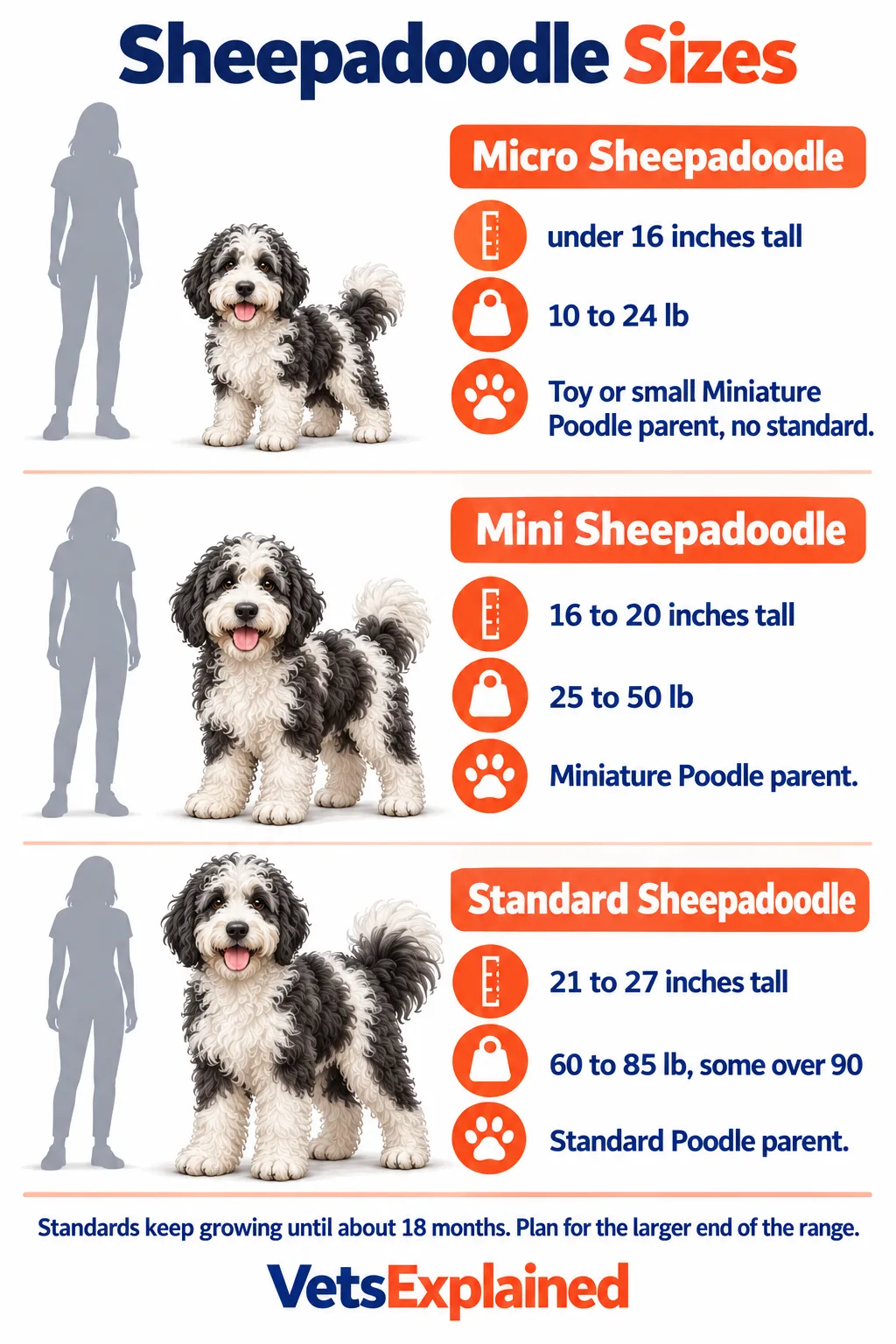
Weight ranges differ from breeder to breeder, and first-generation litters are the least predictable. The best guide to a puppy's adult size is the measured height and weight of both parents and of previous litters from the same pairing, not a label. Our guide to how big Doodles get compares the Sheepadoodle with the other crosses.
Mini Sheepadoodle
The mini has become more popular than the standard in many areas, because a 35 lb black-and-white dog fits a family car and a suburban house more easily than an 80 lb one. Two cautions. First, a mini has the same coat and much of the same energy as a standard; the grooming bill is smaller but not small. Second, minis are typically produced with a Sheepdog mother and a Miniature Poodle father, which means the Sheepdog side, with its particular health risks, is exactly as present as in a standard.
4What Does a Sheepadoodle Look Like?
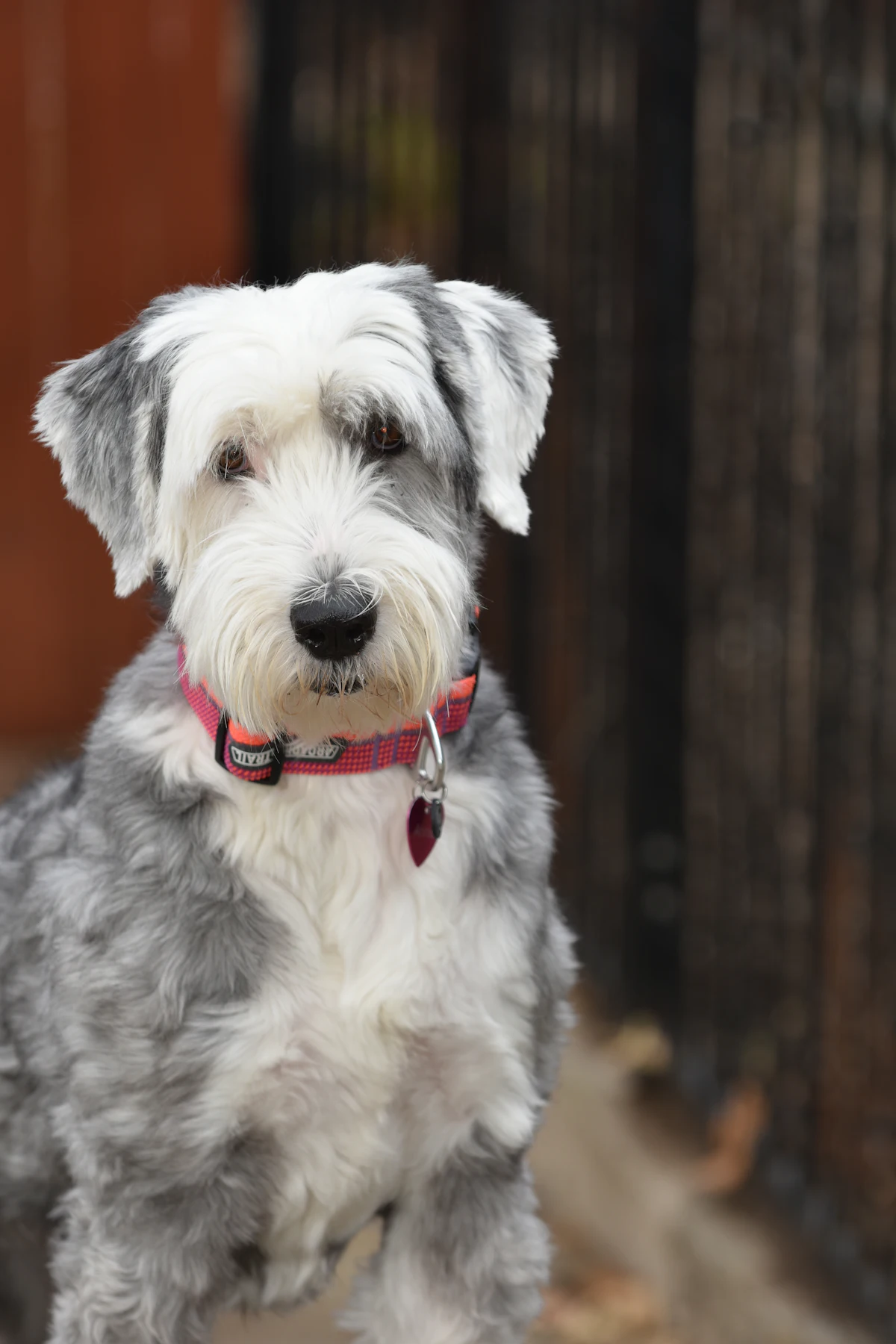
Most Sheepadoodles are black and white, with a white blaze, chest and feet and black patches over the eyes, ears and back. Puppies often look like a panda and lighten as they grow: the Old English Sheepdog carries a greying gene, so many black Sheepadoodles fade to silver or grey by two or three years old. Solid black, grey, and occasionally red, apricot or merle (from Poodle lines) also occur.
The build is heavier than a Goldendoodle of the same height, with a broad head, a shortish muzzle hidden by beard and eyebrows, ears that hang close to the head, and a tail that may be long, bobbed or docked depending on country. The coat is usually dense, soft and wavy to curly; a minority of first-generation dogs have a shaggier, straighter Sheepdog-type coat with a heavy undercoat.
5Sheepadoodle Coat Types and Shedding
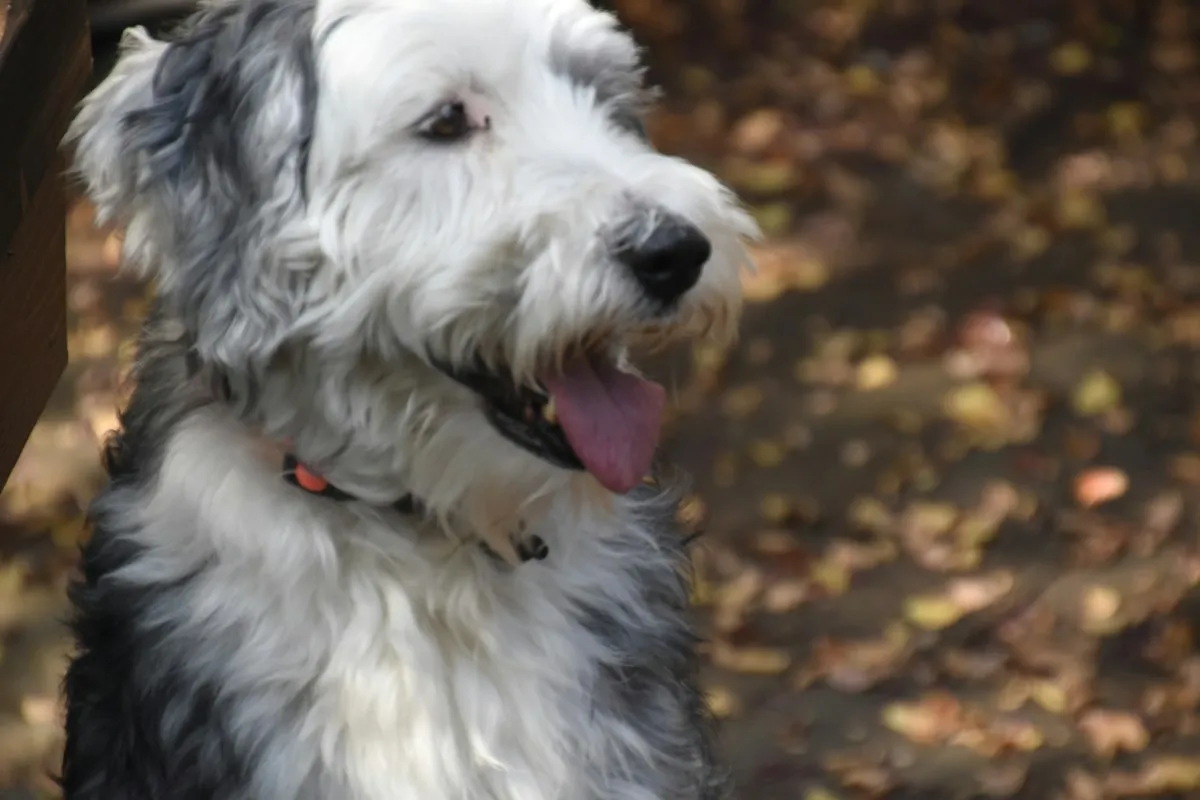
Sheepadoodles shed less than an Old English Sheepdog, but no Sheepadoodle is non-shedding. There are broadly three coats:
- Curly: tight Poodle-type curls, the lowest shedding and the quickest to mat. Most common in F1B dogs.
- Wavy: the typical Sheepadoodle coat, soft and loosely curled, low to moderate shedding, with a light undercoat.
- Straight or shaggy: closest to the Sheepdog, with a thick undercoat that sheds seasonally and needs the most de-shedding. Seen in some F1 litters.
Whatever the coat, loose hair tends to stay trapped in it rather than falling on the floor, which is why the dog looks "non-shedding" and why it mats if brushing is skipped. The adult coat comes in between about 8 and 14 months, and the change from puppy fluff to adult coat is the single most common time for a Sheepadoodle to arrive at the groomer felted to the skin.
6Are Sheepadoodles Hypoallergenic?
No dog is hypoallergenic. Allergic people react to proteins in dander, saliva and urine, which every dog produces. A low-shedding coat can mean less dander around the house, and some allergic owners cope well with a curly-coated Sheepadoodle, while others react just as badly as to any other dog. If allergies are the reason you are looking at this cross, spend time with the actual puppy or an adult from the same breeder, more than once, and talk to your doctor before paying a deposit. No breeder can honestly guarantee an allergy-free dog.
7Sheepadoodle Temperament
Most Sheepadoodles are affectionate, playful, people-focused and clever, and they bond strongly with their family. The Old English Sheepdog contributes a calm, clownish, sometimes stubborn nature; the Poodle contributes sensitivity, quick learning and a need to be involved in everything.
Typical traits owners describe:
- Very attached to their people and prone to following family members from room to room
- Playful well into adulthood, with a bouncy, sometimes clumsy style of play
- Gentle with people they know, and usually friendly or at least polite with strangers
- An independent streak: a Sheepadoodle may decide a request is optional
- Herding behaviour: circling, bumping and nipping at heels, especially with children and other pets
- Sensitivity to harsh handling; raised voices tend to produce a worried dog, not a compliant one
Temperament is not guaranteed by the cross. A 2025 Royal Veterinary College survey of more than 9,400 UK dogs found that Cockapoos, Labradoodles and Cavapoos differed from their parent breeds in about half of the behaviour comparisons, and where they differed, showed more undesirable behaviour (fearfulness, separation problems, excitability) in most of them. Sheepadoodles were not studied, but there is no reason to think the lesson differs: the parents' temperaments, early socialisation and training decide the dog, not the Doodle label.
Do Sheepadoodles bark a lot?
Sheepadoodles are moderate barkers. The Old English Sheepdog has a famously loud, deep bark and was expected to use it at anything unusual, and many Sheepadoodles inherit a watchdog habit of announcing visitors, delivery vans and next door's cat. They are not usually nuisance barkers if they get enough exercise and company; a bored or lonely Sheepadoodle left in a garden all day is a different matter. Teach a "quiet" cue early and reward settling.
8Are Sheepadoodles Good With Children? The Herding Question
Sheepadoodles can be excellent with children, and they are often promoted as the perfect family Doodle, but the herding instinct needs to be taken seriously, especially around toddlers and running children.
The Old English Sheepdog moved stock by bumping and nipping, and that behaviour does not disappear in a cross. A young Sheepadoodle watching children run around a garden may circle them, cut across their path, lean on them or nip at ankles and sleeves. It is not aggression, but a 60 lb adolescent doing it to a four-year-old ends in tears or worse. Add the sheer size and bounce of a standard, and small children get knocked flat.
What works:
- Supervise every interaction between a dog and a child under about eight, without exception.
- Teach an "off switch": settle on a mat, and a reliable recall away from running children, rewarded heavily.
- Give the instinct an outlet: herding-style games with a ball or flirt pole, treibball, scent work and training sessions.
- Teach the children not to run screaming past the dog, climb on it, or disturb it while eating or sleeping.
- Interrupt and redirect early. A nip at a trouser leg at four months is a bite on a calf at ten months if it is laughed off.
- Choose a mini if you have young children and limited experience; the behaviour is the same, but 35 lb of it is more manageable.
For families with school-age children who want a big, soft, playful dog and can commit to training, the Sheepadoodle is a strong candidate. For families with toddlers and no dog experience, a calmer or smaller cross is often the better choice; our comparison of the best Doodles for families weighs the options.
9Are Sheepadoodles Good With Other Dogs and Cats?
Usually, yes, if socialised early. Both parent breeds tend to be sociable, and most Sheepadoodles enjoy other dogs. Two things to watch: their size and clumsy play can frighten small dogs, and the herding instinct can be turned on cats, small dogs and chickens. A Sheepadoodle raised with a cat from puppyhood usually settles into a peaceful arrangement; one introduced to a cat as an adult may spend months trying to round it up.
10Are Sheepadoodles Easy to Train?
Sheepadoodles are quick learners that can be slow to comply. The Poodle side picks things up in a handful of repetitions; the Sheepdog side was bred to make decisions about livestock without waiting for instructions, and it shows. Expect a dog that knows exactly what you want and sometimes weighs up whether it is worth doing.
Reward-based training works best. Keep sessions short, make yourself more interesting than the environment, and start with what makes life with a large dog safe:
- Loose-lead walking, before the dog weighs 50 lb
- Recall, practised daily around increasing distractions
- Settle on a mat and a "quiet" cue
- No jumping up; four feet on the floor for greetings
- "Leave it" and "drop", for shoes, socks and small children's toys
- Handling for grooming: paws, ears, face, being brushed and held still, from the first week home
- Being alone for short, gradually longer periods
Socialisation between about 3 and 14 weeks matters enormously. A Sheepadoodle that meets a range of calm people, dogs, surfaces, noises, traffic and the grooming table as a puppy is a very different adult from one kept in a kitchen until its vaccinations finish.
11How Much Exercise Does a Sheepadoodle Need?
An adult standard Sheepadoodle needs around 60 to 90 minutes of activity a day, split between a proper walk and something that uses its brain. Minis need somewhat less but still a daily outing rather than a trip round the block. The Sheepdog contributes stamina and a steady working pace rather than the explosive drive of a retriever cross, so many adult Sheepadoodles are content with a long walk, a game and a training session, and settle well indoors afterwards.
Good options:
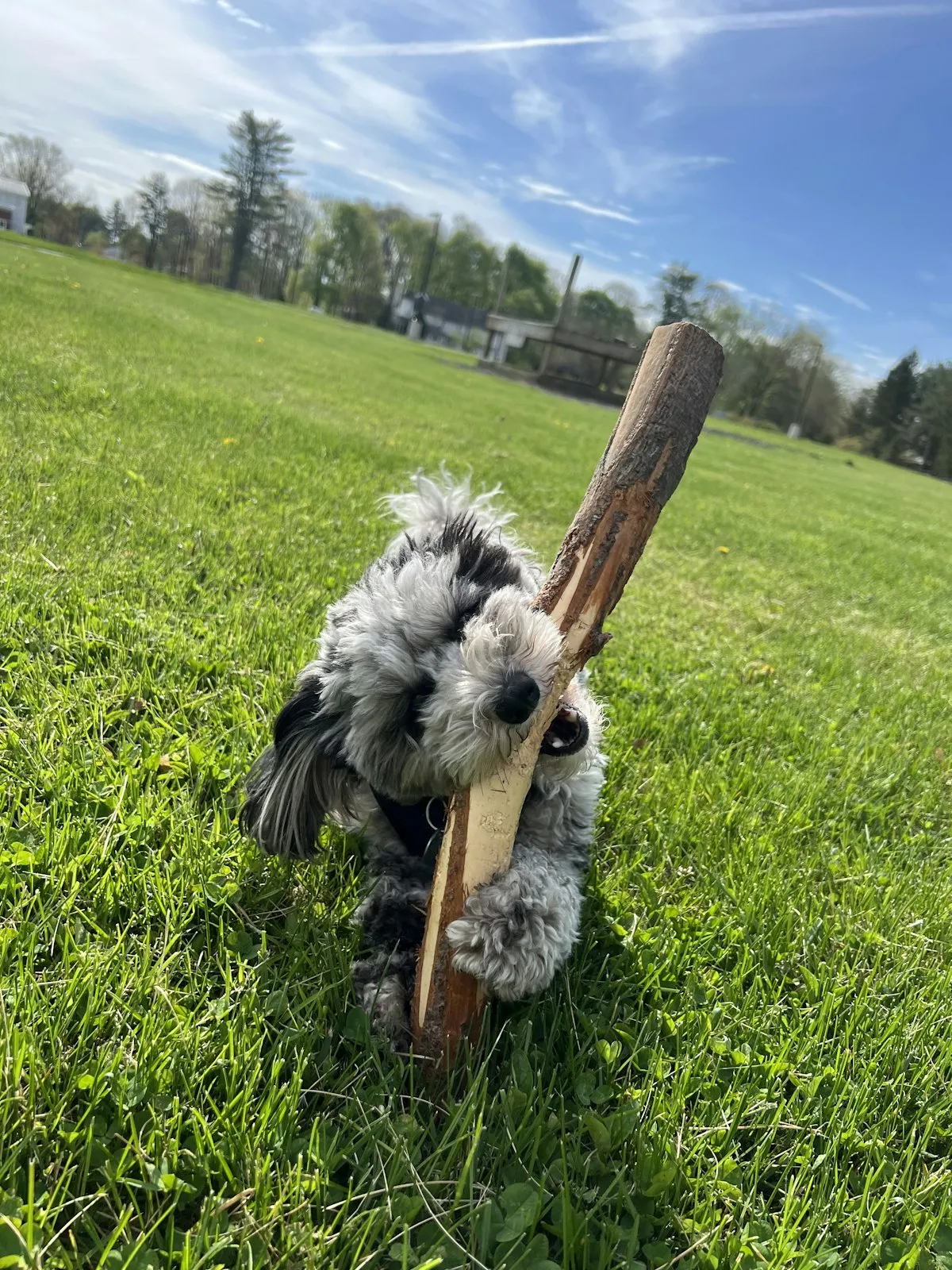
- Long sniffing walks and off-lead time in a safe area once recall is reliable
- Fetch and tug in moderation; many Sheepadoodles are less ball-obsessed than retriever Doodles
- Scent work, puzzle feeders and short training sessions
- Hiking, canicross or agility for adults with mature joints
- Swimming, which suits the Poodle side, followed by thorough drying of that coat
Be careful in hot weather. The dense coat holds heat, and a black Sheepadoodle in full coat overheats quickly. Walk early and late in summer and keep the coat clipped shorter.
Puppy exercise
Large-breed growth plates do not close until around 12 to 18 months, and a heavy puppy that is over-exercised is at higher risk of joint problems later. Keep walks short and on soft ground, avoid stairs, jumping from cars and sofas, and running alongside a bike until your vet confirms the dog is mature. Play, exploration and training give a Sheepadoodle puppy everything it needs.
12Sheepadoodle Grooming: The Honest Version
Grooming is the part of Sheepadoodle ownership that defeats the most owners, and it should be the first thing you weigh up. An Old English Sheepdog in full coat is one of the most demanding dogs in the world to maintain, and the Poodle adds a coat that mats if you look at it wrong. Together, they produce a dense, soft, often double-layered coat that felts close to the skin within days of being neglected.
A typical routine for a wavy or curly Sheepadoodle:
- Brushing to the skin with a slicker brush, in sections, every day or at least every other day, and daily during the coat change at 8 to 14 months
- Combing every section afterwards with a metal comb; if the comb catches, there is a mat the brush slid over
- Professional grooming every 4 to 8 weeks, which for most owners means a clip to one to two inches rather than a full coat
- Bathing every 4 to 8 weeks, always followed by complete drying and brushing, because a damp coat mats fastest
- Ears checked and cleaned weekly; hair growing in the canal may need trimming
- Eyes kept clear of hair, and the face and beard washed after meals
- Nails every 3 to 4 weeks, and the hair between the pads trimmed
- Teeth brushed daily if possible
Budget an hour or more a week of brushing for a clipped standard, and considerably more if you keep the coat long. Hot spots for mats are behind the ears, under the collar and harness, the armpits, the inner thighs, the base of the tail and between the toes. If you find mats tight to the skin, stop and book the groomer; de-matting a felted coat is painful and shaving it off is kinder. Our Doodle grooming guide walks through tools, technique and how to teach a puppy to enjoy it.
Groomers charge more for Sheepadoodles than for most Doodles because of size and coat density, and many will refuse a heavily matted dog or charge extra to shave it. Factor the cost in before you buy, not after.
13Sheepadoodle Health: What to Know
Sheepadoodles can be healthy, long-lived dogs, but the idea that crossbreeding guarantees "hybrid vigour" is not supported by the evidence. The 2024 Royal Veterinary College study of Labradoodles, Cockapoos and Cavapoos found that the crosses were, for the great majority of conditions, no healthier and no less healthy than their parent breeds. A Sheepadoodle inherits the Old English Sheepdog's problems and the Poodle's, and which ones show up depends on the individual dog and, above all, on whether its parents were tested.
Conditions from the Old English Sheepdog side
- Hip dysplasia: the Old English Sheepdog is one of the breeds with a higher rate of dysplastic hips in registry data, and the heavy, fast-growing build of a standard Sheepadoodle adds risk. Both parents should have OFA, PennHIP or BVA/KC hip scores. Keep puppies lean and off hard exercise, and read our guide to hip dysplasia in dogs for the signs to watch.
- Hypothyroidism (autoimmune thyroiditis): an underactive thyroid is common in Old English Sheepdogs and well recognised in Poodles. Signs develop slowly in middle age: weight gain without more food, lethargy, hair loss and a thin or dull coat, recurrent skin and ear infections, and cold intolerance. Diagnosis is by blood test and treatment is a daily tablet for life, usually with an excellent response. Breeding dogs should have a thyroid panel.
- Cerebellar ataxia (hereditary ataxia): a progressive, inherited brain disease of Old English Sheepdogs in which the cerebellum, the part of the brain that coordinates movement, degenerates. Affected dogs develop a wobbly, over-stepping gait, a swaying body and head tremor, typically starting between six months and four years, and the disease worsens over time. A 2014 study from North Carolina State University identified a mutation in the RAB24 gene; the condition is recessive, so a puppy is only affected if both parents carry it, and a DNA test identifies carriers. Breeders using Old English Sheepdogs should test for it.
- Exercise-induced collapse (EIC): the DNM1 gene mutation best known in Labradors has also been found in Old English Sheepdogs, and the breed's national club lists the EIC DNA test among its recommended health tests. In an affected dog, the hind legs become weak and wobbly after a few minutes of intense excitement or exercise, sometimes progressing to collapse, with recovery over 10 to 30 minutes. It is recessive, and a DNA test identifies carriers and affected dogs.
- MDR1 (multidrug sensitivity): see the section below; it affects how a dog handles several common drugs.
- Eye disease: hereditary cataracts and progressive retinal atrophy occur in Old English Sheepdogs, and PRA and cataracts occur in Poodles. Breeding dogs should have an annual eye examination by a veterinary ophthalmologist, and a DNA test exists for the common Poodle form of PRA (prcd-PRA). Entropion (inward-rolling eyelids) and irritation from hair over the eyes also occur in heavy-coated dogs.
- Bloat (gastric dilatation-volvulus): large, deep-chested dogs are at risk, and the Old English Sheepdog is among them. The stomach fills with gas and twists, cutting off its blood supply. Signs are a swollen, tight abdomen, repeated unproductive retching, drooling, restlessness and collapse; it is an emergency that kills within hours without surgery. Feeding two or three smaller meals a day and avoiding hard exercise around mealtimes reduce risk, and preventive gastropexy (tacking the stomach) can be discussed with your vet, often at the time of neutering.
- Deafness and primary ciliary dyskinesia: congenital deafness occurs in the Old English Sheepdog, and BAER hearing testing of puppies is available. Primary ciliary dyskinesia, a rare inherited disorder in which the airways cannot clear mucus, has been described in the breed and has a DNA test.
Conditions from the Poodle side
- Addison's disease (hypoadrenocorticism), with vague, waxing and waning signs of lethargy, poor appetite, vomiting and weakness; diagnosed by an ACTH stimulation test and treated for life
- Sebaceous adenitis, an inflammatory skin disease causing scaling and hair loss
- Bloat, again; the Standard Poodle is also a deep-chested breed
- Ear infections, worsened by floppy ears, hair in the canal and dense coat
- Patellar luxation in Miniature Poodle lines, relevant to mini Sheepadoodles
How long do Sheepadoodles live?
Most Sheepadoodles live 10 to 14 years. The Old English Sheepdog's typical lifespan is around 10 to 12 years and the Standard Poodle's 12 to 15, so a standard Sheepadoodle usually lands between the two, with minis at the upper end. Keeping the dog lean is the most effective single thing an owner can do; a large dog carrying extra weight loses years and develops joint disease sooner.
14The MDR1 Gene: Why Your Vet Needs to Know
The MDR1 mutation makes some dogs dangerously sensitive to several commonly used drugs, and Old English Sheepdogs carry it, so a Sheepadoodle can too.
The MDR1 (ABCB1) gene makes a protein that pumps drugs out of the brain and helps the body clear them. Dogs with a defective copy can suffer severe neurological reactions, including tremors, disorientation, blindness, weakness and death, to drugs that are perfectly safe in other dogs. According to Washington State University's Veterinary Clinical Pharmacology Laboratory, the laboratory that identified the mutation and runs the main testing service, roughly 5 per cent of Old English Sheepdogs carry the mutation, compared with around 70 per cent of Collies and 50 per cent of Australian Shepherds. Mixed-breed dogs are listed at about 5 per cent, and herding crosses higher.
Five per cent is low, but the consequences are serious, so it is worth knowing. In practice:
- Ask the breeder whether the Old English Sheepdog parent has been MDR1 tested; if it has two normal copies, the puppies cannot be affected.
- If the parent's status is unknown, a cheek-swab DNA test on the puppy costs little and settles it for life. Many commercial panels include it.
- Tell your vet the result and have it recorded on the dog's file. Drugs that need caution or dose adjustment in MDR1 dogs include loperamide (Imodium, which should never be given), acepromazine, butorphanol, several chemotherapy drugs, and high doses of ivermectin and related parasite drugs. Standard heartworm preventives at label doses are considered safe by the manufacturers, but owners should never give livestock ivermectin products.
15Health Testing Before Buying a Sheepadoodle Puppy
Because the Sheepadoodle has no breed club with mandatory testing, the only health testing that happens is what the breeder chooses to do. Ask to see the certificates, not just to be told about them, and check them against the registry (OFA in the US, BVA/KC in the UK).
For the Old English Sheepdog parent, the tests recommended by the Old English Sheepdog Club of America and listed by the AKC are a hip evaluation, an eye examination by a veterinary ophthalmologist, a thyroid evaluation and the EIC DNA test. On top of that, a careful breeder will test for cerebellar ataxia, MDR1 and primary ciliary dyskinesia, and may BAER-test for hearing and screen the heart.
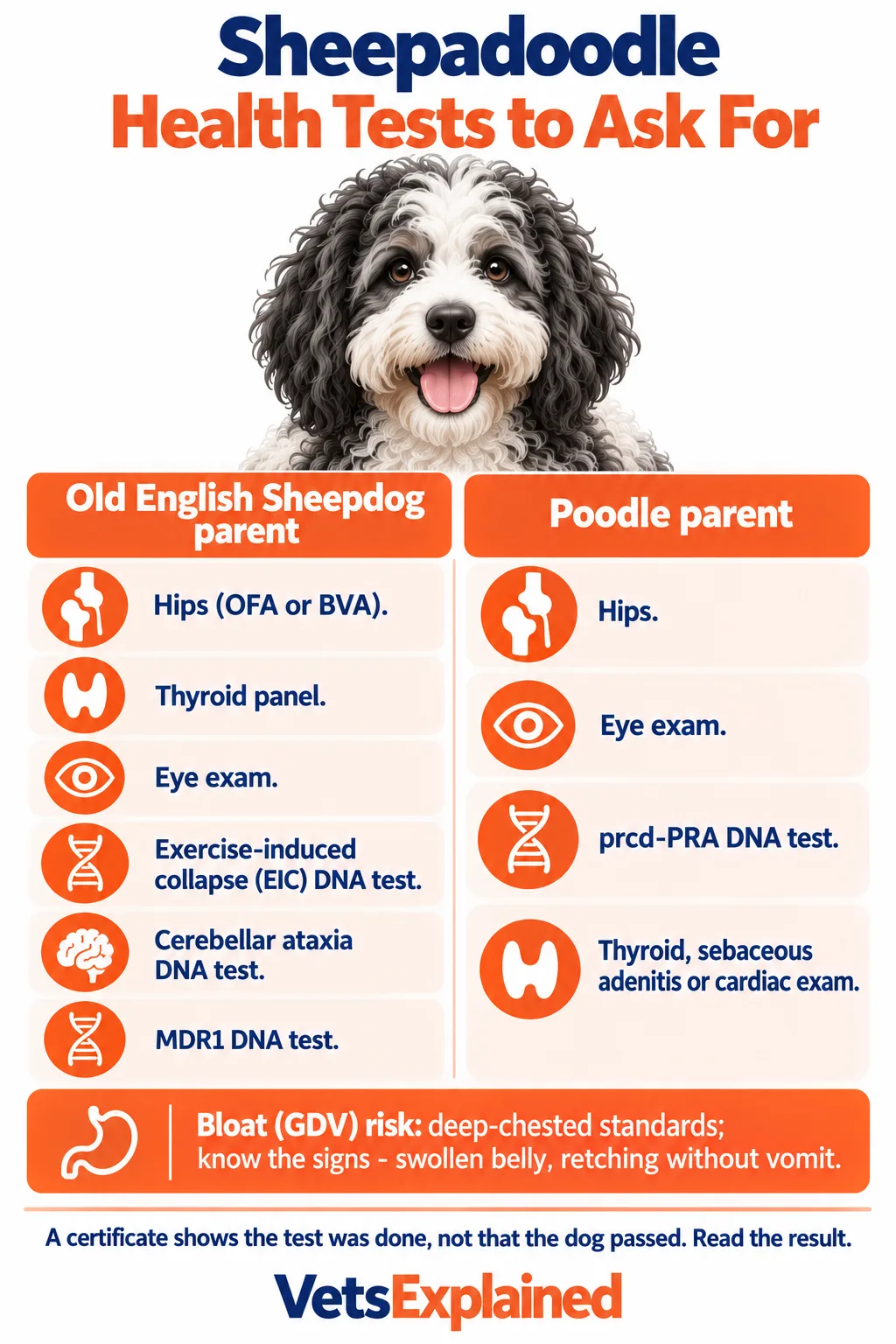
For the Standard Poodle parent: hips, an eye examination, and a thyroid panel, sebaceous adenitis skin biopsy or cardiac evaluation. For a Miniature Poodle parent: patellar luxation, eyes and prcd-PRA DNA testing.
Questions to ask a breeder
- Which health tests have been done on both parents, and can I see the results?
- Has the Old English Sheepdog parent been DNA tested for cerebellar ataxia, EIC and MDR1?
- How tall and heavy is each parent, and how big have previous litters grown?
- Can I meet the mother, and see where the puppies are raised?
- What are the puppies being exposed to before eight weeks?
- What generation is this litter, and what coats have earlier litters had?
- What happens if I can no longer keep the dog?
A breeder with puppies "available now" all year round, in every size and colour, with a deposit required before you have asked a single question, is one to walk away from.
16F1, F1B and Multigenerational Sheepadoodles
- F1: Old English Sheepdog × Poodle. The most variable generation for coat, from shaggy and shedding to curly and low-shedding, and the one with the most "panda" markings.
- F1B: F1 Sheepadoodle × Poodle. Three-quarters Poodle, so more likely to be curly and low-shedding, lighter in build, and more Poodle in temperament and health risks. The most common generation sold to allergy-conscious buyers.
- F2: F1 × F1. Can produce the full range of coats and sizes in one litter.
- Multigenerational: Sheepadoodle × Sheepadoodle over several generations. Less common than in Labradoodles or Goldendoodles; consistency depends on the breeder's selection.
A generation label describes ancestry, not an outcome. An F1B is more likely to shed little; no generation is guaranteed to.
17What Should a Sheepadoodle Eat?
A Sheepadoodle needs a complete and balanced food for its life stage and expected adult size, from a manufacturer that meets the WSAVA guidelines on employing qualified nutritionists and testing its products. The brand matters less than those basics.
Three points matter for this cross:
- Standard puppies need a large-breed puppy food, which controls calcium and energy density to slow growth slightly and protect developing joints in dogs expected to exceed about 50 lb. Mini puppies usually do well on a regular puppy formula.
- Feed two or three meals a day rather than one, and avoid vigorous exercise for an hour either side of meals, to reduce bloat risk in a deep-chested dog.
- Watch body condition, not the bowl. Under all that coat it is easy to miss a dog getting fat. You should feel the ribs easily with light pressure, and there should be a waist when you run your hands along the sides. Adjust food by about 10 per cent at a time if the dog drifts.
Our feeding guide by life stage covers amounts as the dog grows.
18Can Sheepadoodles Be Left Alone?
An adult Sheepadoodle that has been taught gradually can usually manage four to six hours alone; a puppy cannot, and a dog that has never practised it will not cope with a full working day. Sheepadoodles are companion dogs by temperament and tend to be clingy, and separation-related problems are among the behaviours the RVC survey found more often in Doodles than in their parent breeds.
Build independence from the first week: short absences after exercise, a safe space, something to chew, calm departures and returns, and a routine the dog can predict. Howling, destruction around doors, or self-injury when left are signs of distress that need a vet or qualified behaviourist, not more time.
19How Much Does a Sheepadoodle Cost?
Prices vary by country, region, breeder, size and generation, so treat the figures below as a rough guide.
- Puppy from a breeder: in the US, commonly 1,500 to 3,500 dollars in 2026, with minis and F1B dogs from well-known programmes often at the top of that range or above. UK prices typically start around 1,200 to 2,500 pounds.
- Rescue: usually a few hundred dollars or pounds in fees. Sheepadoodles surrendered at 1 to 2 years old, often for size, grooming or herding reasons, are not rare.
- Grooming: the big ongoing cost. A standard Sheepadoodle typically costs 90 to 180 dollars per professional groom, every 4 to 8 weeks, so budget 700 to 1,500 dollars a year, plus brushes, combs and a good dryer.
- Everything else: large-breed food, insurance (higher premiums for a large crossbreed), routine veterinary care, training and, if you choose it, preventive gastropexy.
A cheap Sheepadoodle puppy usually means skipped health testing, which simply moves the cost to you later.
20Sheepadoodle vs Bernedoodle vs Goldendoodle
Sheepadoodle vs Bernedoodle. The two large, often black-and-white Doodles are frequently confused. The Bernedoodle is a Bernese Mountain Dog cross: typically tricolour, calmer and more laid-back, but carrying the Bernese's short lifespan and high cancer risk. The Sheepadoodle is usually black and white or grey, more playful and more inclined to herd, with a generally longer lifespan but the Sheepdog's hips, thyroid and neurological conditions to test for. Both are heavy grooming commitments. Our Bernedoodle breed guide covers the other side of that comparison.
Sheepadoodle vs Goldendoodle. The Goldendoodle is lighter, more athletic, more retriever-like and more eager to please; it is the easier dog for a first-time owner and the more demanding one for exercise. The Sheepadoodle is heavier, calmer at home, more stubborn, and tends to herd rather than retrieve. Grooming demands are similar; the Sheepadoodle's coat is usually denser. The Goldendoodle carries the Golden Retriever's cancer risk, the Sheepadoodle the Sheepdog's hips and thyroid.
21What Are the Disadvantages of a Sheepadoodle?
- The coat is among the most demanding of any Doodle, and the grooming bill lasts for the dog's whole life.
- Standards are big, strong and bouncy, and difficult for children or older people to handle on a lead.
- Herding behaviour towards children and pets needs active management.
- Size and coat vary a lot between litters, and the puppy's adult appearance cannot be promised.
- Inherited conditions from the Sheepdog side, including cerebellar ataxia, EIC and MDR1, are only avoided if the breeder tests for them.
- They overheat in hot climates and summer weather.
- They can be stubborn, clingy and prone to separation problems.
- There is no breed club or standard, so quality varies enormously between breeders.
22Sheepadoodle Pros and Cons
Potential advantages
- Affectionate, playful and strongly bonded to the family
- Intelligent and capable of learning almost anything
- Calmer at home than many retriever Doodles once mature
- Striking black-and-white looks and a soft, usually low-shedding coat
- Available in standard and mini sizes
- Generally sociable with other dogs and with visitors
- Typical lifespan of 10 to 14 years, longer than the Old English Sheepdog alone
Potential challenges
- Very high grooming needs and high grooming costs
- Large adult size; standards often exceed 80 lb
- Herding, bumping and nipping, especially around young children
- Inherited risks of hip dysplasia, hypothyroidism, eye disease, cerebellar ataxia, EIC, MDR1 and bloat
- Stubborn streak that tests inexperienced trainers
- Prone to overheating and to separation-related distress
- Not a recognised breed, so health testing depends entirely on the breeder
23Is a Sheepadoodle Right for You?
A Sheepadoodle suits you if you want a large, soft, affectionate and slightly comical dog that joins in with family life, you can give it an hour or more of exercise and attention a day, you are genuinely willing to brush it most days and pay a groomer every month or two for the next decade, and your children are old enough to be taught how to behave around a big herding dog.
It is probably not the dog for you if you want something low-maintenance, if you have toddlers and no dog experience, if you live in a hot climate without air conditioning, if the dog will be alone most of the working day, or if a non-shedding, allergy-safe dog is the main reason you are looking.
Before you commit, ask yourself:
- Can I manage and afford the coat for 10 to 14 years, including the months when I do not feel like brushing?
- Can everyone in the house walk and control an 80 lb dog?
- Will I supervise the dog with children and train the herding out of it, every time?
- Have I seen test results for hips, thyroid, eyes, EIC, ataxia and MDR1 on the Sheepdog parent?
- Am I choosing this dog for its temperament and health, or because the puppies look like pandas?
If the answers are yes, a Sheepadoodle is a loyal, gentle and entertaining companion, and one that owners rarely regret.
24Final Thoughts
The Sheepadoodle is a big, soft, clever dog with a coat that turns heads and a temperament that, in the right home, is as affectionate as any cross you can buy. It is also a serious commitment: the grooming load is close to the top of the scale, the size is real, the herding instinct is real, and the health conditions on the Old English Sheepdog side are specific enough that you should not buy from a breeder who cannot name them.
Choose the breeder before the puppy, insist on DNA tests for cerebellar ataxia, EIC and MDR1 alongside hips, thyroid and eyes, plan for the coat and the training, and judge the dog in front of you rather than the photographs. For the wider picture on Poodle crosses, including the Bernedoodle and Goldendoodle, read our complete Doodle Dog guide.
Sources
- Washington State University, Veterinary Clinical Pharmacology Laboratory / WADDL. MDR1 in dogs: affected breeds and problem medications. waddl.vetmed.wsu.edu
- Agler C, Nielsen DM, Urkasemsin G, et al. Canine hereditary ataxia in Old English Sheepdogs and Gordon Setters is associated with a defect in the autophagy gene encoding RAB24. PLoS Genetics. 2014;10(2):e1003991. pmc.ncbi.nlm.nih.gov
- Online Mendelian Inheritance in Animals (OMIA), University of Sydney. Exercise-induced collapse in Canis lupus familiaris, OMIA 001466. omia.org
- American Kennel Club. Herding group health testing requirements: Old English Sheepdog (recommended tests from the Old English Sheepdog Club of America). akc.org
- Royal Veterinary College. New RVC study challenges common beliefs on desirable behaviours in designer "Doodle" crossbreeds. 2025. rvc.ac.uk
- Bryson GT, O'Neill DG, Brand CL, Belshaw Z, Packer RMA. The doodle dilemma: how the physical health of "designer-crossbreed" Cockapoo, Labradoodle and Cavapoo dogs compares to their purebred progenitor breeds. PLoS One. 2024;19(8):e0306350. pmc.ncbi.nlm.nih.gov
- Merck Veterinary Manual. Disorders of the thyroid gland in dogs. merckvetmanual.com
- VCA Animal Hospitals. Bloat: gastric dilatation and volvulus in dogs. vcahospitals.com
- WSAVA Global Nutrition Committee. Global nutrition guidelines. wsava.org
Frequently Asked Questions
?What two breeds make a Sheepadoodle?
A Sheepadoodle is an Old English Sheepdog crossed with a Poodle. Most litters use a Standard Poodle; mini Sheepadoodles use a Miniature Poodle, usually with an Old English Sheepdog mother. Crosses with Shetland Sheepdogs or Bearded Collies are sometimes mislabelled as Sheepadoodles.
?How big does a Sheepadoodle get?
A standard Sheepadoodle typically weighs 60 to 85 lb and stands 18 to 25 inches, and some males pass 90 lb. Mini Sheepadoodles usually weigh 25 to 50 lb. The measured size of both parents and earlier litters is the best predictor for an individual puppy.
?Do Sheepadoodles shed?
Less than an Old English Sheepdog, but no Sheepadoodle is non-shedding. Curly and wavy coats shed little, while straighter, shaggy coats shed seasonally. Loose hair stays trapped in the coat, which is why it mats so easily if brushing is skipped.
?Are Sheepadoodles hypoallergenic?
No dog is hypoallergenic. A low-shedding coat spreads less dander, which helps some allergic people and not others. Spend time with the specific puppy or an adult from the same breeder before committing, and ignore any guarantee of an allergy-free dog.
?Are Sheepadoodles good family dogs?
Often, yes, for families with school-age children who can train and supervise a large dog. The cross keeps a herding instinct and may circle, bump and nip at running children, and a standard is heavy enough to knock a toddler over. Supervision and early training are essential.
?Do Sheepadoodles herd and nip?
Many do, particularly as adolescents. The Old English Sheepdog moved livestock by bumping and nipping at heels, and Sheepadoodles often try the same on children, cats and other dogs. Redirect it early into games and training, and never leave a dog with this habit alone with small children.
?Is a Sheepadoodle high maintenance?
Yes, mainly because of the coat. Expect brushing to the skin most days, professional grooming every 4 to 8 weeks, and 60 to 90 minutes of daily activity for a standard. In temperament most are easy to live with once those needs are met.
?How much does it cost to groom a Sheepadoodle?
A professional groom for a standard Sheepadoodle commonly costs 90 to 180 dollars in the US, needed every 4 to 8 weeks, so around 700 to 1,500 dollars a year. Prices vary by region and coat condition, and matted dogs are charged extra or shaved.
?What health problems do Sheepadoodles have?
From the Old English Sheepdog side: hip dysplasia, hypothyroidism, cerebellar ataxia, exercise-induced collapse, the MDR1 drug-sensitivity mutation, cataracts and bloat. From the Poodle side: Addison's disease, sebaceous adenitis, eye disease and ear infections. Testing both parents avoids most of the inherited ones.
?What is MDR1 and does it affect Sheepadoodles?
MDR1 is a gene mutation that makes dogs dangerously sensitive to certain drugs, including loperamide, some sedatives and high-dose ivermectin. Washington State University reports around 5 per cent of Old English Sheepdogs carry it, so a Sheepadoodle can inherit it. A cheek-swab DNA test settles the question.
?How long do Sheepadoodles live?
Most live 10 to 14 years. The Old English Sheepdog averages around 10 to 12 years and the Standard Poodle 12 to 15, so standards usually fall between the two and minis tend to live longer. Keeping the dog lean adds healthy years.
?Are Sheepadoodles easy to train?
They learn fast but can be stubborn. The Poodle side picks up cues in a few repetitions; the Sheepdog side was bred to make its own decisions. Short, reward-based sessions, early socialisation and consistency work best; harsh methods produce a worried dog.
Help us do better!
Was this article helpful and relevant?
Thanks for your feedback!
About Sofia Marin
Sofia Marin is VetsExplained's senior editor. She has edited pet and consumer titles for fifteen years and is responsible for the site's editorial standards and breed coverage.
View all posts by Sofia Marin →