Best Doodle Dogs for Families With Children: A Vet-Reviewed Comparison
 Written by Sofia Marin
 Fact checked by Dr. Tomas Ellery, DVM
For most families the best Doodle is a medium or mini Goldendoodle, Bernedoodle or Labradoodle of 25 to 50 lb from calm, health-tested parents. A 2026 study of 9,402 UK dogs found Cockapoos and Cavapoos scored worse than their parent breeds on several behaviour scales, so the cross alone guarantees nothing.
The information is current and up-to-date in accordance with the latest veterinary research. Learn more »
Doodles are sold to families on a simple promise: a friendly, clever, low-shedding dog that will be gentle with the children. Some of that promise holds up. Some of it does not, and the evidence is clearer now than it was two years ago.
This comparison ranks eight popular Poodle crosses for households with children. It leans on four things rather than reputation: the behaviour data from a 2026 Royal Veterinary College study of 9,402 UK dogs, the health findings of the 2024 "doodle dilemma" study, the realities of size and grooming, and the dog-bite prevention guidance for parents from the American Veterinary Medical Association and the American Academy of Pediatrics.
If you are new to the crosses, our Doodle Dog guide explains generations, coat types and what "Doodle" means. This article assumes you want a Poodle cross and need to know which one, at what size, is the safest bet with children in the house.
Key Takeaways
- Goldendoodle, Bernedoodle and Labradoodle rank highest for families; Aussiedoodle and Maltipoo rank lowest for homes with young children.
- A 2026 RVC study of 9,402 dogs found Cockapoos and Cavapoos scored worse than their parent breeds on several aggression, fear and excitability scales; Labradoodles were mixed.
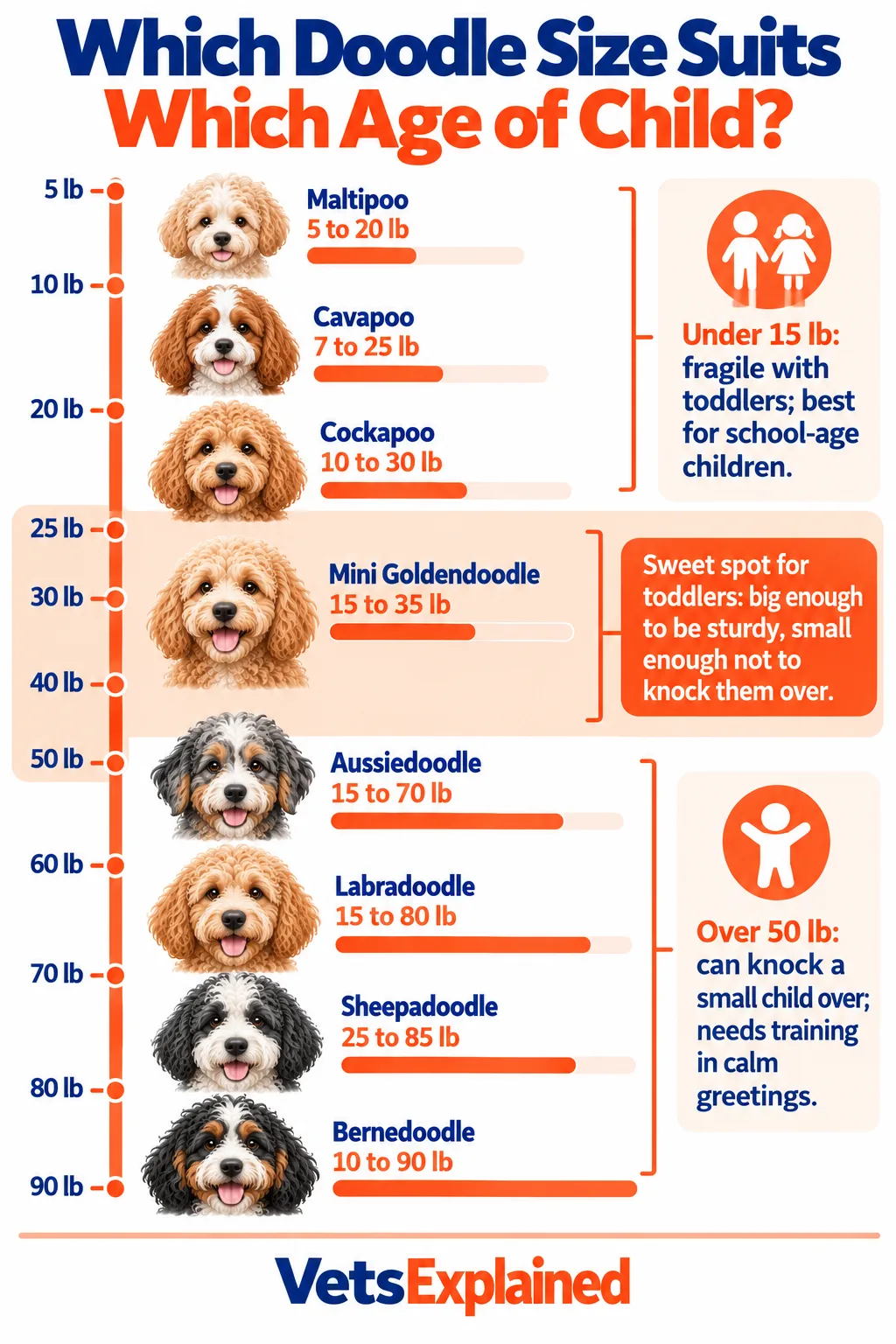
- Size matters more than the cross: 25 to 50 lb is the safest band for toddlers, and dogs under 10 lb are at risk from small children.
- Parents' temperament, socialisation before 14 weeks and adult supervision predict a child-safe dog better than any label.
- Never leave a young child alone with any dog, and give every Doodle a bed children do not go to.
1How We Ranked the Doodles for Families
Temperament evidence carries the most weight, then size, then grooming and health burden, because those decide whether a dog and a child can live together calmly for 12 years.
- Temperament evidence: The 2026 RVC study compared Cockapoos, Labradoodles and Cavapoos with their purebred parents on 12 validated C-BARQ behaviour scales, including owner-directed aggression, stranger-directed aggression, excitability, separation problems and trainability. Where a cross has not been studied, we use the parent breeds and say so.
- Size and knock-over risk: A 70 lb adolescent that jumps up will flatten a four-year-old. A 7 lb dog can be injured by that same child. The middle of the scale is safest.
- Grooming burden: Every Doodle needs brushing to the skin several times a week and clipping every six to eight weeks. A matted, sore dog is a less tolerant dog, and families with young children are the households most likely to fall behind.
- Bite-prevention guidance: The AAP notes that children are the most common victims of dog bites, make up at least half of the roughly 800,000 Americans treated for bites each year, and are usually bitten by a familiar dog during everyday activity. So low touch sensitivity, low excitability and low resource-related aggression matter most.
One caveat first. The RVC study found Doodle households were more likely to include children (36.6% against 29.4%), yet the crosses scored worse than their parent breeds in 32 of 72 comparisons and better in only 7. The authors concluded that the belief that Doodles are easier to train or better with children is not well supported. The ranking below is about relative strengths, not guarantees.
21. Goldendoodle: The Best All-Round Doodle for Most Families
The Goldendoodle ranks first because both parents are among the most people-tolerant breeds kept as pets, and it comes in a medium size that suits children of almost any age.
Why it suits families: Golden Retrievers were bred to work beside people all day and carry things gently, and most Goldendoodles inherit that soft-mouthed, attention-seeking nature. They tolerate handling, want to join in, and quickly learn rules such as "four paws on the floor" when someone small walks in.
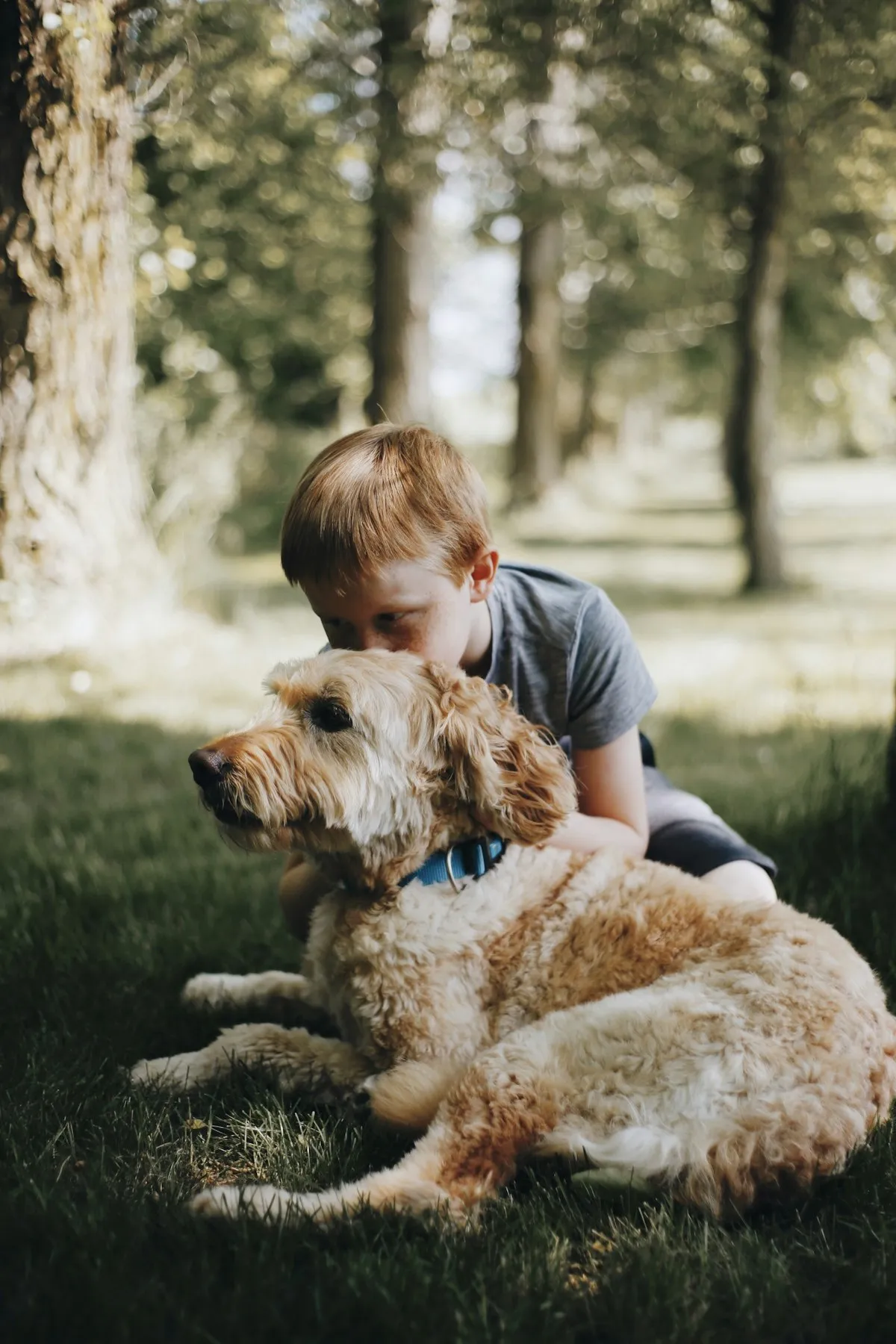
Watch-outs: Adolescents of 6 to 18 months are bouncy and mouthy, and a standard can knock a toddler over through enthusiasm. The Goldendoodle has not been included in the RVC behaviour work, so its temperament evidence is parent-breed inference. Ear infections are common in floppy-eared Poodle crosses, and a dog with sore ears may snap when a child touches its head.
Best for which ages: All ages, with a medium (30 to 45 lb) or mini (15 to 30 lb) the better choice with children under five. A 50 to 75 lb standard suits school-age children and up.
Size and exercise: Mini 15 to 30 lb, medium 30 to 45 lb, standard 50 to 75 lb. Around 60 to 90 minutes of activity a day for a standard adult. Grooming moderate to high.
Read the full Goldendoodle breed guide for coat types, health testing and cost.
32. Bernedoodle: The Calmest Large Doodle, in the Right Size
The Bernedoodle ranks second because the Bernese Mountain Dog contributes a placid, low-reactivity temperament, provided you choose a size the house can cope with.
Why it suits families: Bernese were calm farm dogs that lived alongside children and livestock, and well-bred Bernedoodles are usually patient, slow to startle and less excitable than retriever crosses. Many are content to lie in the middle of family life rather than demand to be part of it.
Watch-outs: Standard Bernedoodles reach 70 to 90 lb, and an adolescent of that weight on a lead held by a child is a safety problem. Bernese also carry a heavy cancer burden; the Bernese Mountain Dog Club of America calls a 7 to 8 year lifespan far too short for the breed and funds histiocytic sarcoma research. A first-generation Bernedoodle usually outlives a Bernese, but ask for the Bernese parent's pedigree health history. Some are reserved with strangers, and the thick coat mats fast.
Best for which ages: Mini Bernedoodles (25 to 50 lb) suit families with toddlers upward. Standards are best with children of around 8 and older.
Size and exercise: Tiny 10 to 25 lb, mini 25 to 50 lb, standard 70 to 90 lb. Moderate exercise of 45 to 60 minutes a day; they overheat easily. Grooming high.
See the Bernedoodle breed guide for generations, colours and health tests.
43. Labradoodle: The Best-Evidenced Family Doodle
The Labradoodle ranks third, and it is the only cross on this list with Doodle-specific behaviour data that is partly reassuring.
Why it suits families: In the 2026 RVC study, Labradoodles scored better than Poodles on all six scales where the two differed, including owner-directed aggression, dog-directed aggression and separation problems. The 2024 health study found lower odds of hip or elbow dysplasia (odds ratio 0.37) and lameness than in Labradors, themselves the archetypal tolerant, food-motivated family dog.
Watch-outs: Compared with Labradors, Labradoodles scored worse on excitability, separation-related problems, non-social fear, dog rivalry and trainability: a bouncier, clingier dog that is harder to settle. Standards of 50 to 80 lb are strong adolescents. The 2024 study also found higher odds of ear infections than in Labradors (OR 1.80) and much higher odds of allergic skin disease than in Poodles.
Best for which ages: Medium Labradoodles (30 to 50 lb) suit families with children from toddler age. Standards are better with school-age children and up.
Size and exercise: Mini 15 to 30 lb, medium 30 to 50 lb, standard 50 to 80 lb. High exercise needs, 60 to 90 minutes a day for a standard. Grooming moderate to high.
The Labradoodle breed guide covers the Australian Labradoodle, coat types and breeder questions.
54. Cavapoo: The Best Small Doodle for Families, With Caveats
The Cavapoo is the top small Doodle for families because it is gentle, light enough for an older child to manage and small enough for a modest home, but the behaviour data are mixed and the heart disease risk is real.
Why it suits families: Cavalier King Charles Spaniels were bred purely as companions, and Cavapoos usually inherit that soft, people-focused nature. At 10 to 20 lb they cannot knock a child over, they need only 30 to 45 minutes of exercise a day, and in the RVC study they scored better than Cavaliers for trainability.
Watch-outs: In the same study Cavapoos scored worse than Cavaliers on eight scales, including owner-directed aggression, stranger-directed aggression, excitability, separation problems and three kinds of fear. A fearful small dog is the classic profile for a bite to a child's face, because children bend down to it. Mitral valve disease is the other problem: the UFAW genetic welfare summary reports that around half of Cavaliers have a heart murmur by age 5 and that MVD causes around 43% of deaths in the breed. Ask for the Cavalier parent's annual heart check results.
Best for which ages: Children of 5 and older who can sit and let the dog come to them. Not ideal with toddlers, who grab, lift and drop small dogs.
Size and exercise: 10 to 20 lb, 11 to 14 inches. Low to moderate exercise. Grooming high for the size, because the soft coat mats easily.
Our Cavapoo breed guide covers sizes, coats and the heart and eye tests to ask for.
65. Cockapoo: Popular, Affectionate and the Most Problem-Prone in the Data
The Cockapoo sits mid-table because it is affectionate and manageable in size, but it had the worst behaviour profile in the only large study that has looked.
Why it suits families: Cockapoos are merry, busy and strongly attached to their people. At 12 to 25 lb they are easy for a parent to handle, cheap to feed and small enough for a terraced house, and many are lovely with children.
Watch-outs: In the 2026 RVC study the Cockapoo scored worse than the Cocker Spaniel on 10 of 12 scales and worse than the Poodle on 6, including owner-directed aggression, stranger-directed aggression, dog rivalry, separation-related problems and excitability. That is owner-reported data on dogs under five and does not mean your Cockapoo will bite, but the "perfect family dog" reputation has no evidential support. The 2024 study found higher odds of ear infections (OR 2.13) and itchy skin (OR 2.67) than in Cockers; a sore dog is a less patient dog. Cockapoos also often struggle with being left alone.
Best for which ages: Children of 6 and older. Choose a breeder who shows you calm, well-socialised adults rather than one selling on colour.
Size and exercise: Toy 6 to 12 lb, mini 12 to 20 lb, standard 20 to 30 lb. Moderate exercise of 45 to 60 minutes a day. Grooming high.
The Cockapoo breed guide covers the English and American Cocker lines and separation problems.
76. Sheepadoodle: Gentle but Big, and Half Herding Dog
The Sheepadoodle ranks sixth because the Old English Sheepdog is good-natured, but the cross is large, heavily coated and carries herding instincts that can be a problem with running children.
Why it suits families: Well-bred Sheepadoodles are often goofy, affectionate and tolerant, and the Old English Sheepdog was a family drover's dog rather than a guard. Many are calmer indoors than Goldendoodles.
Watch-outs: Standard Sheepadoodles weigh 60 to 85 lb, and a dog that size that leans, jumps or herds will put a small child on the floor. Herding instinct shows up as circling, nudging and sometimes nipping at heels when children run and shriek. The coat is among the heaviest of any Doodle and mats within days. There is no Doodle-specific research for the cross; hip dysplasia and eye disease run in both parents, so insist on hip scores and eye tests.
Best for which ages: Children of 8 and older. Mini Sheepadoodles (25 to 50 lb) widen that to younger school-age children.
Size and exercise: Mini 25 to 50 lb, standard 60 to 85 lb. Sixty minutes or more a day. Grooming very high.
Read the Sheepadoodle breed guide for size predictions and coat care.
87. Maltipoo: A Lovely Lap Dog That Is Too Small for Toddlers
The Maltipoo ranks seventh, not because it is a bad dog but because a 5 to 12 lb dog and a toddler are a poor match for each other.
Why it suits families: Maltipoos are affectionate, portable, cheap to keep and need only 20 to 30 minutes of walking a day. For a family with teenagers, or a quieter household with one older child, they are an easy, loving companion.
Watch-outs: Small dogs are the ones most often dropped, stepped on, squeezed and picked up against their will, and a frightened small dog defends itself with its teeth at a child's face height. Toy Poodle crosses are also prone to patellar luxation and dental disease. There is no Doodle-specific behaviour research for the cross.
Best for which ages: Children of 10 and older. We do not recommend a Maltipoo for a household with children under 5.
Size and exercise: 5 to 12 lb, 8 to 14 inches. Low exercise. Grooming high, with daily eye wiping.
See the Maltipoo breed guide for coat types, dental care and breeder questions.
98. Aussiedoodle: Brilliant, Athletic and the Hardest Doodle for Young Children
The Aussiedoodle comes last for families with young children because the Australian Shepherd is an intense herding breed, and that intensity does not reliably disappear when a Poodle is added.
Why it suits families: For an active family with older children who want a dog to run, hike, do agility or learn tricks with, the Aussiedoodle is one of the most capable Doodles.
Watch-outs: The AKC describes the Australian Shepherd as a work-oriented dog that needs a job, and Aussiedoodles inherit that drive along with the herding habit of chasing, nipping and controlling movement. Many are watchful with strangers, which with a stream of visiting children can become a problem. Breeder-run owner surveys consistently rate the Aussiedoodle as the Doodle least suited to young children; that is not research, but it matches the parent breed. Both parents carry hereditary eye disease and the merle gene, so colour-driven breeding is a specific risk.
Best for which ages: Children of 10 and older in a genuinely active household. Not recommended with toddlers.
Size and exercise: Mini 15 to 35 lb, standard 40 to 70 lb. Ninety minutes or more of exercise and mental work a day for a standard. Grooming moderate to high.
The Aussiedoodle breed guide covers merle genetics, eye testing and keeping one occupied.
10Which Doodle Is Best for Toddlers?
A mini or medium Goldendoodle, mini Bernedoodle or medium Labradoodle of roughly 25 to 50 lb from calm parents is the best Doodle for a family with toddlers.
That size band matters more than the cross. A dog under 15 lb is at risk from the child; a dog over 60 lb puts the child at risk from accidental knocks. For older children the whole list opens up: active families suit a standard Goldendoodle, Labradoodle or Aussiedoodle, quieter families a Bernedoodle or Sheepadoodle, and teenagers who want a lap dog a Maltipoo.

11What Matters More Than the Cross
The parents' temperament, early socialisation and the family's supervision rules predict how a Doodle behaves with children far better than which cross it is.
Meet the parents, especially the mother
Temperament is partly inherited, and the mother shapes the puppies' first eight weeks. Ask to see her with the litter and with visitors. A mother who hides, growls or guards is a warning whatever the breeder says about the cross. Our guide on bringing home a dog lists the other questions worth asking first.
Socialisation between 3 and 14 weeks
Puppies raised in a kitchen among noise, visitors and gentle handling start well ahead of puppies raised in a barn. After the puppy comes home, keep introducing it to children of different ages in short, calm sessions where the child sits still and the puppy chooses to approach. The RVC finding that Doodles score higher on several fear scales is one more reason not to waste this window.
Supervision rules that actually work
The RSPCA's guidance on dogs and children and the AAP's bite-prevention tips agree on the core rules, and they are the same for every cross:
- An adult stays in the room whenever a child and the dog are together.
- The dog has a bed or crate in a quiet place, and children never go to it there.
- Children do not approach a dog that is eating, chewing, sleeping or unwell.
- No hugging, kissing the face, climbing on, pulling ears or tails, or taking toys and food.
- No tug-of-war, wrestling or chase games between children and the dog.
- Children learn to stand still if a dog is over-excited, and to curl up and protect their face if knocked down.
Teaching the dog "go to bed" and "leave it" early, and teaching children to notice when a dog turns its head away, licks its lips or yawns, prevents most incidents that end in a bite. If a dog of any cross starts to guard food or toys, our article on resource guarding explains what to do.
Health and comfort
A dog in pain has a shorter fuse. The 2024 study found all three studied Doodles had higher odds of ear infections, vomiting or itchy skin than at least one parent breed. Keep ears clean and dry, treat skin disease early, and keep weight off the joints; our guide to hip dysplasia in dogs explains the early signs in a larger Doodle.
12Doodles That Are Harder for Families
Some Doodles are a poor fit for households with young children, and it is better to say so than to pretend every cross is a family dog.
- Herding crosses: Aussiedoodles, Sheepadoodles and Bordoodles carry herding instinct. Chasing, circling and nipping at running children is a trait, not a training failure, and some never lose it.
- Tiny Maltipoos and toy Cavapoos or Cockapoos: Dogs under 10 lb are fragile, and fear-based biting is the predictable result of being grabbed and dropped by toddlers.
- Guarding crosses: Rottweiler, German Shepherd or Great Pyrenees crosses add protective instinct and size, and have no place on a first-time family's list.
- Any Doodle from a colour-first breeder: Merle, parti and "teddy bear" marketing says nothing about temperament.
- Any standard-sized Doodle with a baby or toddler: Not because of temperament, but because of weight and exuberance in adolescence.
If that describes your household, a well-matched adult dog from a rescue, assessed with children, is often a better route than any Doodle puppy. Our guide to gentle dog breeds for first-time owners covers purebred alternatives too.
13Potential Advantages and Challenges of a Doodle for a Family
Potential advantages
- Medium Goldendoodles, Bernedoodles and Labradoodles combine robustness, trainability and a people-focused nature.
- Low-shedding coats mean less hair on clothes and furniture, though no Doodle is hypoallergenic.
- Sizes from 10 to 90 lb mean there is a Doodle for most homes.
- The health research to date shows Doodles are broadly as healthy as their parents.
Potential challenges
- The only large behaviour study found Cockapoos and Cavapoos scored worse than their parents on aggression, fear and excitability scales.
- Grooming takes 15 minutes every other day plus clipping every 6 to 8 weeks for life.
- Ear infections, itchy skin and digestive upsets are more common than in Poodles.
- Separation-related problems were higher in all three studied crosses than in at least one parent breed.
14Final Thoughts
The best Doodle for a family with children is usually a medium-sized Goldendoodle, Bernedoodle or Labradoodle from calm, health-tested parents, raised in a home and socialised with children before 14 weeks. Cavapoos and Cockapoos can be wonderful too, but the research says to choose the breeder and the individual dog with extra care. Herding crosses and tiny dogs suit households with older children.
Whichever cross you pick, the rules that keep children safe are the same: an adult in the room, a quiet bed the dog can retreat to, and children taught to let the dog come to them. For a grounding in the crosses, generations and coats, go back to our Doodle Dog guide before you contact a breeder.
Sources
- Bryson GT, O'Neill DG, Belshaw Z, Brand CL, Packer RMA. Comparing undesirable behaviours between 'designer' Poodle-cross dogs and their purebred progenitor breeds. PLoS One. 2026;21(3):e0342847. journals.plos.org
- Bryson GT, O'Neill DG, Brand CL, Belshaw Z, Packer RMA. The doodle dilemma: how the physical health of "designer-crossbreed" Cockapoo, Labradoodle and Cavapoo dogs compares to their purebred progenitor breeds. PLoS One. 2024;19(8):e0306350. pmc.ncbi.nlm.nih.gov
- American Veterinary Medical Association. Dog bite prevention. avma.org
- American Academy of Pediatrics, HealthyChildren.org. Dog bite prevention tips. healthychildren.org
- RSPCA. Dogs and children. rspca.org.uk
- Universities Federation for Animal Welfare (Science for Animal Welfare). Genetic welfare problems of companion animals: Cavalier King Charles Spaniel, mitral valve disease. scienceforanimalwelfare.org
- Bernese Mountain Dog Club of America. Health. bmdca.org
- American Kennel Club. Australian Shepherd breed information. akc.org
Frequently Asked Questions
?What is the best Doodle for a family with young children?
A medium or mini Goldendoodle, mini Bernedoodle or medium Labradoodle of around 25 to 50 lb is the safest choice. That size copes with toddlers but is not heavy enough to knock them down, and all three come from tolerant, people-focused parent breeds.
?Are Doodles good with kids?
Many are, but the evidence does not show they are better with children than their parent breeds. A 2026 study of 9,402 UK dogs found Cockapoos and Cavapoos scored worse than their parents on several aggression and fear scales. The individual dog, its parents and its upbringing matter most.
?Which Doodle is the calmest?
The Bernedoodle is usually the calmest, especially from a placid Bernese parent, followed by the Sheepadoodle. Goldendoodles and Labradoodles are friendlier but more excitable; the RVC study found Labradoodles more excitable than Labradors. Adolescents of every cross are lively.
?Is a mini Doodle or a standard Doodle better for kids?
Mini and medium Doodles of 20 to 50 lb are better for young children. Standards of 60 lb or more are fine with older children but can knock small ones over, and tiny Doodles under 10 lb are easily hurt by toddlers and more likely to bite out of fear.
?Are Cockapoos good family dogs?
Many Cockapoos are affectionate family dogs, but they had the most problem behaviours in the 2026 RVC study, scoring worse than Cocker Spaniels on 10 of 12 scales. Pick a breeder on temperament, socialise early and plan for separation training.
?Is a Cavapoo good with toddlers?
Cavapoos are gentle but, at 10 to 20 lb, are easily hurt or frightened by toddlers, and the RVC study found higher fear and excitability scores than in Cavaliers. They are a better match for children of 5 and older who can sit still and let the dog approach.
?Are Aussiedoodles good with children?
Aussiedoodles are best with children of 10 and older in active families. The Australian Shepherd parent brings herding drive, which can mean chasing and nipping running children, and often a watchful attitude to strangers. They are not a good choice with toddlers.
?Do Doodles bite children?
Any dog can bite, and children are the most common victims according to the AVMA and the AAP, usually bitten by a familiar dog during everyday activity. No Doodle is exempt. Supervision, a quiet retreat for the dog and teaching children not to disturb a resting or eating dog prevent most bites.
?How much grooming does a family Doodle need?
Plan for brushing to the skin every other day, about 15 minutes each time, and professional clipping every 6 to 8 weeks. Families with young children are the most likely to fall behind, and a matted, sore dog is a less tolerant one, so budget the time before buying.
?Should a family get a Doodle puppy or an adult dog?
An adult dog assessed with children, from a rescue or a breeder rehoming a retired dog, is often the safer choice for a home with toddlers because its temperament and size are known. A puppy gives you control of socialisation but needs months of close supervision.
Help us do better!
Was this article helpful and relevant?
Thanks for your feedback!
About Sofia Marin
Sofia Marin is VetsExplained's senior editor. She has edited pet and consumer titles for fifteen years and is responsible for the site's editorial standards and breed coverage.
View all posts by Sofia Marin →