Goldendoodle vs Labradoodle: Which Doodle Is Right for You?
 Written by Sofia Marin
 Fact checked by Dr. Tomas Ellery, DVM
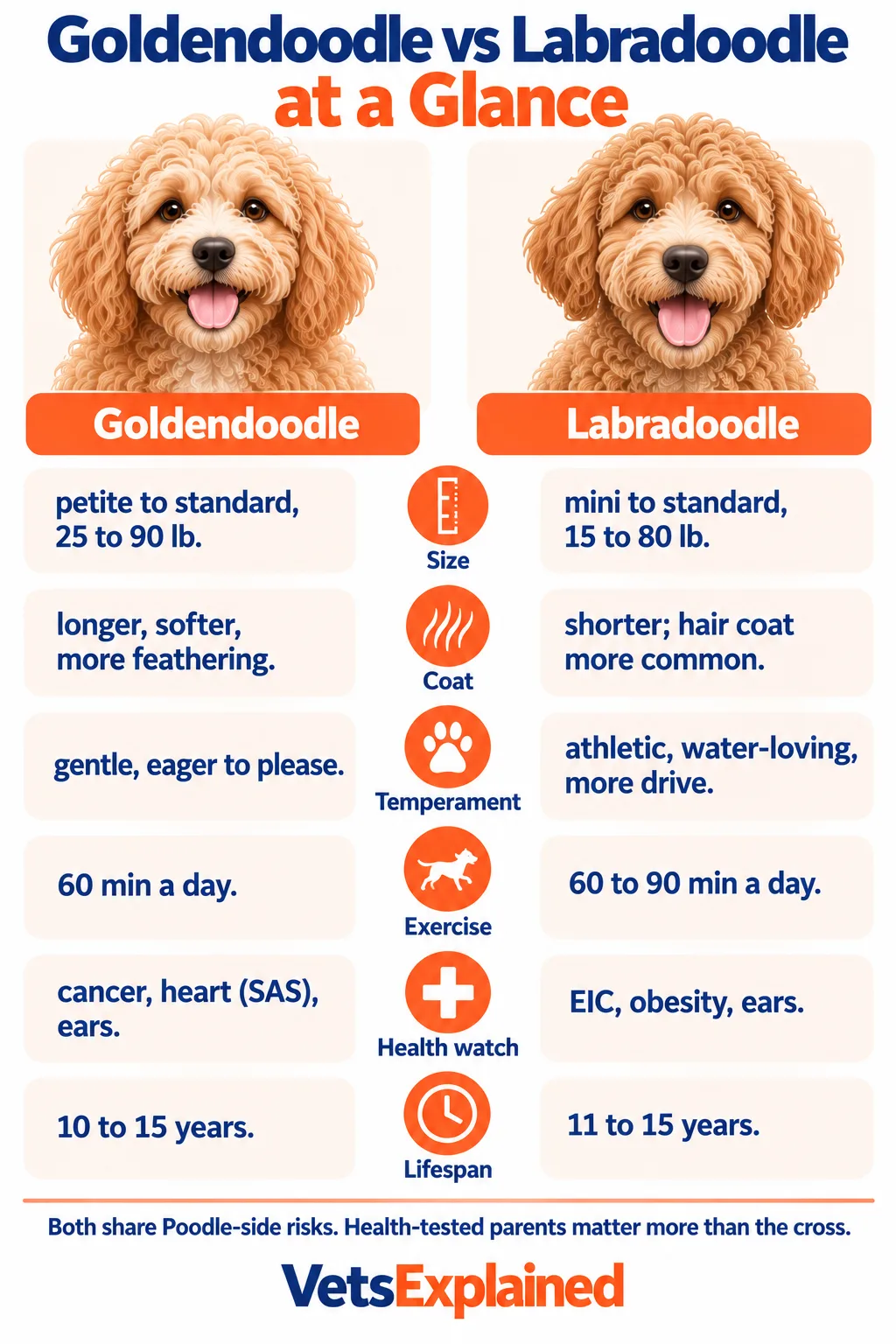
Goldendoodles and Labradoodles overlap far more than they differ. Goldendoodles tend to be softer-coated, gentler and slightly less driven; Labradoodles tend to be more athletic, more often hair-coated and more shed-prone. Standards of both weigh 50 to 80 lb, need 60 to 90 minutes of exercise and cost 1,500 to 4,000 dollars.
The information is current and up-to-date in accordance with the latest veterinary research. Learn more »
Goldendoodle vs Labradoodle is the most common choice people face once they have settled on a Doodle, and it is a closer call than breeder websites suggest. Both are a retriever crossed with a Poodle, both come in mini, medium and standard sizes, and both are friendly, clever and expensive to groom. The differences come down to the retriever on the other side of the cross.
The Golden Retriever brings a longer, softer coat, a gentler personality and a well-documented cancer risk. The Labrador brings a shorter, denser coat, more athletic drive, a famous appetite and a few problems of its own. Everything else, from grooming to the Poodle-side health risks, is shared.
This comparison puts the two side by side and says which suits families, first-time owners, apartments and allergy sufferers. Our full Goldendoodle guide and Labradoodle guide go deeper on each dog, and our Doodle Dog guide explains what all Poodle crosses have in common.
Key Takeaways
- The two crosses share size tiers, grooming needs, Poodle-side health risks and prices; the differences come from the retriever parent.
- Goldendoodles tend to be softer-coated and gentler, and carry the Golden Retriever's documented cancer risk.
- Labradoodles tend to be more athletic, more often hair-coated in F1 litters, and had 2.95 times the odds of ear infections in a 2021 UK study.
- A 2024 study found Labradoodles about as healthy as their parents; no equivalent study exists for Goldendoodles.
- For small children and first-time owners, lean Goldendoodle; for sporting households, lean Labradoodle; for allergies, choose coat type over cross.
1Where Do Goldendoodles and Labradoodles Come From?
The Labradoodle is older and was bred for a job; the Goldendoodle followed as a companion dog.
- Origin: Goldendoodle, appeared in the 1990s in North America and Australia as a pet / Labradoodle, first bred in 1989 by Wally Conron for the Royal Guide Dogs Association of Australia, as a guide dog with a coat an allergic household could tolerate
- Recognition: Neither is a kennel-club breed. The Goldendoodle Association of North America (GANA) publishes a standard and size categories. The ordinary Labradoodle has no standard; the Australian Labradoodle is a separate multigenerational line, with Cocker Spaniel in its foundation, bred to a written standard and registered through the ALAA and WALA
2How Big Do Goldendoodles and Labradoodles Get?
Both come in the same size tiers; a standard of either is a 50 to 80 lb dog.
- Petite or mini: Goldendoodle, Petite under 14 inches and 25 lb or less, Mini 14 to 17 inches and 26 to 35 lb (GANA) / Labradoodle, 14 to 16 inches and roughly 15 to 30 lb
- Medium: Goldendoodle, 17 to 21 inches and about 36 to 50 lb / Labradoodle, 17 to 20 inches and roughly 30 to 50 lb
- Standard: Goldendoodle, over 21 inches and usually 51 lb or more / Labradoodle, 21 to 24 inches and roughly 50 to 80 lb
Size follows the Poodle parent, because Golden Retrievers and Labradors are a similar size. F1 minis of both often land at 35 to 45 lb, so ask for the measured size of both parents rather than trusting a label.
3Coat and Shedding: Which Doodle Sheds Less?
Neither is non-shedding, but a Labradoodle is more likely to carry the shed-prone hair coat, and a Goldendoodle the long, soft, wavy coat people picture.
- The retriever behind the coat: Goldendoodle, the Golden Retriever's long, feathered coat means even a straight-coated Goldendoodle is shaggy / Labradoodle, the Labrador's short, dense coat gives Labrador-leaning dogs a flatter, often wiry "hair" coat
- Coat types: Goldendoodle, straight, wavy or curly, with wavy most common and furnishings (beard and eyebrows) usual / Labradoodle, hair, fleece or wool; hair coats appear mostly in F1 litters
- Shedding: Goldendoodle, "open-faced" dogs without furnishings shed most / Labradoodle, a hair-coated dog can shed almost as much as a Labrador
- Predictability: Both are a lottery in F1 litters, and the adult coat often does not settle until 10 to 14 months
Generation and individual coat matter more than the cross: F1B fleece coats shed about the same in both, while an F1 Labradoodle litter holds slightly more hair-coat tickets. Our guide to Doodle coat types explains how to read a puppy's coat at eight weeks.
4Temperament: Is a Goldendoodle Calmer Than a Labradoodle?
On average, slightly, but the gap between the two crosses is smaller than the gap between individual dogs.
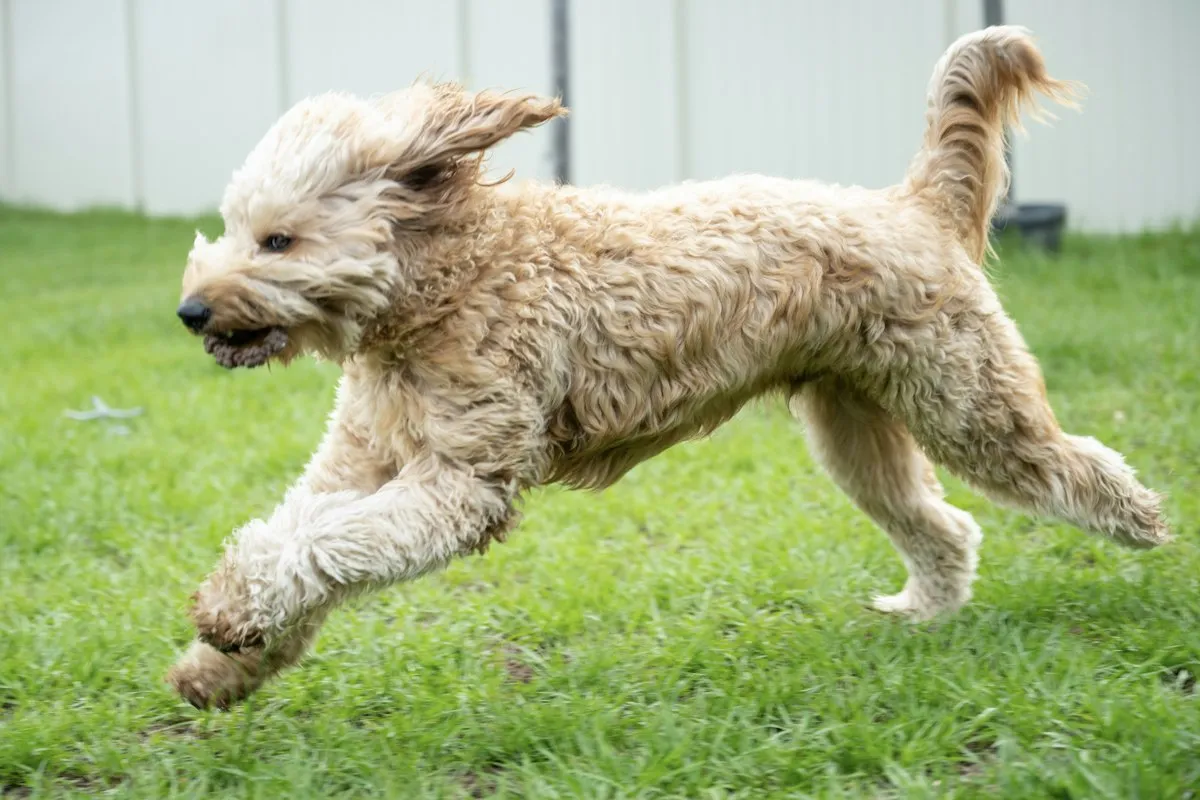
- Character: Goldendoodle, gentle, eager to please, often a "velcro" dog / Labradoodle, bolder and more driven, with a stronger retrieving and water instinct
- Energy: Goldendoodle, moderate to high; settles more readily indoors as an adult / Labradoodle, high; wants a task, a ball or a swim
- Sensitivity: Goldendoodle, softer / Labradoodle, more robust, and more likely to inherit the Labrador's appetite
The only peer-reviewed behaviour data on either cross come from Labradoodles. A 2026 Royal Veterinary College study compared owner-reported C-BARQ scores for 583 Labradoodles, 2,099 Labradors and 927 Poodles. Labradoodles scored worse than Labradors for noise fear, excitability, separation problems and trainability, but better than Poodles for aggression and fear of strangers. Goldendoodles were not included, so claims that they are "the calmer Doodle" rest on owner impressions, not evidence.
5Trainability: Which Is Easier to Train?
Both are among the easiest dogs to train; the differences are in style rather than ability.
- Motivation: Goldendoodle, praise, play and food equally / Labradoodle, strongly food-driven, which speeds training and complicates weight control
- Focus: Goldendoodle, distracted by people it wants to greet / Labradoodle, distracted by anything that moves, and slower to settle as an adolescent
For a first-time owner, the Goldendoodle's lower drive makes it marginally the easier dog; for agility, scent work or canicross, the Labradoodle's drive is an asset.
6Exercise: Which Needs More?
A standard Labradoodle generally needs a little more than a standard Goldendoodle, but both need a proper daily outing.
- Standard adult: Goldendoodle, around 60 minutes a day of walks, play and training / Labradoodle, 60 to 90 minutes, and some need more
- Puppies: Growth plates in standards close at roughly 12 to 18 months; keep puppy exercise short and low-impact until then
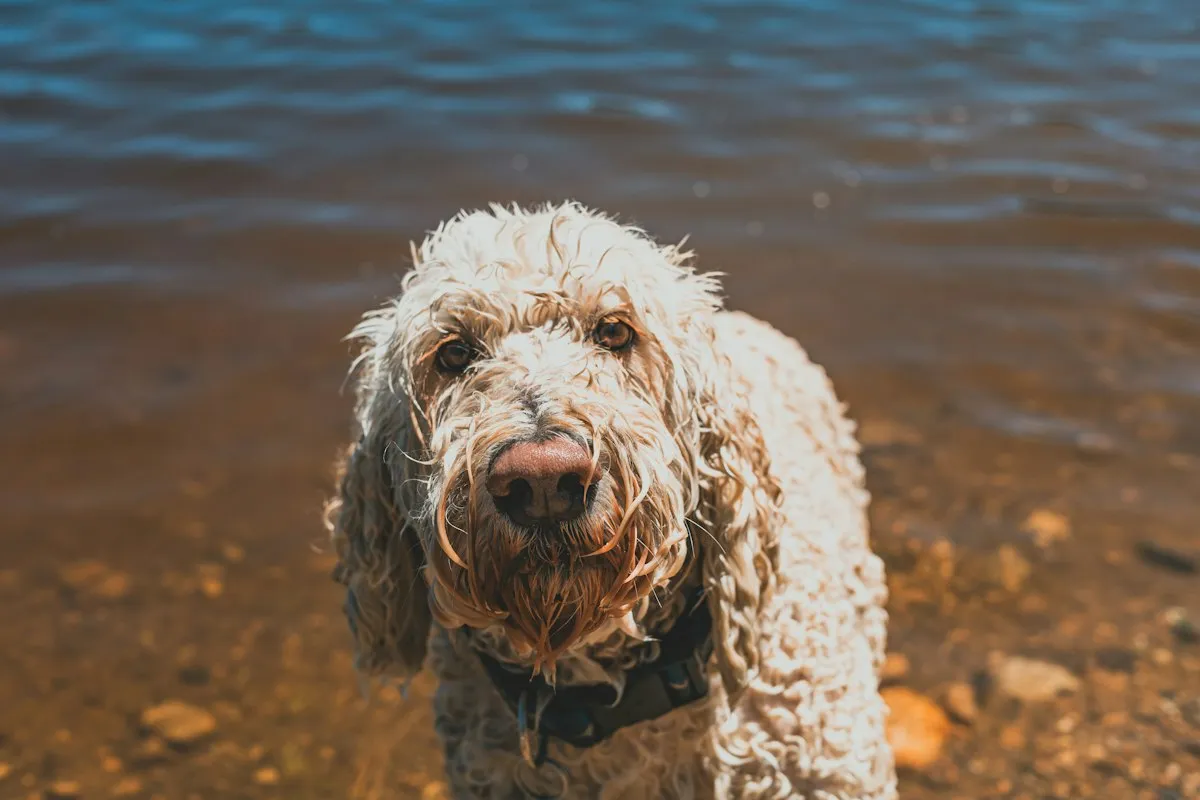
Under-exercised, both chew, bark and counter-surf; the Labradoodle gets there first.
7Grooming: Which Is More Work?
The grooming load is almost identical, because the Poodle side sets it.
- Brushing: Both wavy, fleece or curly coats need brushing to the skin three or four times a week, daily for wool coats
- Clipping: Both every 6 to 8 weeks, at roughly 80 to 150 dollars a visit for a standard, varying by region
- Exception: Labradoodle, a hair-coated dog needs the least brushing of any Doodle coat but sheds the most / Goldendoodle, a straight coat is still long and feathered, so it needs regular brushing and sheds noticeably
Only the Labradoodle offers a short-coated option, at the price of shedding; otherwise coat type, not cross, sets the grooming bill.
8Health: What the Studies Show for Each Cross
Each cross inherits its own retriever's problems on top of the shared Poodle risks, and the evidence does not show that either is healthier than its parents.
The Golden Retriever side
- Cancer: The Morris Animal Foundation Golden Retriever Lifetime Study, following more than 3,000 Goldens since 2012, had recorded 500 diagnoses of haemangiosarcoma, lymphoma, high-grade mast cell tumour and osteosarcoma by 2023. Crossing with a Poodle dilutes but does not remove that risk.
- Hips, elbows and eyes: Hip dysplasia, elbow dysplasia, pigmentary uveitis, PRA and cataracts; test both parents.
- Heart: Subvalvular aortic stenosis (SAS), which the Golden Retriever Club of America calls the most common congenital heart disease in the breed; affected dogs can die suddenly, so ask for a cardiologist's clearance of both parents.
- Ears: A 2021 VetCompass study of 22,333 UK dogs found Golden Retrievers had 2.23 times the odds of otitis externa compared with crossbreds.
The Labrador side
- Exercise-induced collapse (EIC): A recessive DNM1 mutation, identified by the University of Minnesota, causes collapse after 5 to 20 minutes of intense exercise. The Labrador Retriever Club lists the DNA test among its minimum clearances with hips, elbows and eyes.
- Obesity: A 2021 VetCompass study found Labradors had 1.70 times the odds of being recorded overweight compared with crossbreds; Golden Retrievers were also at raised risk.
- Ears: The same 2021 study found Labradoodles had 2.95 times the odds of otitis externa compared with crossbreds, the third-highest of any breed studied. prcd-PRA is also tested for on this side.
What the Doodle dilemma study found
The best direct evidence on either cross is the 2024 Royal Veterinary College study of 583 Labradoodles, 2,099 Labradors and 927 Poodles across 57 disorders. Labradoodles showed no difference from Labradors for 52 disorders and from Poodles for 50; they had lower odds than Labradors of hip or elbow dysplasia, higher odds of ear infections, and higher odds than Poodles of vomiting, diarrhoea and eating things they should not. A Labradoodle is about as healthy as its parents, not healthier.
Goldendoodles have no equivalent study, so assume the same: the Golden Retriever's and the Poodle's risks, cancer included. Both crosses can also inherit the Poodle's Addison's disease, sebaceous adenitis, hypothyroidism, patellar luxation and bloat.
9Lifespan: Which Lives Longer?
The Labradoodle has a slight edge at standard size; at mini size they are the same.
- Standard: Goldendoodle, estimated 10 to 14 years / Labradoodle, estimated 11 to 14 years
- Mini: Both 12 to 15 years
- Why: The Golden Retriever's cancer burden pulls the standard Goldendoodle down
- What you control: Body condition; in the only lifetime feeding trial in dogs, lean-fed Labradors lived about 1.8 years longer
These are estimates; our guide to how long Doodles live explains them.
10Price: Which Costs More?
About the same, and the breeder's line matters more than the cross.
- Puppy price: Both typically 1,500 to 4,000 US dollars from a breeder in 2026 for an F1 or F1B, varying by region, size, colour and breeder
- Premium lines: Goldendoodle, multigenerational "teddy bear" minis are priced at the top / Labradoodle, registered Australian Labradoodles often sit above the range
- Rescue: Both a few hundred dollars in fees, and both are common in rescue at 12 to 18 months
A cheap puppy of either cross is a warning sign.
11Which Is Better for Families With Children?
Both are good family dogs; the Goldendoodle is the safer bet for young children, the Labradoodle for active older ones.
- Goldendoodle: Softer and more tolerant of a toddler's clumsiness, though a standard will still knock a small child over
- Labradoodle: Equally affectionate but more boisterous and mouthy as an adolescent; excellent with children old enough to throw a ball
Supervise either with small children, and consider a medium if toddlers are in the house.
12Which Is Better for First-Time Owners?
The Goldendoodle, by a small margin. Its lower drive makes it the easier introduction to dog ownership, which is why it appears on first-time owner shortlists despite its grooming and exercise demands. A Labradoodle is just as trainable but more intense and slower to settle.
13Which Is Better for Apartments?
Neither standard is ideal, but a mini or medium of either can work, and the Goldendoodle adapts slightly better because it settles more readily. Hours alone matter more than floor space.
14Which Is Better for Allergy Sufferers?
Neither is hypoallergenic, and coat type and generation matter far more than the cross. An F1B or multigenerational dog of either with a curly, fleece or wool coat spreads least dander; avoid F1 Labradoodles, whose hair coats shed freely. Allergens come from dander, saliva and urine, which every dog produces, so spend time with the specific dog before committing. If allergies drive the decision, a well-bred Poodle removes the coat lottery entirely.
15Choose a Goldendoodle If...
- You want the gentlest, most people-focused temperament the Doodle world offers
- You prefer the long, soft, teddy-bear look
- Your exercise is daily walks and play rather than sport
- You accept the Golden Retriever's cancer risk and will have any lump checked
16Choose a Labradoodle If...
- You want an athletic, outdoorsy dog for running, hiking, swimming or dog sports
- You want the predictability of a multigenerational Australian Labradoodle and will pay for it
- You will manage the Labrador appetite and ask for the EIC DNA test
17Goldendoodle vs Labradoodle Pros and Cons
Potential advantages
- Goldendoodle: gentler temperament; slightly easier for first-time owners and apartments; soft coat with consistent furnishings; marginally lower exercise need
- Labradoodle: more athletic and resilient; wider colour range; the only Doodle with a short-coat option; lower hip and elbow dysplasia odds than Labradors in the 2024 study
Potential challenges
- Goldendoodle: carries the Golden Retriever's cancer burden and a slightly shorter estimated lifespan at standard size; long coat mats readily; no published health or behaviour study yet
- Labradoodle: higher energy and excitability; hair-coated F1s shed heavily; 2.95 times the odds of ear infections in UK data; inherits the Labrador appetite and EIC risk
18Final Thoughts
Goldendoodle vs Labradoodle is a choice between two versions of the same idea. If you want gentle and people-focused, lean Goldendoodle. If you want athletic and game for anything, lean Labradoodle. Then judge the litter, not the label: meet the mother, see both parents' health certificates, and plan for the grooming and exercise either dog needs for 12 to 15 years.
For the wider picture on Poodle crosses, read our complete Doodle Dog guide.
Sources
- Bryson GT, O'Neill DG, Brand CL, Belshaw Z, Packer RMA. The doodle dilemma: how the physical health of "designer-crossbreed" Cockapoo, Labradoodle and Cavapoo dogs compares to their purebred progenitor breeds. PLoS One. 2024;19(8):e0306350. pmc.ncbi.nlm.nih.gov
- Bryson GT, O'Neill DG, Belshaw Z, Brand CL, Packer RMA. Comparing undesirable behaviours between 'designer' Poodle-cross dogs and their purebred progenitor breeds. PLOS ONE. 2026. journals.plos.org
- O'Neill DG, Volk AV, Soares T, Church DB, Brodbelt DC, Pegram C. Frequency and predisposing factors for canine otitis externa in the UK: a primary veterinary care epidemiological view. Canine Medicine and Genetics. 2021;8:7. pmc.ncbi.nlm.nih.gov
- Royal Veterinary College, VetCompass. RVC study reveals extent of dog obesity crisis in the UK. 2021. rvc.ac.uk
- Morris Animal Foundation. Golden Retriever Lifetime Study reaches 500 diagnoses of four major cancers. 2023. morrisanimalfoundation.org
- Golden Retriever Club of America. Heart disease: subvalvular aortic stenosis (SAS). grca.org
- University of Minnesota Canine Genetics Laboratory. Dynamin-1 associated exercise-induced collapse. canine-genetics.umn.edu
- The Labrador Retriever Club. Health issues and recommended health clearances. thelabradorclub.com
- Goldendoodle Association of North America. Goldendoodle breed standard. goldendoodleassociation.com
Frequently Asked Questions
?What is the main difference between a Goldendoodle and a Labradoodle?
The retriever parent. A Goldendoodle (Golden Retriever × Poodle) tends to have a longer, softer coat and a gentler temperament. A Labradoodle (Labrador × Poodle) tends to be more athletic, with a shorter coat in Labrador-leaning dogs. Size, grooming and Poodle-side risks are shared.
?Which is calmer, a Goldendoodle or a Labradoodle?
Goldendoodles are usually described as slightly calmer, Labradoodles as more driven. A 2026 UK study found Labradoodles more excitable than Labradors, but Goldendoodles were not studied, so the difference rests on owner impressions and is smaller than the variation between individual dogs.
?Which sheds less, a Goldendoodle or a Labradoodle?
Neither is non-shedding. F1B dogs with wavy, fleece, curly or wool coats shed least in both crosses. F1 Labradoodles more often carry the Labrador-type hair coat, which sheds freely, so they are the more likely shedders.
?Which is better for allergies?
Neither is hypoallergenic, because allergens come from dander, saliva and urine, not hair. A low-shedding F1B of either cross spreads less dander. Spend time with the individual dog before committing, and consider a Poodle if allergies decide it.
?Which needs more exercise?
The Labradoodle, slightly. A standard adult Labradoodle needs about 60 to 90 minutes of activity a day; a standard Goldendoodle usually manages on around an hour. Both need mental work too.
?Which is healthier?
Neither has been shown to be healthier than its parents. Goldendoodles carry the Golden Retriever's cancer risk plus hip, elbow, eye and heart (SAS) problems; Labradoodles carry the Labrador's exercise-induced collapse, obesity and ear infection risks. A 2024 study found Labradoodles about as healthy as their parents.
?Which lives longer?
Standard Labradoodles are estimated at 11 to 14 years and standard Goldendoodles at 10 to 14, with the Golden Retriever's cancer burden explaining the gap. Minis of both are estimated at 12 to 15 years. Keeping the dog lean adds more years than the choice of cross.
?Which costs more?
About the same: typically 1,500 to 4,000 US dollars from a breeder, varying by region. Registered Australian Labradoodles and multigenerational mini Goldendoodles often sit above that range. Running costs are identical for the same size.
Help us do better!
Was this article helpful and relevant?
Thanks for your feedback!
About Sofia Marin
Sofia Marin is VetsExplained's senior editor. She has edited pet and consumer titles for fifteen years and is responsible for the site's editorial standards and breed coverage.
View all posts by Sofia Marin →More from Dog Breeds



You Might Like
 Dog BreedsLabradoodle Dog Breed Guide: Temperament, Size, Grooming, Health and Care
 Dog BehaviorWhy Does My Dog Eat Grass? A Vet Separates Myth From Evidence
 Dog BreedsBernedoodle Dog Breed Guide: Temperament, Size, Coat, Health and Cost
 Dog BreedsCavapoo Dog Breed Guide: Size, Temperament, Health, Grooming and Cost